
Geotextile for Road Construction: Separation, Filtration and Stabilization
Geotextile is used in road construction mainly to separate subgrade soil from aggregate, control soil migration at permeable interfaces, and support selected stabilization or drainage functions. Woven geotextiles are commonly considered where separation and installation survivability are important, while needle-punched nonwoven geotextiles are frequently evaluated where filtration and water passage are required.
The correct road geotextile cannot be selected by GSM, tensile strength or fabric type alone. Subgrade condition, soil gradation, aggregate, drainage, construction traffic, hydraulic properties and the project specification should be reviewed together. AASHTO M 288 covers geotextiles used for highway applications such as separation, stabilization and subsurface drainage, while FHWA guidance also emphasizes filtration and construction survivability at soil–aggregate interfaces.
Author: Geosynsource Technical Team
Reviewed by: Product and Application Team
Last Updated: August 2026
This page supports product comparison and procurement. Final road-section design, layer thickness and material selection should follow the project specification and responsible engineer’s review.
What Is Geotextile Used for in Road Construction?
Geotextile does not perform only one function in a road. Its role depends on its position, fabric construction, surrounding materials and the purpose of the road section.
| Function | Role in the road structure | Important limitation |
|---|---|---|
| Separation | Limits mixing between subgrade soil and aggregate | Does not automatically reinforce every road |
| Filtration | Allows water to pass while controlling unacceptable soil migration | Smaller openings are not automatically better |
| Stabilization | May contribute to the service performance of a granular layer in suitable systems | Cannot be evaluated from tensile strength alone |
| Drainage support | Acts as a filter around drainage aggregate or pipes | Does not replace a pipe, drainage core or outlet |
| Protection | Reduces direct contact and installation damage in selected systems | Does not compensate for poor subgrade preparation |
The required function should be defined before selecting woven or nonwoven geotextile, fabric weight or a product grade.
Separation Between Subgrade and Aggregate
A separation geotextile is commonly installed between prepared subgrade soil and an aggregate base or subbase. Its purpose is to limit excessive intermixing between the two materials.
Without effective separation, fine subgrade particles may migrate into the aggregate layer, while coarse aggregate may press into weak or wet soil. This can change the gradation and drainage behavior of the granular layer.
The geotextile must also survive placement of aggregate, movement of construction equipment and compaction. FHWA guidance notes that a road-separation geotextile should satisfy filtration requirements as well as survivability and endurance requirements during construction.
Separation performance therefore depends on the complete interface:
- subgrade condition;
- aggregate size and angularity;
- fabric construction;
- placement procedure;
- initial aggregate cover;
- construction traffic.
A geotextile should not be described as permanently preventing all material mixing under every road condition.
Filtration at Soil–Aggregate Interfaces
Filtration allows water to move through the geotextile while limiting unacceptable movement of soil particles into the adjacent aggregate or drainage layer.
A suitable filter must balance two requirements:
- sufficient soil retention;
- sufficient water passage.
A fabric with openings that are too large may allow excessive soil migration. A fabric that is unnecessarily restrictive may reduce flow or create an unsuitable soil–geotextile interface.
Apparent Opening Size, or AOS, is an index property used to characterize the approximate opening size of a geotextile. Permittivity indicates how readily water passes through an isolated geotextile under defined laboratory conditions. Neither value independently proves long-term filtration compatibility with a particular soil.
For road filtration applications, review:
- soil gradation;
- fines content;
- expected hydraulic gradient;
- AOS;
- permittivity or specified flow rate;
- clogging risk;
- construction damage.
Selected Stabilization Functions
Some geotextiles may contribute to the performance of granular road layers by maintaining separation, interacting with surrounding materials and limiting deformation under suitable conditions.
However, stabilization is a system-level function. It depends on:
- subgrade strength and variability;
- aggregate gradation and quality;
- layer thickness;
- drainage;
- loading;
- product properties;
- installation quality.
Material tensile strength alone does not establish the allowable road load, predicted rutting or possible aggregate reduction. Those conclusions require a recognized design method or performance evidence relevant to the proposed road section.
AASHTO M 288 includes stabilization as a geotextile application, but it remains a material specification rather than a substitute for project-specific pavement or working-platform design.
Drainage Support
Geotextile is frequently used as a filter around:
- roadside drainage aggregate;
- trench drains;
- edge drains;
- perforated pipes;
- permeable base layers.
The fabric helps limit the migration of surrounding fines into the drainage aggregate. It does not create a complete drainage system by itself.
An effective drainage arrangement still requires:
- sufficient drainage capacity;
- a collector pipe or drainage path where required;
- suitable gradient;
- an open discharge point;
- installation details that do not block the outlet.
Geotextile supports drainage by providing filtration. It does not replace the components that collect and discharge water.
Where Is Geotextile Installed in a Road Structure?
The installation position depends on the required function and the road design. Three common locations are shown below.
Between the Subgrade and Aggregate Base
A common arrangement is:
Surface Course
Base or Subbase Aggregate
Geotextile
Prepared Subgrade
At this interface, geotextile commonly provides separation and may also provide filtration where water can move between the soil and aggregate.
The fabric should be placed on a prepared surface and covered without excessive displacement, folding or damage.
Around Edge Drains and Drainage Trenches
A typical drainage arrangement may include:
Road Edge
Drainage Aggregate
Perforated Pipe
Geotextile Filter
Surrounding Soil
The geotextile separates the surrounding soil from the drainage aggregate while allowing water to enter the drain.
The pipe, aggregate, fabric and outlet must be treated as one system. Wrapping a pipe with geotextile does not correct an inadequate gradient, blocked outlet or undersized drainage zone.
Beneath Temporary Roads and Working Platforms
Geotextile may also be installed beneath temporary access roads or working platforms to separate weak subgrade from imported aggregate.
Selection should consider:
- construction-plant loading;
- subgrade condition;
- aggregate thickness and quality;
- drainage;
- weather;
- intended service period;
- acceptable deformation.
Temporary use does not remove the need to review drainage, construction damage or platform safety.
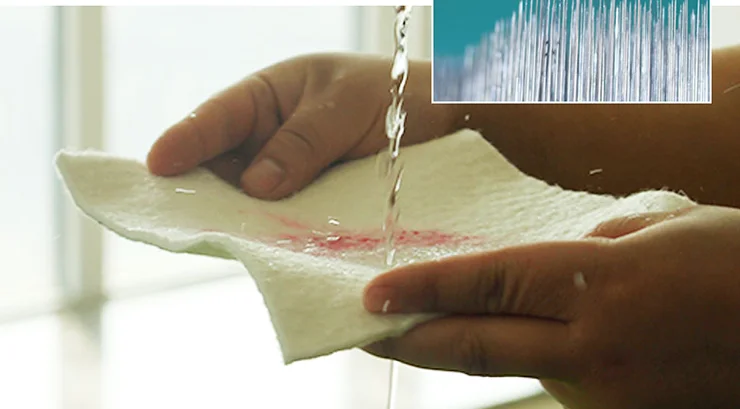
Woven or Nonwoven Geotextile for Road Construction?
Neither woven nor nonwoven geotextile is automatically the better road product. The correct choice depends on whether the principal requirement is separation, filtration, drainage support, installation survivability or a combination of functions.
| Product type | Common road application direction | Properties to review | Main limitation |
|---|---|---|---|
| Slit-film woven geotextile | Separation and selected stabilization applications | Tensile, elongation, tear, puncture and survivability | Hydraulic properties may not suit every filtration interface |
| Needle-punched nonwoven geotextile | Filtration, separation and drainage support | AOS, permittivity, tensile, tear and puncture | Higher GSM alone does not establish road suitability |
| Woven monofilament geotextile | Selected engineered filtration applications | AOS, permittivity, tensile and soil compatibility | Must not be confused with ordinary slit-film woven fabric |
| Geotextile and geogrid combination | Separation or filtration together with granular-layer stabilization | Product compatibility, sequence and system requirements | Both products are not automatically required |
Woven geotextile may be considered when:
- separation is the primary function;
- high installation survivability is required;
- the relevant tensile and puncture properties are specified;
- the product’s hydraulic properties are compatible with the interface.
Nonwoven geotextile may be considered when:
- filtration is important;
- cross-plane water passage is required;
- the fabric is used around drainage aggregate;
- cushioning or protection is also relevant.
A general product label is not enough. Slit-film woven, woven monofilament, staple-fiber nonwoven and continuous-filament nonwoven products can have substantially different structures and properties.
Related guide: Woven vs Nonwoven Geotextile Fabric
Key Factors in Road-Geotextile Selection
1. Define the Required Function
Begin by deciding what the material must actually do:
- separation;
- filtration;
- drainage support;
- stabilization;
- protection.
Do not begin with a preferred GSM, fabric color or supplier product name.
2. Review the Subgrade
Important subgrade information may include:
- soil type;
- particle-size distribution;
- fines content;
- moisture sensitivity;
- available strength information;
- pumping or migration risk;
- soft or highly variable areas;
- seasonal groundwater.
A CBR value can be useful project information, but it is not sufficient by itself to select the geotextile or determine the complete road section.
3. Review the Aggregate
Aggregate affects both system performance and installation survivability.
Consider:
- gradation;
- maximum particle size;
- particle angularity;
- cleanliness;
- placement method;
- compaction equipment;
- contamination during construction.
Coarse or sharply angular aggregate may increase puncture and installation-damage risk. Fine-contaminated aggregate may also affect filtration and drainage.
4. Evaluate Water and Drainage
Road-geotextile selection should consider:
- groundwater;
- surface infiltration;
- seasonal saturation;
- edge drainage;
- crossfall or longitudinal fall;
- collector pipes;
- outlet condition.
A geotextile cannot compensate for a drainage system that has no effective discharge route.
5. Consider Construction Traffic
The geotextile must often survive the construction period before the road enters service.
Potential risks include:
- aggregate dumping;
- grading;
- turning or braking vehicles;
- exposed equipment traffic;
- insufficient initial cover;
- wrinkles and displacement;
- temporary UV exposure.
A product that meets a laboratory tensile requirement can still be damaged by unsuitable placement procedures.
6. Follow the Project Specification
Confirm whether the project specifies:
- woven or nonwoven construction;
- polymer;
- test methods;
- minimum, maximum or MARV requirements;
- AOS;
- permittivity;
- tensile, tear or puncture properties;
- seam or overlap requirements;
- roll identification;
- acceptance documentation.
When the specification and supplier data use different methods, units or reporting bases, they should not be treated as directly equivalent.
Important Geotextile Specifications for Roads
| Property | What it indicates | Selection caution |
|---|---|---|
| Product construction | Woven, nonwoven, slit-film or monofilament structure | Different constructions are not interchangeable |
| Polymer | PP, PET or another identified material | Polymer alone does not determine application suitability |
| Mass per unit area | Fabric mass reported in GSM or oz/yd² | It is not a complete performance grade |
| Thickness | Fabric thickness under a defined test | More thickness does not automatically mean better filtration |
| Tensile strength | Tensile response under a specified method | It is not the complete road-design capacity |
| Elongation | Deformation measured during tensile testing | Compare only consistent methods and directions |
| Tear resistance | Resistance to tear propagation | Does not replace puncture or survivability review |
| Puncture resistance | Resistance under a defined puncture test | Field performance still depends on aggregate and installation |
| AOS | Apparent opening-size index | Must be evaluated with the surrounding soil |
| Permittivity | Cross-plane water passage through isolated fabric | Does not represent in-plane drainage capacity |
| Water-flow rate | Flow under specified test conditions | Compare only consistent methods, units and test heads |
| UV resistance | Resistance during defined exposure testing | Does not prove suitability for permanent exposure |
| Roll dimensions | Width, length and roll weight | Affect overlaps, handling, waste and transport |
ASTM D4751 is used to determine geotextile AOS, while ASTM D4491/D4491M addresses water permeability in terms of permittivity. ASTM notes that permittivity represents flow through an isolated geotextile under test conditions, so it should not be presented as the complete field drainage capacity of a road system.
Related guide: Geotextile GSM, Oz, AOS and Permittivity Explained
Geotextile vs Geogrid in Road Construction
Geotextile and geogrid are not interchangeable materials. They may be used in the same road project, but they normally address different functions.
| Requirement | Geotextile | Geogrid |
|---|---|---|
| Separation between soil and aggregate | Common function | Open apertures do not normally provide complete fine-soil separation |
| Filtration | Common for appropriately selected products | Does not provide conventional soil filtration |
| Retention of fine soil particles | Evaluated through opening and hydraulic properties | Not normally selected as a filter |
| Aggregate confinement | Product- and system-dependent | Common granular-layer stabilization mechanism |
| Drainage filtering | Common application | Does not replace filter fabric |
| Reinforcement | Possible only for products and systems designed for that role | Common in designed stabilization or reinforcement systems |
| Combined use | May provide separation or filtration beneath a geogrid | May provide aggregate stabilization above a geotextile |
FHWA guidance states that geotextiles are primarily suited to separation and filtration, while geogrids are generally more effective for reinforcement. FHWA also notes that a geotextile may be used with geogrid where fine subgrade soil could pump into the base layer.
Some roads use geotextile for separation or filtration and geogrid for aggregate stabilization. The need for one or both depends on the project objective, subgrade, aggregate, drainage and accepted design method.
Related guide: Geogrid for Road Construction
When Geotextile Alone May Not Be Enough
Very Weak or Highly Variable Subgrade
A geotextile separator may not address every bearing-capacity, deformation or settlement problem.
Additional measures may include:
- geogrid;
- geocell;
- thicker aggregate;
- removal and replacement;
- chemical stabilization;
- staged construction;
- drainage improvement;
- other ground-treatment methods.
The appropriate solution requires project-specific evaluation.
Reinforcement-Dominated Applications
Where the primary objective is tensile reinforcement, aggregate confinement or structural load transfer, a geogrid or another designed reinforcement product may be more appropriate.
A geotextile should not be presented as a direct substitute simply because it has a high tensile value.
Significant Water Accumulation
Where substantial water enters or remains within the pavement structure, filtration alone may not be sufficient.
The system may also require:
- open-graded drainage aggregate;
- edge drains;
- collector pipes;
- geocomposite drains;
- improved crossfall;
- functioning outlets.
Unsuitable Fill or Poor Compaction
Geotextile cannot compensate for:
- unsuitable base material;
- uncontrolled moisture;
- inadequate compaction;
- large untreated soft spots;
- severe rutting during construction;
- blocked drainage;
- incorrect construction sequence.
The fabric should be treated as one component of the road system.
Basic Installation Sequence for Road Geotextile
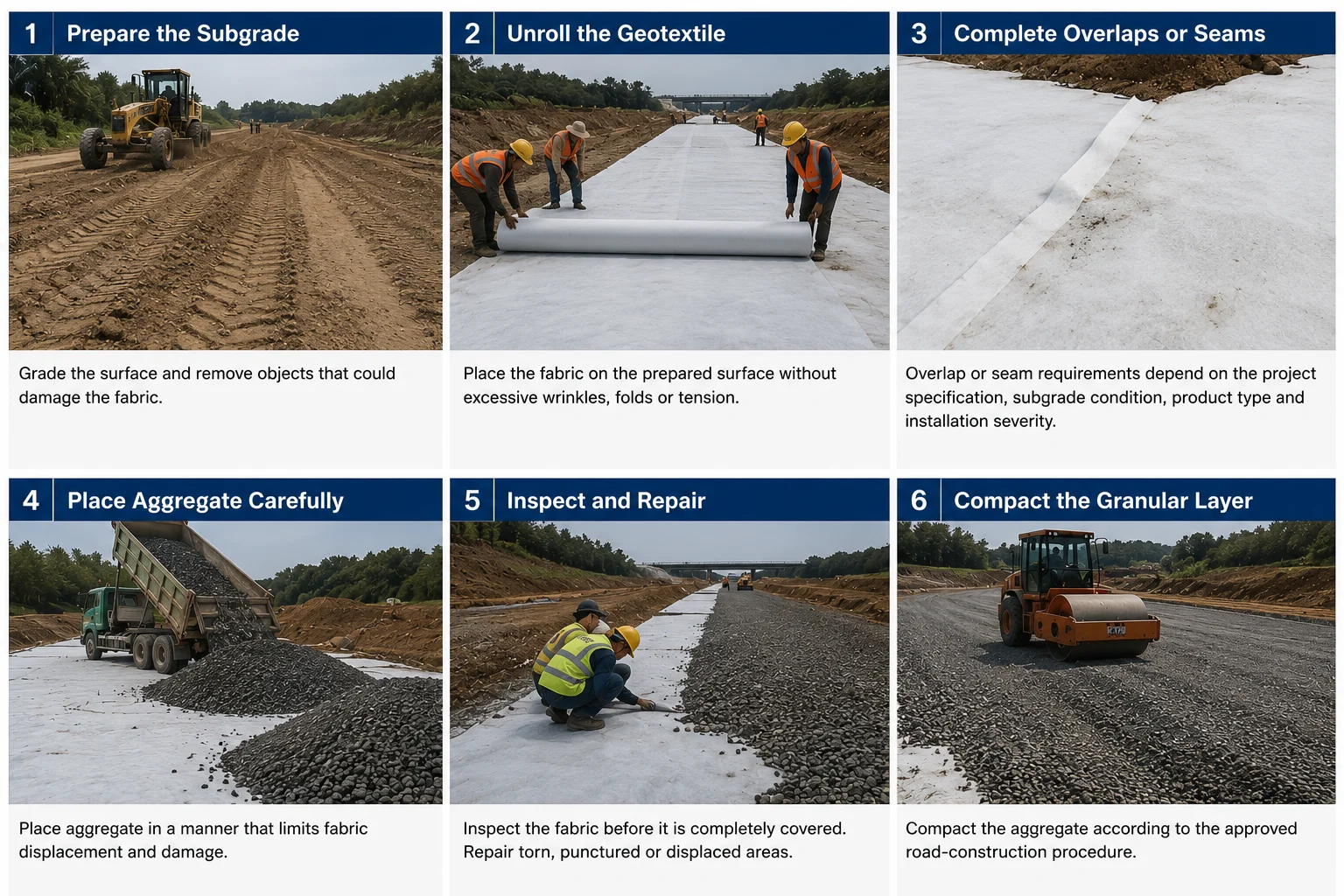
The following sequence is a general construction overview. Project drawings and specifications take priority.
Step 1 — Prepare the Subgrade
Grade the surface and remove objects that could damage the fabric. Address severe rutting, standing water and obvious soft areas before placement.
Step 2 — Unroll the Geotextile
Place the fabric on the prepared surface without excessive wrinkles, folds or tension. Follow the specified roll direction where one is required.
Step 3 — Complete Overlaps or Seams
Overlap or seam requirements depend on the project specification, subgrade condition, product type and installation severity.
Do not use one fixed overlap dimension for every road.
Step 4 — Place Aggregate Carefully
Place aggregate in a manner that limits fabric displacement and damage. Avoid uncontrolled dumping or direct turning and braking on exposed geotextile.
Step 5 — Inspect and Repair
Inspect the fabric before it is completely covered. Repair torn, punctured or displaced areas in accordance with the approved procedure.
Step 6 — Compact the Granular Layer
Compact the aggregate according to the approved road-construction procedure. Continue checking for movement, contamination and drainage problems.
Common Road-Geotextile Mistakes
Selecting by GSM Alone
GSM only describes mass per unit area. Two products with the same GSM may have different tensile strength, thickness, AOS, permittivity and puncture resistance.
Better practice: Compare complete technical data using the same test methods and reporting basis.
Assuming Woven Is Always Better for Roads
Some woven geotextiles provide useful separation and installation properties, but different woven structures have different hydraulic characteristics.
Better practice: Confirm whether the project requires separation only or a combination of separation and filtration.
Assuming Nonwoven Always Provides Adequate Drainage
A nonwoven appearance does not prove that its AOS and permittivity are suitable for the surrounding soil.
Better practice: Review the hydraulic data and soil compatibility.
Ignoring the Drainage Outlet
A filter fabric cannot remove water if the drainage system has no effective collection or discharge path.
Better practice: Evaluate the fabric, aggregate, pipe, gradient and outlet as one drainage system.
Allowing Equipment to Travel on Exposed Fabric
Direct construction traffic may wrinkle, displace, tear or contaminate the geotextile.
Better practice: Follow the approved aggregate-placement and initial-cover procedure.
Comparing Typical Values With MARV Values
A typical test value and a Minimum Average Roll Value do not represent the same reporting basis.
Better practice: Confirm whether each value is typical, minimum, maximum, MARV or guaranteed.
Treating TDS Values as Road-Design Values
A product data sheet describes material properties. It does not independently determine base thickness, allowable traffic, settlement or project safety.
Better practice: Use the TDS to verify product compliance with the project specification, not to replace road design.