

Nanjing GeoCore New Materials Co., Ltd. is a China-based geosynthetics trading and export company working with specialized geomembrane manufacturing partners.
We supply geomembranes for water containment, environmental protection, mining, landfill, wastewater and civil engineering applications.
Rather than treating every liner project as the same, we review the required material, thickness, surface type, roll dimensions, testing requirements, installation conditions and project specification before matching the order with a suitable manufacturing resource.
Our team coordinates specification review, technical documentation, inspection, packing and international shipment.
Request Product Data & Quotation →
What Type of Geomembrane Do You Need?
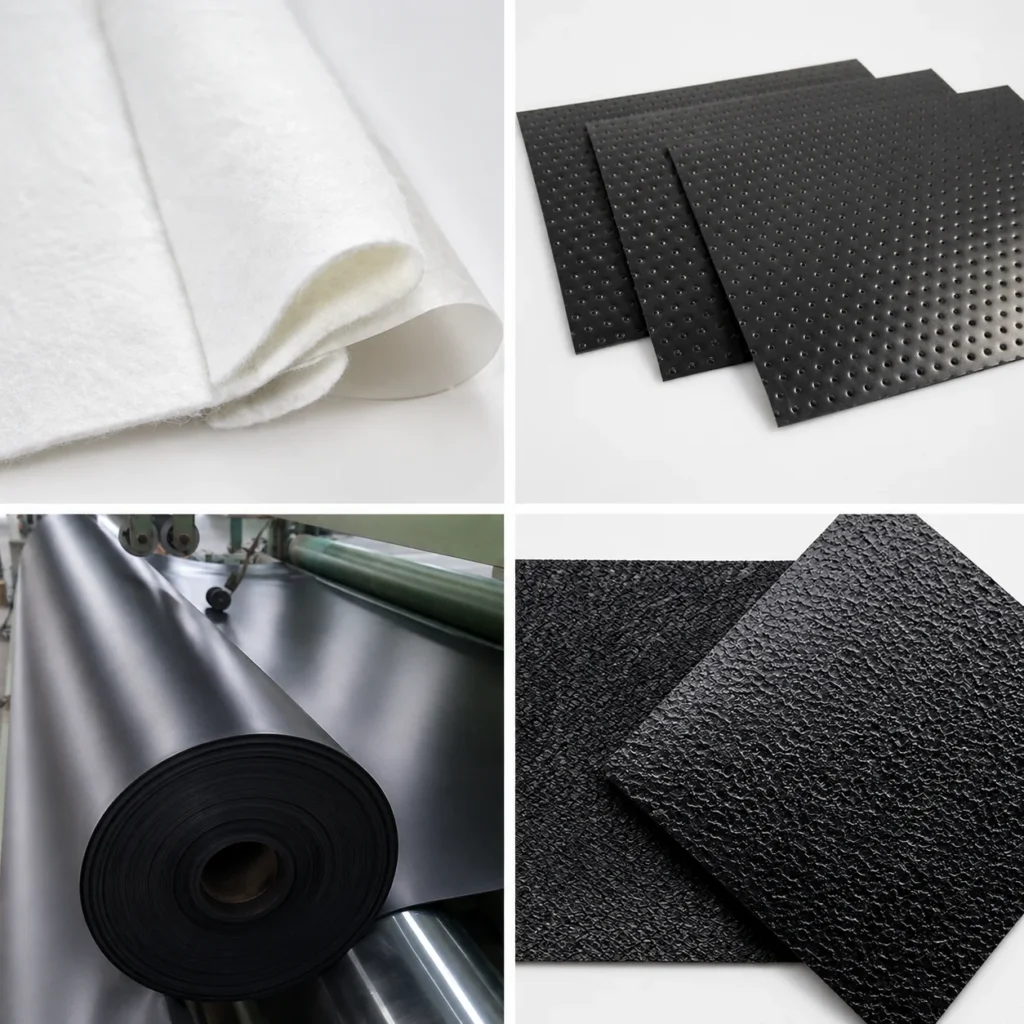
Different containment projects require different liner properties.
| Product | Typical Characteristics | Common Applications |
|---|---|---|
| HDPE Smooth Geomembrane | Smooth polyethylene liner | Ponds, reservoirs, landfill lining, wastewater containment |
| HDPE Textured Geomembrane | Textured surface for interface applications | Slopes, landfill systems, mining and containment structures |
| LLDPE Geomembrane | More flexible polyethylene liner | Applications requiring greater flexibility or conformity |
| Composite Geomembrane | Geomembrane combined with geotextile layers | Water conservancy, canals and selected civil engineering applications |
The appropriate liner should be selected according to the project specification and exposure conditions rather than material name alone.
HDPE Geomembrane
HDPE geomembrane is widely used where a continuous low-permeability barrier is required.
Typical applications include:
- Reservoirs
- Farm ponds
- Landfills
- Wastewater lagoons
- Tailings and mining facilities
- Industrial containment
- Canals
- Aquaculture ponds
Its final performance depends not only on the sheet material itself, but also on subgrade preparation, seam welding, puncture protection, drainage, anchorage and installation quality.
Related Guide
HDPE Geomembrane Properties, Standards and Tensile Strength
Smooth vs Textured Geomembrane
Smooth and textured geomembranes serve different interface conditions.
| Feature | Smooth Geomembrane | Textured Geomembrane |
|---|---|---|
| Surface | Smooth | One or both surfaces textured |
| Typical use | Flat or general containment surfaces | Slope and interface applications |
| Installation | Generally easier to handle and weld | Requires appropriate welding and QA procedures |
| Selection basis | Containment requirements | Interface shear and project design requirements |
Textured geomembrane should not automatically be considered “better” than smooth geomembrane.
Selection depends on the liner system, slope geometry, adjacent materials and project design.
Where Are Geomembranes Used?
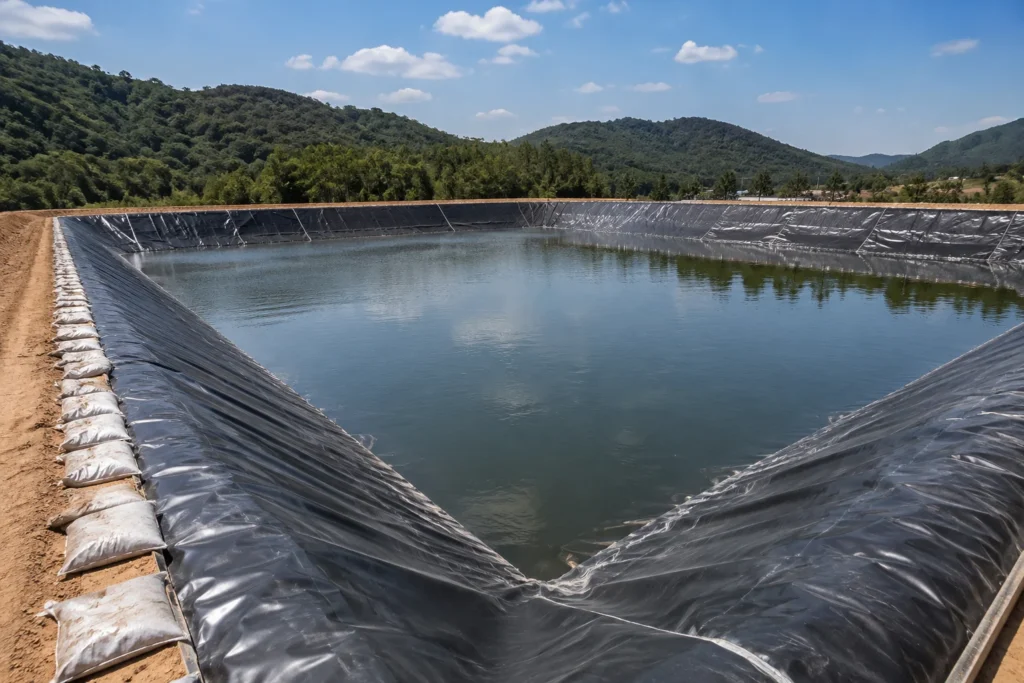
Pond & Reservoir Liners
Geomembranes can provide a continuous barrier for water containment in:
- Farm ponds
- Irrigation reservoirs
- Aquaculture ponds
- Decorative or industrial ponds
- Water storage structures
Subgrade preparation and puncture protection should be considered when rocks, roots or uneven surfaces are present.
Landfill Containment
Geomembranes may form part of composite landfill liner and cover systems.
A landfill lining system can involve multiple components, including:
- Geomembrane
- Geotextile
- GCL
- Drainage layer
- Leachate collection system
- Protective layers
The geomembrane should therefore be treated as one component of the complete containment system.
Mining & Tailings
Geomembrane liners are used in selected mining applications such as:
- Heap leach facilities
- Process ponds
- Tailings containment
- Solution ponds
- Secondary containment
Chemical exposure, temperature, puncture risk and installation conditions should be reviewed before selecting the liner.
Wastewater & Industrial Containment
Geomembranes may be used for:
- Wastewater lagoons
- Evaporation ponds
- Industrial storage areas
- Chemical containment
- Secondary containment
Material compatibility should be evaluated according to the actual liquid or chemical environment.
Do Not Compare Geomembrane Suppliers by Thickness Alone
A common purchasing mistake is comparing quotations only by:
1.0 mm
1.5 mm
2.0 mm
Thickness is important, but it is only one part of the specification.
Two geomembranes with the same nominal thickness may differ in material formulation, manufacturing consistency, test values, surface structure, roll dimensions and quality documentation.
When comparing suppliers, buyers should also review the following.
What Should You Check Before Buying Geomembrane?
1. Raw Material
Confirm whether the product is manufactured from the specified polyethylene resin and whether the formulation matches the required product standard.
Avoid relying only on statements such as:
“100% virgin material”
without supporting product information where verification is required.
2. Thickness
Confirm:
- Nominal thickness
- Thickness tolerance
- Measurement method
- Whether the value is minimum or nominal
Do not compare suppliers using nominal numbers alone if their tolerance basis is different.
3. Tensile Properties
Depending on the product specification, relevant properties may include:
- Yield strength
- Break strength
- Yield elongation
- Break elongation
These values should be interpreted according to the specified test method.
4. Tear & Puncture Resistance
Puncture and tear resistance may be important where the liner can be exposed to:
- Sharp aggregate
- Rough subgrade
- Construction traffic
- Equipment
- Installation damage
A protective geotextile may be required in some liner systems.
5. Carbon Black & UV Stabilization
For polyethylene geomembranes exposed to sunlight or long-term outdoor service, formulation and stabilization are relevant durability considerations.
These should be evaluated from product-specific documentation rather than marketing statements alone.
6. Oxidative Resistance
Where long-term durability is important, oxidative resistance data may form part of the material evaluation.
A single accelerated laboratory value should not automatically be interpreted as a guaranteed field service life.
7. Surface Type
For textured liners, verify:
- One-sided or double-sided texture
- Texture structure
- Relevant interface-performance data
- Project requirement
Surface appearance alone does not establish slope suitability.
Geomembrane Technical Information Buyers Should Request
Before comparing quotations, request a clear technical data sheet.
Typical information may include:
| Property | Why Buyers Check It |
|---|---|
| Thickness | Material specification |
| Density | Polymer/product characterization |
| Tensile properties | Sheet mechanical behavior |
| Elongation | Deformation characteristics |
| Tear resistance | Mechanical durability |
| Puncture resistance | Installation and service risk |
| Carbon black content | Material stabilization |
| Carbon black dispersion | Quality consistency |
| Oxidative induction time | Oxidative resistance evaluation |
| Roll width | Installation efficiency |
| Roll length | Area and logistics |
| Surface type | Smooth or textured application |
The required test methods should follow the project specification or accepted applicable standard.
Welding Quality Matters as Much as the Liner
A geomembrane can have good material properties and still fail to perform as intended if seams are poorly welded.
Important installation factors include:
- Welding temperature
- Welding speed
- Ambient temperature
- Surface cleanliness
- Moisture
- Operator experience
- Equipment condition
- Trial seams
- Seam inspection
- Destructive or non-destructive testing where required
For containment projects, liner performance depends on the completed system rather than the roll material alone.
How to Compare Geomembrane Manufacturers and Suppliers
| What to Check | Why It Matters |
|---|---|
| Product specialization | Different facilities may specialize in different liner types |
| Manufacturing equipment | Influences production capability and consistency |
| Raw-material control | Important for product consistency |
| Thickness control | Avoids specification mismatch |
| Testing capability | Supports verification |
| Batch traceability | Helps identify supplied material |
| Roll dimensions | Affect installation and freight |
| Technical documents | Allow meaningful comparison |
| Inspection acceptance | Important for international purchasing |
| Export packing | Protects rolls during transport |
| Delivery capacity | Important for large-volume projects |
A lower price per square meter does not necessarily mean a lower project cost.
Roll dimensions, welding requirements, installation loss, quality documentation, freight and specification compliance should all be considered.
How GeoCore Coordinates Geomembrane Supply
Step 1 — Review the Requirement
Send us:
- Application
- Material
- Thickness
- Smooth / textured
- Roll dimensions
- Quantity
- Project standard
- Test requirements
- Destination port
- Required delivery date
If a project specification or BOQ is available, sending the original document is usually more useful than manually rewriting the data.
Step 2 — Match Manufacturing Resources
Different manufacturing facilities may be considered according to:
- Product specialization
- Production capability
- Material requirement
- Thickness range
- Width requirement
- Testing capability
- Order quantity
- Delivery schedule
- Inspection requirements
We do not assume that one factory is the best choice for every geomembrane order.
Step 3 — Confirm Technical Documents
Depending on the order, available documentation may include:
- Technical Data Sheet
- Test report
- Certificate of Analysis
- Product labels
- Packing information
- Production records
Where certificates or test reports belong to the manufacturing facility, the original certificate holder should remain visible.
Step 4 — Production & Inspection
Inspection options can be discussed according to the order requirement.
These may include:
- Production photos
- Production videos
- Roll dimensions
- Product labels
- Packing inspection
- Batch documentation
- Third-party inspection
- Container-loading records
Step 5 — Export Coordination
GeoCore coordinates:
- Packing
- Labeling
- Export documents
- Container planning
- Shipping communication
for international customers sourcing geomembrane from China.
Packaging & Container Loading
Geomembrane is typically supplied in large rolls.
Packing and loading planning should consider:
- Roll width
- Roll diameter
- Roll weight
- Container type
- Loading method
- Protection during transport
- Unloading conditions at destination
For large projects, container planning should be confirmed before final quotation because roll dimensions can significantly affect freight efficiency.
What Information Should You Send for a Geomembrane Quote?
For the fastest quotation, provide:
| Requirement | Example |
|---|---|
| Application | Pond / landfill / mining / wastewater |
| Material | HDPE / LLDPE |
| Thickness | 1.0 mm / 1.5 mm / project specification |
| Surface | Smooth / textured |
| Roll width | If specified |
| Quantity | m² / rolls / containers |
| Standard | Project specification |
| Destination | Country + port |
| Documents | TDS / COA / testing / inspection |
| Delivery | Required shipment date |
Request Geomembrane Technical Data & Quotation
Need geomembrane for a pond, reservoir, landfill, mining or wastewater containment project?
Send us your:
Specification + Quantity + Application + Destination
Our team can review the requirement, coordinate suitable manufacturing resources and provide available technical documentation and quotation support.
Email: [email protected]
WhatsApp / Phone: +86 133 3157 4138
CTA
Frequently Asked Questions
Are you a geomembrane manufacturer?
Nanjing GeoCore New Materials Co., Ltd. is a geosynthetics trading and export company rather than a single self-owned geomembrane factory.
We work with specialized manufacturing partners in China and coordinate specification confirmation, documentation, inspection, packing and international shipment.
What types of geomembrane do you supply?
Available products may include HDPE smooth geomembrane, textured HDPE geomembrane, LLDPE geomembrane and selected composite membrane products.
Availability should be confirmed according to the required specification.
What thickness of geomembrane do I need?
The required thickness depends on the application, subgrade, exposure, puncture risk, containment requirements and project specification.
Thickness should not be selected only from price.
Is HDPE geomembrane waterproof?
HDPE geomembrane is used as a low-permeability barrier in many containment applications.
However, system performance also depends on seams, penetrations, subgrade preparation, puncture protection and installation quality.
What is the difference between smooth and textured geomembrane?
Smooth geomembrane has a relatively smooth surface and is widely used for general containment applications.
Textured geomembrane provides a different interface surface and is commonly considered where interface shear performance is relevant, particularly on slopes.
The appropriate type depends on the complete liner system and project design.
Can you provide geomembrane test reports?
Available documentation depends on the selected product and manufacturing facility.
Technical data sheets, relevant test reports, COA or other production documentation can be discussed before order confirmation.
Can you arrange third-party inspection?
Yes.
Independent inspection can be discussed according to the order, project requirements and inspection scope.
Can you supply large geomembrane projects by container?
Yes.
Container-loading plans can be prepared according to liner thickness, roll width, roll length, quantity and destination.