
Woven · Nonwoven · PET · PP Geotextiles for Civil Engineering Projects
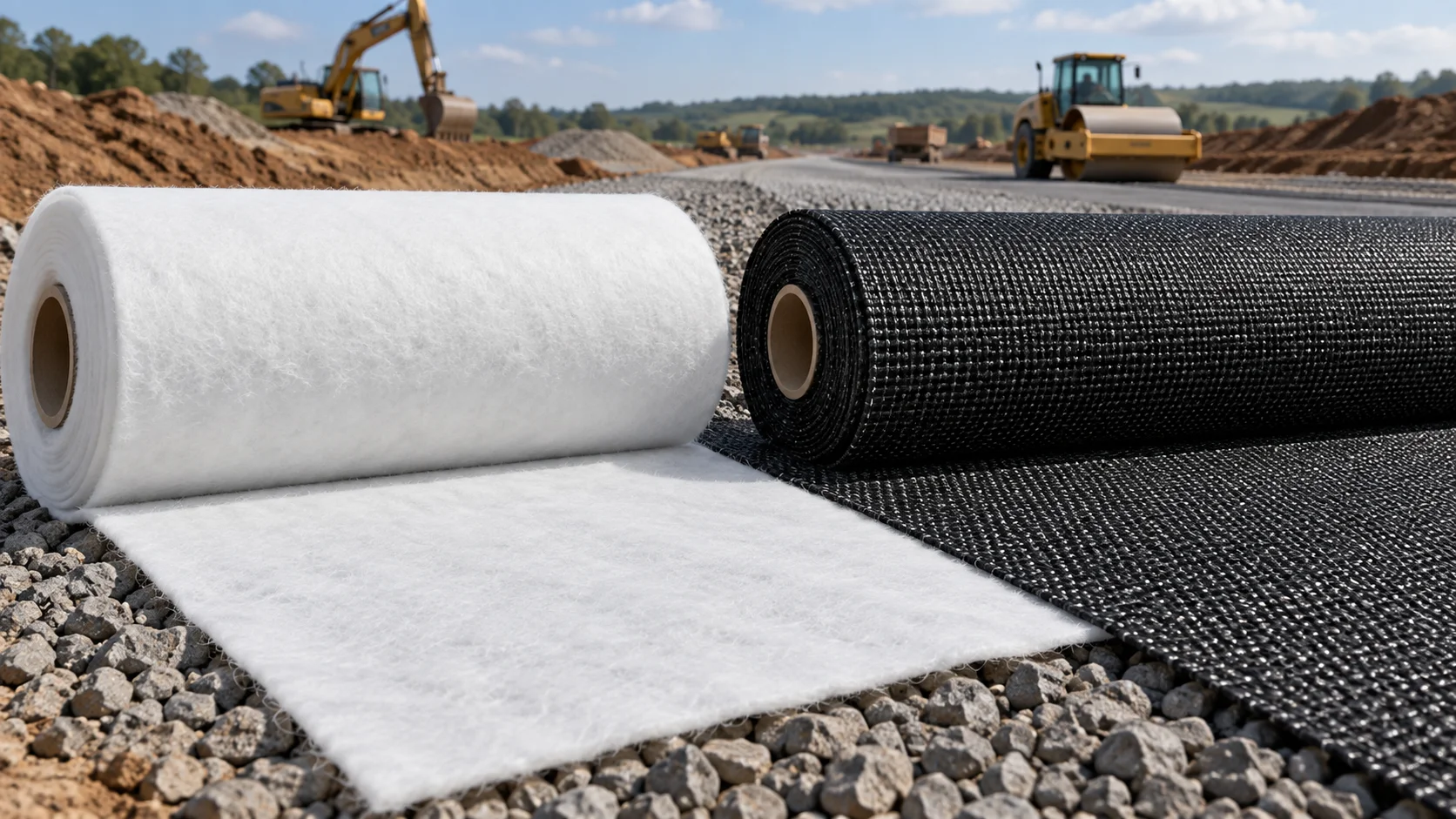
Nanjing GeoCore New Materials Co., Ltd. is a China-based geosynthetics trading and export company working with specialized geotextile manufacturing partners.
We supply woven, nonwoven, filament and composite geotextiles for road construction, filtration, drainage, separation, geomembrane protection and other civil engineering applications.
Rather than comparing geotextiles only by GSM or price per square meter, we review the required function, material, mechanical properties, hydraulic properties, roll dimensions, testing requirements and project specification before matching the order with a suitable production resource.
Our team coordinates specification review, manufacturing-resource matching, technical documents, inspection, packing and international shipment.
CTA
2. What Type of Geotextile Do You Need?
Geotextiles with similar appearance may perform very differently depending on their manufacturing structure, polymer and intended function.
The first selection question should therefore be:
What does the geotextile need to do in the project?
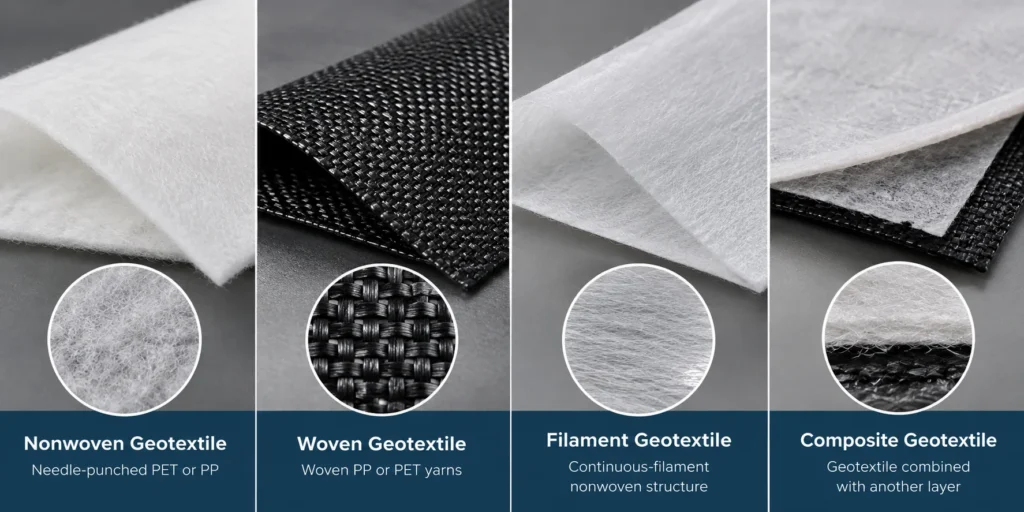
| Geotextile Type | Typical Structure | Common Functions | Typical Applications |
|---|---|---|---|
| Nonwoven Geotextile | Needle-punched PET or PP | Filtration, drainage, separation, protection | Roads, drainage systems, liner protection, erosion-control systems |
| Woven Geotextile | Woven PP or PET yarns | Separation, stabilization support, reinforcement-related functions | Roads, working areas, subgrade separation |
| Filament Geotextile | Continuous-filament nonwoven structure | Filtration, drainage, separation, protection | Civil engineering, hydraulic and environmental applications |
| Composite Geotextile | Geotextile combined with another layer | Protection, filtration or composite barrier functions | Waterproofing and selected containment systems |
The product structure should not be treated as a universal performance ranking.
A woven geotextile is not automatically “better” than a nonwoven geotextile, and a heavier product is not automatically more suitable for every project.
3. Nonwoven Geotextile
Nonwoven geotextiles are commonly selected where filtration, drainage, separation or cushioning is required.
Typical applications include:
- Road subgrade separation
- Drainage systems
- French drains
- Geomembrane protection
- Landfill liner systems
- Pond and reservoir lining systems
- Erosion-control structures
- Hydraulic engineering
Depending on the application, buyers may need to compare more than mass per unit area.
Relevant properties can include:
- Tensile strength
- Elongation
- Puncture resistance
- Apparent opening size
- Permittivity
- Water flow
- Thickness
- Polymer type
Suggested Internal Link
View Nonwoven Geotextile Products
4. Woven Geotextile
Woven geotextiles are manufactured by interlacing polymer yarns or strips into a relatively regular structure.
They are commonly used where separation and mechanical performance are important, including:
- Roads
- Access roads
- Working platforms
- Aggregate layers
- Soft subgrade separation
- Selected reinforcement-related applications
Product performance depends on the actual woven structure, polymer, tensile behavior and interaction with the surrounding soil or aggregate.
A woven fabric should therefore be evaluated against the project specification rather than selected only because it has higher nominal tensile strength.
Suggested Internal Link
Woven vs Nonwoven Geotextile: How to Choose
5. Geotextile Applications
Road Construction
In road construction, geotextile may be installed between the subgrade and aggregate layer to help maintain separation and, depending on the system, provide filtration or other supporting functions.
Without adequate separation, aggregate can become contaminated by fine subgrade soil, particularly under traffic and wet conditions.
Important project variables include:
- Subgrade condition
- Soil gradation
- Aggregate type
- Traffic loading
- Drainage
- Installation damage
- Required geotextile function
Geotextile does not replace proper drainage or pavement design.
Related Guide
Geotextile for Road Construction →
Drainage & Filtration
Filtration is one of the most important geotextile functions.
A properly selected filter geotextile should allow water to pass while helping control movement of soil particles under the intended conditions.
Selection may involve:
- Soil particle-size distribution
- Geotextile opening size
- Water-flow requirements
- Hydraulic gradient
- Soil retention
- Clogging risk
- Installation conditions
For drainage applications, choosing a fabric only by GSM can result in poor material selection.
Geomembrane Protection
Nonwoven geotextile is commonly used as a protective layer in geomembrane systems.
It can help reduce the risk of mechanical damage caused by:
- Rough subgrade
- Aggregate
- Sharp particles
- Construction activity
- Overlying drainage materials
Protection requirements depend on the complete liner system and actual loading conditions.
A geotextile should not be described as making a geomembrane “puncture-proof.”
Related Page
Geomembrane Manufacturer & Supplier →
Separation
Geotextile separation helps prevent two dissimilar material layers from mixing.
A typical road section may contain:
Aggregate
↓
Geotextile
↓
Soft or fine-grained subgrade
Maintaining separation can help preserve the intended properties of the aggregate layer.
The required product depends on soil conditions, loading and installation requirements.
6. Do Not Compare Geotextiles by GSM Alone
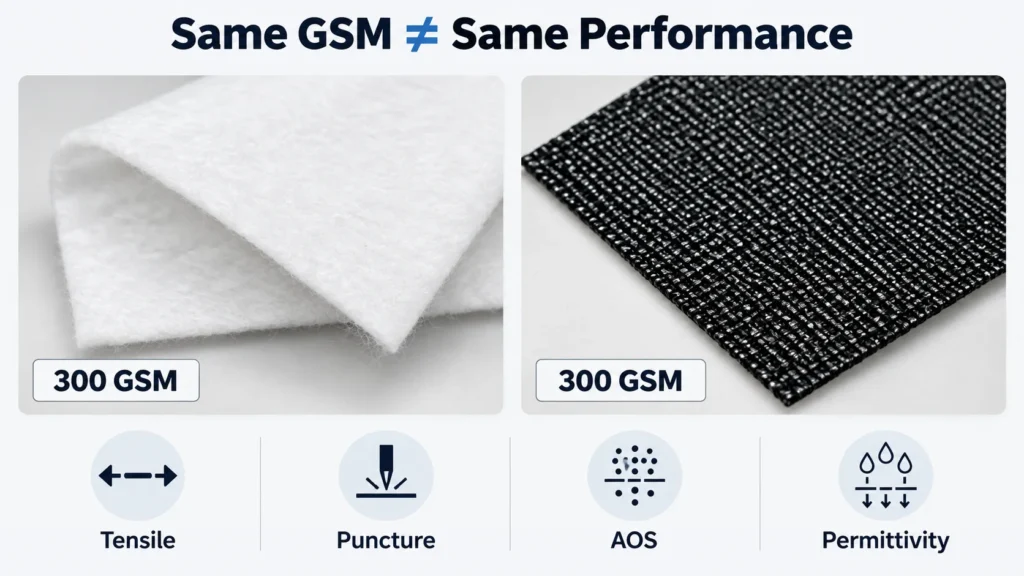
One of the most common purchasing mistakes is comparing geotextiles only by:
200 GSM
300 GSM
400 GSM
500 GSM
Mass per unit area is useful for identifying a product, but it does not fully describe performance.
Two fabrics with the same nominal GSM may have different:
- Tensile properties
- Elongation
- Puncture resistance
- Opening size
- Permittivity
- Thickness
- Polymer composition
- Manufacturing structure
For project procurement, GSM should therefore be reviewed together with the properties relevant to the required function.
7. What Properties Should Buyers Check?
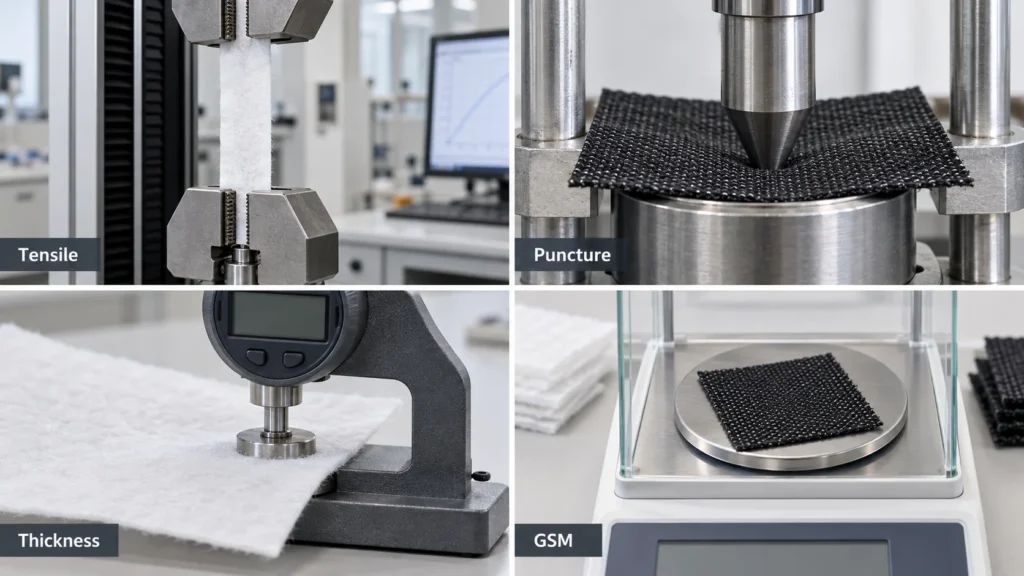
1. Mass per Unit Area
Mass per unit area is commonly expressed in g/m².
It is useful for product identification and comparison but should not be used as the only engineering selection criterion.
2. Tensile Properties
Relevant information may include:
- Tensile strength
- Elongation
- Test direction
- Test method
Woven and nonwoven structures can exhibit different tensile behavior.
The reported value should therefore be interpreted according to the test method and product structure.
3. Puncture Resistance
Puncture resistance can be particularly important where geotextile is used:
- Below geomembrane
- Above geomembrane
- Against coarse aggregate
- Over rough subgrade
- In protection layers
Actual protection performance depends on the complete system rather than one laboratory index value.
4. Apparent Opening Size
Opening size is particularly relevant to filtration applications.
It should be considered in relation to the soil or material being retained.
A smaller opening is not automatically better because filtration must balance:
soil retention + water transmission
5. Permittivity & Water Flow
Where filtration or drainage is the main function, hydraulic properties can be more important than GSM.
Relevant information may include:
- Permittivity
- Water flow
- Flow direction
- Test conditions
These values should be matched to the intended drainage or filtration function.
6. Polymer
Common geotextile polymers include:
- Polypropylene
- Polyester
Material name alone does not establish overall product suitability.
Manufacturing structure, exposure, installation conditions and project specification should also be considered.
8. How to Compare Geotextile Manufacturers and Suppliers
Before comparing price, confirm that suppliers are offering technically comparable products.
| What to Check | Why It Matters |
|---|---|
| Geotextile type | Woven and nonwoven fabrics perform different functions |
| Polymer | PET and PP have different material characteristics |
| Mass per unit area | Useful for product identification |
| Tensile properties | Relevant to mechanical performance |
| Elongation | Helps characterize tensile response |
| Puncture resistance | Important for protection applications |
| Opening size | Important for filtration |
| Water-flow properties | Important for drainage |
| Roll dimensions | Affect installation and freight |
| Test methods | Make supplier data comparable |
| Batch traceability | Supports product verification |
| Technical documentation | Helps confirm what is being supplied |
| Inspection acceptance | Important for international procurement |
| Export packing | Protects rolls during transport |
A lower price per square meter does not necessarily mean a lower installed cost.
Roll width, overlaps, installation loss, product consistency, required documentation and freight should also be considered.
9. Geotextile Technical Information
Depending on the application and specification, a geotextile datasheet may include information such as:
| Property | Procurement Purpose |
|---|---|
| Material | PET / PP identification |
| Mass per unit area | Product identification |
| Thickness | Physical characterization |
| Tensile strength | Mechanical property |
| Elongation | Tensile behavior |
| Puncture resistance | Protection / mechanical durability |
| Opening size | Filtration selection |
| Permittivity | Hydraulic performance |
| Water flow | Drainage performance |
| Roll width | Installation planning |
| Roll length | Quantity and logistics |
| Roll weight | Handling and shipping |
The required properties depend on the application.
Not every project requires every parameter.
10. How GeoCore Coordinates Geotextile Supply
GeoCore does not present every geotextile as coming from a single self-owned production line.
Different geotextile products require different raw materials, manufacturing processes, equipment and testing capabilities.
We therefore match production resources according to the confirmed requirement.
Step 1 — Review Your Requirement
Please provide available information including:
- Application
- Woven / nonwoven
- PET / PP
- GSM
- Tensile requirement
- Puncture requirement
- Opening size or hydraulic requirement
- Roll width
- Roll length
- Quantity
- Project standard
- Destination
- Required delivery date
If a specification or BOQ is available, sending the original document is usually preferable to manually rewriting individual values.
Step 2 — Match Manufacturing Resources
Depending on the product, manufacturing resources may specialize in:
- Staple-fiber needle-punched geotextile
- Continuous-filament geotextile
- Woven PP geotextile
- High-strength woven products
- Composite geotextiles
Potential production resources can be reviewed according to:
- Product specialization
- Equipment
- Material requirement
- Product specification
- Testing capability
- Roll-width capability
- Order volume
- Delivery schedule
- Inspection requirements
The objective is to match the order with an appropriate production resource rather than force every specification through the same facility.
Step 3 — Confirm Product & Documents
Before order confirmation, the commercial and technical requirements should clearly identify the agreed:
- Product type
- Polymer
- GSM
- Required properties
- Roll dimensions
- Quantity
- Packing
- Testing
- Documentation
- Destination
- Delivery requirements
Available documents may include:
- Technical Data Sheet
- Product specification
- Test reports
- Sample COA
- Product labels
- Packing information
- Batch-related records
Where reports or certificates belong to the manufacturing facility, the original certificate holder should remain visible.
Step 4 — Production & Inspection Coordination
Depending on the order, inspection options may include:
- Production photographs
- Production videos
- Roll-width measurement
- Roll-length verification
- Weight verification
- Product-label inspection
- Packing inspection
- Batch documentation
- Third-party inspection
- Container-loading records
The inspection scope should be agreed before production where specific project verification is required.
Step 5 — Export & Shipment Support
GeoCore coordinates the international trade side of the order, including:
- Export packing
- Labeling
- Container planning
- Export documentation
- Shipment communication
- Loading coordination
11. Packaging & Container Loading
Geotextiles are commonly supplied in rolls.
Packing should protect the material from:
- Moisture
- Dirt
- Mechanical damage
- Unnecessary UV exposure
- Handling damage during transport
Container planning depends on:
- Roll width
- Roll length
- Roll diameter
- Roll weight
- Product density
- Container type
For large orders, packing and loading efficiency should be considered before final quotation.
12. What Information Should You Send for a Geotextile Quote?
For a faster and more accurate quotation, provide:
| Information | Example |
|---|---|
| Application | Road / drainage / liner protection |
| Type | Woven / nonwoven |
| Material | PET / PP |
| GSM | 200 / 300 / 400 g/m² |
| Required performance | Tensile / puncture / filtration |
| Roll width | If specified |
| Roll length | If specified |
| Quantity | m² / rolls / containers |
| Standard | Project or tender specification |
| Destination | Country + port |
| Documents | TDS / test report / COA |
| Inspection | Factory / third-party |
| Delivery | Required shipment date |
If you are unsure which parameter is important, send the original project specification.
13. Request Geotextile Technical Data & Quotation
Need woven or nonwoven geotextile for a road, drainage, filtration, geomembrane-protection or civil engineering project?
Send us your:
Specification + Application + Quantity + Destination
Our team can review the requirement, compare suitable manufacturing resources and provide available product documentation and quotation support.
Email: [email protected]
WhatsApp / Phone: +86 133 3157 4138
CTA Buttons
Send Your Specification
Request Geotextile Quote
14. Frequently Asked Questions
Are you a geotextile manufacturer?
Nanjing GeoCore New Materials Co., Ltd. is a geosynthetics trading and export company rather than a single self-owned geotextile factory.
We work with specialized manufacturing partners in China and coordinate product selection, specification confirmation, technical documentation, inspection, packing and international shipment.
What types of geotextile do you supply?
Our supply range may include woven geotextile, needle-punched nonwoven geotextile, continuous-filament geotextile and selected composite products.
Available specifications should be confirmed according to the project requirement.
Is woven or nonwoven geotextile better?
Neither is universally better.
Woven and nonwoven geotextiles have different structures and are commonly selected for different functions.
Nonwoven products are widely used for filtration, drainage and protection, while woven products are commonly used where separation and mechanical performance are important.
The correct choice depends on the project conditions and specification.
Is higher GSM always better?
No.
Higher mass per unit area does not automatically mean better project performance.
Selection may also depend on tensile properties, elongation, puncture resistance, opening size, hydraulic properties and product structure.
What geotextile should be used under gravel?
The required geotextile depends on the purpose of the layer and the underlying soil.
For road and aggregate applications, separation, filtration, subgrade condition, aggregate size, traffic and drainage should all be considered.
There is no single GSM or fabric type suitable for every gravel application.
What geotextile is used for drainage?
Nonwoven geotextile is commonly used in drainage and filtration applications.
Selection should consider soil retention, apparent opening size, permittivity or water flow and potential clogging conditions.
Can geotextile be installed under geomembrane?
Yes.
Nonwoven geotextile is commonly used as a protective or cushioning layer in geomembrane systems.
However, the required product depends on subgrade condition, aggregate, applied pressure and project-specific puncture-protection requirements.
Can you provide geotextile test reports?
Available documentation depends on the selected product and manufacturing facility.
Technical Data Sheets, relevant test reports, COA or batch-related records can be discussed before order confirmation.
Can you arrange third-party inspection?
Yes.
Independent inspection can be discussed according to order requirements, project specifications and agreed inspection scope.
Can you supply full-container geotextile orders?
Yes.
Container-loading planning can be prepared according to roll width, roll length, GSM, roll diameter, quantity and destination.