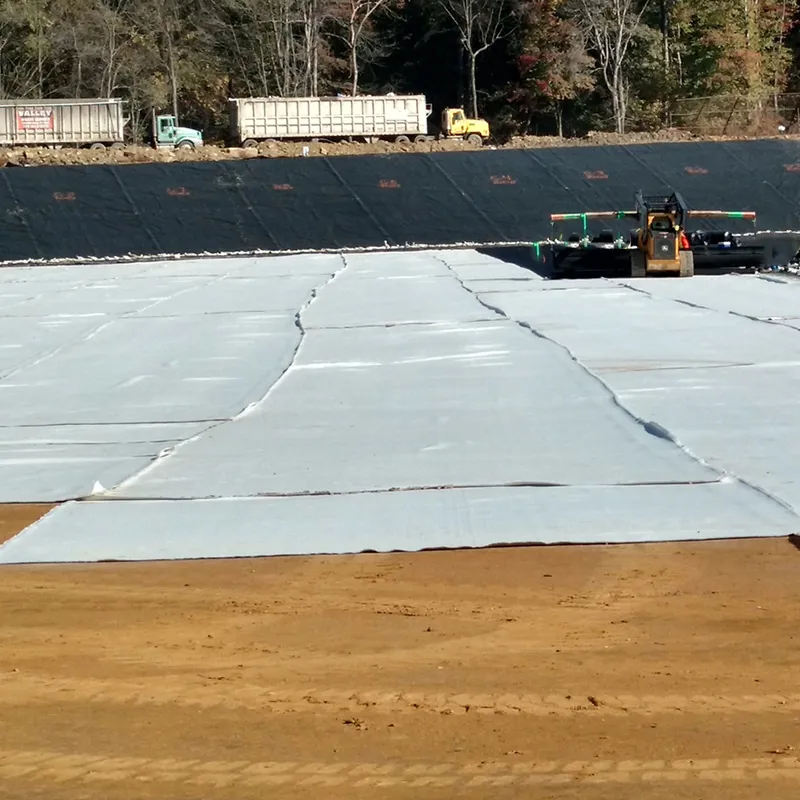
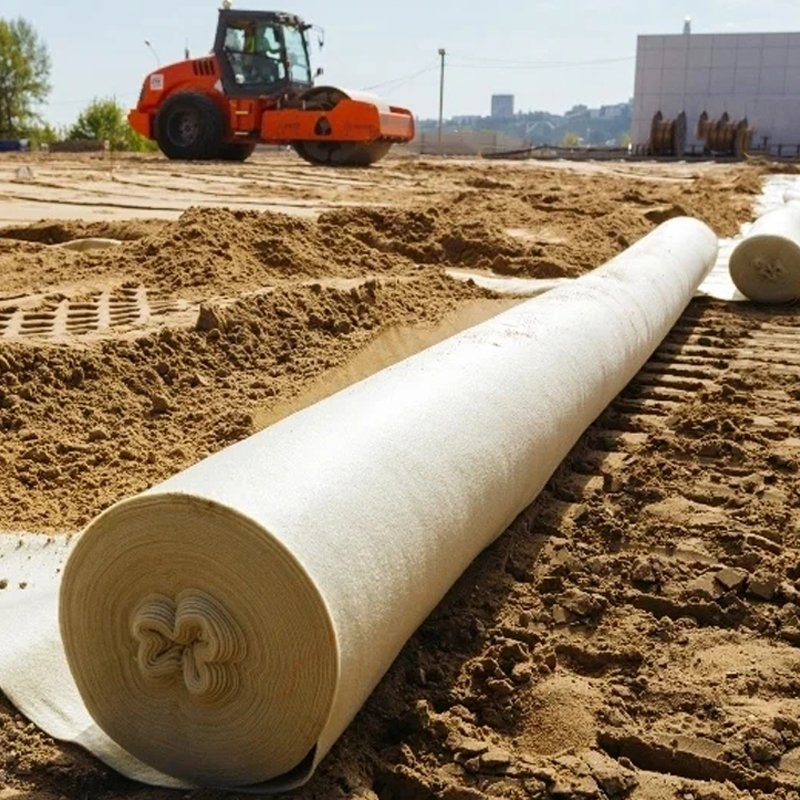
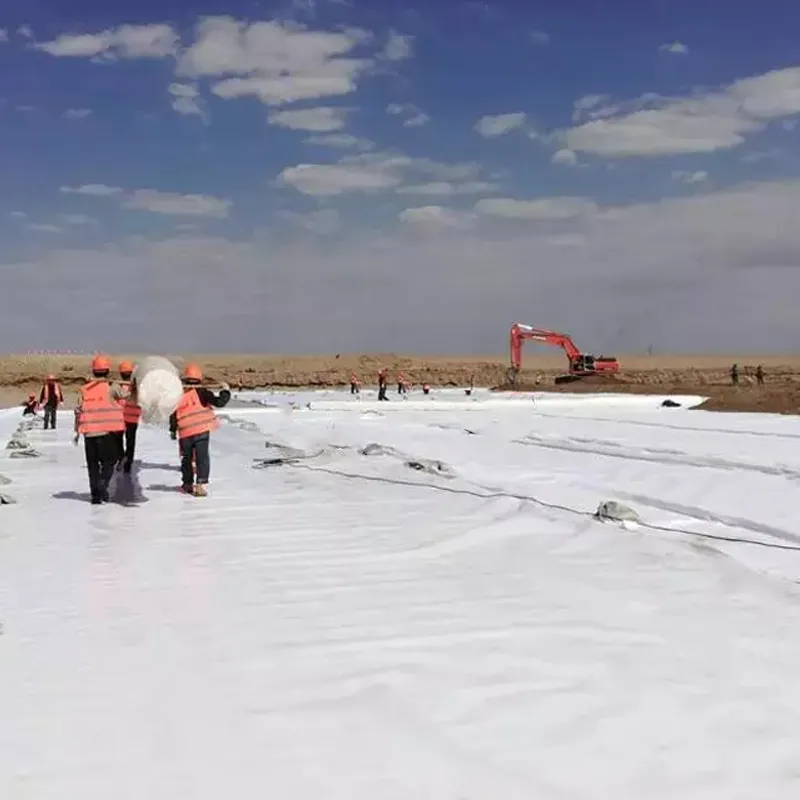
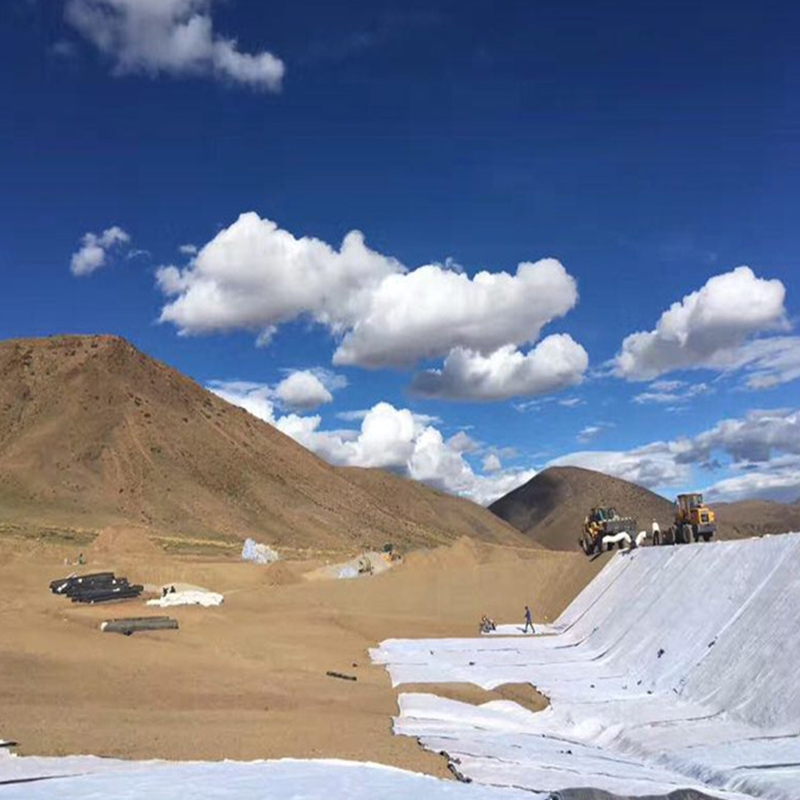
See how geotextiles are used as protection layers in landfill, mining, and TSF projects
Global Geomembrane Liner Case Study Collection
Continuous-filament polyester geotextile for filtration, separation, erosion control, drainage and geomembrane cushioning in civil and environmental engineering projects.
Available in project-specific grades from 100 to 1000 g/m², with roll widths from 1 to 6 meters.
GeoSynSource supports specification matching, technical-data coordination, production follow-up, inspection and international project supply.
CTA: Get a Project Quote
| Item | Available Specification |
|---|---|
| Polymer | Polyester, PET |
| Fiber structure | Continuous filament |
| Production process | Spunbond web formation and needle punching |
| Mass per unit area | 100–1000 g/m² |
| Standard data-table grades | 100–800 g/m² |
| Roll width | 1–6 m |
| Roll length | Produced according to order requirements |
| Elongation at break | 40–80% catalogue reference |
| Characteristic opening size O90 | 0.07–0.20 mm catalogue reference |
| Main functions | Filtration, separation, protection, cushioning and erosion control |
| Main applications | Roads, railways, drainage systems, containment systems and geomembrane protection |
Final specifications must be confirmed against the approved technical data sheet, required test method and project specification before production.
PET filament nonwoven geotextile is a permeable geosynthetic fabric made from polyester chips.
During production, the polyester material is extruded into continuous filaments. The filaments are laid into a web through a spunbond process and then mechanically entangled by needle punching.
This process creates a flexible three-dimensional fiber structure that can provide mechanical strength, elongation, hydraulic performance and surface conformity.
Unlike a short-fiber geotextile, the fibers are not cut into short lengths before web formation. Unlike a woven geotextile, the fabric is not produced by weaving separate yarns in perpendicular directions.
The finished material is permeable. It can filter, separate, drain and protect, but it does not replace a waterproof geomembrane.
The continuous-filament structure provides an interconnected fiber network throughout the material. Different grades are available according to the required mass, thickness, tensile strength and puncture resistance.
Needle punching mechanically entangles the filaments without turning the product into a rigid sheet. This allows the geotextile to conform to prepared soil surfaces, slopes and containment systems.
The pore structure permits water to pass through the fabric while helping retain specified soil particles.
For filtration applications, the product must be selected according to soil grading, O90 or AOS, permeability, flow requirements and clogging risk—not by GSM alone.
The thickness and fiber structure can reduce direct contact between a geomembrane and angular soil, aggregate or drainage materials.
The required protection grade depends on puncture resistance, aggregate size and angularity, applied pressure and installation conditions.
The fabric allows water to pass while helping retain soil particles in drainage and hydraulic applications.
An effective filter design must balance:
The geotextile can be placed between soil and aggregate layers to reduce mixing and help preserve the intended function of each layer.
It does not replace proper subgrade preparation or structural reinforcement design.
Selected grades can be installed above or below a geomembrane as a cushioning layer.
The geotextile helps reduce direct contact between the liner and:
Learn more about our HDPE geomembrane for containment systems.
Filament nonwoven geotextile can support soil retention and filtration in selected erosion-control systems.
Its exact position and required opening size must be determined from the hydraulic and soil conditions of the project.
The interconnected void structure allows water to pass through the fabric. Drainage performance depends on the selected grade, confinement pressure, hydraulic gradient and adjacent materials.
The following values are taken from the supplier product catalogue and should be treated as preliminary selection references.
| Mass | Thickness | Breaking Strength | CBR Puncture Resistance* | Tear Strength | Elongation |
|---|---|---|---|---|---|
| 100 g/m² | 0.8 mm | 4.5 kN/m | 0.8 kN | 0.14 kN | 40–80% |
| 150 g/m² | 1.2 mm | 7.5 kN/m | 1.4 kN | 0.21 kN | 40–80% |
| 200 g/m² | 1.6 mm | 10.0 kN/m | 1.8 kN | 0.28 kN | 40–80% |
| 250 g/m² | 1.9 mm | 12.5 kN/m | 2.2 kN | 0.35 kN | 40–80% |
| 300 g/m² | 2.2 mm | 15.0 kN/m | 2.6 kN | 0.42 kN | 40–80% |
| 350 g/m² | 2.5 mm | 17.5 kN/m | 3.0 kN | 0.49 kN | 40–80% |
| 400 g/m² | 2.8 mm | 20.5 kN/m | 3.5 kN | 0.56 kN | 40–80% |
| 500 g/m² | 3.4 mm | 22.5 kN/m | 4.7 kN | 0.70 kN | 40–80% |
| 600 g/m² | 4.2 mm | 25.0 kN/m | 5.5 kN | 0.82 kN | 40–80% |
| 800 g/m² | 5.5 mm | 30.0 kN/m | 7.0 kN | 1.10 kN | 40–80% |
Additional catalogue information:
| Property | Catalogue Reference |
|---|---|
| Characteristic opening size O90 | 0.07–0.20 mm |
| Available mass range | 100–1000 g/m² |
| Available width | 1–6 m |
| Roll length | According to order requirements |
*The original catalogue uses the expression “CBR Mullen Burst Strength.” For technical publication, this should be written as CBR puncture resistance, but the factory must confirm the corresponding test method and standard.
The catalogue does not provide a complete performance row for the 1000 g/m² grade. Its thickness, tensile strength, puncture resistance and tear strength must therefore be confirmed from the current TDS before quotation or publication.
The geotextile can separate soil and aggregate layers in road and railway construction while allowing water movement through the system.
Where reinforcement is the primary design function, the engineer should also evaluate woven geotextile or geogrid products.
The fabric can be placed around drainage aggregate, trenches or subsurface drainage components to allow water passage while helping limit soil migration.
The required O90 and hydraulic properties must be matched to the surrounding soil.
Filament geotextile can act as a filtration and soil-retention component beneath selected erosion-control materials.
It should not be used as a substitute for hydraulic analysis, anchoring or surface-protection design.
In reservoirs, landfills, mining containment and other liner systems, selected filament geotextile grades can protect the geomembrane from direct contact with subgrade or covering materials.
The geotextile is the protection layer; the geomembrane remains the waterproof barrier.
Suitable grades may be used as protection, filtration or separation components in:
Product suitability must be evaluated as part of the complete engineered system.
| Factor | PET Filament Geotextile | Staple-Fiber Geotextile |
|---|---|---|
| Fiber structure | Continuous PET filaments | Cut PP or PET fibers |
| Web formation | Spunbond process | Fiber opening and carding or web formation |
| Bonding process | Needle punching | Needle punching |
| Available positioning | Filtration, protection, separation and demanding civil systems | General filtration, drainage, separation and protection |
| Product selection | Tested mechanical and hydraulic performance | Tested mechanical and hydraulic performance |
| Main decision factors | Puncture, tensile, O90, hydraulic properties and durability | Polymer, GSM, filtration, drainage and project economy |
Neither structure is automatically suitable for every project.
The correct choice depends on:
For short-fiber products, see our staple-fiber nonwoven geotextile.
Do not select filament geotextile only by GSM.
Before requesting a quotation, confirm the following information.
Specify whether the geotextile is intended for:
Provide the required:
For filtration and drainage applications, provide:
Confirm whether the project requires:
Values produced under different test methods should not be assumed to be directly interchangeable.
Provide:
Depending on the confirmed product grade and order requirements, production and inspection controls may include:
Available documents may include:
Required documents and test standards should be agreed before production.
Please provide:
If the full specification is not yet available, send the application, site conditions and available project drawings for an initial product review.
CTA: Send Your Specification
CTA: Request a Quotation
It is a permeable geosynthetic fabric produced from continuous polyester filaments. The filaments are formed into a web through a spunbond process and mechanically entangled by needle punching.
The supplier catalogue lists an available range of 100–1000 g/m². Detailed reference performance values are provided for grades from 100 to 800 g/m². The 1000 g/m² grade requires separate TDS confirmation.
The catalogue lists widths from 1 to 6 meters. The final available width depends on product grade, production capability and shipping requirements.
No. It is permeable and is used for filtration, drainage, separation and protection. A geomembrane is required where waterproof containment is needed.
Yes. An appropriately selected grade can act as a cushioning layer above or below the geomembrane. Selection should consider puncture resistance, thickness, aggregate characteristics and applied loads.
No. Products with the same nominal GSM can have different tensile, puncture, opening-size and hydraulic properties. Selection should be based on the complete technical specification.
Filament geotextile uses continuous filaments, while short-fiber geotextile uses cut fibers. Both can perform filtration, drainage, separation and protection functions, but their structure, polymer options and tested performance differ.
Available TDS, batch data and inspection documents can be coordinated according to the selected grade and order requirements. Required documentation should be confirmed before production.
Send us your application, required performance, roll dimensions, quantity and destination.
GeoSynSource will review the requested mechanical and hydraulic properties, coordinate the appropriate PET continuous-filament geotextile grade and provide quotation and available technical-document support.
100–1000 g/m² available range
1–6 m roll width
Filtration, separation and protection
Project-based specification matching
International supply coordination
To make it easier for you to receive a quote, simply leave your information, and we will contact you as soon as possible.