Author: Geosynsource Technical Team
Reviewed by: Application Engineering Team
Last Updated: July 2026
Short Answer
Woven geotextile fabric is generally the better choice when a project needs separation, stabilization, and load support under aggregate, such as gravel driveways, road base, parking areas, and construction access roads. Non-woven geotextile fabric is generally better when a project needs filtration, drainage, cushioning, or puncture protection, such as French drains, retaining wall drainage, erosion control, pond liner underlayment, and geomembrane protection.
The best choice is not based only on the fabric name. It depends on the project function, soil type, water flow, aggregate size, load condition, installation method, and required specifications. For heavy traffic or weak subgrade, woven geotextile or geogrid may be needed. For drainage or filtration, non-woven geotextile is usually the safer starting point.
Key Takeaways
- Use woven geotextile when the main goal is separation and stabilization.
- Use non-woven geotextile when the main goal is filtration, drainage, or cushioning.
- For gravel driveways and road base, woven geotextile is usually preferred.
- For French drains and drainage trenches, non-woven geotextile is usually preferred.
- For pond liner or geomembrane protection, non-woven geotextile is commonly used as an underlayment layer.
- For retaining walls, both materials may appear in different zones: drainage, separation, or reinforcement.
- For high-load applications, geogrid may be required in addition to geotextile.
- Do not choose geotextile only by weight, price, or roll size. Engineering properties matter.
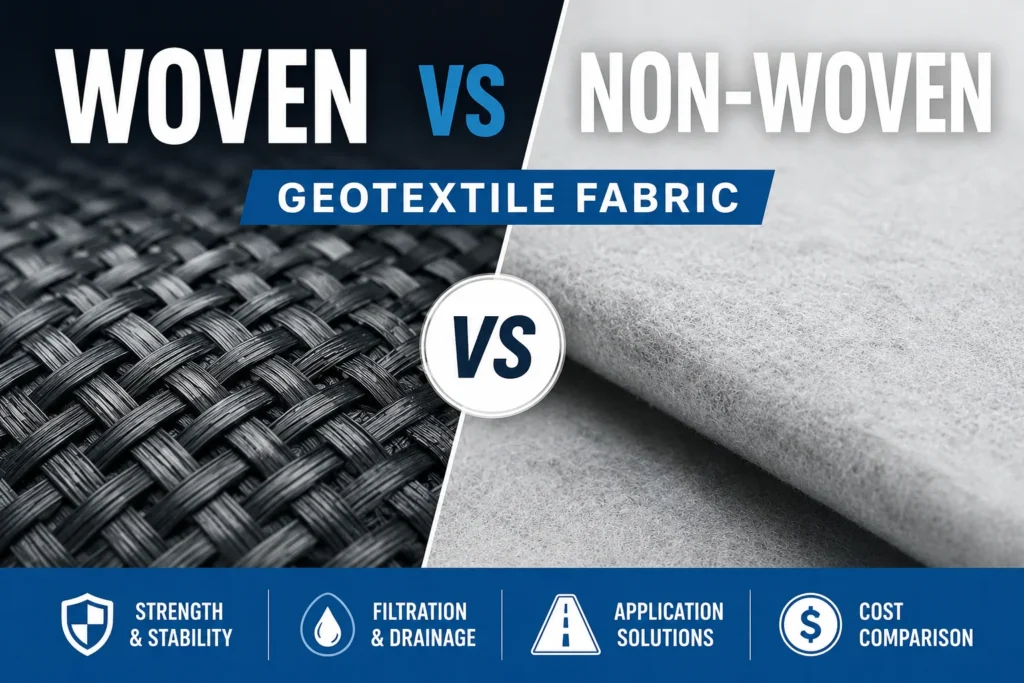
Quick Comparison Table: Woven vs Non-Woven Geotextile Fabric
| Comparison Point | Woven Geotextile Fabric | Non-Woven Geotextile Fabric |
|---|---|---|
| Main function | Separation and stabilization | Filtration, drainage, and protection |
| Structure | Interlaced tapes or yarns | Needle-punched or bonded fibers |
| Appearance | Flat, grid-like, woven surface | Felt-like fabric surface |
| Strength | Usually higher tensile strength | Usually lower tensile strength than woven |
| Elongation | Usually lower elongation | Usually higher elongation |
| Water flow | Moderate to low, depending on specification | Usually higher permeability |
| Filtration | Possible, but must be selected carefully | Usually better for filtration applications |
| Load support | Better for driveways and road base separation | Not usually the first choice for heavy stabilization |
| Cushioning | Limited | Better cushioning and puncture protection |
| Common use | Driveways, road base, construction roads, aggregate separation | French drains, drainage trenches, retaining wall drainage, pond liner protection |
| Best buyer intent | “geotextile fabric for driveway” | “geotextile fabric for French drain” |
| Main risk if misused | Poor filtration in drainage applications | Rutting or stretching under heavy load |
What Is Woven Geotextile Fabric?
Woven geotextile fabric is made by weaving polypropylene or polyester tapes, yarns, or filaments into a stable fabric structure. The woven structure gives the material good tensile strength and dimensional stability, which makes it suitable for applications where soil and aggregate must remain separated under load.
In civil engineering and construction applications, woven geotextile is often placed between weak subgrade soil and crushed stone. Its job is to prevent aggregate from sinking into the soil while helping distribute load across a broader area.
This is why woven geotextile is commonly used for:
- Gravel driveways
- Unpaved roads
- Construction access roads
- Parking lots
- Road base separation
- Temporary working platforms
- Aggregate separation over soft soil
- Subgrade stabilization projects
When Woven Geotextile Works Well
Woven geotextile is a good choice when the base layer needs to stay stable under traffic or repeated loading. For example, a gravel driveway built directly over soft soil may develop rutting because the stone gradually mixes with the subgrade. A woven geotextile layer can help maintain separation between the aggregate and the soil, reducing stone loss and improving long-term base performance.
It can also be useful when the project needs lower elongation. A fabric that stretches too much may not provide the same stabilizing effect under repeated wheel loads.
When Woven Geotextile May Not Be the Best Choice
Woven geotextile is not always the best option for drainage systems. Some woven fabrics have lower water flow capacity than non-woven fabrics. If the project is a French drain, trench drain, retaining wall drainage layer, or filter wrap, using the wrong woven fabric may reduce drainage efficiency or increase clogging risk.
For filtration and drainage, non-woven geotextile is usually the more common starting point unless the project specification clearly calls for a woven filtration geotextile.
What Is Non-Woven Geotextile Fabric?
Non-woven geotextile fabric is made by bonding synthetic fibers together, usually through needle-punching or thermal bonding. The result is a felt-like, permeable fabric that allows water to pass through while helping retain soil particles.
Non-woven geotextile is commonly selected when the main project function is filtration, drainage, protection, or cushioning rather than heavy load stabilization.
Common uses include:
- French drains
- Drainage trenches
- Retaining wall drainage
- Erosion control
- Riprap underlayment
- Pond liner underlayment
- Geomembrane protection
- Landfill liner cushioning
- Wastewater pond liner protection
- Landscape and subsurface drainage systems
When Non-Woven Geotextile Works Well
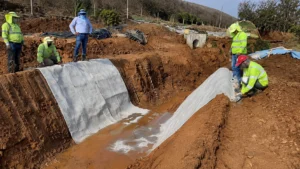
Non-woven geotextile works well when water must move through the fabric while soil particles are retained. In a French drain, for example, the fabric helps stop fine soil from entering the gravel and perforated pipe. This helps keep the drainage system open for longer.
It is also commonly used as a protective layer under geomembrane liners. If a pond liner, landfill liner, or wastewater containment liner is placed directly over sharp stones, roots, or uneven subgrade, puncture damage may occur. A non-woven geotextile underlayment provides cushioning and helps reduce that risk.
When Non-Woven Geotextile May Not Be the Best Choice
Non-woven geotextile is usually not the best standalone option for heavy-duty road base stabilization. It may separate and protect, but its higher elongation and lower tensile strength can make it less effective under repeated vehicle loading compared with woven geotextile or geogrid.
For high-load roads, crane pads, haul roads, or weak subgrade conditions, project design should consider woven geotextile, geogrid, or a combined geosynthetic system.
Woven vs Non-Woven Geotextile by Application
| Application | Usually Better Choice | Why |
| Gravel driveway | Woven geotextile | Helps separate aggregate from soil and reduce rutting |
| Road base | Woven geotextile | Better stabilization and subgrade separation |
| Construction access road | Woven geotextile | Better suited for repeated vehicle loads |
| Parking area | Woven geotextile | Helps support aggregate base under traffic |
| French drain | Non-woven geotextile | Better filtration and water flow |
| Drainage trench | Non-woven geotextile | Allows water movement while retaining soil |
| Retaining wall drainage | Non-woven geotextile | Helps filter soil around drainage stone and pipe |
| Retaining wall base separation | Woven geotextile | Helps separate base aggregate from subgrade |
| Pond liner protection | Non-woven geotextile | Provides cushioning under geomembrane or pond liner |
| Landfill liner protection | Non-woven geotextile | Helps protect geomembrane from puncture |
| Riprap underlayment | Non-woven geotextile | Helps prevent soil loss while allowing water flow |
| Erosion control | Non-woven geotextile | Supports filtration and soil retention |
| Weak soil stabilization | Woven geotextile or geogrid | Depends on load, soil strength, and design requirements |
| Heavy-load reinforcement | Geogrid may be needed | Geogrid provides interlock and reinforcement beyond fabric separation |
Woven vs Non-Woven Geotextile for Driveways
For most gravel driveways, woven geotextile fabric is usually the better choice.
The reason is simple: the main problem in many gravel driveways is not only water. It is aggregate contamination and base movement. When gravel is installed directly over soft soil, the stone can migrate into the subgrade over time. This reduces the effective thickness of the aggregate layer and often leads to rutting, potholes, and repeated maintenance.
A woven geotextile layer helps create a separation barrier between the soil and the stone base. It helps keep the aggregate working as a structural layer instead of mixing with the soil below.
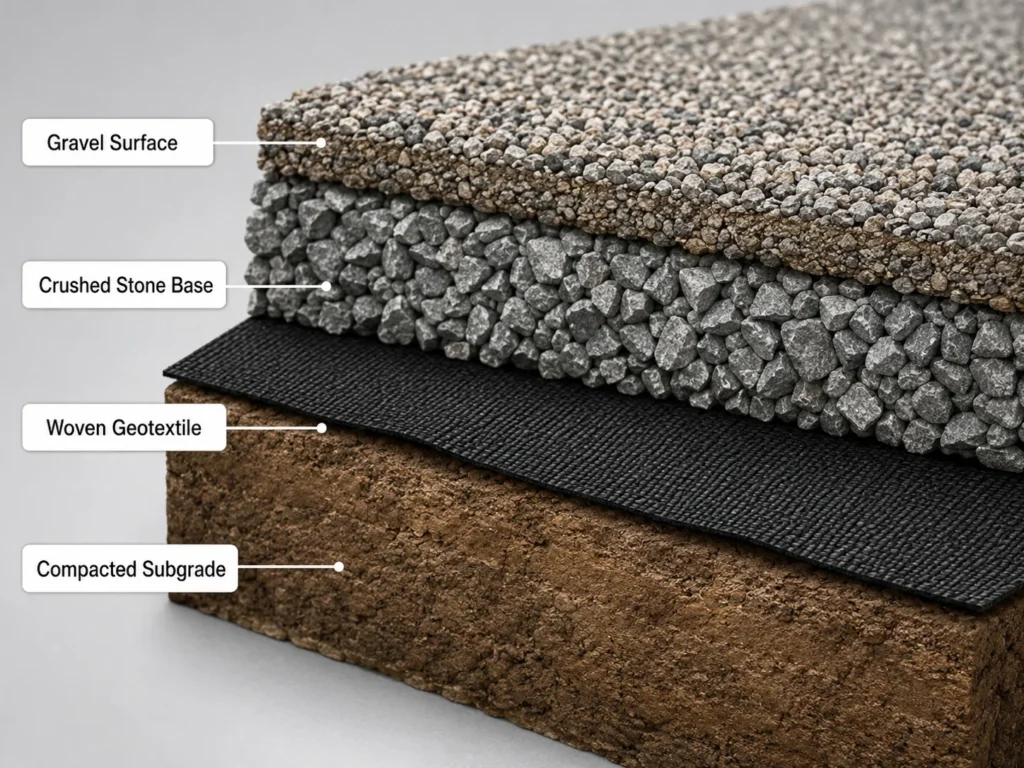
Typical Gravel Driveway Layer Structure
A typical gravel driveway using woven geotextile may include:
- Existing soil or prepared subgrade
- Compaction and grading
- Woven geotextile fabric
- Overlap between fabric rolls
- Crushed stone base layer
- Compacted surface gravel
- Edge restraint and drainage management
When Non-Woven May Still Be Used in a Driveway Project
Non-woven geotextile may still be used in driveway-related drainage zones, such as side drains, trench drains, or underdrain systems. But under the main traffic-bearing gravel base, woven geotextile is usually the more suitable option.
Recommended internal links:
- Woven geotextile fabric for driveway and road base
Woven vs Non-Woven Geotextile for French Drains
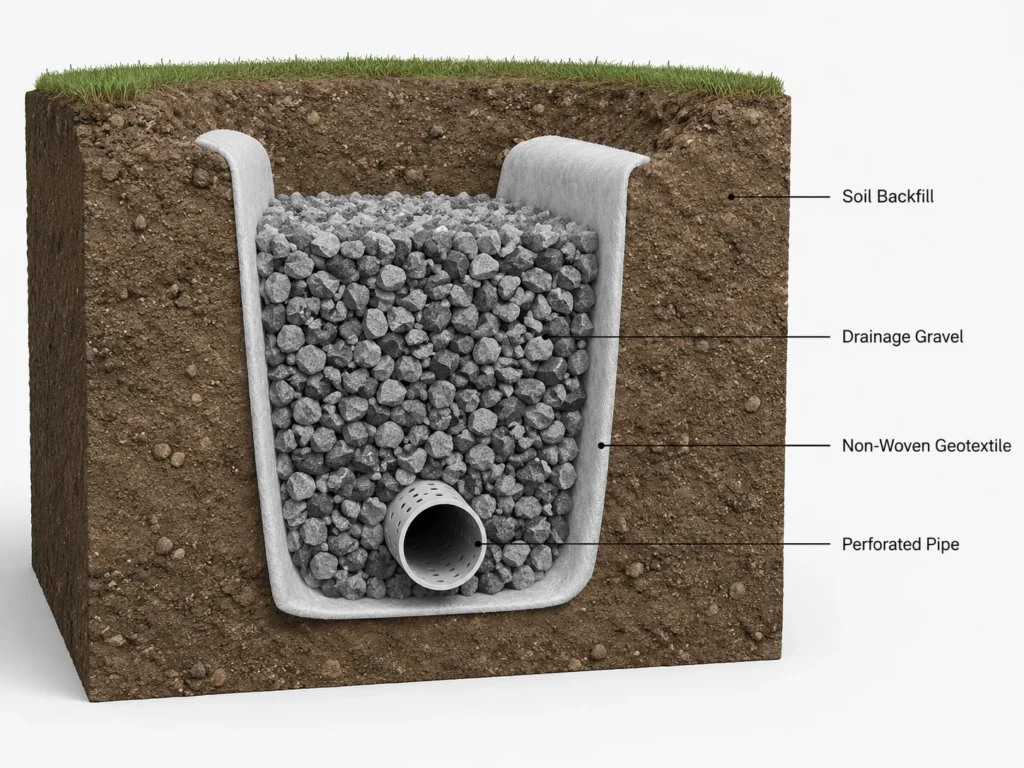
For most French drains, non-woven geotextile fabric is usually the better choice.
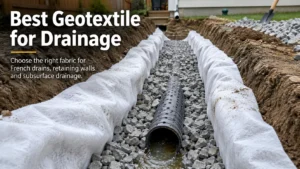
A French drain needs to collect and move water. The fabric must allow water to pass into the gravel and pipe system while reducing soil migration into the drainage zone. Non-woven geotextile is commonly used because it provides good filtration and permeability for this type of application.
Typical French Drain Layer Structure
A typical French drain using non-woven geotextile may include:
- Excavated trench
- Non-woven geotextile lining
- Drainage gravel
- Perforated drainage pipe
- Additional gravel cover
- Fabric wrap closure
- Soil or surface backfill
Why Woven Fabric Is Usually Not the First Choice
Woven geotextile may provide separation, but it is not always ideal for a drainage wrap. If the fabric opening size, permeability, or soil compatibility is not correct, the system may drain poorly or clog over time.
That does not mean woven geotextile can never be used for filtration. Some woven filtration fabrics are designed for drainage and hydraulic applications. However, for common French drain projects, non-woven geotextile is usually easier to specify and more commonly selected.
Recommended internal links:
- Non-woven geotextile fabric for drainage and filtration
Woven vs Non-Woven Geotextile Under Gravel
The right geotextile under gravel depends on the purpose of the gravel layer.
If the gravel is part of a driveway, road base, construction road, or parking area, woven geotextile is usually recommended because it provides better separation and stabilization.
If the gravel is part of a drainage trench, French drain, retaining wall drainage layer, or water collection system, non-woven geotextile is usually recommended because filtration and water flow are more important.
Simple Selection Rule
| Project Problem | Recommended Material |
| Gravel is sinking into soft soil | Woven geotextile |
| Driveway is rutting under vehicles | Woven geotextile |
| Road base needs soil separation | Woven geotextile |
| Drainage trench is clogging with fines | Non-woven geotextile |
| Water must pass through the fabric | Non-woven geotextile |
| Pond liner needs puncture protection | Non-woven geotextile |
| Heavy load needs structural reinforcement | Geogrid or woven geotextile, depending on design |
| Both drainage and stabilization are needed | A combined design may be required |
Woven vs Non-Woven Geotextile for Retaining Walls
Retaining wall projects may use both woven and non-woven geotextile, but in different functions.
Non-woven geotextile is commonly used in the drainage zone behind the wall. It helps separate soil from drainage stone and reduces soil migration into the drainage layer. This is especially important where fine-grained backfill may move into the gravel and reduce drainage performance.
Woven geotextile may be used for separation under the base aggregate or in some reinforced soil applications, depending on design requirements. However, many reinforced retaining wall systems use geogrid rather than geotextile as the primary reinforcement.
Practical Retaining Wall Guidance
| Wall Component | Possible Geosynthetic | Function |
| Drainage stone wrap | Non-woven geotextile | Filtration and soil retention |
| Base aggregate separation | Woven geotextile | Separation from subgrade |
| Reinforced soil zone | Geogrid or high-strength geotextile | Reinforcement, depending on design |
| Behind-wall drainage pipe | Non-woven geotextile | Filter wrap or drainage separation |
| Soft foundation improvement | Woven geotextile or geogrid | Stabilization or reinforcement |
For retaining walls, the correct material depends on wall height, backfill type, drainage conditions, surcharge loads, and local engineering requirements.
Woven vs Non-Woven Geotextile for Pond Liners and Geomembranes
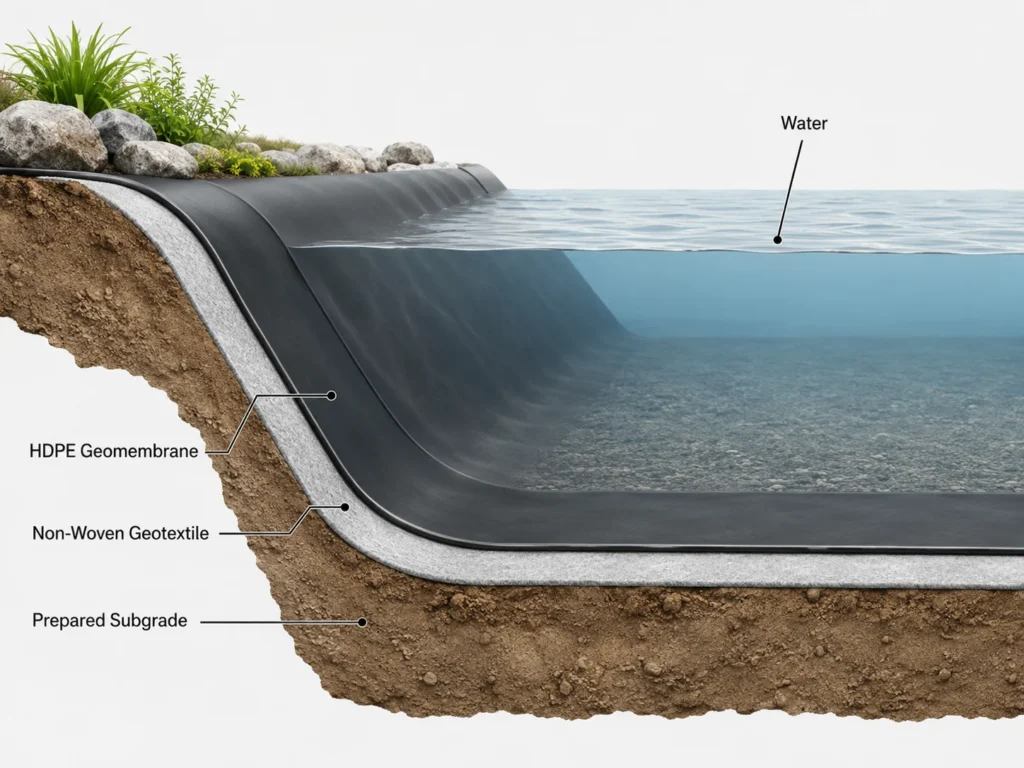
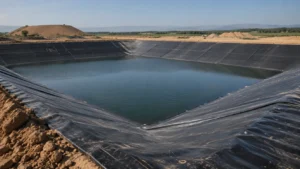
For pond liners, reservoirs, wastewater containment, and landfill liners, non-woven geotextile is commonly used as a protection layer.
The geotextile is usually placed under the geomembrane or pond liner to reduce puncture risk from stones, roots, uneven soil, or construction damage. It may also be placed above the liner in some designs to protect the geomembrane from cover soil or ballast.
Why Non-Woven Is Commonly Used for Liner Protection
Non-woven geotextile is suitable for liner protection because it provides:
- Cushioning
- Puncture resistance
- Surface protection
- Separation
- Drainage support in some designs
- Better conformance to uneven subgrade
Woven geotextile is not usually the first choice for geomembrane cushioning because it has a flatter and less cushioning structure. However, project specifications may require different materials depending on load, slope, subgrade, cover material, and liner thickness.
Related internal links:
- HDPE geomembrane products
- Non-woven geotextile underlayment
Geotextile Fabric vs Landscape Fabric
Geotextile fabric and landscape fabric are often confused, but they are not the same in engineering use.
Landscape fabric is usually designed for weed control, garden beds, and light landscaping. It may not have the strength, filtration properties, opening size, puncture resistance, or durability needed for construction applications.
Geotextile fabric is an engineering material used for separation, filtration, drainage, reinforcement, protection, and erosion control. It is commonly selected by function and specification, not only by appearance.
When Landscape Fabric Is Not Enough
Ordinary landscape fabric may not be suitable for:
- Gravel driveways with vehicle traffic
- Road base separation
- Construction access roads
- French drains requiring long-term filtration
- Retaining wall drainage
- Pond liner protection
- Erosion control under riprap
- Heavy-duty drainage trenches
For engineering projects, it is usually better to choose a proper woven or non-woven geotextile fabric based on application requirements.
Geogrid vs Geotextile: Which One Do You Need?
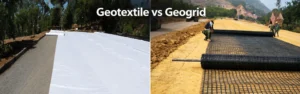
Geogrid and geotextile are both geosynthetic materials, but they solve different problems.
Geotextile is a fabric material used for separation, filtration, drainage, protection, and sometimes stabilization.
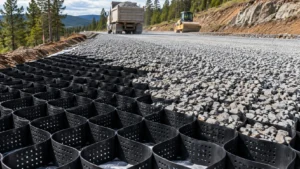
Geogrid is an open-grid reinforcement material designed to interlock with aggregate and reinforce soil or base layers. It is commonly used in retaining walls, road base reinforcement, slopes, and heavy-load platforms.
Quick Comparison
| Material | Main Function | Best Used For |
| Woven geotextile | Separation and stabilization | Driveways, road base, construction roads |
| Non-woven geotextile | Filtration, drainage, protection | French drains, drainage trenches, liner protection |
| Geogrid | Reinforcement and aggregate interlock | Retaining walls, road base reinforcement, slopes |
| Geocomposite | Combined functions | Projects needing stabilization + separation + filtration |
In some projects, geogrid and geotextile may be used together. For example, a road base over weak soil may need geogrid for reinforcement and geotextile for separation or filtration.
Related internal link:
Engineering Selection Factors
Choosing between woven and non-woven geotextile should be based on project function and specification. The following factors usually matter more than the product name alone.
1. Function
First define the primary function:
- Separation
- Filtration
- Drainage
- Protection
- Stabilization
- Reinforcement
- Erosion control
A single geotextile may perform more than one function, but one function is usually the main design driver.
2. Soil Type
Fine-grained soils, clay, silt, sand, and aggregate all interact differently with geotextile. For drainage projects, soil particle size and clogging risk are especially important.
3. Water Flow Requirement
For French drains, retaining wall drainage, and erosion control, the fabric must allow enough water to pass through while retaining soil particles. Permeability and apparent opening size should be considered.
4. Load Condition
Driveways, roads, parking lots, and construction access areas are affected by repeated loading. Tensile strength, elongation, and installation survivability become important.
5. Aggregate Size
Large or angular aggregate may damage fabric during installation if the selected geotextile does not have enough puncture or tear resistance.
6. Installation Conditions
Geotextile performance can be affected by subgrade preparation, overlap, wrinkles, equipment traffic, weather, UV exposure, and backfill placement.
7. Required Standards or Project Specifications
For larger civil projects, the required material may be defined by project drawings, DOT specifications, AASHTO classes, ASTM test values, or engineer-approved submittals. In these cases, the product should be selected according to the specification rather than a general recommendation.
Specification Properties to Check Before Buying
Before purchasing woven or non-woven geotextile fabric, review the technical datasheet. The most important properties may include:
| Property | Why It Matters |
| Grab tensile strength | Indicates resistance to pulling forces |
| Wide-width tensile strength | Important for reinforcement and stabilization |
| Elongation | Affects deformation under load |
| Puncture resistance | Important under angular stone or liner protection |
| Tear strength | Important during installation |
| Apparent opening size | Affects filtration and soil retention |
| Permittivity | Affects water flow through the fabric |
| Water flow rate | Important for drainage applications |
| UV resistance | Important if fabric may be exposed before covering |
| Roll width and length | Affects installation speed, overlap, and waste |
| Material type | Usually PP or PET depending on project conditions |
| Mass per unit area | Useful, but should not be the only selection factor |
Important note: fabric weight, such as 4 oz, 6 oz, or 8 oz, is not the same as complete engineering performance. Weight can help identify product grade, but strength, flow, opening size, puncture resistance, and application suitability should also be checked.
Common Mistakes When Choosing Woven or Non-Woven Geotextile
Mistake 1: Choosing by Price Only
Low-cost fabric may look similar on the surface, but the performance can be very different. A cheaper material may have lower strength, lower puncture resistance, poor filtration performance, or shorter service life.
Mistake 2: Using Non-Woven Fabric for Every Driveway
Non-woven geotextile is useful for drainage and filtration, but it is not usually the first choice for the main base layer of a gravel driveway. Woven geotextile is often more suitable where separation and stabilization are the main functions.
Mistake 3: Using Woven Fabric for Every Drainage Project
Woven geotextile is strong, but drainage systems need filtration and water flow. For French drains and trench drains, non-woven geotextile is often a better starting point.
Mistake 4: Ignoring Soil Fines
Drainage failure is often related to soil fines entering the gravel or pipe system. The fabric opening size and filtration performance should match the soil conditions.
Mistake 5: Treating Landscape Fabric as Engineering Geotextile
Landscape fabric may work for weed control, but it should not automatically be used for driveways, road base, retaining walls, French drains, or liner protection.
Mistake 6: Leaving Fabric Exposed Too Long
Most geotextiles should be covered as soon as practical after installation. Long UV exposure before backfilling may reduce performance depending on the material and site conditions.
Mistake 7: Poor Overlap Between Rolls
Insufficient overlap can allow soil and aggregate to mix at seams. Overlap requirements depend on soil strength, load, slope, and installation conditions.
Mistake 8: Driving Directly on Uncovered Fabric
Construction equipment can wrinkle, tear, or displace geotextile if aggregate is not placed properly. Follow proper installation sequence and avoid unnecessary traffic on exposed fabric.
Practical Selection Matrix
| Project Type | Main Problem | Recommended Starting Point |
| Gravel driveway over soft soil | Rutting and aggregate loss | Woven geotextile |
| French drain | Soil fines clogging drainage stone | Non-woven geotextile |
| Road base | Subgrade separation and load support | Woven geotextile or geogrid |
| Retaining wall drainage | Soil migration into drainage zone | Non-woven geotextile |
| Retaining wall reinforcement | Lateral earth pressure and soil reinforcement | Geogrid or high-strength geotextile |
| Pond liner installation | Puncture risk below liner | Non-woven geotextile |
| Landfill liner protection | Geomembrane cushioning | Non-woven geotextile |
| Erosion control under riprap | Soil loss under stone | Non-woven geotextile |
| Temporary construction road | Repeated equipment traffic | Woven geotextile or geogrid |
| Drainage blanket | Water movement and soil retention | Non-woven geotextile |
Recommended Products
Woven Geotextile Fabric
Choose woven geotextile fabric when your project requires separation and stabilization under aggregate.
Suitable applications include:
- Gravel driveways
- Road base
- Parking areas
- Construction access roads
- Subgrade separation
- Aggregate base stabilization
Non-Woven Geotextile Fabric
Choose non-woven geotextile fabric when your project requires filtration, drainage, cushioning, or liner protection.
Suitable applications include:
- French drains
- Trench drains
- Retaining wall drainage
- Pond liner underlayment
- Geomembrane protection
- Erosion control
- Riprap underlayment
Geotextile Product Category
For buyers comparing multiple geotextile options, visit the main geotextile product page:
Project-Specific Recommendation CTA
Need help choosing woven or non-woven geotextile for your project?
Send us your project details, including application, soil type, water flow condition, aggregate size, load condition, and required roll size. Our team can recommend a suitable geotextile option based on your project needs.
FAQ
What is the difference between woven and non-woven geotextile fabric?
Woven geotextile fabric is made from interlaced tapes or yarns and is mainly used for separation and stabilization. Non-woven geotextile fabric is made from bonded fibers and is mainly used for filtration, drainage, cushioning, and protection. Woven fabric is usually better for driveways and road base, while non-woven fabric is usually better for French drains and liner protection.
Is woven or non-woven geotextile better?
Neither material is always better. Woven geotextile is usually better when the project needs strength, separation, and stabilization under aggregate. Non-woven geotextile is usually better when the project needs water flow, filtration, drainage, or puncture protection.
Should I use woven or non-woven geotextile for a driveway?
For most gravel driveways, woven geotextile is usually the better choice because it helps separate the aggregate base from the subgrade and reduces rutting. Non-woven geotextile may be used in drainage zones, but it is usually not the first choice under the main driveway base.
Should I use woven or non-woven geotextile for a French drain?
For most French drains, non-woven geotextile is usually the better choice because it allows water to pass through while helping prevent soil fines from entering the gravel and pipe system. Woven geotextile may be used only when the specification requires a suitable woven filtration fabric.
Can non-woven geotextile be used under gravel?
Yes, non-woven geotextile can be used under gravel when the main purpose is drainage, filtration, or cushioning. However, for gravel driveways, roads, and parking areas, woven geotextile is often a better choice because stabilization and separation are usually more important.
Is geotextile fabric the same as landscape fabric?
No. Landscape fabric is usually used for weed control in light landscaping. Geotextile fabric is an engineering material used for separation, filtration, drainage, stabilization, protection, and erosion control. For driveways, French drains, retaining walls, and pond liner protection, proper geotextile fabric is usually more suitable than ordinary landscape fabric.
Is geogrid better than geotextile?
Geogrid is better for reinforcement and aggregate interlock, especially in retaining walls, road base reinforcement, and slope stabilization. Geotextile is better for separation, filtration, drainage, and protection. In some projects, geogrid and geotextile may be used together.
What geotextile should I use under a pond liner?
Non-woven geotextile is commonly used under pond liners and geomembranes because it provides cushioning and helps reduce puncture risk. The required weight and puncture resistance depend on subgrade condition, liner thickness, stones, roots, slope, and installation method.
Does geotextile fabric allow water to pass through?
Yes, geotextile fabric is permeable, but the water flow rate depends on the product type and specification. Non-woven geotextile usually provides better permeability for drainage and filtration. Woven geotextile may allow water flow, but it is mainly selected for separation and stabilization.
How do I choose the right geotextile roll?
Choose based on project function, soil type, water flow, load condition, aggregate size, required strength, puncture resistance, and roll size. For large civil projects, follow the engineering specification or provide project details to a geotextile supplier for selection support.
Conclusion
Woven and non-woven geotextile fabrics are both useful, but they are not used for the same purpose.
Use woven geotextile when the project needs separation and stabilization under aggregate. This includes gravel driveways, road base, parking areas, and construction access roads.
Use non-woven geotextile when the project needs filtration, drainage, cushioning, or puncture protection. This includes French drains, retaining wall drainage, erosion control, pond liner underlayment, and geomembrane protection.
For high-load or weak soil projects, geogrid may also be required. For drainage-sensitive projects, the geotextile should be selected carefully based on soil conditions and hydraulic requirements.
The safest approach is to define the project function first, then select the fabric based on engineering performance rather than appearance, price, or weight alone.