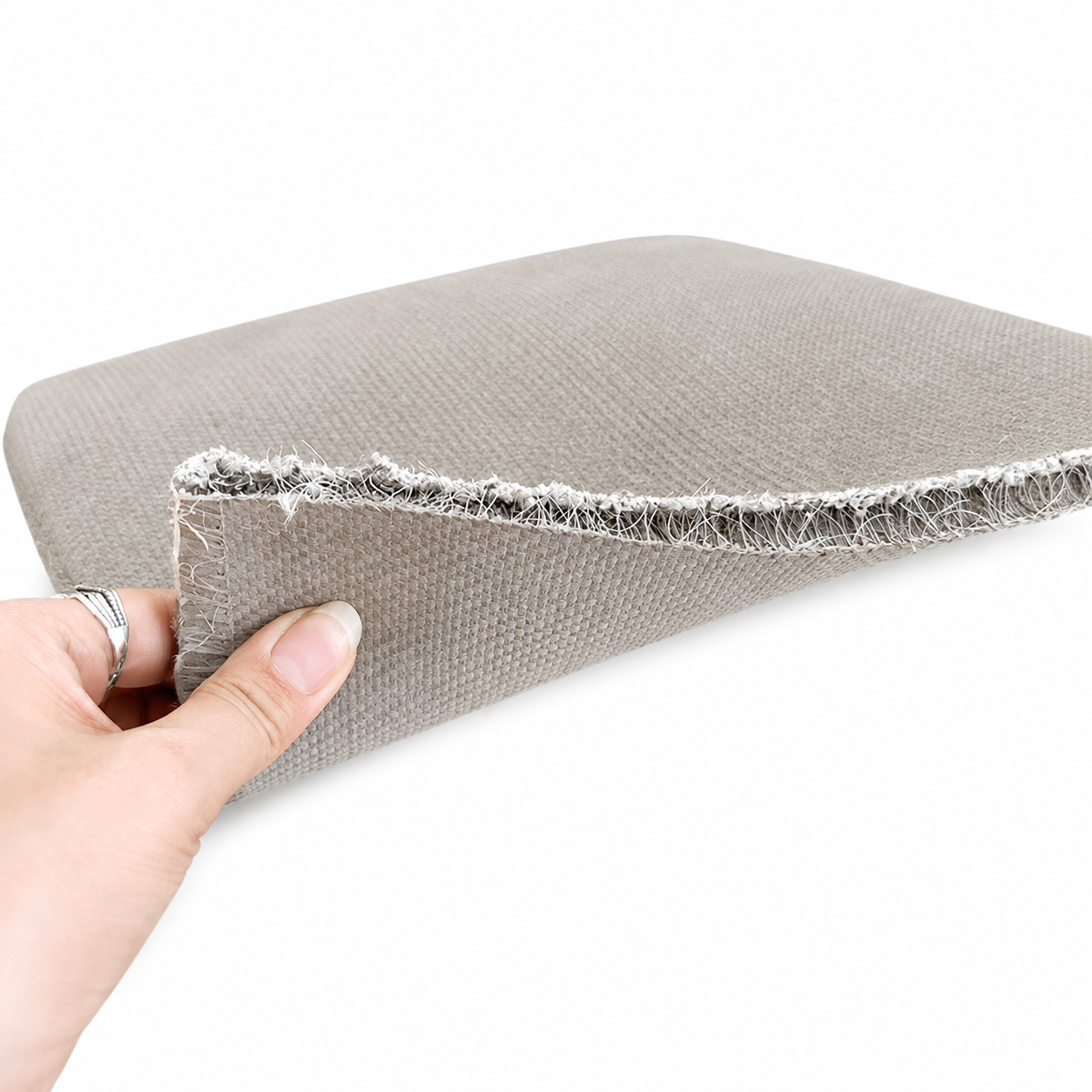
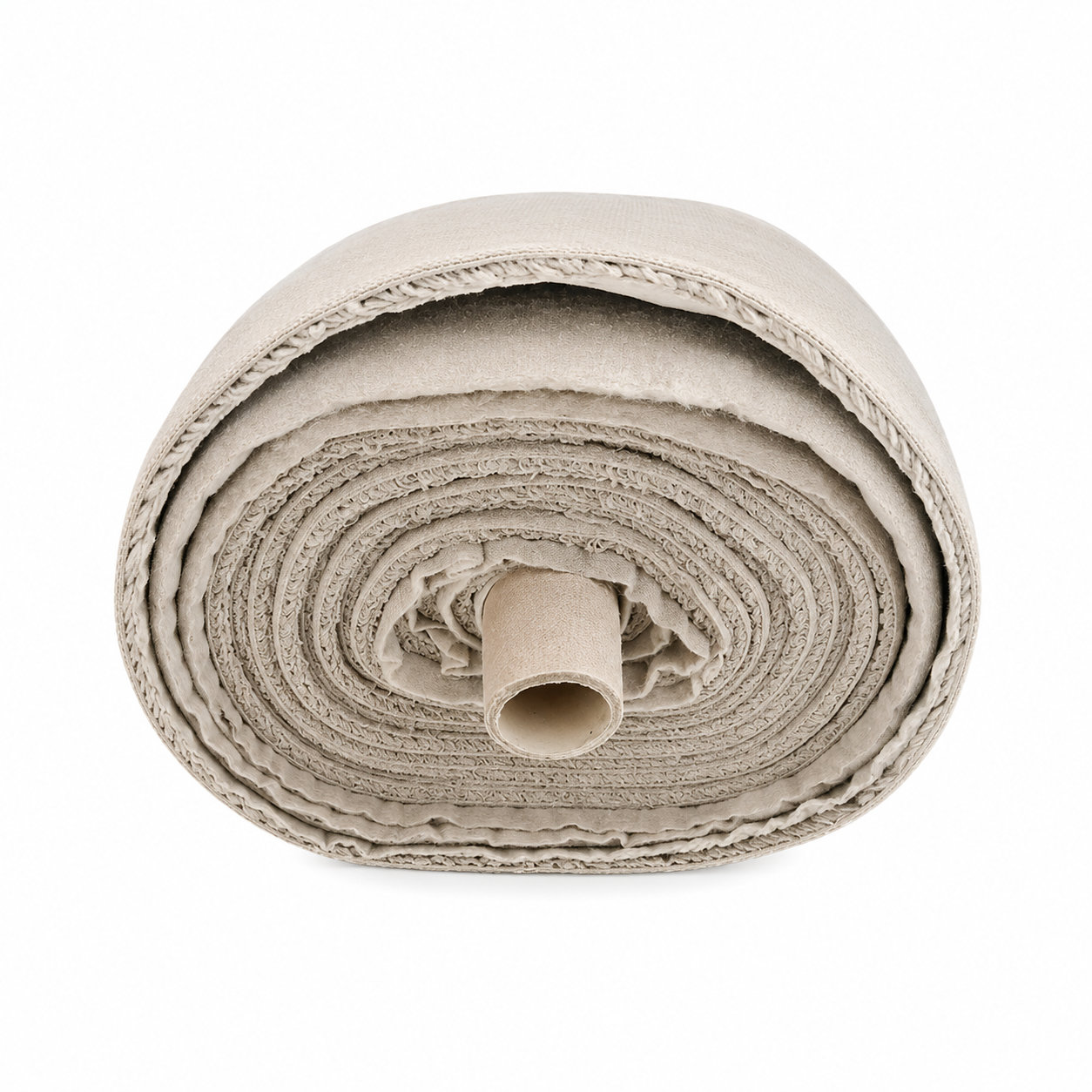
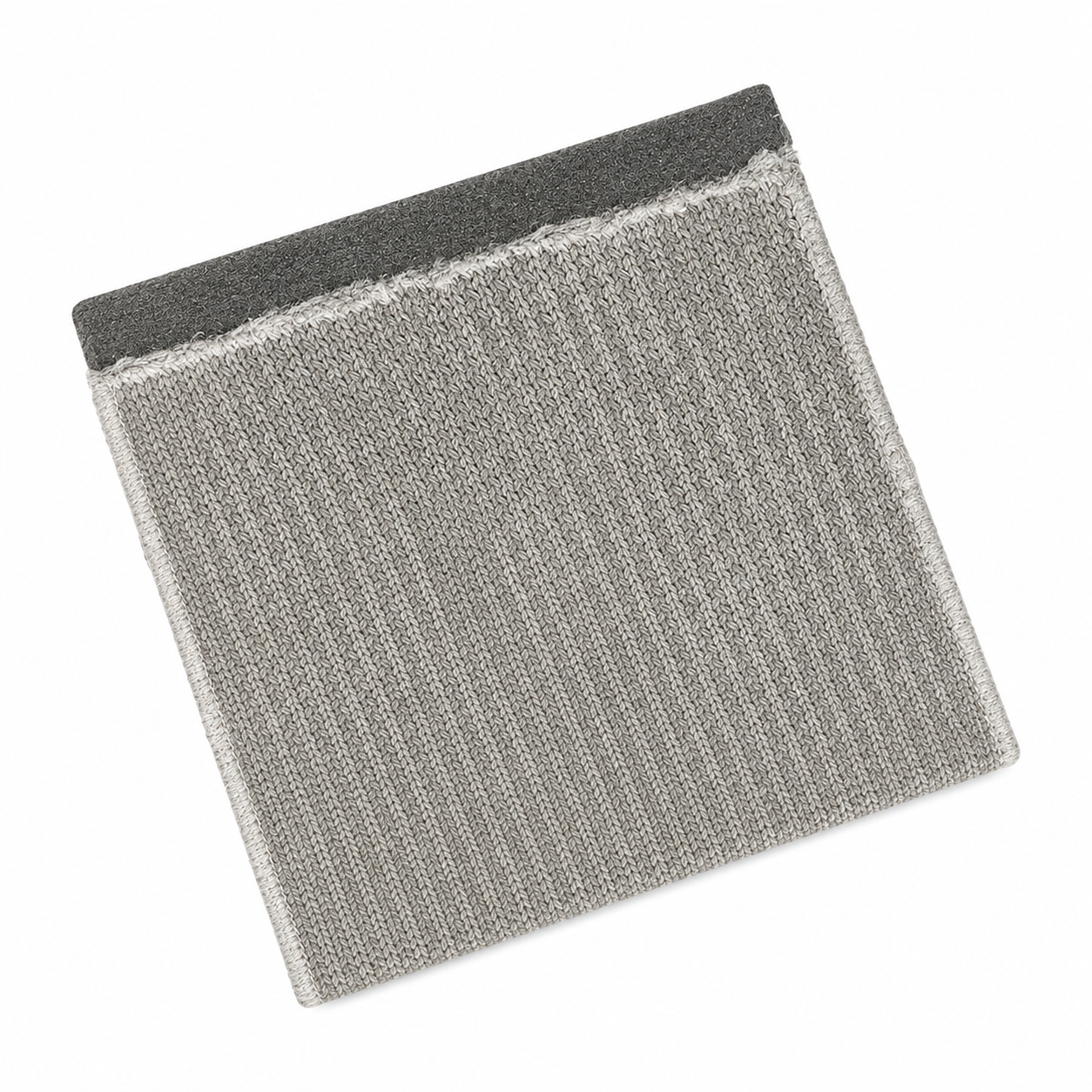
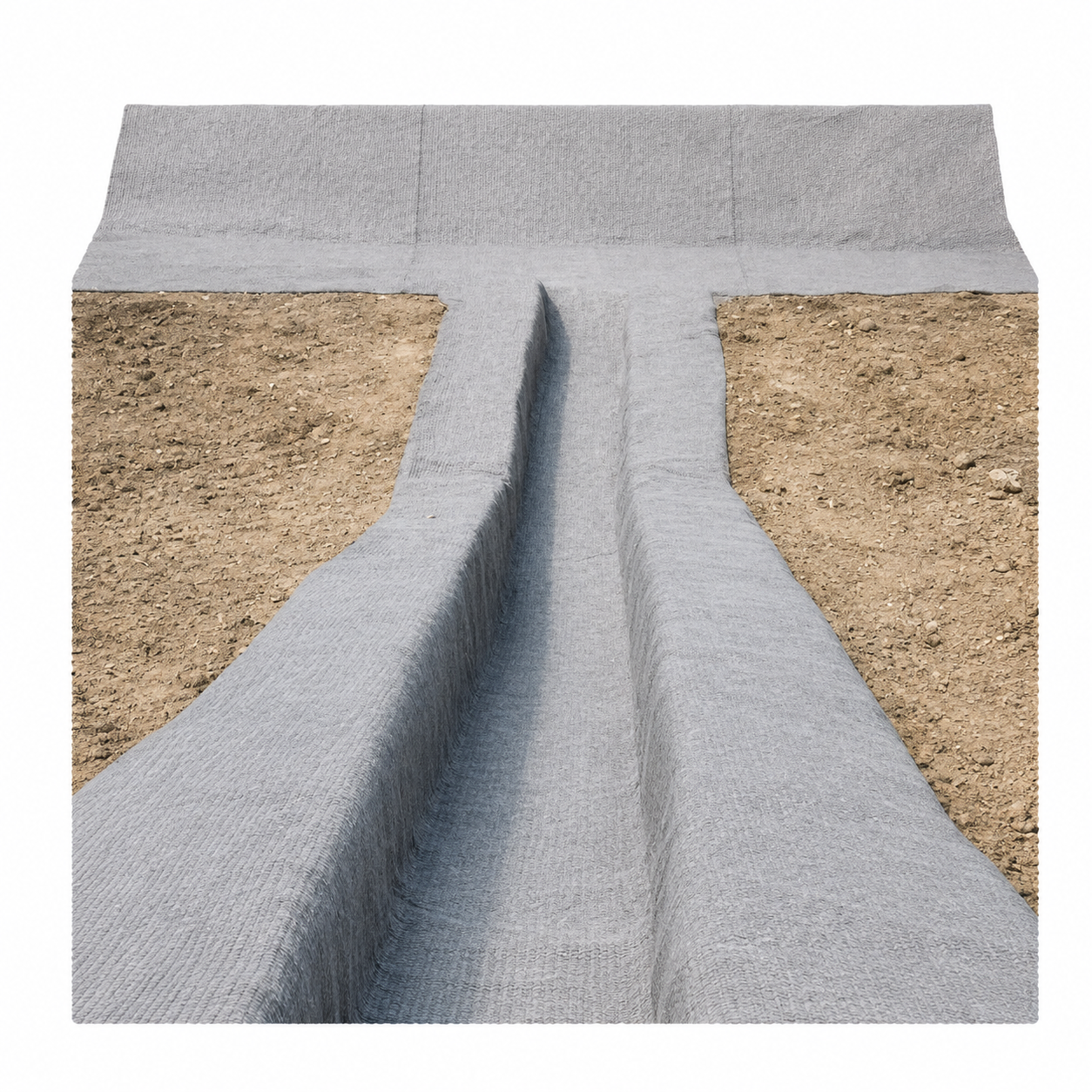
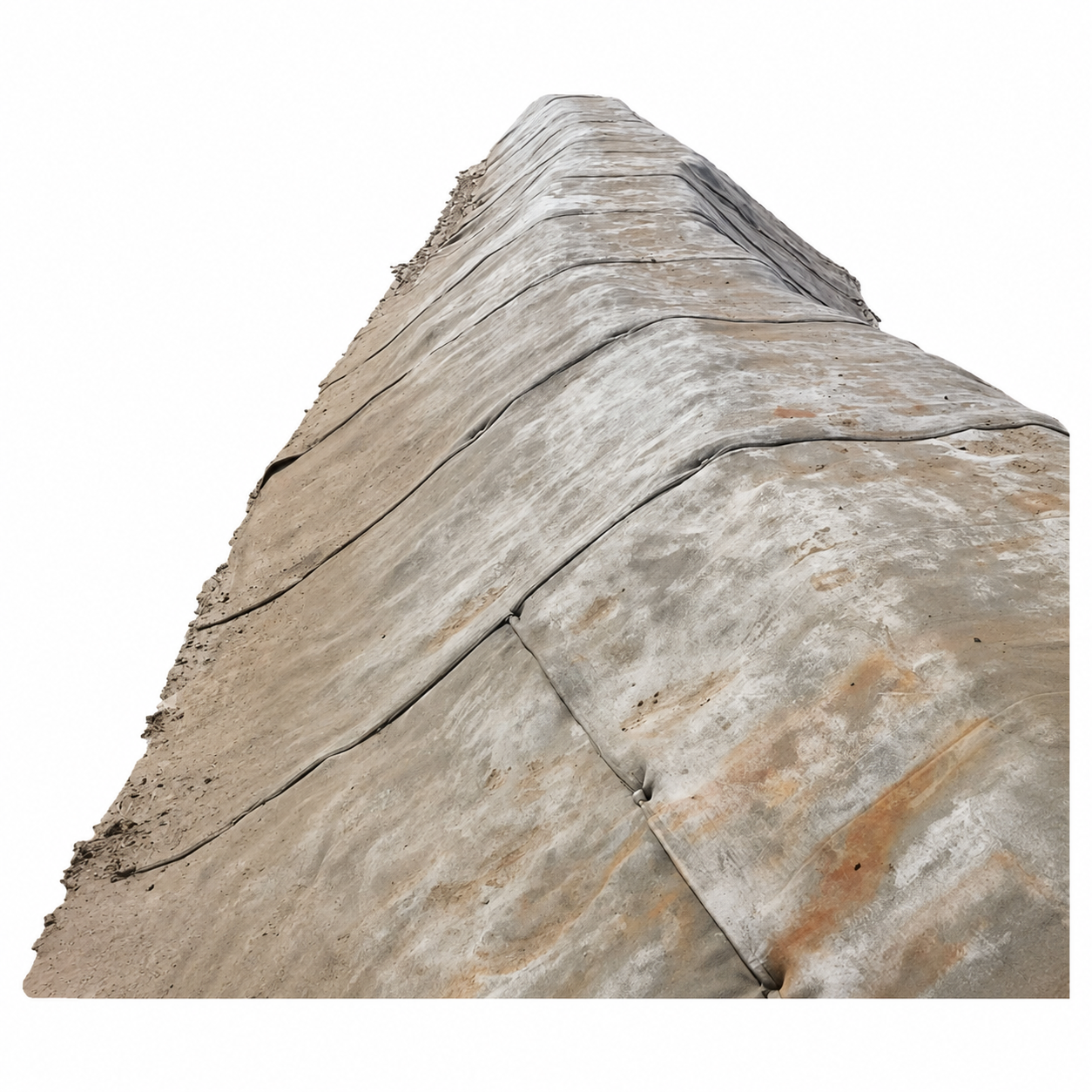
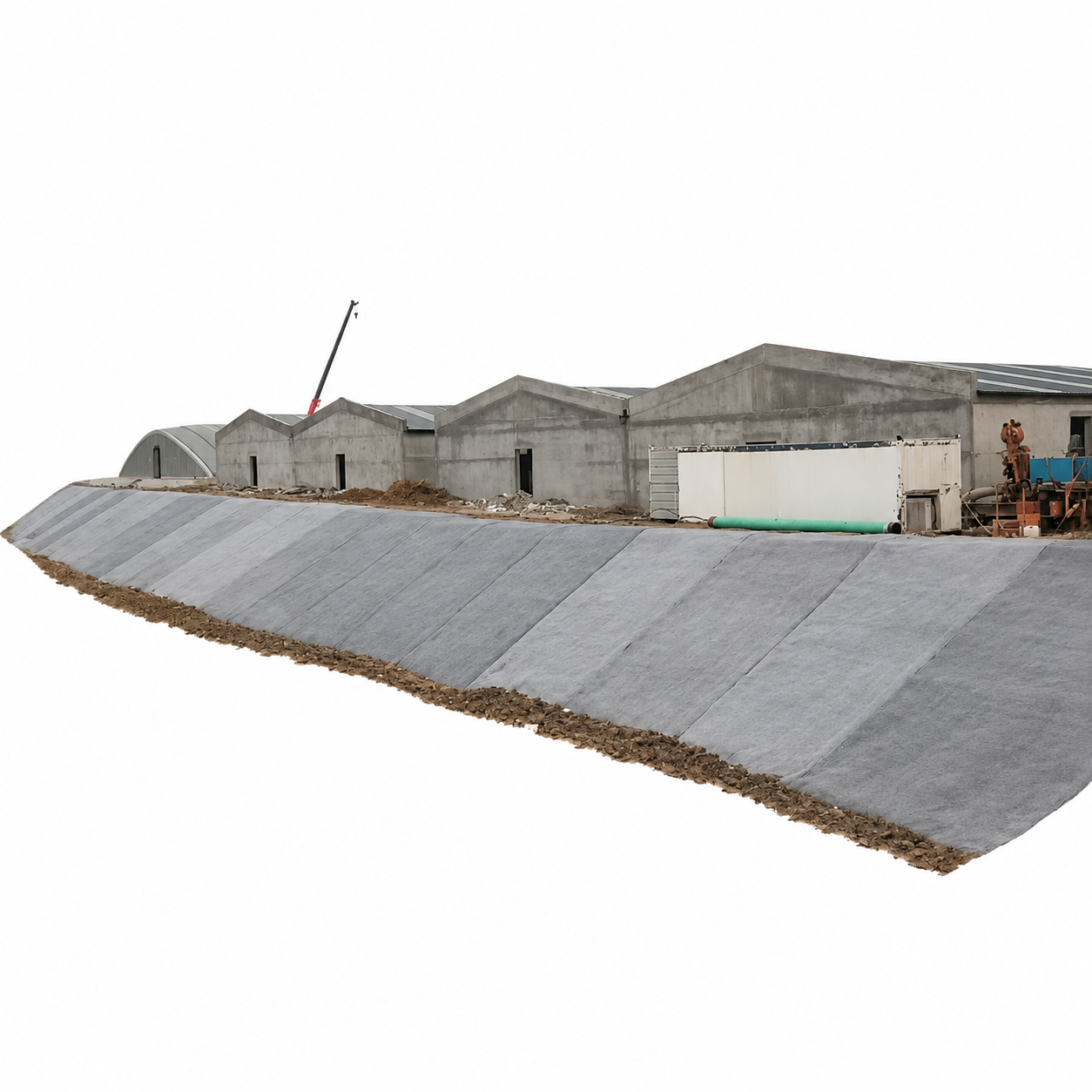
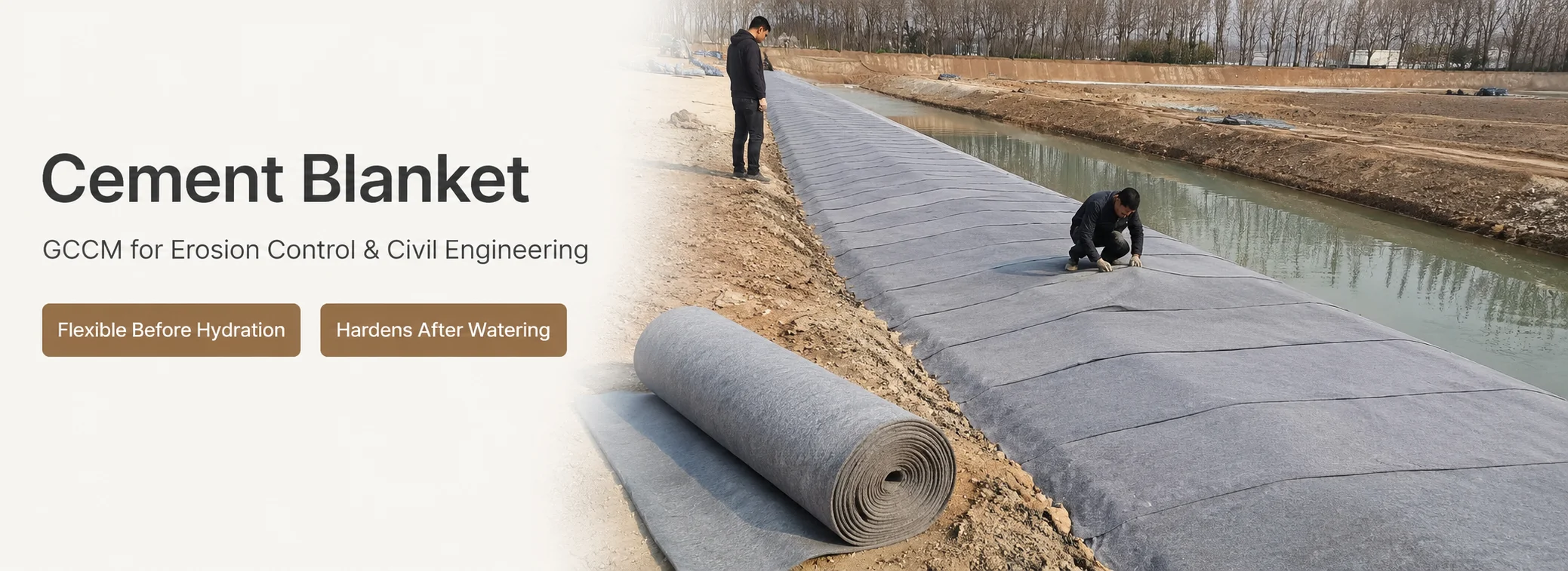
Cement blanket is a flexible, roll-supplied cementitious composite material that hardens after hydration to form a thin protective concrete layer.
Also known in the market as concrete cloth, concrete fabric, or a Geosynthetic Cementitious Composite Mat (GCCM), it is commonly considered for projects where conventional poured concrete is difficult, slow or labor-intensive to install.
GeoCore supplies cement blanket rolls for applications including erosion control, slope protection, drainage channels, ditch lining and embankment surface protection.
Flexible Before Hydration · Hardens After Watering · Roll Format · Custom Specifications
CTA: Request Specifications
CTA: Get a Project Quote
A cement blanket is a factory-produced composite material containing a dry cementitious mixture within a flexible textile structure.
Before hydration, the material can be transported, unrolled, cut and positioned over the prepared surface. After water is applied, the cementitious component hydrates and gradually hardens, creating a conforming protective layer.
This combination of flexible installation before hydration and cementitious performance after curing makes cement blanket particularly useful on slopes, channels and irregular surfaces where traditional cast-in-place concrete may require more equipment, formwork or site preparation.
In technical specifications, this product category may also be described as a Geosynthetic Cementitious Composite Mat, or GCCM.
A typical cement blanket consists of several functional components working together.
The upper textile layer helps contain the cementitious material and supports handling during transportation and installation.
A dry cement-based mixture is contained within the composite structure and activated when sufficient water is applied.
The internal textile or fiber matrix helps maintain the shape and integrity of the composite before and after hydration.
Depending on the selected product configuration, a backing layer may be incorporated where additional separation or water-control performance is required.
Actual layer construction should be confirmed against the supplied product specification before project selection.
| Parameter | Available / Reference Range |
|---|---|
| Product | Cement Blanket / GCCM |
| Product Form | Flexible roll |
| Material | Cementitious composite with textile structure |
| Thickness | Available in different specifications |
| Width | Customizable according to order |
| Length | 5–50 m |
| Color | Typically gray / customizable |
| Activation | Hydration with water |
| Roll Size | Project-dependent |
| Packaging | Rolled with moisture-protective packaging |
| MOQ | Reference: 1,000 m² |
| Customization | Thickness, width, length and packaging subject to confirmation |
Need a technical specification for your project?
Send us the required application, roll size, quantity and destination so we can recommend an available configuration.
Cement blanket arrives at the site in roll form. It can be positioned directly over a prepared surface without batching fresh concrete on site.
For long slopes, drainage channels and difficult-access areas, this can simplify material handling and reduce the number of conventional concrete operations required on site.
Before watering, the material remains flexible enough to follow many irregular surfaces and contours.
This is particularly useful on:
One of the main characteristics behind searches such as cement blanket just add water is its hydration process.
Once properly positioned and fixed, water is applied to the installed blanket. The cementitious material then begins to hydrate and harden.
The required water quantity, curing procedure and time should follow the specific product instructions and site conditions.
Because the cementitious material is contained within a manufactured composite, the installed layer can be more controlled than manually placing a thin cement mortar layer on an irregular slope.
Actual finished thickness and performance still depend on the selected product, hydration and installation quality.
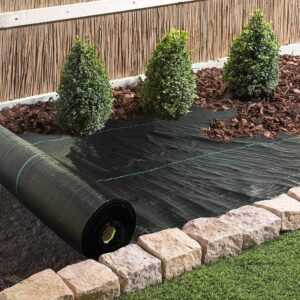
Cement blanket is commonly considered for surface erosion protection where exposed soil is affected by rainfall, runoff or flowing water.
After hydration and curing, the material forms a hardened surface over the underlying ground, helping protect the exposed soil from direct erosion.
Typical locations include:
The required product configuration should be selected according to slope geometry, water conditions, substrate, anchoring requirements and project specifications.
Slopes exposed to rainfall and concentrated runoff can gradually lose surface soil, particularly where vegetation alone cannot provide adequate protection.
A cement blanket can be installed over a prepared slope to create a hardened protective surface.
Typical projects may include:
Cement blanket should not be treated as a substitute for geotechnical slope stability design. Where deep-seated instability, groundwater pressure or structural reinforcement is involved, additional engineering measures may be required.
Drainage channels and ditches are among the most practical applications for cement blanket.
The roll material can be placed along the channel profile, fixed in position and hydrated after installation.
It may be considered for:
Channel design should still consider water velocity, hydraulic loading, joints, anchoring and possible scour conditions.
Cement blanket can also be used as a surface-protection layer on selected road, railway and civil-engineering embankments.
Its roll format can be useful where large surfaces need to be covered and conventional concrete placement would require extensive access, formwork or labor.
The blanket primarily provides surface protection. It should not automatically be interpreted as structural reinforcement for the embankment itself.
Depending on product configuration and project design, cement blankets may also be considered for:
For selected drainage, culvert or utility protection works where a conforming cementitious surface is needed.
Roll-based deployment can be useful where construction access or installation time is limited.
Some cement blanket configurations may be used around ponds, channels or hydraulic works for erosion protection.
If the project requires water containment, however, the backing, seams, penetrations and hydraulic performance must be checked separately. A cement blanket should not automatically be treated as a substitute for an HDPE geomembrane.
The basic installation process is straightforward, although actual details should follow the project specification.
Remove loose debris, sharp projections, large stones and vegetation that could prevent the blanket from sitting properly against the substrate.
Place the cement blanket over the prepared surface in the required direction.
Avoid unnecessary wrinkles or unsupported areas.
The flexible material can be fitted around site geometry before hydration.
Openings, corners and transitions should be detailed according to the installation plan.
Adjacent rolls are joined or overlapped and mechanically fixed as required.
Anchoring is particularly important on slopes and in hydraulic applications.
Apply water according to the product instructions so the cementitious material is adequately hydrated.
Restrict unnecessary disturbance while the material is hardening.
Curing behavior depends on product formulation, thickness, water application and environmental conditions.
| Factor | Cement Blanket | Traditional Concrete |
|---|---|---|
| Delivery | Roll format | Cement, aggregate or ready-mix |
| Before Installation | Flexible | Fluid / mixed material |
| Formwork | Often reduced for surface lining | Frequently required |
| On-Site Mixing | Generally not required | May be required |
| Irregular Surfaces | Conforms before hydration | Requires placement and finishing |
| Installation Access | Suitable for many restricted areas | Equipment access may be more important |
| Finished Layer | Thin cementitious composite | Conventional concrete section |
| Structural Use | Application-dependent | Can be structurally designed |
The two systems should not be treated as direct replacements in every project.
Cement blanket is particularly relevant for surface lining and erosion-control applications. Conventional reinforced or mass concrete remains more appropriate where significant structural thickness, load-bearing capacity or engineered reinforced-concrete behavior is required.
Do not choose a cement blanket only by price per square meter.
For a meaningful product recommendation, provide the following information:
Is the material being used for a slope, drainage channel, ditch, embankment, pond area or another structure?
If a project specification already defines the thickness or performance requirement, send us the document for review.
Provide slope angle, channel dimensions or installation drawings where available.
Tell us whether the material will experience rainfall only, continuous flow, intermittent flow or permanent immersion.
Width and roll length affect installation efficiency, overlaps, handling and shipping.
For commercial quotations, provide the total square meters required.
Country, port or delivery address helps determine packing and shipping options.
For B2B engineering orders, product selection should be supported by more than a product name or headline strength value.
Depending on the order and project requirements, available documentation may include:
If your specification references a GCCM standard or particular test method, send the requirement before ordering so that the available product and documentation can be reviewed against it.
GeoCore supplies cement blanket rolls for civil engineering, erosion control and infrastructure projects.
Rather than offering one specification for every application, we coordinate product selection according to the project requirement.
For quotation, please send:
CTA: Request Cement Blanket Specifications
CTA: Get a Quote for Your Project
Cement blanket is useful for many surface-protection applications, but it is not a universal replacement for conventional concrete.
A different system or additional engineering review may be required when:
For these applications, material selection should be based on the complete project conditions rather than the cement blanket thickness alone.
A cement blanket is a flexible cementitious composite supplied in roll form. It contains dry cement-based material within a textile structure. After installation and hydration, it hardens to form a thin concrete-like protective layer.
These terms are often used in the market for similar roll-based cementitious composite materials. In technical applications, Geosynthetic Cementitious Composite Mat (GCCM) is a more precise product-category term.
Water activates the dry cementitious material contained inside the blanket. Hydration begins after watering and the material gradually changes from a flexible composite into a hardened cementitious layer.
Typical applications include erosion control, slope protection, drainage channels, ditch lining, embankment surface protection and selected hydraulic or civil-engineering works.
Roll dimensions can vary by specification. Reference products are available in lengths from approximately 5 to 50 meters, while width, thickness and roll configuration can be selected according to the available product range and project requirement.
Cement blanket price depends on thickness, roll size, product structure, total quantity, packaging and destination. For B2B projects, price comparison should therefore be based on the same specification rather than price per square meter alone.
Yes, erosion control is one of the common applications for this type of cementitious composite. Suitability depends on slope geometry, runoff or water-flow conditions, anchoring, substrate preparation and the project specification.
It should not automatically be treated as a replacement for a conventionally designed concrete driveway. Vehicle loading, substrate conditions, thickness, joints and long-term wear need to be evaluated before using a cement blanket on traffic-bearing surfaces.
No. A cement blanket or GCCM contains cementitious material and hardens after hydration. An insulated concrete curing blanket is placed over freshly poured concrete to retain heat and moisture during curing. They are different products and serve different functions.
Send us your application, required dimensions, quantity and destination.
We can help you review available cement blanket specifications, roll sizes, packaging and supporting technical documentation before quotation.
Cement Blanket · GCCM · Concrete Cloth · Concrete Fabric
Request Specifications →
Send Project Details →