| Property | Description |
|---|---|
| Product Type | Coconut Fiber Erosion Control Mat |
| Material | Coconut Coir Fiber |
| Reference Configuration | 360 g/m² |
| Supply Form | Roll |
| Main Function | Surface Erosion Control |
| Vegetation | Allows vegetation to establish through the mat |
| Typical Applications | Slopes, landscaping, roadside and restoration |
| Color | Natural Brown |
| Project Supply | Specification confirmed before quotation |
Note: 360 g/m² is a reference configuration for this product line. Final mass per unit area, roll dimensions, netting structure and other requirements should be confirmed before quotation and production.
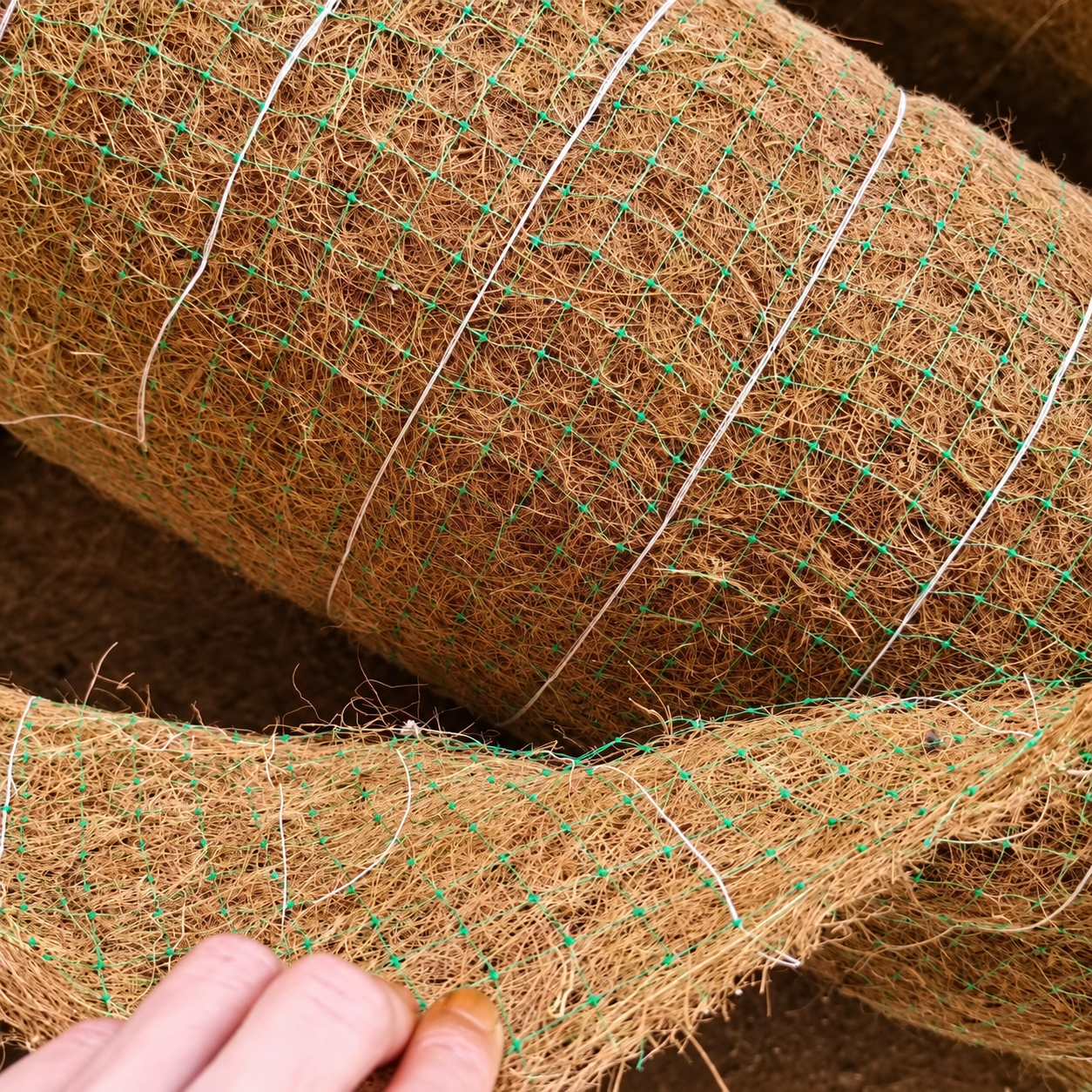
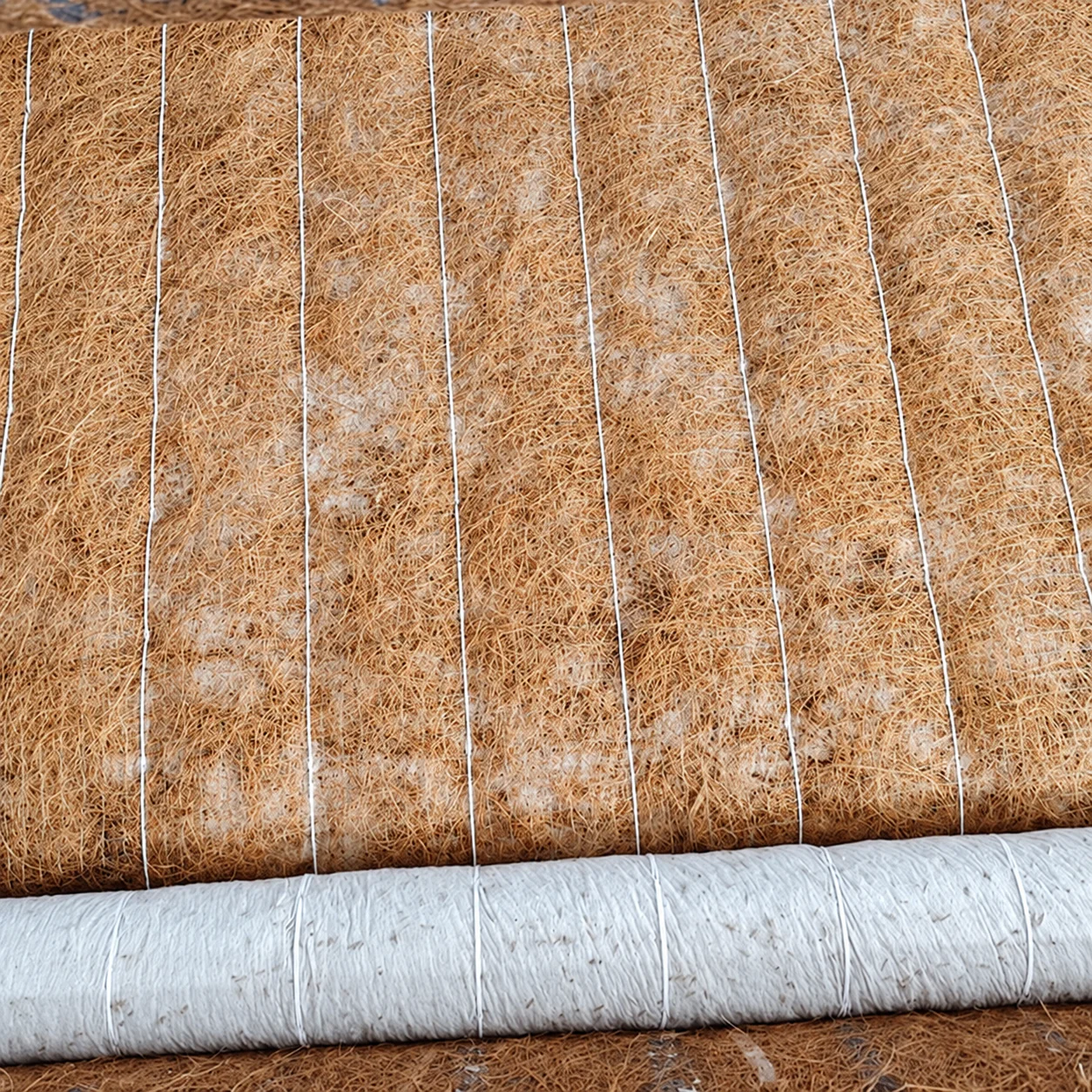
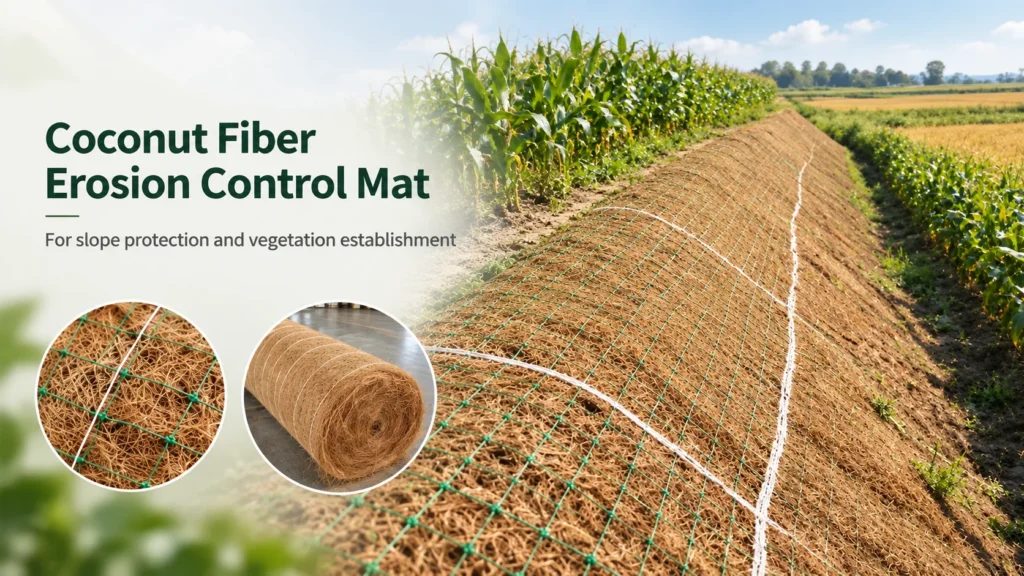
A coconut fiber erosion control mat, commonly called a coir mat, coir erosion mat or coconut matting, is a fibrous covering installed over exposed soil to provide temporary surface protection while vegetation becomes established.
The coconut coir fibers form a rough, interconnected layer between rainfall or shallow surface runoff and the soil below.
This can help reduce direct raindrop impact, limit the movement of loose surface particles and maintain a more protected environment for vegetation establishment.
Unlike structural reinforcement materials, however, a coir erosion control mat is primarily intended for surface erosion management.
It should not automatically be treated as a solution for deep-seated slope instability, bearing-capacity problems or structural soil reinforcement.
A coconut fiber mat works mainly at the soil surface.
After the slope or ground is prepared, the mat is laid over the soil and secured so that the material maintains reasonably close contact with the surface.
Its performance depends not only on the mat itself, but also on surface preparation, anchoring, runoff conditions, vegetation and installation quality.
The coir layer creates a physical buffer between falling rain and exposed soil.
This can reduce the direct disturbance of loose surface particles.
The fibrous structure helps cover the soil while vegetation is still developing.
It is particularly relevant during the period when newly prepared soil remains exposed.
The open structure allows grass and other suitable vegetation to emerge through the material.
As plant cover develops, vegetation gradually takes a larger role in long-term surface erosion control.
Flexible roll material can follow prepared slopes and irregular surfaces when correctly installed and anchored.
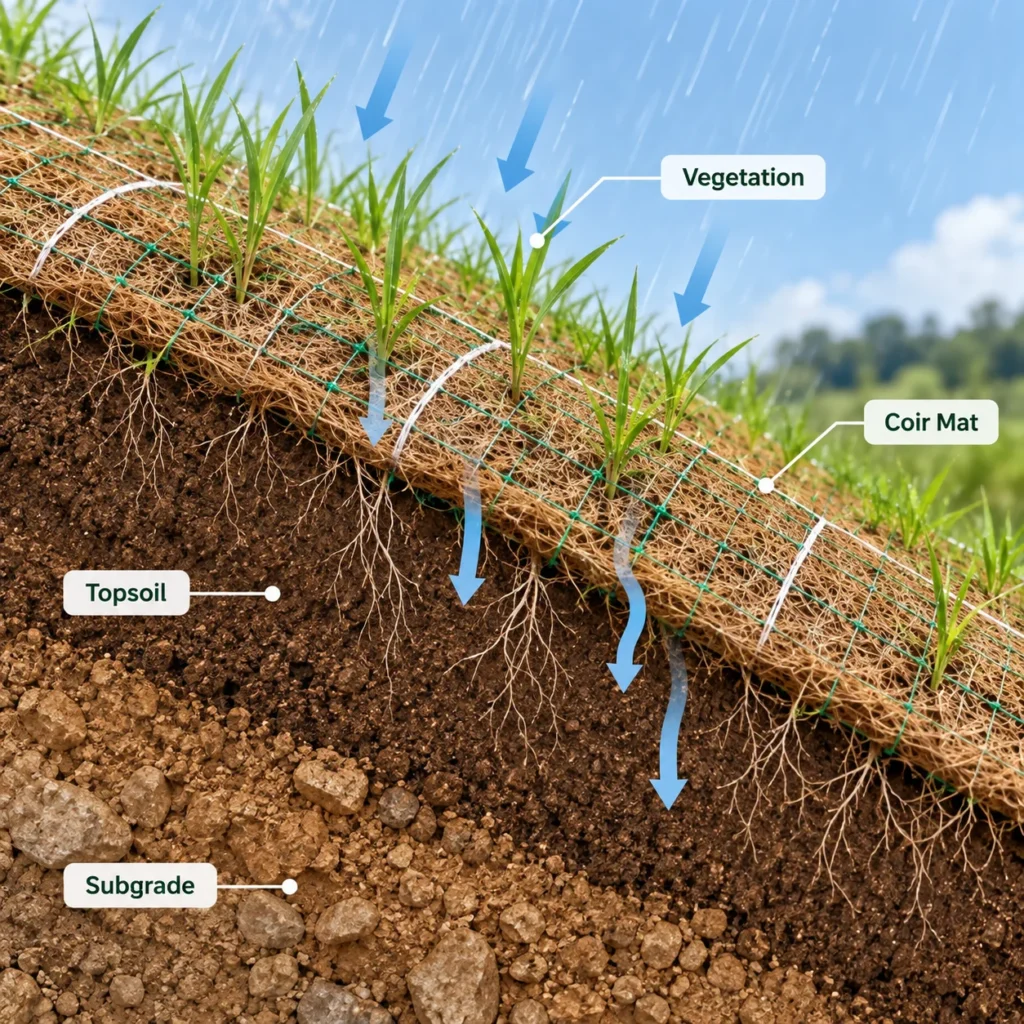
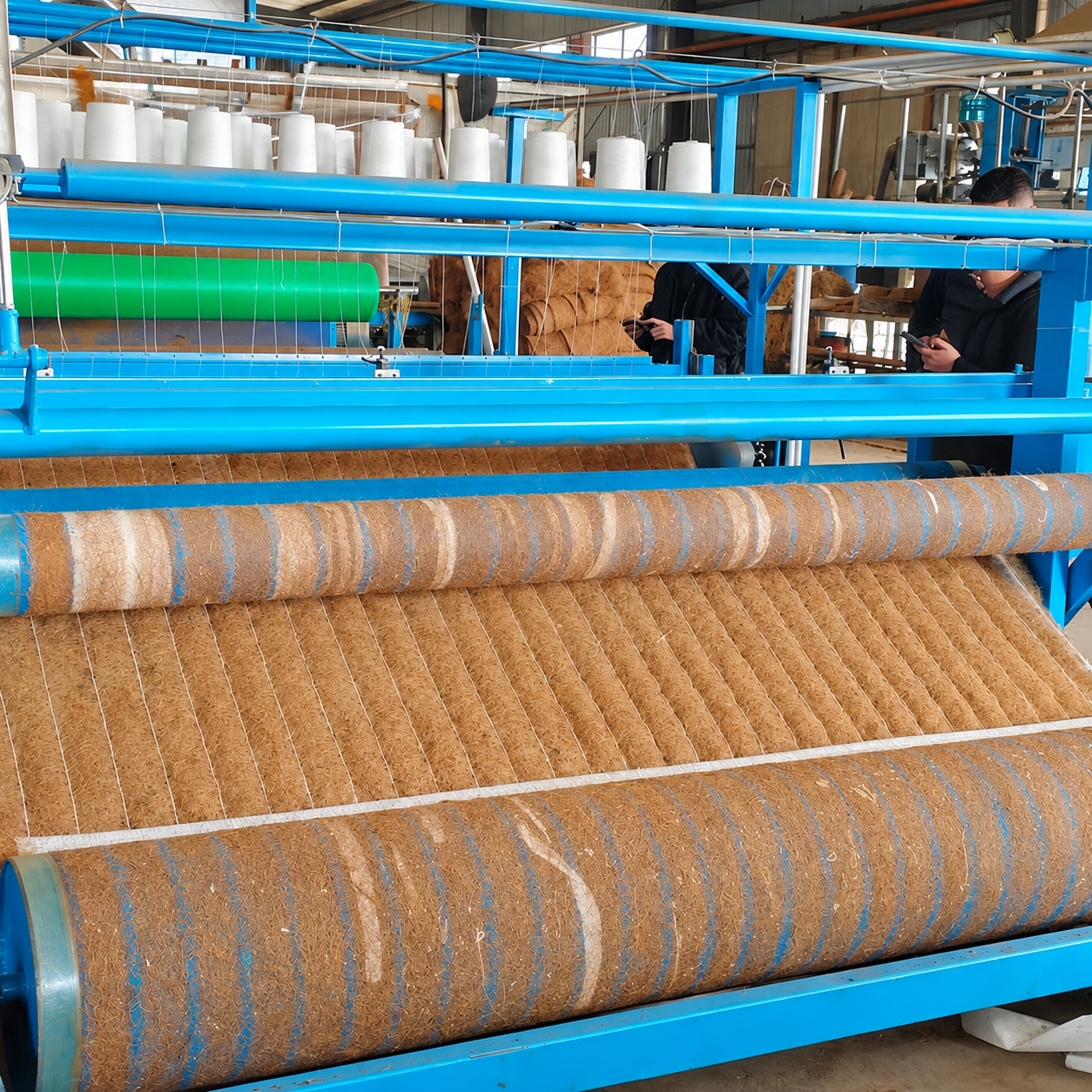
A typical coconut erosion control mat consists primarily of a coir fiber layer, with the fibers held together in a roll-form structure.
Depending on the required product configuration, the mat may also incorporate netting or stitching to maintain integrity during handling and installation.
Vegetation
↓
Coir Fiber Erosion Control Mat
↓
Topsoil / Seeded Soil
↓
Slope or Ground SurfaceThe coconut coir fiber itself is biodegradable.
However, the biodegradability of the complete finished mat depends on the actual netting, stitching or reinforcement materials used.
For projects that specifically require an all-natural or biodegradable configuration, this requirement should be confirmed before production.
Coconut coir forms a coarse, interconnected layer that can protect exposed soil without forming a completely closed barrier over the ground.
The open structure allows vegetation to establish through the mat, making it suitable for projects where plant cover forms part of the long-term erosion-control approach.
Roll-form coir matting can follow prepared ground contours and slopes when properly placed and anchored.
Coir erosion matting is particularly useful where exposed soil requires protection during the period before vegetation becomes established.
Its natural brown fiber structure is suitable for landscaping, ecological restoration and other projects where highly visible synthetic materials may be undesirable.
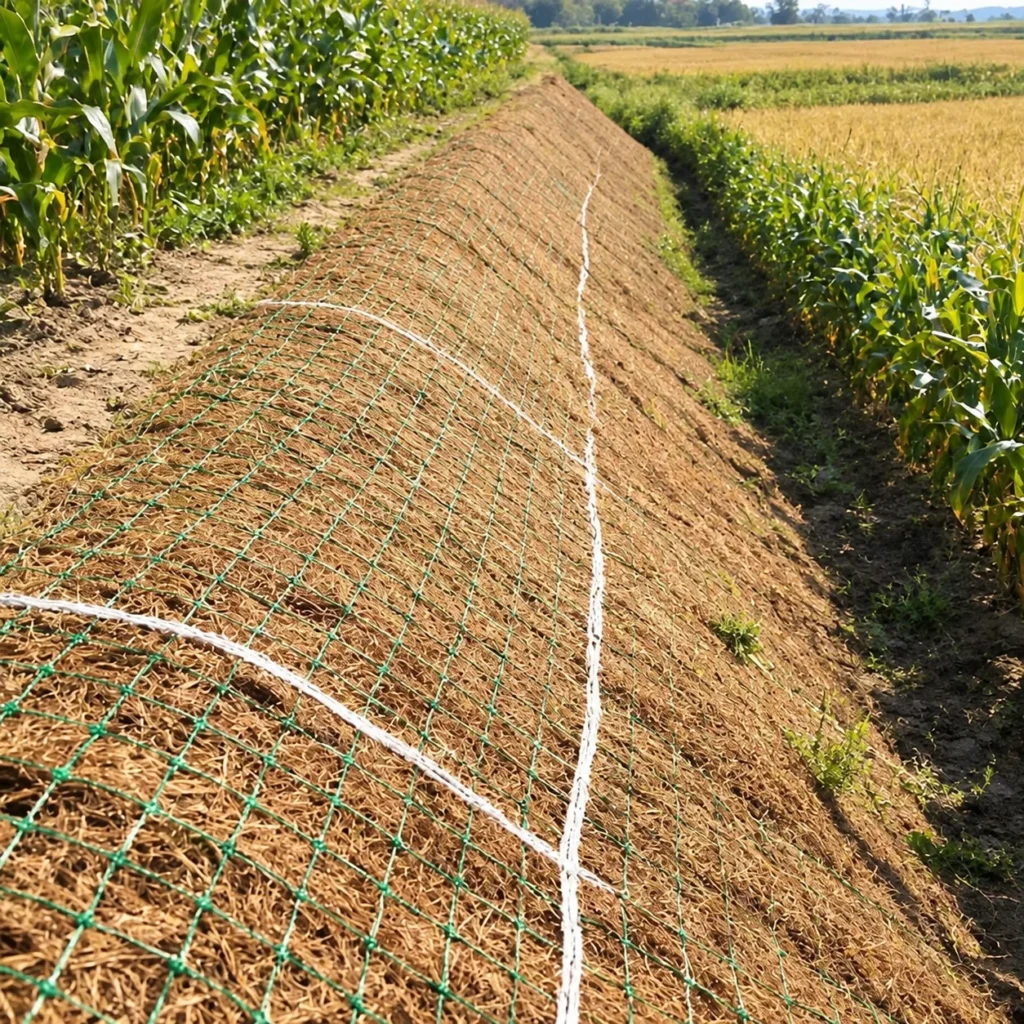
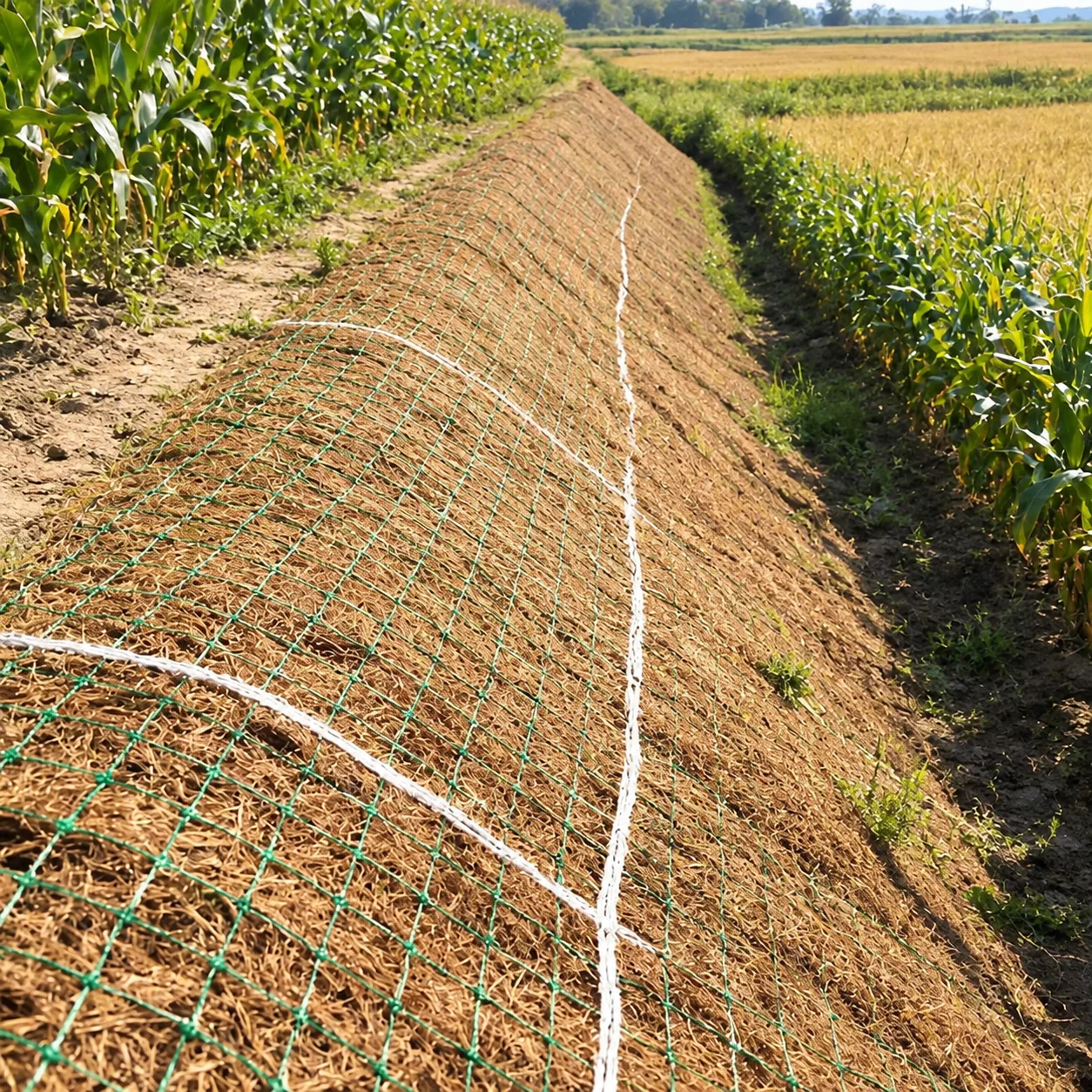
Coconut fiber erosion control mat can be installed over prepared slopes to provide surface protection while grass or other specified vegetation develops.
Common considerations include:
Keyword naturally covered:
coconut fiber mat erosion control / coir mat erosion control
Coir matting can be considered for cut slopes, fill slopes, roadside landscaping and other disturbed soil surfaces where surface erosion and revegetation need to be managed together.
Proper drainage and anchoring remain important, particularly where runoff may become concentrated.
Coconut fiber matting can be used in landscaped areas, parks, embankments and disturbed ground where soil protection is required during vegetation establishment.
The natural appearance can also make coir suitable for visually sensitive landscaping applications.
Coir mats may be considered on selected riverbanks, drainage-side slopes and similar applications.
However, hydraulic conditions must be considered.
A standard coir mat should not automatically be specified for locations exposed to severe, concentrated or high-velocity flow without confirming whether the selected erosion-control system is suitable.
Coconut fiber mats can form part of revegetation and restoration projects where temporary soil-surface protection is required before vegetation becomes established.
A coconut fiber erosion mat may be worth considering when the main requirement is surface erosion control combined with vegetation establishment.
Typical conditions include:
| Project Condition | Coir Mat Suitability |
|---|---|
| Exposed soil requiring vegetation | Good potential application |
| Newly seeded slope | Common application |
| Landscaping slope | Common application |
| Roadside revegetation | Common application |
| Temporary erosion protection | Common application |
| Natural-looking surface treatment | Often suitable |
| Severe structural slope instability | Not a standalone solution |
| High concentrated water flow | Requires further assessment |
| Permanent structural reinforcement | Other systems may be required
|
A coconut fiber mat is primarily a surface erosion-control product.
It should not automatically be used as a substitute for slope stability design, drainage systems or structural reinforcement.
Additional engineering measures may be necessary when a project involves:
If the slope has an underlying stability problem, simply covering the surface with coir matting does not address the deeper failure mechanism.
Water concentrated into channels can create much greater erosive forces than rainfall acting over a broad soil surface.
Riverbanks, channels or drainage structures exposed to significant flow may require a more robust erosion-control system.
Water pressure or persistent saturation can create conditions that cannot be solved by surface matting alone.
Where the project requires tensile reinforcement, confinement or structural stabilization, materials such as geogrid or geocell may be more relevant, depending on the design.
| Property | Available / Reference Information |
|---|---|
| Product | Coconut Fiber Erosion Control Mat |
| Alternative Name | Coir Mat / Coir Erosion Control Mat |
| Primary Material | Coconut Coir Fiber |
| Reference Mass per Unit Area | 360 g/m² |
| Form | Roll |
| Appearance | Natural Brown Fiber |
| Main Function | Surface Erosion Control |
| Vegetation Compatible | Yes, subject to project planting system |
| Netting / Stitching | Confirm according to product configuration |
| Roll Width | Confirm before quotation |
| Roll Length | Confirm before quotation |
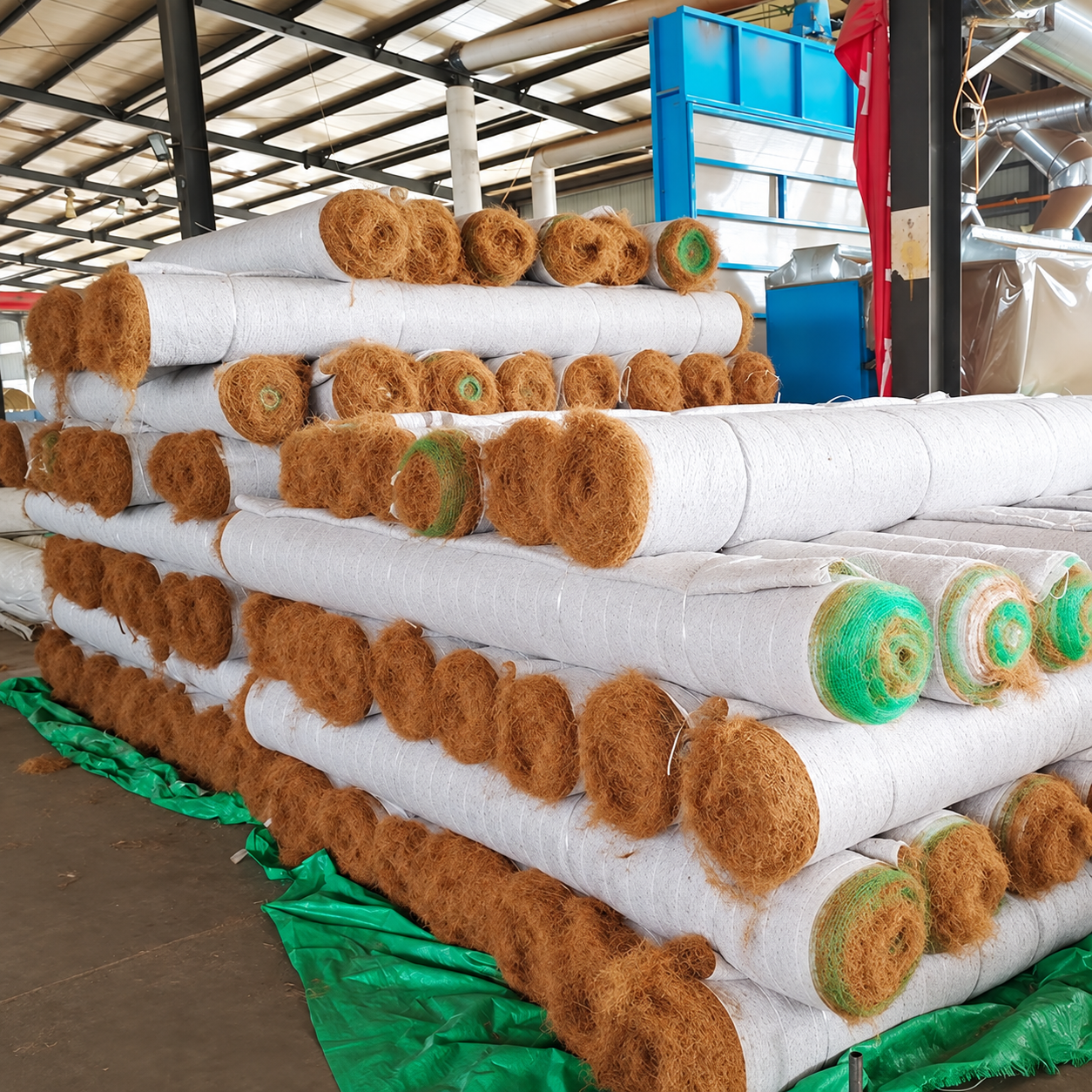
| Packaging | Roll packaging |
| Custom Requirements | Subject to specification review |
Product specifications should be confirmed against the required project specification before order placement. Material properties alone should not be interpreted as a complete engineering design recommendation.
The 360 g/m² coconut fiber erosion control mat is one reference configuration for slope protection, landscaping and revegetation applications.
Rather than choosing a coir mat only by basis weight, the project should also consider:
Please send us:
Required Area + Roll Size + Application + Project Location + Netting Requirement
CTA:
Request 360 g/m² Coir Mat Pricing →
First determine whether the material will be used for:
The erosion environment can differ significantly between these applications.
A lightly exposed landscaped slope and a slope receiving concentrated stormwater runoff should not automatically use the same erosion-control solution.
The more aggressive the erosion environment, the more important it is to consider the complete system rather than only mat weight.
Consider:
These factors affect how well the mat can remain in contact with the soil.
Coir matting is often selected where temporary surface protection is needed while vegetation develops.
The expected vegetation-establishment period should therefore form part of material selection.
Do not look only at the coconut fiber.
Confirm:
If your project specification already defines basis weight, material composition, roll dimensions or other test requirements, send those requirements before quotation.
We can review the requested configuration against available supply options.
| Factor | Coconut Coir Mat | Synthetic Erosion Control Mat |
|---|---|---|
| Main Material | Coconut coir fiber | Polymer-based materials |
| Appearance | Natural | Depends on product |
| Typical Role | Surface protection during revegetation | Temporary or longer-term erosion control depending on design |
| Vegetation | Compatible with vegetation establishment | Depends on structure |
| Degradation | Coir fiber gradually biodegrades | Many synthetic components remain |
| Typical Projects | Slopes, landscaping, restoration | Wider range depending on product type |
| Selection Basis | Site conditions + required protection period | Performance requirement + site conditions |
Neither material is automatically “better.” The appropriate option depends on erosion conditions, required service period, vegetation strategy and project specifications.
Best considered when the project mainly requires surface erosion protection combined with vegetation establishment.
A synthetic three-dimensional erosion-control structure may be considered where a longer-lasting polymeric surface system is required.
Geocell provides cellular confinement and is used where soil or aggregate confinement forms part of the stabilization or erosion-control solution.
These products do not perform exactly the same function.
Selection should depend on the actual erosion mechanism, soil condition, slope geometry, drainage and project design.
Remove large stones, branches, debris and other objects that prevent the mat from maintaining contact with the soil.
Repair significant ruts or irregularities where necessary.
Complete grading, topsoil preparation, seeding or planting work according to the project vegetation plan.
Unroll the coir mat in the required installation direction while keeping it reasonably close to the prepared surface.
Avoid leaving large voids beneath the material.
Secure the mat using appropriate staples, stakes or anchors for the soil and slope conditions.
The exact anchor type and spacing should follow the project or installation specification.
Provide suitable overlap or edge treatment where adjacent rolls meet.
Pay particular attention to edges and locations where runoff could travel beneath the mat.
Check for:
Correct these issues before leaving the site.
Large stones, deep ruts and uneven surfaces can prevent the mat from remaining in contact with the soil.
A mat that moves, lifts or shifts cannot provide the intended surface protection.
Coir matting should not be expected to compensate for uncontrolled concentrated runoff or poor drainage.
Runoff entering beneath the edge of the mat can undermine the installed system.
Higher basis weight alone does not automatically make a mat suitable for every slope or hydraulic condition.
Surface erosion and geotechnical slope instability are different problems.
A coconut fiber erosion control mat is a coir-based material installed over exposed soil to help control surface erosion while vegetation becomes established. It is also commonly called a coir mat, coconut matting or coir erosion control mat.
Coir mat can be suitable for surface erosion-control applications where soil protection and vegetation establishment are required together. Its suitability depends on factors such as slope conditions, runoff, installation, anchoring and the required protection period.
Coconut coir fiber itself is biodegradable. However, the complete product may contain netting or stitching made from other materials. If full-product biodegradability is required, the construction should be confirmed before ordering.
Yes, slope erosion control is a common application of coconut coir matting. However, slope geometry, soil condition, drainage, runoff and anchoring requirements should be considered before selecting a product.
Not by itself. Coir matting mainly addresses surface erosion. A slope affected by deeper instability may require drainage, geotechnical reinforcement, ground improvement or another engineered stabilization system.
360 g/m² describes the nominal mass of the mat per unit area for a particular product configuration. It is one product characteristic and should not be used as the only basis for selecting an erosion-control solution.
It may be suitable for selected riverbank or water-adjacent applications. However, water velocity, hydraulic loading, bank geometry and erosion severity need to be considered. High-flow applications may require a different or combined erosion-control system.
Roll dimensions should be confirmed according to the required product configuration and order. Send us your preferred width, roll length and project quantity for confirmation.
The open fibrous structure is designed to allow vegetation to establish through the mat when soil preparation, seeding, moisture and other growing conditions are suitable.
Please provide your required quantity, GSM, roll dimensions, application, project location, netting requirements and destination. If you already have a technical specification, send it with your inquiry.
Engineering Note: Product selection should be based on project conditions and applicable specifications. The information on this page is intended for general product and procurement reference and does not replace project-specific erosion-control, hydraulic or geotechnical design.