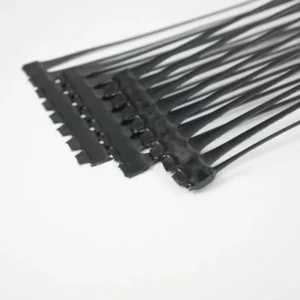
Plastic geogrid is a polymer-based geosynthetic material widely used for soil reinforcement and ground stabilization in civil engineering and infrastructure projects. Manufactured primarily from polypropylene (PP) or high-density polyethylene (HDPE), plastic geogrids are designed to improve the mechanical performance of soil by enhancing load distribution, increasing bearing capacity, and reducing long-term deformation.
Due to their durability, lightweight structure, and resistance to chemical and biological degradation, plastic geogrids are commonly applied in road construction, railway subgrades, retaining walls, embankments, and slope protection systems.
Plastic geogrid is a type of geosynthetic product formed into a grid-like structure with regularly spaced apertures. These apertures allow soil or aggregate particles to interlock with the grid, creating a composite system that improves overall soil stability.
When subjected to external loads, plastic geogrids provide tensile reinforcement that restrains lateral soil movement and distributes stress more evenly across the foundation. This reinforcement mechanism helps reduce rutting, settlement, and shear failure, making plastic geogrids an effective solution for weak or soft soil conditions.
Plastic geogrids are typically produced through extrusion, stretching, or molding processes, resulting in high tensile strength and controlled elongation characteristics suitable for long-term engineering applications.

Uniaxial plastic geogrids are designed to provide high tensile strength in one primary direction. They are commonly used in applications where loads are predominantly applied in a single direction.
Typical applications include:
Retaining walls
Steep slopes
Embankment reinforcement
Uniaxial plastic geogrids offer excellent creep resistance and long-term stability, making them suitable for structural reinforcement projects.

Biaxial plastic geogrids provide tensile strength in two perpendicular directions. This type is widely used for load distribution and soil stabilization in planar applications.
Typical applications include:
Road and highway base reinforcement
Railway subgrades
Industrial yards and parking areas
Biaxial plastic geogrids improve load-bearing capacity and reduce differential settlement under repeated traffic loads.
Plastic geogrids are extensively used across various civil engineering and infrastructure projects, including:
Plastic geogrids enhance pavement performance by reinforcing the base and subbase layers, reducing rutting, and extending service life.
In railway applications, plastic geogrids help stabilize ballast and subgrade layers, improving track stability under dynamic loading.
Plastic geogrids provide tensile reinforcement that allows the construction of stable, reinforced soil structures with reduced earth pressure.
By reinforcing soil masses, plastic geogrids help prevent erosion and slope failure in embankments and cut slopes.
Compared with fiberglass or steel geogrids, plastic geogrids offer several advantages:
Corrosion resistance: Suitable for chemically aggressive environments
Lightweight: Easy handling and installation
Durability: Long service life with minimal maintenance
Cost-effectiveness: Lower overall project costs in many applications
Plastic geogrids are particularly suitable for large-scale infrastructure projects where long-term performance and installation efficiency are critical.
Key technical parameters of plastic geogrids typically include:
Tensile strength
Elongation at break
Aperture size
Junction efficiency
Creep resistance
Plastic geogrids are commonly tested and evaluated according to international standards such as ASTM and ISO to ensure consistent performance and quality in engineering applications.
Plastic geogrids are installed by placing them directly on prepared subgrades or base layers, followed by proper tensioning and overlap as required by design specifications. Aggregate or soil is then placed and compacted over the geogrid to achieve effective interlocking.
Correct installation is essential to ensure optimal reinforcement performance and long-term stability.
Selecting the appropriate plastic geogrid depends on several factors:
Soil conditions
Load requirements
Project type and design life
Engineering evaluation is recommended to determine the most suitable geogrid type and specification for each project.
What is plastic geogrid used for?
Plastic geogrid is used for soil reinforcement, load distribution, and ground stabilization in civil engineering projects.
Is plastic geogrid suitable for road construction?
Yes, plastic geogrids are widely used in road and highway base reinforcement to improve pavement performance.
What is the difference between uniaxial and biaxial plastic geogrid?
Uniaxial geogrids provide strength in one direction, while biaxial geogrids provide strength in two directions.
How long does plastic geogrid last?
Plastic geogrids are designed for long-term use and can last for decades under proper installation and design conditions.