Short Answer
For long-term reinforcement projects like retaining walls or heavy-duty roads, PET geogrids are often preferred due to their low creep and high durability.
HDPE geogrids can be sufficient for temporary roads or low-load applications and are generally more economical upfront.
What Is PET Geogrid?
PET geogrid is a polyester-based geosynthetic material designed for soil reinforcement.
It works by:
- Mechanically interlocking aggregate particles
- Providing lateral restraint to limit movement under load
- Distributing traffic loads over a wider area
Key Advantage: Long-term performance under sustained loads, making it ideal for weak subgrades and high-load applications.
Internal Link: PET Geogrid Product
What Is HDPE Geogrid?
HDPE geogrid is a high-density polyethylene geosynthetic commonly used for:
- Temporary roads
- Gravel stabilization
- Lightweight soil reinforcement
It offers good tensile strength and UV resistance but exhibits higher long-term creep compared to PET.
PET vs HDPE Geogrid: Material Comparison
| Feature | PET Geogrid | HDPE Geogrid |
|---|---|---|
| Material | Polyester | Polyethylene |
| Long-Term Creep | Very Low | Moderate |
| Stiffness | High | Medium |
| Retaining Wall | Excellent | Limited |
| Road Reinforcement | Excellent | Good |
| UV Resistance | Good | Excellent |
| Cost | Higher | Lower |
Applications
Roads
- Reinforcing weak subgrade
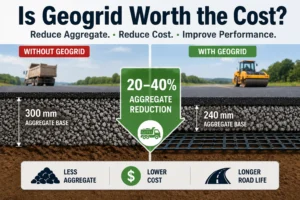
- Reducing aggregate thickness
- Improving load distribution
Internal Link: Geogrid for Road Construction
Retaining Walls
- Soil reinforcement layers
- Preventing wall bulging
Slopes
- Erosion protection
- Structural stability
Strength Selection for PET Geogrid
Key factors for optimal performance:
- CBR of subgrade
- Traffic loading
- 2% strain tensile stiffness
- Aggregate aperture compatibility
Rule of thumb: Aggregate D50 ≈ 0.5 × geogrid aperture
What Strength Geogrid Do I Need?
H2: Lifespan and Durability
PET geogrids can last for decades when properly installed:
- Buried to protect from UV
- Compatible with soil chemistry
- Designed for sustained load
Internal Link: How Long Does PET Geogrid Last?
Cost Comparison and Decision
PET geogrids generally have higher upfront cost than HDPE but often provide better life-cycle value.
Example Calculation:
1 km road, 7 m width, 300 mm aggregate:
- Without PET: 2100 m³ aggregate → $73,500
- With PET (20% reduction): 1680 m³ aggregate → $58,800
- Aggregate saved: 420 m³ → $14,700
In many projects, the aggregate savings plus reduced maintenance offset the cost of PET geogrid.
When to Choose PET vs HDPE
Choose PET:
- Retaining walls
- Steep slopes
- Long-term projects
- Heavy or sustained load
Choose HDPE:
- Temporary roads
- Low-load projects
- Tight budget