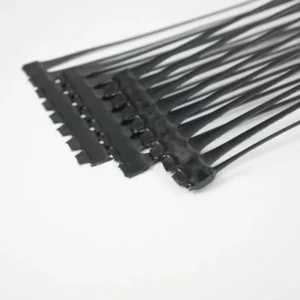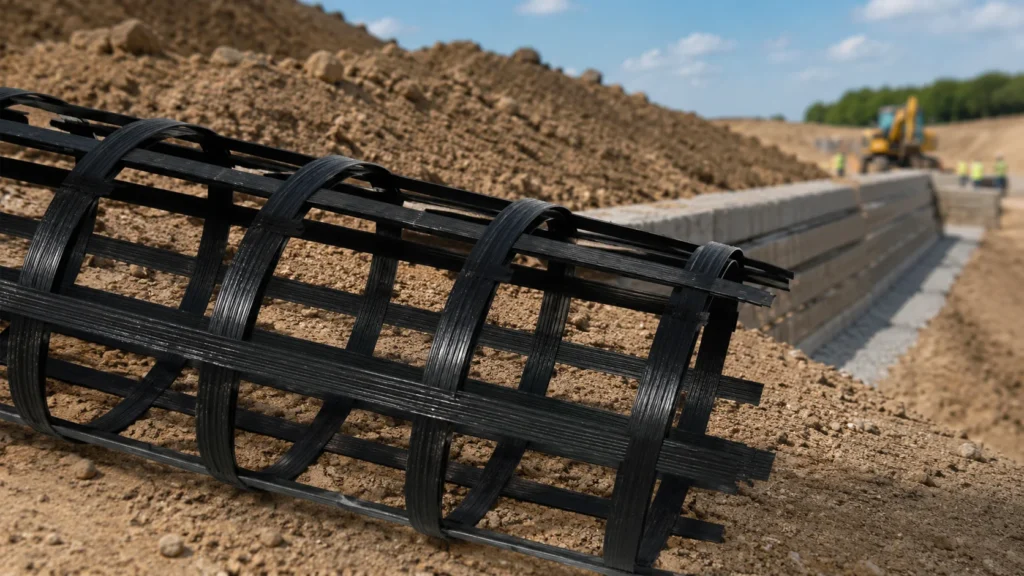
Engineered for heavy-duty civil infrastructure, GeoSynSource PET Geogrid is a high-performance polyester geosynthetic manufactured using high-tenacity warp-knitted or welded structures. As a trusted geosynthetic supplier, GeoSynSource delivers premium PET geogrids that offer high long-term design strength, minimal creep strain, and excellent chemical resistance. Ideal for MSE retaining walls, slope stabilization, and soft ground improvement, GeoSynSource polyester geogrids are fully tested to ASTM standards and available with factory-direct technical documentation, BOQ support, and worldwide delivery.
GeoSynSource supplies warp-knitted PET geogrid and welded PET geogrid with available nominal tensile-strength grades ranging from approximately 25 to 200 kN/m, depending on product structure and specification.
Warp-Knitted & Welded Options
25–200 kN/m Product Grades
Low-Strain Tensile Data Available
TDS & Project Supply Support
[Request Technical Data & Quote]
PET geogrid is a geosynthetic reinforcement product manufactured using polyester-based tensile elements arranged into an open grid structure.
Its primary role in reinforced-soil applications is to provide tensile reinforcement within the soil mass.
Depending on the required project function, PET geogrid may be considered for:
| Property | Available Product Information |
|---|---|
| Product | PET Geogrid / Polyester Geogrid |
| Main Material | Polyester (PET) |
| Product Structures | Warp-knitted / Welded |
| Nominal Tensile Strength | Approx. 25–200 kN/m depending on type |
| Warp-Knitted Coating | PVC-coated according to supplied catalog |
| Primary Function | Soil reinforcement |
| Main Applications | Retaining walls, slopes, embankments, reinforced soil |
| Low-Strain Data | 2% and 5% strain values available |
| Technical Documents | TDS / Test Data / COA upon request |
| Supply Type | Project and bulk supply |
Engineering Note: Nominal tensile strength is a product test property, not automatically an allowable design strength. Final reinforcement selection should also consider soil properties, required long-term strength, connection conditions, installation damage, drainage and the applicable design method.
Warp-knitted PET geogrid is manufactured from high-strength polyester industrial yarns arranged into a grid structure and finished with a protective coating.
According to the supplied product catalog, the warp-knitted product uses a PVC coating and is available in multiple equal nominal tensile-strength grades.
It is commonly considered for reinforced-soil systems where flexible high-strength polyester reinforcement is required.
30-30 / 50-50 / 80-80 / 100-100 / 150-150 / 200-200 kN/m
3.9 m × 50 m / 100 m
Custom dimensions are available subject to order confirmation.
Welded geogrid is manufactured from high-strength polymer strips joined at intersections to form a regular grid structure.
Your supplied catalog lists this welded product family in PET / PP material options. For this PET product page, the relevant configuration is the welded PET geogrid.
Available welded-product strengths range from approximately:
25–150 kN/m
The welded structure also provides measurable connection-point performance in addition to the strip tensile properties.
Material Note: PP welded geogrid should be treated as a separate material option rather than as a synonym for PET geogrid.
| Grade | Nominal Tensile Strength* | Tensile Strength at 2% Strain | Tensile Strength at 5% Strain |
|---|---|---|---|
| 30-30 | ≥30 kN/m | ≥5.4 kN/m | ≥10.8 kN/m |
| 50-50 | ≥50 kN/m | ≥9 kN/m | ≥18 kN/m |
| 80-80 | ≥80 kN/m | ≥14.4 kN/m | ≥28.8 kN/m |
| 100-100 | ≥100 kN/m | ≥18 kN/m | ≥36 kN/m |
| 150-150 | ≥150 kN/m | ≥27 kN/m | ≥54 kN/m |
| 200-200 | ≥200 kN/m | ≥36 kN/m | ≥72 kN/m |
Additional supplied properties:
| Property | Catalog Data |
|---|---|
| Ultimate Tensile Elongation | ≤13% |
| UV Resistance Retention Rate | ≥80% |
| Coating | PVC |
| Typical Roll Width | 3.9 m |
| Typical Roll Length | 50 / 100 m |
*The catalog identifies the nominal tensile strength in vertical and horizontal directions.
The values above reproduce the supplied product catalog data. Before using them in a formal engineering specification, confirm the current TDS, test method, reporting basis and product grade.
| Grade | Standard Breaking Strength | Force at 2% Elongation | Force at 5% Elongation |
|---|---|---|---|
| 25 | 25 kN/m | 10 kN/m | 15 kN/m |
| 40 | 40 kN/m | 20 kN/m | 25 kN/m |
| 60 | 60 kN/m | 22 kN/m | 40 kN/m |
| 80 | 80 kN/m | 35 kN/m | 55 kN/m |
| 100 | 100 kN/m | 55 kN/m | 65 kN/m |
| 125 | 125 kN/m | 60 kN/m | 90 kN/m |
| 150 | 150 kN/m | 85 kN/m | 100 kN/m |
Additional supplied data:
| Property | Catalog Data |
|---|---|
| Nominal Tensile Elongation | ≤13% |
| Ultimate Peel Force of Connection Point | 30 N |
| Product Structure | Welded grid |
| Material Options in Product Family | PET / PP |
Note: The formal test method and complete reporting basis for these catalog values should be confirmed in the current product TDS before they are used as project specification values.
PET geogrid is available in a wide range of nominal tensile-strength grades, allowing the product specification to be matched to different reinforced-soil requirements.
However, higher ultimate tensile strength alone does not automatically mean that one grade will perform better in every structure.
The supplied catalog includes tensile values at 2% and 5% strain, providing additional information beyond ultimate breaking strength.
These properties can be useful when comparing product tensile response, provided the same test method and reporting basis are used.
Warp-knitted PET geogrid provides a flexible grid structure suitable for installation within reinforced fill systems.
Welded PET geogrid provides a different manufactured grid structure with defined connection points.
The appropriate choice depends on the project specification rather than on the product name alone.
In reinforced-soil applications, performance depends on interaction between the geogrid and the surrounding fill.
Important factors include:
PET geogrid is commonly considered as reinforcement within mechanically stabilized or reinforced-soil retaining wall systems where the product properties meet the project specification.
A retaining wall should be evaluated as a complete system involving:
PET geogrid selection for a retaining wall should not be based on wall height or nominal tensile strength alone.
[Read the Geogrid Retaining Wall Guide]
PET geogrid can carry tensile forces within reinforced fill and is commonly used in reinforced-soil applications requiring a geosynthetic reinforcement layer.
This is the most important semantic home for:
PET geogrid for soil reinforcement
and:
polyester geogrid for reinforced soil
PET geogrid can form part of an engineered reinforced-slope system.
Final reinforcement requirements depend on:
Polyester geogrid may be used in embankment reinforcement systems where tensile reinforcement is required within the soil structure.
Selection should consider foundation conditions, fill properties, deformation requirements and project-specific design criteria.
The supplied catalog also identifies reinforcement of soft-soil foundations as an application.
In these projects, PET geogrid may contribute tensile reinforcement, but settlement and bearing performance should still be evaluated as part of the complete foundation and ground-improvement system.
Your supplied product documentation lists roads, railways and municipal infrastructure as application areas.
For the page, I would phrase this carefully:
PET geogrid may be used in selected road and railway reinforcement systems where tensile reinforcement is the required function.
Do not rewrite this section around:
soil stabilization geogrid
just because that keyword has Volume 170.
Your knowledge base clearly distinguishes soil reinforcement from granular-layer stabilization.
| Function | Reinforcement | Stabilization |
|---|---|---|
| Primary Mechanism | Geogrid carries tensile forces within a soil structure | Geogrid interacts with granular layers to improve service performance |
| Typical Projects | Retaining walls, reinforced slopes, embankments | Road base, working platforms, granular foundation layers |
| Main Design Focus | Tensile strength, long-term behavior, soil interaction, connection | Aggregate confinement, rutting, layer behavior, subgrade |
| PET Product Page Focus | Primary | Project-specific / secondary |
PET geogrid is particularly relevant to reinforced-soil applications. A search for “soil stabilization geogrid” does not mean that every PET geogrid should automatically be selected for granular base stabilization.
First confirm whether the project requires soil reinforcement, granular-layer stabilization or another function.
Clarify whether the specification refers to:
These are not interchangeable values.
Confirm whether the specification requires:
Reinforcement performance depends on interaction with the actual fill material and installation conditions.
For long-term reinforced-soil structures, review appropriate creep, durability and reduction-factor information rather than relying on a generic service-life claim.
Your internal technical library specifically notes that PET long-term behavior depends on product-specific properties, coating, chemical environment and relevant creep/durability evidence.
For retaining-wall systems, connection performance can be as important as nominal geogrid tensile strength.
| Factor | Warp-Knitted PET Geogrid | Welded PET Geogrid |
|---|---|---|
| Main Structure | Polyester yarn grid | Welded polymer strip grid |
| Catalog Strength Range | 30–200 kN/m | 25–150 kN/m |
| Low-Strain Data | 2% / 5% tensile values | 2% / 5% tensile values |
| Connection Property | Grid/yarn structure | Connection-point peel data available |
| Coating | PVC according to catalog | Confirm selected product |
| Selection Basis | Project specification | Project specification |
Choose the structure specified for the project and supported by the relevant product test data. The two products should not be treated as interchangeable simply because they have similar nominal tensile strengths.
For project evaluation and supplier comparison, GeoSynSource can provide technical product documentation according to the selected grade and order requirements.
Relevant information may include:
When comparing PET geogrid suppliers, compare values using the same test method, direction and reporting basis. A meaningful comparison requires more than one headline tensile-strength number.
[Request PET Geogrid TDS & Test Data]
Typical catalog roll size:
3.9 m × 50 m / 100 m
Additional roll requirements can be confirmed according to the order.
Roll dimensions should be confirmed according to the selected welded PET grade and current factory specification.
PET geogrid pricing depends on more than the product name.
Key quotation factors include:
For an accurate project quotation, send the required product grade, strength basis, roll size, quantity and destination.
[Request PET Geogrid Price & Quote]
GeoSynSource supplies polyester geogrid for engineering projects, distributors and bulk procurement requirements.
Warp-knitted grades are available up to 200 kN/m in the supplied catalog, while welded grades are available up to 150 kN/m.
Product-level tensile, low-strain and other available technical data can be provided for procurement review.
Buyers can send the required strength basis, project specification or BOQ before quotation.
Samples can be arranged according to product and purchasing requirements.
Roll packaging and international shipment support can be arranged for project and bulk orders.
For a useful quotation, please provide:
Have a Project Specification or BOQ?
[Send Your PET Geogrid Requirements]
Learn which factors affect geogrid reinforcement selection in retaining-wall systems.
[Read the Retaining Wall Geogrid Guide]
→ geogrid-retaining-wall-ultimate-guide
Understand soil, geometry, groundwater and reinforcement considerations for reinforced slopes.
[Read the Slope Reinforcement Guide]
Compare geogrid applications for reinforced soil, road construction, slopes and other civil engineering systems.
[Explore Geogrid Applications]
Understand what affects geogrid pricing before comparing product quotations.
[Read the Geogrid Cost Guide]
PET geogrid is a geosynthetic reinforcement product made using polyester reinforcement elements arranged into an open grid structure. It is commonly used in reinforced-soil applications such as retaining walls, slopes and embankments.
Yes. PET stands for polyethylene terephthalate, a polyester polymer. In this product category, PET geogrid and polyester geogrid commonly refer to the same material family.
Based on the supplied catalog, warp-knitted PET geogrid is available from 30 to 200 kN/m, while welded PET geogrid is available from approximately 25 to 150 kN/m.
Final availability should be confirmed against the selected product grade and current TDS.
No. PET describes the polymer material, not a universal reinforcement geometry.
PET geogrids can be manufactured using different grid structures. Your current catalog includes warp-knitted and welded PET geogrids.
Yes, PET geogrid is commonly used as reinforcement in reinforced-soil retaining-wall systems when the selected product properties, fill interaction and connection requirements meet the project design.
The required grade, reinforcement length and spacing depend on the complete wall design.
Warp-knitted PET geogrid uses polyester yarns formed into a grid and coated, while welded PET geogrid uses high-strength strips joined at grid intersections.
They have different structures and should be compared using the relevant product test data and project requirements.
No.
Ultimate tensile strength is one product property. Project performance may also depend on low-strain response, long-term strength, soil interaction, connection performance, installation damage and the complete reinforced-soil system.
Avoid using a single fixed lifetime for all PET geogrids.
Long-term performance depends on the specific PET product, creep behavior, coating, installation damage, temperature, chemical environment and the design method used for the project.
Send the required product structure, tensile-strength grade, roll dimensions, quantity and destination. If the project includes a specification or BOQ, provide it so the quotation can be matched to the required product data.
Need PET geogrid or polyester geogrid for a retaining wall, reinforced slope, embankment or other reinforced-soil project?
Send us your:
application, required strength, product structure, roll dimensions, quantity and destination.
GeoSynSource can provide available PET geogrid grades, technical documentation and quotation support for procurement review.
Product supply recommendations are based on the information provided for procurement review. Final structural reinforcement selection should follow the applicable project specification and engineering design.