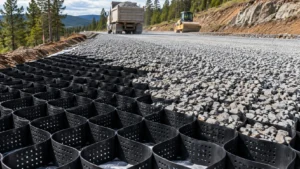
Short Answer
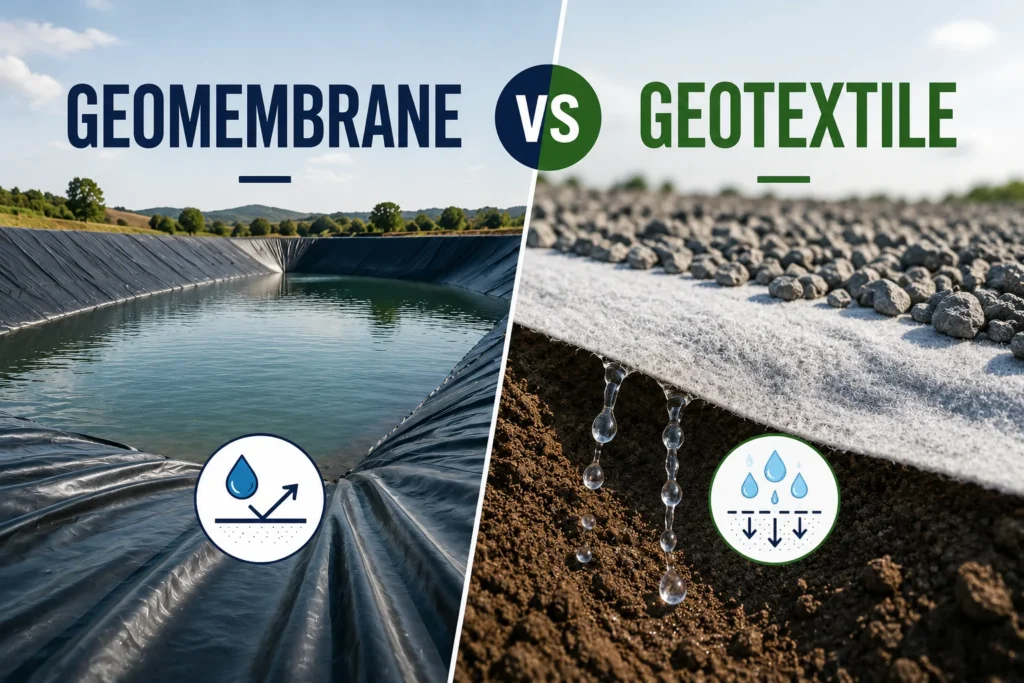
The main difference between geomembrane and geotextile is how they manage water and soil. A geomembrane is a low-permeability barrier used for containment and seepage control, while a geotextile is a permeable fabric used for filtration, separation, drainage, protection, and some reinforcement applications.
Choose a geomembrane when the project needs to retain water or contain liquids and contaminants. Choose a geotextile when water must pass through while soil particles are filtered, separated, or protected. In many ponds, landfills, wastewater systems, and other liner applications, both are used together: the geomembrane provides the barrier, while the geotextile protects the liner or supports filtration and drainage.
Key Takeaways
- Geomembrane = barrier. It is used to stop liquid, gas, or contaminant migration.
- Geotextile = permeable fabric. It is used to filter, separate, drain, protect, or reinforce soil.
- Geotextile is not a waterproof liner. It cannot replace geomembrane when leakage control is required.
- Geomembrane is not a filtration fabric. It cannot replace geotextile when drainage or soil filtration is required.
- They are often used together. A geotextile can protect a geomembrane from puncture, while the geomembrane provides the waterproof barrier.
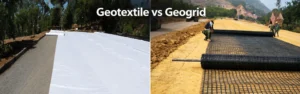
Geomembrane vs Geotextile: Key Differences
Quick rule: use geomembrane for containment, geotextile for filtration, separation, drainage or protection, and use both when a liner system needs both containment and protection.
| Factor | Geomembrane | Geotextile |
|---|---|---|
| Main function | Barrier / containment | Filtration / separation / drainage / protection |
| Permeability | Low permeability or impermeable | Permeable |
| Water movement | Blocks water or liquid movement | Allows water to pass through |
| Material form | Continuous polymer sheet | Woven or nonwoven fabric |
| Common materials | HDPE, LLDPE, PVC, EPDM, PP | PP, PET |
| Typical use | Pond liners, landfill liners, wastewater lagoons, mining ponds, containment systems | Roads, drainage systems, erosion control, soil separation, retaining walls |
| Can it filter water? | No | Yes |
| Can it stop leakage? | Yes | No |
| Often used with | Geotextile protection layer | Geomembrane liner |
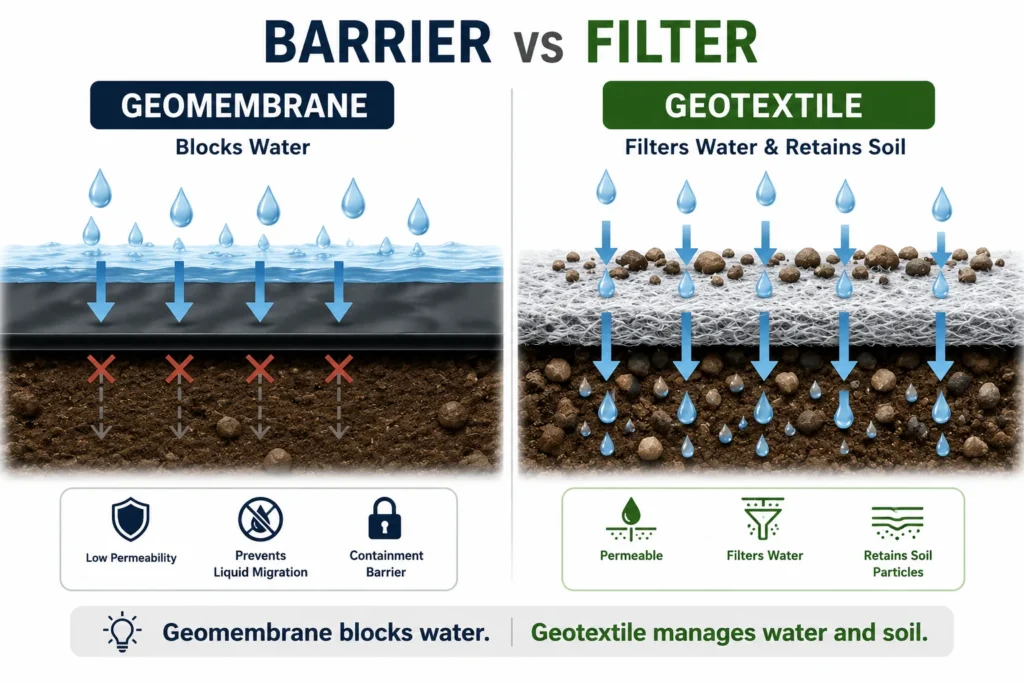
The easiest way to remember the difference is:
Geomembrane blocks water. Geotextile manages water and soil.
Difference 1: Permeability
Permeability is the biggest difference between geomembrane and geotextile.
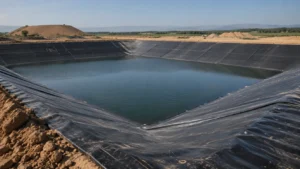
A geomembrane is designed to be impermeable or very low-permeability. Its job is to stop water, wastewater, leachate, chemicals, or gases from passing through.
A geotextile is designed to be permeable. It allows water to pass through while helping retain soil particles, separate layers, or support drainage performance.
For example, if you are building a pond and need to stop water from leaking into the ground, you need a geomembrane. If you are building a drainage layer behind a retaining wall, you need a geotextile.
Competitor pages consistently identify this as the core difference: geomembrane is impermeable, while geotextile is permeable.
Difference 2: Main Function
Geomembrane and geotextile are both geosynthetic materials, but their functions are different.
Geomembrane Functions
A geomembrane is mainly used for:
- Waterproofing
- Anti-seepage
- Liquid containment
- Gas barrier
- Chemical containment
- Environmental protection
Its purpose is to create a barrier.
Geotextile Functions
A geotextile is mainly used for:
- Filtration
- Drainage
- Separation
- Protection
- Reinforcement
- Erosion control
Its purpose is to improve soil-water interaction and protect or stabilize soil structures.
Western Liner also separates the two by function: geomembranes are used for leak prevention and containment, while geotextiles are used for reinforcement, erosion prevention, and drainage systems.
Difference 3: Material Structure
A geomembrane is a continuous polymer sheet. It has no open fiber structure. This is why it can work as a waterproof or containment barrier.
A geotextile is a fabric-like material. It may be woven like a textile or made as a nonwoven felt-like sheet. Its fiber structure creates openings that allow water to pass while controlling soil particles.
This structure difference explains why the two materials cannot simply replace each other.
A solid sheet can block leakage, but it cannot filter water.
A permeable fabric can filter water, but it cannot stop leakage.
Difference 4: Applications
Geomembrane and geotextile are used in different project situations.
Geomembrane Applications
Use geomembrane for:
- Farm ponds
- Fish ponds
- Landfill liners
- Wastewater lagoons
- Mining leach pads
- Tailings ponds
- Canal lining
- Reservoir lining
- Secondary containment
- Industrial wastewater containment
Geotextile Applications
Use geotextile for:
- Road base separation
- Drainage systems
- Retaining wall filtration
- Erosion control under riprap
- Slope protection
- Subgrade stabilization
- Landscaping separation
- Geomembrane cushioning
- Soil filtration
Geomembranes are used when containment failure could cause leakage or contamination. Geotextiles are used when the project needs soil separation, water flow, filtration, or protection.
Difference 5: Installation Method
Geomembrane installation usually requires more precision because the liner must remain watertight. Large geomembrane panels are often welded together in the field using hot wedge welding or extrusion welding, depending on the material and project requirements.
A poor seam, puncture, or wrinkle can affect containment performance.
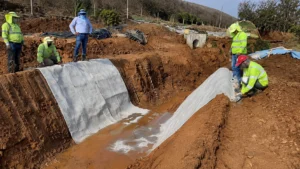
Geotextile installation is usually simpler. Rolls are placed over the prepared surface with proper overlap, then covered with soil, aggregate, riprap, or another geosynthetic layer. The main concerns are correct placement, overlap, protection from damage, and avoiding contamination of the fabric.
In real projects, geotextile is often easier to install, but geomembrane requires more quality control because its barrier function depends on seam integrity and puncture resistance.
What Is a Geomembrane?
A geomembrane is a synthetic liner or barrier made from polymer materials. Its main purpose is to prevent the movement of liquids, gases, or contaminants.
Geomembranes are commonly used in:
- Pond liners
- Landfill liners
- Wastewater lagoons
- Mining ponds
- Canal lining
- Aquaculture ponds
- Secondary containment
- Industrial wastewater containment
- Environmental protection projects
Common geomembrane materials include:
- HDPE
- LLDPE
- PVC
- EPDM
- PP
Among these, HDPE geomembrane is widely used for large-scale containment projects because of its chemical resistance, durability, and low permeability.
If you need to understand how HDPE relates to geomembrane liners, read our HDPE and geomembrane comparison guide
What Is a Geotextile?
To choose the correct fabric layer, it is helpful to understand the three types of geotextile fabric: woven, nonwoven, and knitted.
A geotextile is a permeable synthetic fabric used with soil, rock, aggregate, or other geotechnical materials. Unlike geomembrane, geotextile is designed to allow water to pass through while controlling soil movement.
Geotextiles are commonly used for:
- Filtration
- Drainage
- Soil separation
- Erosion control
- Road base stabilization
- Retaining wall drainage
- Slope protection
- Geomembrane protection
- Subgrade improvement
Geotextiles are usually made from polypropylene or polyester and can be produced as woven or nonwoven fabrics. Woven geotextiles are often used where tensile strength and stabilization are important, while nonwoven geotextiles are commonly used for filtration, drainage, cushioning, and protection.
For a deeper explanation of filtration, separation, and drainage functions, see our guide on what geotextile is used for
Can Geotextile Replace Geomembrane?
No. Geotextile cannot replace geomembrane when waterproofing, seepage control, or liquid containment is required.
Even a thick nonwoven geotextile is still permeable. Water will pass through it. This means geotextile should not be used as the main pond liner, landfill liner, canal liner, or wastewater containment barrier.
Use geotextile when you need filtration, drainage, soil separation, reinforcement, or liner protection.
Use geomembrane when you need to stop leakage.
Can Geomembrane Replace Geotextile?
No. Geomembrane cannot replace geotextile when filtration, drainage, or soil separation is required.
A geomembrane blocks water. It does not allow water to pass through and does not function as a filter. If installed where drainage is required, it may trap water or create hydrostatic pressure unless the drainage system is properly designed.
Use geomembrane for containment.
Use geotextile for water flow, soil retention, and drainage performance.
When Should You Use a Geomembrane?
You should use a geomembrane when the main goal is to prevent leakage or contain liquids, gases, or contaminants.
Choose geomembrane when your project needs:
- Waterproofing
- Anti-seepage control
- Pond water retention
- Wastewater containment
- Landfill leachate containment
- Chemical containment
- Mining solution containment
- Canal seepage reduction
- Secondary containment
- Environmental barrier protection
For example, a farm pond needs a geomembrane because the main goal is to stop water loss. A landfill needs a geomembrane because the main goal is to stop leachate from entering the surrounding soil and groundwater.
Internal link suggestion:
Before choosing a liner material, it is also helpful to understand the three types of geomembranes used in containment and waterproofing projects:
When Should You Use a Geotextile?
You should use a geotextile when the main goal is to manage soil and water movement.
Choose geotextile when your project needs:
- Soil separation
- Filtration
- Drainage
- Erosion control
- Subgrade stabilization
- Protection layer
- Retaining wall drainage
- Aggregate separation
- Slope protection
- Cushioning under geomembrane
For example, road construction often uses geotextile to separate soft subgrade from aggregate base. Retaining wall drainage systems often use geotextile to allow water flow while preventing soil particles from clogging the drainage layer.
For landscaping and garden projects, geotextile fabric is often used for soil separation, drainage support, and weed control.
Can Geomembrane and Geotextile Be Used Together?
Yes. Geomembrane and geotextile are often used together in liner systems.
In many pond, landfill, wastewater, mining, and containment projects, the geomembrane provides the waterproof barrier, while the geotextile protects the geomembrane from puncture, separates soil layers, or provides filtration and drainage.
A common system may look like this:
Soil subgrade
↓
Protection geotextile
↓
HDPE geomembrane
↓
Cover geotextile or drainage layer
↓
Soil, aggregate, water, waste, or process liquid
In this system:
- The geomembrane stops leakage.
- The geotextile protects the liner from stones or rough subgrade.
- The geotextile can also help with drainage, cushioning, or soil separation.
This is one of the most important practical differences between the two materials. They are not competitors in many engineering systems. They are often complementary materials.
BSD’s article also notes that composite materials can combine both geotextile and geomembrane functions for complex applications.
Geomembrane vs Geotextile by Project Type
| Project Need | Use Geomembrane | Use Geotextile | Use Both |
|---|---|---|---|
| Stop pond water leakage | Yes | No | Sometimes |
| Protect liner from puncture | No | Yes | Yes |
| Filter drainage water | No | Yes | Yes |
| Landfill leachate containment | Yes | No | Yes |
| Road base separation | No | Yes | No |
| Canal seepage control | Yes | No | Sometimes |
| Retaining wall drainage | No | Yes | No |
| Mining pond containment | Yes | No | Yes |
| Wastewater lagoon | Yes | No | Sometimes |
| Erosion control under riprap | No | Yes | No |
| Soft subgrade stabilization | No | Yes | Sometimes |
| Secondary chemical containment | Yes | No | Sometimes |
Common Mistakes When Choosing Between Geomembrane and Geotextile
Mistake 1: Using Geotextile as a Pond Liner
Geotextile is permeable. It can support drainage, filtration, and protection, but it cannot stop water leakage by itself.
For pond lining, use a geomembrane.
Mistake 2: Using Geomembrane as a Filter Layer
Geomembrane is not a filter. It blocks water and does not allow controlled drainage.
For filtration or drainage, use geotextile.
Mistake 3: Choosing Only by Thickness
A thicker material is not always the right material.
A thick geotextile is still permeable. A thin geomembrane may still work as a barrier if it is properly selected and installed. The correct choice depends on the function required.
Mistake 4: Ignoring Protection Layers
A geomembrane can be damaged by sharp stones, rough subgrade, construction traffic, or cover material. In many projects, a geotextile protection layer is needed to reduce puncture risk.
Mistake 5: Treating All Geotextiles the Same
Woven and nonwoven geotextiles are not the same.
Woven geotextiles are commonly used where tensile strength and separation are important. Nonwoven geotextiles are commonly used where filtration, drainage, cushioning, and protection are important.
How to Choose Between Geomembrane and Geotextile
Ask these questions before choosing:
1. Do you need to stop water or liquid movement?
Use geomembrane.
2. Do you need water to pass through while retaining soil?
Use geotextile.
3. Do you need to prevent soil and aggregate from mixing?
Use geotextile.
4. Do you need to protect a liner from puncture?
Use geotextile with geomembrane.
5. Do you need both containment and drainage?
Use both materials in a designed liner system.
6. Is the project a pond, landfill, canal, wastewater lagoon, or mining pond?
The main barrier is usually geomembrane, often with geotextile protection.
7. Is the project a road, retaining wall, drainage trench, slope, or erosion control system?
The main material is often geotextile.
Final Recommendation
Geomembrane and geotextile are both important geosynthetic materials, but they are not used for the same purpose.
A geomembrane is used when the project needs a barrier. It stops water, liquid, gas, or contaminants from passing through.
A geotextile is used when the project needs filtration, separation, drainage, protection, or soil support. It allows water to pass while helping control soil movement.
In many real engineering projects, the best solution is not choosing one over the other. It is using both correctly.
For ponds, landfills, wastewater lagoons, mining ponds, and containment systems, the geomembrane provides the waterproof barrier, while geotextile may protect the liner or support drainage. For roads, retaining walls, erosion control, and drainage systems, geotextile is usually the more suitable material.
The right choice depends on the project function:
Need a barrier? Use geomembrane.
Need filtration or drainage? Use geotextile.
Need containment plus protection? Use both.
FAQ
What is the main difference between geotextile and geomembrane?
The main difference is permeability and function. A geomembrane is a low-permeability liner used as a barrier to stop water, liquid, gas, or contaminants. A geotextile is a permeable fabric used for filtration, separation, drainage, protection, and soil reinforcement.
Is geotextile waterproof?
No. Geotextile is not waterproof. It is designed to allow water to pass through while helping retain soil particles or separate soil layers.
Can geotextile be used as a pond liner?
No. Geotextile should not be used as the main pond liner because it is permeable. A pond liner needs a geomembrane or another waterproof liner material to prevent water leakage.
Is geomembrane the same as geotextile?
No. A geomembrane is a waterproof or low-permeability barrier sheet, while geotextile is a permeable fabric used for filtration, separation, drainage, protection, and reinforcement.
Can geomembrane and geotextile be used together?
Yes. They are often used together. The geomembrane provides the waterproof barrier, while the geotextile protects the liner, separates soil layers, or provides filtration and drainage.
Which is better for drainage, geomembrane or geotextile?
Geotextile is better for drainage because it allows water to pass through. Geomembrane blocks water and is used for containment, not drainage.
Which is better for pond liner, geomembrane or geotextile?
Geomembrane is better for pond lining because it prevents water leakage. Geotextile may be used under or above the geomembrane as a protection layer, but it cannot replace the liner.
What is geotextile used for under geomembrane?
Geotextile is used under geomembrane to protect the liner from puncture caused by stones, rough subgrade, or uneven ground. It can also provide cushioning and separation.
Is geomembrane permeable or impermeable?
Geomembrane is designed to be impermeable or very low-permeability. Its main purpose is to prevent liquid, gas, or contaminant migration.
Which material should I choose for landfill or wastewater containment?
For landfill or wastewater containment, geomembrane is usually required as the main barrier. Geotextile may also be used as a protection, separation, or drainage layer depending on the liner system design.