Short Answer
HDPE is usually stronger than PVC for long-term geomembrane and containment applications where chemical resistance, UV durability, puncture resistance, and outdoor exposure matter. PVC is not simply a weaker material, but its strength is different. PVC liners are usually stronger in flexibility, conformance, and ease of installation.
If “stronger” means higher tensile strength in rigid plastic sheet or pipe form, PVC may appear stronger in some material data. For example, rigid PVC can show a tensile strength of 7,500 psi, while typical HDPE sheet data may show around 4,000 psi. However, tensile strength alone does not decide which material is better for geomembranes or liners.
For liner applications, the better question is not only “Which material is stronger?” but “Which type of strength does the project require?”
Why “Stronger” Depends on the Application
The question “Which is stronger, HDPE or PVC?” can be misleading because strength is not one single property.
A material may have high tensile strength but lower flexibility. Another material may be less stiff but better at resisting chemicals, UV exposure, puncture damage, or long-term outdoor degradation.
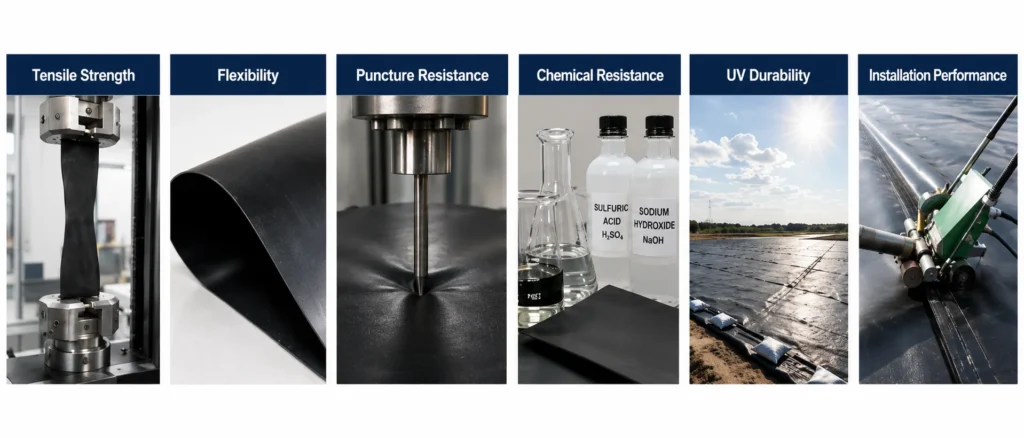
For geomembranes and liners, strength should be judged by the full project condition, including:
- Tensile strength
- Flexibility
- Elongation
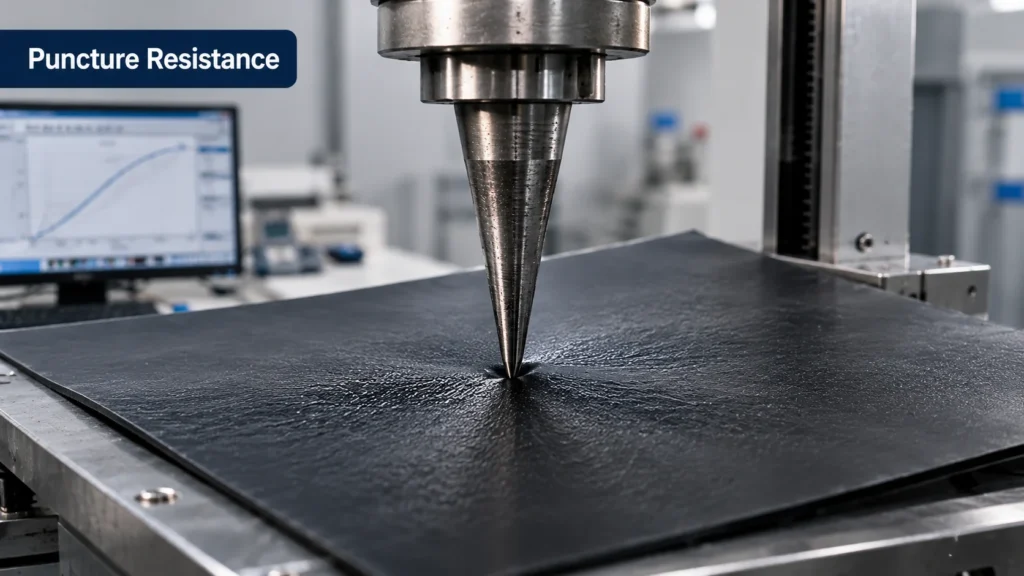
- Puncture resistance
- Tear resistance
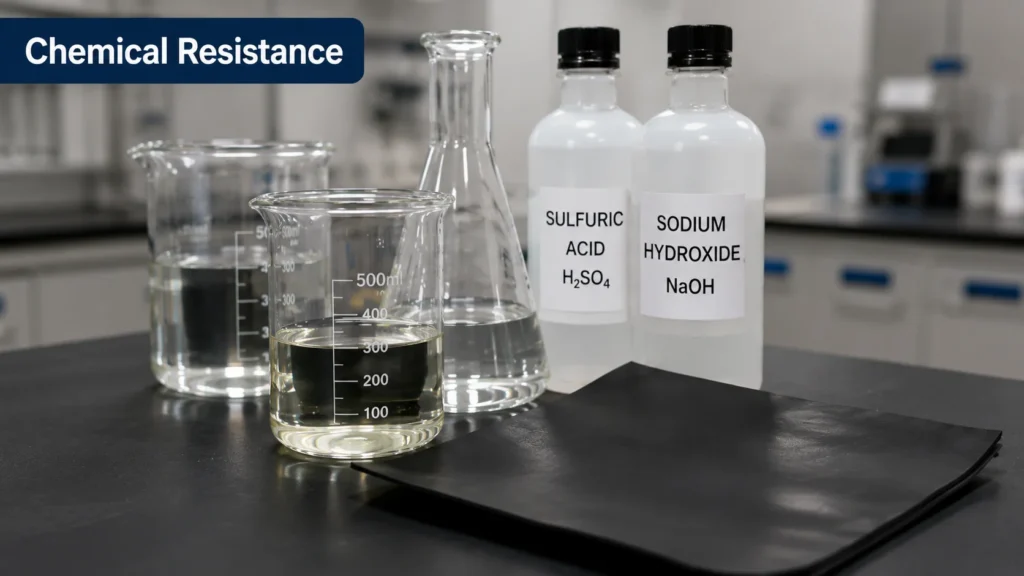
- Chemical resistance
- UV durability
- Stress crack resistance
- Seam quality
- Installation conditions
- Long-term exposure environment
In pipe applications, PVC is often described as having higher tensile strength, while HDPE is valued for flexibility, fatigue resistance, and toughness under dynamic conditions. But this article focuses on geomembranes, pond liners, containment liners, and waterproofing barriers, where the performance requirements are different from pipe systems.
HDPE vs PVC Strength Comparison
| Strength Factor | HDPE | PVC |
|---|---|---|
| Rigid sheet tensile strength | Lower than rigid PVC in typical plastic sheet data | Higher than HDPE in typical rigid sheet data |
| Flexibility | Lower in geomembrane form | Higher when used as flexible liner |
| Stiffness | Higher | Lower when plasticized |
| Chemical resistance | Usually stronger for harsh containment | Depends heavily on formulation and chemical exposure |
| UV durability | Usually stronger for exposed outdoor liners | Depends on formulation and exposure design |
| Puncture resistance | Strong for demanding containment systems | Flexible and can conform around irregularities |
| Installation handling | Stiffer, requires careful field welding | More flexible, often easier to handle |
| Best use | Landfills, mining, wastewater, industrial containment | Flexible liners, ponds, canals, irregular shapes, prefabricated panels |
The most practical conclusion is:
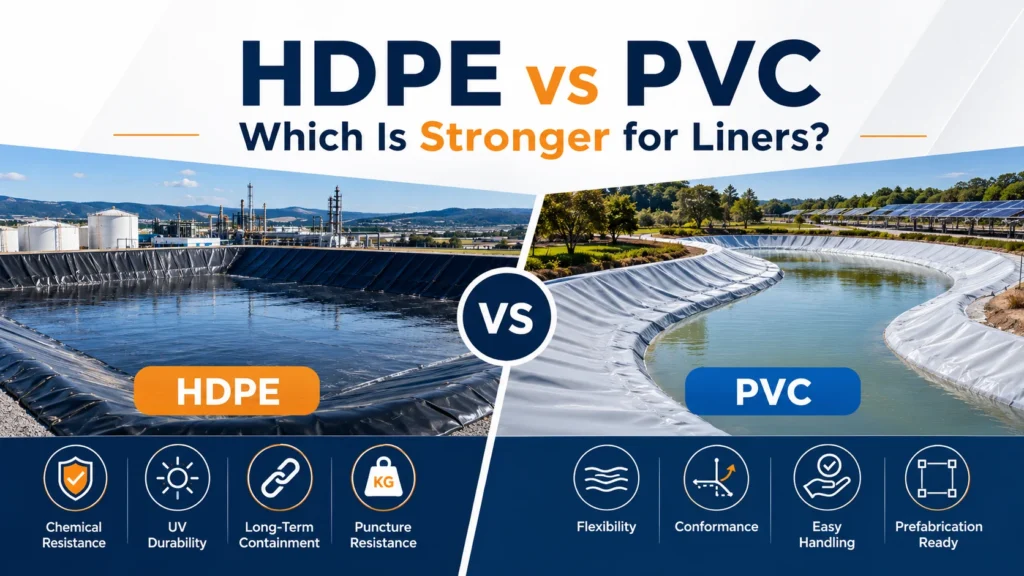
HDPE is usually stronger for harsh containment and long-term outdoor liner performance. PVC is usually stronger for flexibility, handling, and conformance to irregular surfaces.
What Is HDPE?
If you need a more basic explanation of how HDPE relates to geomembranes, you can first read our HDPE and geomembrane comparison guide.
HDPE stands for high-density polyethylene. In geomembrane applications, HDPE is one of the most widely used liner materials for environmental containment, water containment, wastewater treatment, mining, landfill lining, and industrial secondary containment.
HDPE geomembrane is commonly selected because it offers excellent chemical resistance, UV stability, and durability. The Fabricated Geomembrane Institute describes HDPE as a thermoplastic geomembrane barrier recognized for chemical resistance, UV stability, and durability, and notes that it is commonly used in landfills, mining, wastewater treatment systems, and produced water ponds.
HDPE is strong and durable, but it is also relatively stiff. This stiffness can be an advantage in heavy-duty containment projects, but it also means HDPE requires proper subgrade preparation, careful placement, and reliable field welding.
Internal link suggestion:
Link the anchor text HDPE and geomembrane comparison guide to your existing page about the difference between HDPE and geomembrane.
What Is PVC?
PVC stands for polyvinyl chloride. In rigid plastic sheet form, PVC is a stiff, strong, cost-effective plastic that can be fabricated, bonded, and welded. Curbell describes rigid PVC as stiff and strong, with typical tensile strength values listed at 7,500 psi.
In geomembrane and liner applications, however, PVC is usually used as a flexible liner material. Flexible PVC liners often include plasticizers and additives that improve handling, flexibility, and installation performance.
PVC liners are valued for their ability to:
- Bend around corners
- Fit irregular shapes
- Conform to uneven surfaces
- Be prefabricated into panels
- Reduce installation difficulty on complex sites
PVC can be a practical liner option for ponds, canals, decorative water features, tank liners, and projects where flexibility is more important than stiffness.
However, PVC performance depends strongly on formulation. Layfield notes that PVC and other lower-crystallinity liners provide better flexibility than HDPE, but standard PVC may involve tradeoffs in chemical and UV resistance unless specially formulated.
HDPE vs PVC: Key Strength Differences
1. Tensile Strength
For a deeper technical view, you can also review HDPE geomembrane properties and tensile strength before comparing HDPE with PVC liners.
If you compare rigid plastic sheet data, PVC may show higher tensile strength than HDPE. Rigid PVC is listed with tensile strength of 7,500 psi, while typical HDPE sheet data may show around 4,000 psi.
But this does not automatically mean PVC is the stronger geomembrane.
Geomembrane strength is not determined by tensile strength alone. A liner must also survive installation, resist puncture, tolerate environmental exposure, maintain seam integrity, and remain compatible with the contained liquid.
For example, a rigid material may have high tensile strength but still perform poorly if it is not flexible enough for the site conditions. A flexible material may have lower stiffness but perform better over irregular subgrade.
So tensile strength is only one part of the comparison.
2. Flexibility and Elongation
PVC is usually stronger in flexibility.
Flexible PVC liners can bend, fold, and conform to complex shapes more easily than HDPE. This makes PVC useful for ponds, canals, tanks, decorative water features, and irregular subgrades.
HDPE is stiffer. FGI notes that HDPE has a higher crystalline structure, which gives good chemical resistance and durability but also makes the material more rigid, with lower flexibility and elongation.
This means HDPE is not always the best material when the liner must handle complex geometry, settlement, wrinkles, sharp corners, or multiaxial movement.
In simple terms:
HDPE is stronger in stiffness and containment durability. PVC is stronger in flexibility and conformance.
3. Puncture and Tear Resistance
HDPE is often preferred for demanding containment projects where puncture resistance, abrasion resistance, and long-term durability are important.
However, puncture performance is not only a material property. It also depends on:
- Liner thickness
- Subgrade smoothness
- Protection geotextile
- Stone size
- Installation method
- Cover soil
- Construction traffic
- Seam quality
PVC may perform well in applications where flexibility helps the liner conform around small surface irregularities. Layfield describes PVC geomembranes as offering puncture, abrasion, and tear resistance, while also noting that chemical qualification is especially important for organic chemical exposure.
For this reason, the best liner should be selected based on site conditions, not only by the material name.
4. Chemical Resistance
HDPE is usually stronger for chemical resistance, especially in demanding environmental containment applications.
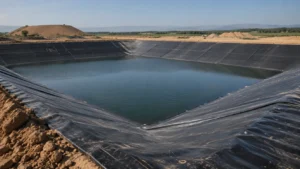
HDPE geomembranes are widely used in landfill liners, mining containment, wastewater lagoons, industrial ponds, and secondary containment systems because they provide strong resistance to many chemicals and harsh service environments. FGI identifies HDPE as having excellent chemical resistance and lists landfills, mining, wastewater treatment, and produced water ponds as common applications.
PVC can also resist many chemicals, especially inorganic chemicals, but its chemical performance depends more heavily on formulation and the specific exposure. Layfield notes that PVC geomembranes require special attention when evaluating resistance to organic chemicals.
For chemical containment projects, final material selection should always consider:
- Chemical type
- Concentration
- Temperature
- Exposure duration
- Liner thickness
- Manufacturer compatibility data
- Project design requirements
5. UV Resistance and Outdoor Durability
HDPE is usually stronger for long-term outdoor exposure.
HDPE geomembranes are commonly stabilized with carbon black, antioxidants, and UV stabilizers to support long-term performance. FGI states that HDPE is stabilized with carbon black, performance antioxidants, and UV stabilizers, and that HDPE is commonly used in exposed applications because of its chemical resistance and UV stability.
PVC can perform well in many liner applications, but exposed outdoor durability depends strongly on formulation. Standard PVC may need special formulation when long-term UV exposure or harsh chemical exposure is expected.
If a liner will remain exposed to sunlight for a long period, HDPE is usually the stronger default material to evaluate first.
6. Stress Crack Resistance
HDPE strength should not be judged by density alone.
Higher density often increases stiffness, but stiffness is not the same as long-term durability. Atarfil explains that crystalline polyethylene has tightly packed chains that provide high stiffness and chemical resistance, while tie-chains help improve ductility and stress-crack resistance. The same source also notes that some high stress-crack-resistant geomembrane resins may use broader molecular-weight distributions and lower density ranges to improve long-term crack resistance.
This is important because a good HDPE geomembrane is not simply “strong because it is dense.” Long-term performance also depends on:
- Polymer structure
- Stress crack resistance
- Carbon black dispersion
- Antioxidant package
- Thickness
- Welding quality
- Installation stress
- Site movement
For engineered containment projects, ask for the technical data sheet and confirm the relevant project specification.
7. Installation and Welding
HDPE is usually field welded using thermal fusion methods such as hot wedge welding and extrusion welding. FGI notes that HDPE is not suitable for factory fabrication and must be field welded using thermal fusion methods.
PVC is usually easier to handle because it is more flexible. Depending on the product and project, PVC liners may be prefabricated into panels, folded, transported, and installed more easily on complex or smaller sites.
This does not mean PVC is always better. It means PVC may be stronger from an installation-handling perspective when the project has complex shapes or irregular surfaces.
HDPE may be better for large, demanding containment projects where field welding, chemical resistance, and UV durability are the main priorities.
When Is HDPE Stronger Than PVC?
HDPE is usually the stronger option when the project requires:
- Long-term chemical resistance
- UV-stabilized outdoor exposure
- Heavy-duty environmental containment
- Landfill lining
- Mining pond lining
- Wastewater lagoon lining
- Industrial chemical containment
- Secondary containment
- Large-scale field-welded liner systems
- Durable containment under harsh conditions
HDPE is often the better choice when failure risk must be minimized and the liner will face aggressive liquid, sunlight, puncture risk, or long-term environmental exposure.
When Is PVC Stronger Than HDPE?
If flexibility is the main concern, you may also want to compare HDPE vs LLDPE geomembrane, because LLDPE is often considered when users need more flexibility than HDPE.
PVC may be the stronger practical choice when the project requires:
- Better flexibility
- Easier handling
- Conformance to uneven subgrade
- Complex shapes
- Tight corners
- Prefabricated liner panels
- Smaller ponds
- Canal lining
- Tank liners
- Decorative water features
- Installation over irregular surfaces
PVC is not simply a weaker material. In flexible liner applications, PVC may be better when the liner needs to bend, fold, or fit complicated shapes without creating excessive stress.
HDPE vs PVC for Common Liner Applications
| Application | Usually Better Choice | Why |
|---|---|---|
| Landfill liner | HDPE | Strong chemical resistance and long-term containment durability |
| Mining pond | HDPE | Better for harsh chemical and outdoor exposure |
| Wastewater lagoon | HDPE | Strong durability and chemical resistance |
| Industrial containment | HDPE | Better for demanding chemical environments |
| Secondary containment | HDPE | Better long-term chemical and UV performance |
| Exposed outdoor liner | HDPE | Better UV-stabilized long-term performance |
| Decorative pond | PVC or LLDPE | Easier installation and better flexibility |
| Canal liner | PVC or LLDPE | Better conformance to long or irregular surfaces |
| Tank liner | PVC / flexible liner | Easier prefabrication and handling |
| Irregular subgrade | PVC or LLDPE | Better flexibility and conformance |
Common Mistakes When Comparing HDPE and PVC
Mistake 1: Judging Strength Only by Tensile Strength
Rigid PVC may show higher tensile strength than HDPE in some plastic sheet data, but this does not automatically make PVC better for geomembrane or liner applications.
A liner must perform under site conditions, not only in a lab test.
Mistake 2: Thinking Stiffer Always Means Stronger
HDPE is stiffer than flexible PVC, but stiffness is not always the same as better performance.
A stiff liner may perform well in a properly prepared containment system. But a flexible liner may be better when the site has complex geometry, corners, irregular subgrade, or expected movement.
Mistake 3: Ignoring Chemical Compatibility
For chemical containment, material selection should never be based only on the names HDPE or PVC.
The contained liquid, concentration, temperature, exposure time, and project standard must all be checked before choosing the liner.
Mistake 4: Ignoring UV Exposure
Outdoor exposed liners need UV-resistant formulation.
HDPE is commonly used for exposed applications because of its UV stability and stabilizer package. PVC may also be used outdoors if properly formulated, but standard PVC should not be assumed suitable for long-term UV exposure without confirmation.
Mistake 5: Using One Material for Every Project
HDPE and PVC both have strong use cases.
HDPE is usually stronger for long-term containment, chemical resistance, and outdoor exposure. PVC is usually stronger for flexibility, handling, and conformance.
The right material depends on the actual project.
Final Recommendation
HDPE is usually stronger than PVC for geomembrane and liner projects that require chemical resistance, UV stability, puncture resistance, and long-term containment durability.
PVC is usually stronger in flexibility, installation handling, and conformance to irregular surfaces.
If your project involves landfill leachate, mining fluids, wastewater, industrial chemicals, secondary containment, or long-term outdoor exposure, HDPE is usually the stronger material to evaluate first.
If your project involves a small pond, complex shape, tight corner, prefabricated liner panel, or uneven subgrade, PVC may be the more practical option.
The best material is not simply the one with the highest tensile strength. It is the one that matches the project’s real exposure, installation, and service conditions.
FAQ
Is HDPE stronger than PVC?
For geomembrane and liner applications, HDPE is usually stronger in chemical resistance, UV durability, puncture resistance, and long-term containment performance. PVC is usually stronger in flexibility, conformance, and installation handling.
Does PVC have higher tensile strength than HDPE?
Rigid PVC can have higher tensile strength than general HDPE plastic sheet. However, tensile strength alone does not determine which material is better for geomembranes or liners.
Is HDPE more durable than PVC?
HDPE is often more durable in harsh outdoor containment applications because of its chemical resistance, UV stability, and long-term use in landfills, mining, wastewater lagoons, and industrial containment projects.
Is PVC more flexible than HDPE?
Yes. Flexible PVC liners are generally more flexible than HDPE geomembranes. This makes PVC easier to install around corners, irregular shapes, and uneven surfaces.
Which is better for pond liner, HDPE or PVC?
HDPE is better for demanding containment and long-term outdoor exposure. PVC may be easier to install for small ponds or irregular shapes. For many pond projects, LLDPE may also be considered because it offers better flexibility than HDPE with good chemical resistance.
Which is better for chemical containment, HDPE or PVC?
HDPE is usually preferred for demanding chemical containment, but final selection should be based on chemical type, concentration, temperature, exposure time, and manufacturer compatibility data.
Is HDPE better than PVC for outdoor use?
For long-term exposed liner applications, HDPE is usually stronger because HDPE geomembranes are commonly stabilized with carbon black, antioxidants, and UV stabilizers. PVC may require special formulation for long-term UV exposure.
Can PVC be used as a geomembrane liner?
Yes. PVC can be used as a geomembrane liner, especially when flexibility, prefabrication, and conformance to irregular surfaces are important. However, chemical resistance and UV resistance should be confirmed for the specific project.