Short Answer:
Geogrid usually costs about $0.50 to $7.00 per square meter, or approximately $0.05 to $0.70 per square foot, depending on geogrid type, tensile strength, polymer material, roll size, order volume and project requirements.
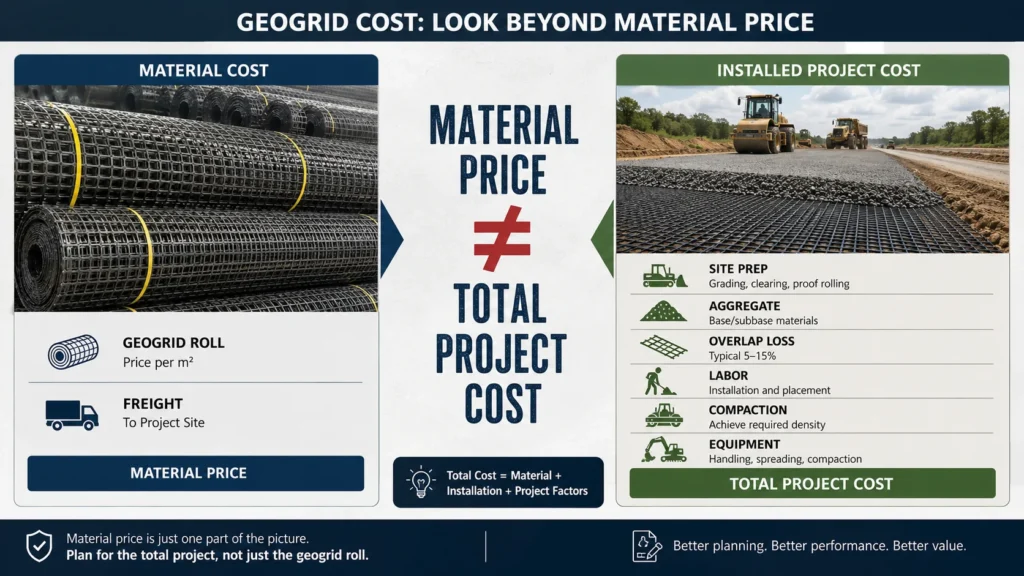
However, geogrid material price is not the same as installed project cost. Installation, site preparation, overlap loss, aggregate placement, compaction, shipping and project design can significantly change the final cost.
For road construction, retaining walls, slopes, driveways and weak subgrade stabilization, the cheapest geogrid is not always the most economical option. A higher-performance geogrid may reduce aggregate thickness, improve load distribution, reduce rutting or lower long-term maintenance costs.
How Much Does Geogrid Cost?
Geogrid prices usually range from $0.50 to $7.00 per square meter. In square foot pricing, this is roughly $0.05 to $0.70 per square foot.
This is a general market range. The final price depends on several factors:
- Type of geogrid
- Tensile strength
- Polymer material
- Aperture size
- Junction strength
- Roll width and roll length
- Order quantity
- Certification and testing requirements
- Packaging
- Freight terms
- Destination country or delivery address
A small roll sold for landscaping, driveway repair or retail use will usually have a higher unit price than a bulk project order. A large infrastructure project with full-roll quantities can often reduce the price per square meter.
Before comparing prices, it is useful to understand the main geogrid applications
Roads, retaining walls, slopes and driveways require different strength levels, installation methods and long-term performance requirements.
Geogrid Price by Type
Different geogrid types are designed for different engineering functions. Price should not be compared only by the name of the product.
A low-strength biaxial geogrid for a driveway and a high-strength uniaxial geogrid for a retaining wall are not in the same cost category.
| Geogrid Type | Typical Price Range | Common Applications |
|---|---|---|
| PP Biaxial Geogrid | $0.60–$3.50/m² | Roads, parking lots, driveways, subgrade stabilization |
| HDPE / PET Uniaxial Geogrid | $1.00–$6.00/m² | Retaining walls, steep slopes, MSE structures |
| Triaxial Geogrid | $1.50–$5.50/m² | Heavy-duty roads, weak subgrades, high-traffic areas |
| Fiberglass Geogrid | $0.30–$2.00/m² | Asphalt overlays, reflective crack control |
| Polyester Geogrid | $1.20–$7.00/m² | High-strength reinforcement, slopes, retaining walls |
These ranges are for material reference only. Actual quotes depend on strength grade, roll size, quantity, coating, testing standard and shipping conditions.
When comparing biaxial vs uniaxial geogrid, buyers should not only compare unit price. They should also check whether the reinforcement direction matches the project design:
Biaxial Geogrid Cost
Biaxial geogrid usually provides strength in both machine and cross-machine directions. It is commonly used for road bases, parking lots, driveways, working platforms and subgrade stabilization.
Typical cost range:
$0.60–$3.50 per m²
$0.06–$0.35 per ft²
Biaxial geogrid is often chosen when the project requires aggregate interlock and load distribution in two directions. It is commonly used above weak soils to improve base course performance and reduce rutting.
For road and pavement applications, price should be evaluated together with subgrade CBR, aggregate size, aperture compatibility and low-strain stiffness.
For road projects, geogrid for road construction should be selected according to subgrade CBR, traffic load, aggregate size and required reinforcement performance:
Uniaxial Geogrid Cost
Uniaxial geogrid is designed to provide higher tensile strength in one main direction. It is commonly used for retaining walls, reinforced soil slopes, embankments and mechanically stabilized earth structures.
Typical cost range:
$1.00–$6.00 per m²
$0.10–$0.60 per ft²
Uniaxial geogrid price is strongly affected by tensile strength, polymer type, creep resistance, coating and long-term design requirements. High-strength PET or HDPE uniaxial geogrid can cost more than standard biaxial geogrid because it must support long-term reinforcement loads.
For retaining wall projects, geogrid for retaining walls is usually selected based on long-term tensile strength, embedment length, wall height and soil conditions:
Triaxial Geogrid Cost
Triaxial geogrid is designed for multi-directional load distribution. It is often used in heavy-duty roads, weak subgrade zones, haul roads and high-traffic pavement systems.
Typical cost range:
$1.50–$5.50 per m²
$0.15–$0.55 per ft²
Although triaxial or advanced geogrids may have a higher material price, they can sometimes reduce the total project cost by reducing aggregate thickness and improving construction productivity.
This is why a geogrid quote should be compared by installed performance, not only by square meter price.
Fiberglass Geogrid Cost
Fiberglass geogrid is commonly used in asphalt reinforcement, especially for reflective crack control in pavement maintenance.
Typical cost range:
$0.30–$2.00 per m²
$0.03–$0.20 per ft²
This product category is different from soil stabilization geogrids. Fiberglass geogrid is usually selected for asphalt overlay projects where the goal is to reduce reflective cracking, not to reinforce granular base over weak soil.
Geogrid Cost by Strength Level
Tensile strength is one of the most important price drivers. Two geogrids may look similar but have very different costs if their strength, junction efficiency or long-term performance is different.
| Strength Level | Typical Use | Price Level |
|---|---|---|
| 15–30 kN/m | Driveways, light roads, temporary access | Low |
| 30–60 kN/m | Roads, parking lots, subgrade stabilization | Medium |
| 60–120 kN/m | Retaining walls, slopes, MSE structures | Medium to high |
| 120–200+ kN/m | Heavy retaining walls, steep slopes, high-load structures | High |
For road applications, low-strain performance is especially important. A geogrid that develops useful stiffness at low strain can help limit rutting and aggregate movement more effectively than a product selected only by ultimate tensile strength.
If the project specification is not clear, start by checking the required geogrid strength before comparing supplier quotations:
Geogrid Cost by Application
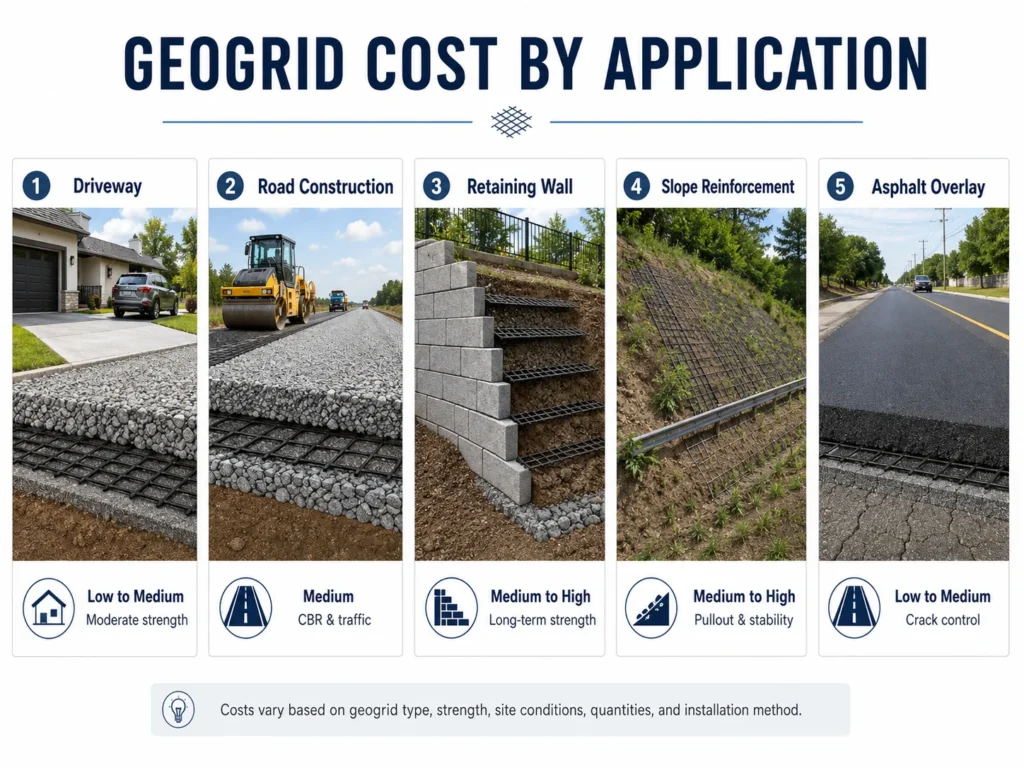
Geogrid cost should be evaluated according to the project application. A driveway, retaining wall and heavy haul road require different performance levels.
| Application | Recommended Type | Price Level | Main Cost Driver |
|---|---|---|---|
| Driveway | PP biaxial geogrid | Low to medium | Moderate strength, roll size, retail vs bulk supply |
| Road construction | Biaxial / triaxial geogrid | Medium | CBR, traffic load, aggregate thickness |
| Retaining wall | Uniaxial PET / HDPE geogrid | Medium to high | Long-term tensile strength and creep resistance |
| Steep slope | Uniaxial / high-strength PET geogrid | Medium to high | Pullout resistance and long-term stability |
| Asphalt overlay | Fiberglass geogrid | Low to medium | Crack control and asphalt system design |
| Heavy-duty pavement | Triaxial / high-performance geogrid | Medium to high | Load distribution and base reduction potential |
For road projects, geogrid price should be evaluated together with subgrade CBR. When CBR is below 3%, reinforcement becomes more important because the subgrade has limited bearing capacity. Very soft subgrades may require stronger geogrids, wider overlaps and better construction control.
Driveway Geogrid Cost
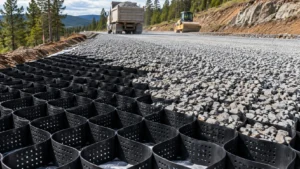
Driveway geogrid usually costs less than geogrid used for retaining walls or heavy-duty roads. Most driveway projects use biaxial geogrid or ground grid systems designed to stabilize gravel and reduce rutting.
Typical driveway geogrid cost depends on:
- Driveway size
- Soil condition
- Gravel thickness
- Geogrid roll size
- Product strength
- Whether it is a retail roll or bulk order
- Installation method
For residential or light commercial driveways, the geogrid does not usually need the same strength as a highway or retaining wall system. However, using the wrong product can still lead to rutting, gravel movement or poor long-term performance.
For driveway projects, driveway geogrid is usually selected for aggregate confinement, rutting control and easier construction over weak soil:
Road Construction Geogrid Cost
Road construction geogrid cost depends on subgrade strength, traffic load, aggregate thickness and project design.
For weak subgrades, geogrid can help improve base course performance by providing aggregate interlock and lateral confinement. This can reduce rutting, improve load distribution and sometimes reduce aggregate thickness.
Important cost factors include:
- CBR value
- Traffic loading
- Base course thickness
- Aggregate size
- Aperture size compatibility
- Required stiffness at low strain
- Roll width
- Overlap requirement
- Construction speed
A low-cost geogrid may not be economical if it does not provide enough interlock or stiffness for the road structure.
Retaining Wall Geogrid Cost
Retaining wall geogrid is usually more expensive than standard driveway or road base geogrid because it often requires higher long-term tensile strength.
The cost depends on:
- Wall height
- Soil type
- Geogrid strength
- Reinforcement length
- Vertical spacing
- Number of layers
- Long-term design strength
- Creep resistance
- Wall design requirements
In retaining walls, geogrid is not simply a separation layer. It is a structural reinforcement material. For this reason, selecting the cheapest product without checking long-term tensile strength can increase deformation or pullout risk.
Slope Reinforcement Geogrid Cost
Geogrid used for steep slopes and embankments often needs higher tensile strength and better long-term performance than ordinary driveway products.
Slope reinforcement cost depends on:
- Slope height
- Slope angle
- Soil condition
- Fill material
- Required pullout resistance
- Geogrid strength
- Number of reinforcement layers
- Drainage conditions
- Erosion protection requirements
In slope projects, the total cost should include not only the geogrid material but also soil preparation, compaction, drainage and surface erosion control.
Asphalt Reinforcement Geogrid Cost
Asphalt reinforcement usually uses fiberglass geogrid or asphalt reinforcement grids. These products are used to reduce reflective cracking and improve pavement maintenance performance.
The cost is usually lower than high-strength soil reinforcement geogrids, but the installation method is different.
Asphalt geogrid cost depends on:
- Pavement condition
- Crack severity
- Grid type
- Coating
- Asphalt layer thickness
- Installation width
- Project area
- Local paving method
Fiberglass geogrid should not be compared directly with biaxial or uniaxial soil reinforcement geogrids because the application and performance function are different.
Material Price vs Installed Project Cost
Geogrid material price refers only to the cost of the geogrid roll itself.
Installed project cost includes:
- Geogrid material
- Site preparation
- Subgrade grading
- Overlap loss
- Cutting and placement
- Aggregate fill
- Compaction
- Labor
- Equipment
- Drainage work
- Shipping and unloading
- Quality control
- Maintenance risk
This distinction is important because the lowest material price may not produce the lowest total project cost.
A higher-performance geogrid can sometimes reduce aggregate thickness, shorten construction time or reduce future maintenance. In this case, the material price may be higher, but the installed project cost may be lower.
How Much Does It Cost to Install Geogrid?
Geogrid installation cost varies by project size, labor market, site condition and application. In many projects, installation and related site work can add a significant amount to the material price.
Installation cost is affected by:
- Site access
- Subgrade condition
- Required overlap
- Number of layers
- Aggregate thickness
- Compaction requirements
- Slope or wall geometry
- Drainage conditions
- Labor and equipment rates
- Weather and construction schedule
For simple driveway or small road projects, installation may be straightforward. For retaining walls, slopes and heavy-duty roadways, installation must follow engineered plans and may require stricter quality control.
Is Geogrid Worth It?
Geogrid is worth it when it reduces total project cost, improves performance or lowers long-term maintenance risk.
Geogrid may be worth using when:
- The subgrade is weak
- CBR is low
- Rutting is likely
- Aggregate thickness needs to be reduced
- Construction traffic is heavy
- A retaining wall needs long-term reinforcement
- A steep slope needs tensile reinforcement
- Maintenance access is difficult or expensive
- Project failure would be costly
Geogrid may not be worth it when:
- The subgrade is already strong
- Loads are light
- The application does not require reinforcement
- The wrong type of geogrid is selected
- Installation is not controlled
- Aggregate and aperture size are poorly matched
The question should not be “Is geogrid cheap?”
The better question is:
Does geogrid reduce the total installed cost or improve long-term performance for this project?Why Cheap Geogrid Can Cost More
A cheaper geogrid may reduce the material price, but it can increase total project cost if it does not match the engineering requirement.
Common risks of low-cost or under-specified geogrid include:
- Insufficient tensile strength
- Poor junction efficiency
- Unsuitable aperture size
- Weak aggregate interlock
- Poor creep resistance
- Lower UV resistance
- Unclear testing data
- No project-specific technical support
- Higher risk of rutting or deformation
In road projects, poor interlock may lead to aggregate movement and rutting. In retaining walls, insufficient long-term tensile strength may increase deformation or pullout risk.
Before choosing a low-cost product, buyers should also understand the disadvantages of geogrids when they are installed incorrectly or used in the wrong application:
How to Compare Geogrid Supplier Quotes
When comparing geogrid quotes, do not compare only the price per roll or price per square meter. Check whether the products have the same technical performance.
| Quote Item | Why It Matters |
|---|---|
| Geogrid type | Biaxial, uniaxial, triaxial and fiberglass serve different functions |
| Polymer type | PP, HDPE, PET and fiberglass have different costs and performance |
| Tensile strength | Higher strength usually increases cost |
| Strength at 2% / 5% strain | Important for road stabilization and early stiffness |
| Junction efficiency | Affects load transfer and aggregate interlock |
| Aperture size | Should match aggregate size for effective interlock |
| Roll size | Affects seams, overlap loss and shipping cost |
| Coating | Important for PET and fiberglass geogrids |
| Certification | Test reports and standards reduce project risk |
| Freight terms | FOB, CIF and local delivery change the final landed cost |
A quote with a lower unit price may not be cheaper if the roll size is smaller, overlap loss is higher, freight is excluded or performance is lower.
Buyer Checklist Before Requesting a Geogrid Price
To get an accurate geogrid quotation, buyers should provide clear project information.
Before asking for a price, prepare:
- Application: road, retaining wall, slope, driveway or asphalt overlay
- Required geogrid type
- Tensile strength requirement
- Roll width and roll length
- Project area or total quantity
- Soil condition or CBR value
- Fill material or aggregate size
- Number of layers
- Required overlap
- Required standards or test reports
- Destination port or delivery address
- Packing requirements
- Target delivery time
This information helps the supplier recommend the correct product instead of giving a generic low price.
After confirming the application, strength, roll size and project quantity, buyers can request a geogrid quotation based on the required specification:
When Should You Use Geogrid?
Geogrid should be used when soil or aggregate layers need reinforcement, stabilization or confinement.
Common situations include:
- Weak subgrade under roads
- Gravel roads and temporary access roads
- Parking lots and driveways
- Retaining walls
- Reinforced soil slopes
- Embankments
- Railways
- Heavy haul roads
- Asphalt overlay crack control
- Working platforms over soft ground
For road construction, geogrid is especially useful when the subgrade has low bearing capacity. If CBR is below 3%, reinforcement should be evaluated carefully. If CBR is below 1%, the site should be treated as very soft ground and construction control becomes more important.
What Is the Disadvantage of Geogrids?
Geogrids are useful reinforcement materials, but they are not suitable for every situation.
Common disadvantages include:
- They require correct installation.
- They do not provide filtration like geotextiles.
- They may not work well if aperture size does not match aggregate size.
- They can be damaged during installation if covered incorrectly.
- They require correct overlap and placement direction.
- Some applications require engineering design.
- Low-quality geogrids may have poor long-term performance.
In road applications, a geogrid must work with suitable aggregate. In retaining wall applications, the geogrid must be placed in the correct direction and length according to the design.
How Long Does Geogrid Last?
A properly selected and installed geogrid can last for several decades. Long-term performance depends on polymer type, UV exposure, chemical environment, installation damage, creep resistance and whether the geogrid is buried or exposed.
For permanent roads, slopes and retaining walls, long-term design strength is more important than short-term tensile strength alone. The design should consider installation damage reduction factors, creep reduction factors and environmental conditions.
Geogrid Price Summary Table
| Buyer Question | Practical Answer |
|---|---|
| What is the cost of geogrid? | Usually $0.50–$7.00/m² or $0.05–$0.70/ft² |
| Which geogrid is cheapest? | Standard PP biaxial and fiberglass geogrids are usually lower-cost |
| Which geogrid costs more? | High-strength uniaxial PET / HDPE and triaxial geogrids usually cost more |
| Is geogrid worth it? | Yes, when it reduces aggregate thickness, rutting, deformation or maintenance |
| What affects price most? | Type, tensile strength, material, roll size, quantity and shipping |
| What affects installed cost? | Site prep, overlap, aggregate, labor, compaction and drainage |
Conclusion
Geogrid usually costs around $0.50 to $7.00 per square meter or $0.05 to $0.70 per square foot, but this range only describes the material price. The real project cost depends on geogrid type, tensile strength, application, subgrade condition, overlap, aggregate thickness, installation and freight.
For simple driveway or landscaping projects, a lower-cost biaxial geogrid may be enough. For retaining walls, steep slopes, soft subgrades and heavy-duty roads, stronger geogrids may cost more per square meter but reduce total project risk.
The best geogrid price is not the lowest number on a quotation. It is the price that matches the required performance, application and total installed cost.