— Practical Engineering Insights from Real-World Projects
Geomembranes such as HDPE and LLDPE have become essential materials for modern environmental protection and civil engineering. From landfills to mining facilities and industrial evaporation ponds, geomembrane systems play a critical role in preventing leakage, containing chemicals, and ensuring long-term environmental safety.
This article summarizes practical lessons from multiple real-world international projects, covering different climates, loading conditions, chemical environments, and construction challenges. These case studies can provide valuable technical references for your future projects.
Want to explore all geomembrane application types?
Visit our full application guide →
https://www.geosynsource.com/geomembrane-application/
Case Study 1 | USA · New Jersey — Municipal Landfill Bottom Liner System

Application
Municipal Solid Waste (MSW) landfill bottom liner system
Materials Used
-
HDPE 1.5 mm (60 mil), textured geomembrane
Referenced from the IGS Digital Library (International Geosynthetics Society)
Project Scale
The liner system has been in service for 22 years under active landfill operations.
IGS Digital Library
Key Challenges
-
Long-term exposure to municipal leachate
-
Temperature cycling
-
Differential settlement under heavy waste load
-
Potential long-term oxidative aging
Engineering Solution
Exhumed liner samples were retrieved from site and tested. The results showed that the HDPE geomembrane’s mechanical properties had “barely changed” after 22 years and remained well above current specification limits.
IGS Digital Library
Key Takeaways
-
With proper CQC/CQA, HDPE geomembranes can retain excellent durability even after 20+ years of service.
-
For high-load and high-chemical environments, initial material specifications must include safety margins.
-
Periodic monitoring helps ensure long-term reliability for operational landfills.
Case Study 2 | Australia · Queensland — Copper Mine Heap Leach Facility
Application
Heap leach pad liner system for copper extraction
Materials Used
-
HDPE 2.0 mm (base layer)
-
Textured HDPE 1.5 mm (slope protection)
Referenced from bpmgeomembrane.com
Project Scale
The heap leach pad covers hundreds of thousands of square meters (manufacturer data).
Key Challenges
-
High puncture risk from crushed-rock subgrade
-
Intense UV exposure and high temperature
-
Strongly acidic/chemical leach solutions
-
Large slopes requiring enhanced interface friction
Engineering Solution
-
Use of thick HDPE for chemical resistance
-
Textured HDPE on slopes for improved friction
-
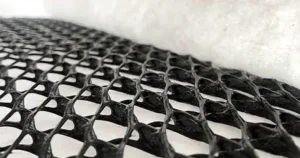
Geotextile cushioning layer to prevent puncture
-
UV-stabilized formulation to resist long-term exposure
Key Takeaways
-
Heap leach pads impose some of the most demanding conditions on geomembrane systems.
-
Textured geomembranes significantly improve slope stability.
-
Subgrade preparation (smoothing, removing sharp rocks, installing geotextile) is essential for preventing damage.
Case Study 3 | UAE · Abu Dhabi — Industrial Waste Evaporation Pond
Application
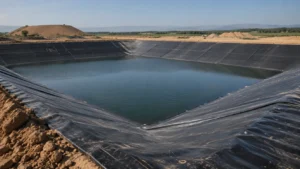
Evaporation pond for high-salinity, oil-contaminated industrial wastewater
Materials Used
-
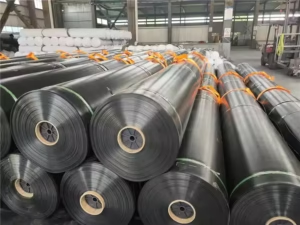
LLDPE 1.5 mm geomembrane (for enhanced flexibility)
-
Nonwoven geotextile protection layer
Project Scale
Approx. 65,000 m²
Key Challenges
-
Extremely high salinity and chemical aggression
-
Strong desert winds affecting membrane stability
-
Complex pond geometry
-
Long-term exposure under harsh desert climate
Engineering Solution
-
Use of LLDPE for superior flexibility under settlement and temperature changes
-
High-density anchor trenches + sandbags + mechanical ballast bars
-
Dual seam testing: vacuum box + spark testing
-
Reinforced detailing at corners and irregular edges
Key Takeaways
-
In chemically aggressive and high-wind environments, membrane flexibility and anchorage design are critical.
-
Corners, internal angles and transitions are the highest-risk zones and must be reinforced.
-
Seam quality directly determines long-term performance.
Case Study 4 | Chile · Atacama Plateau — Lithium Brine Evaporation Pond
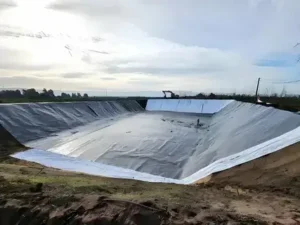
Application
Evaporation and concentration ponds for lithium brine extraction
Materials Used
-
HDPE 2.0 mm
-
White reflective geomembrane (reduces surface heat gain)
Project Scale
Approx. 300,000 m²
Key Challenges
-
Extremely high UV radiation (one of the highest in the world)
-
Large day–night temperature variation at high altitude
-
High-salinity brine with crystallization and puncture risks
-
Strong winds across the salt flats
Engineering Solution
-
Use of white reflective HDPE to reduce thermal expansion
-
Subgrade covered with gravel + geotextile for puncture protection
-
Continuous sandbag ballast chains along edges
-
Reinforced anchor trenching and slope stabilization
Key Takeaways
-
Extreme environments (salt lakes, high altitude) demand integrated system design, not just material upgrades.
-
Thermal movement and UV aging can become structural issues.
-
White geomembranes are highly effective in controlling temperature-driven stresses.
Case Study 5 | Canada · British Columbia — Tailings Storage Facility Retrofit
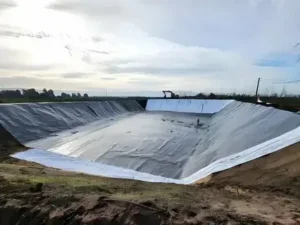
Application
Secondary containment liner system for an existing TSF
Materials Used
-
HDPE 1.5 mm smooth + textured
-
GCL (bentonite liner)
-
Geonet drainage layer
Project Scale
Approx. 120,000 m²
Key Challenges
-
Cold-weather construction (risk of material brittleness)
-
Uneven subgrade settlement
-
Numerous penetration and structural details
-
Limited workable temperature window
Engineering Solution
-
Use of heated welding tents and heating blankets
-
Use of cold-resistant HDPE with high ESCR
-
Extrusion-welded reinforcement patches for all penetrations
-
Multi-layer system increases redundancy and safety
Key Takeaways
-
Temperature is the most critical factor in cold-region geomembrane installation.
-
GCL + HDPE + Geonet provides a robust multi-barrier system.
-
Penetrations and joints are the primary failure points and require skilled workmanship.
Case Study 6 | Zimbabwe · Gold Mine Heap Leach & Tailings Liner System

Application
Heap leach pad and tailings containment for gold mining operations
Materials Used
-
HDPE 1.0 mm (cost-effective grade)
Project Scale
Medium-to-large mining project (exact size not disclosed)
Key Challenges
-
Highly aggressive lixiviants (cyanide, high pH)
-
Remote construction site
-
Logistics and technical-support limitations
-
Need for cost-control while maintaining safety
Engineering Solution
-
Use of high-crystallinity HDPE for chemical resistance
-
Manufacturer-provided remote + on-site technical assistance
-
Strict CQA for welding, seams, and detail work
-
Risk-based design approach with targeted reinforcement
Key Takeaways
-
Cost-optimized liners require higher-quality installation to remain reliable.
-
Remote mining sites face supply chain and training challenges.
-
In mining, geomembrane failure carries major environmental and financial risks—redundancy is essential.
⭐ Summary: Global Lessons for Geomembrane Engineering
Across these six international projects, several core principles consistently emerge:
1. Material selection is environment-specific
-
High UV → reflective or UV-stabilized HDPE
-
High chemical load → thick HDPE / high-crystallinity formulations
-
High settlement → flexible LLDPE
-
Cold regions → cold-resistant HDPE + heated welding tents
2. Subgrade preparation is crucial
A perfectly installed geomembrane can fail if placed on a poorly prepared base.
3. Seam quality control (CQA) defines long-term performance
Vacuum testing, air-pressure testing, spark testing, and destructive testing are essential.
4. Details and penetration points are the highest-risk zones
These require reinforced detailing and skilled technicians.
5. Multi-layer systems provide greater safety
(HDPE + GCL + Geonet) is common in high-risk mining and landfill environments.
Learn more about landfill liners, mining liners, evaporation ponds, wastewater containment and other application scenarios in our
Geomembrane Application Page →
https://www.geosynsource.com/geomembrane-application/