(GeoSynSource Technical Insight – 2025 Edition)
Introduction
Selecting the right geosynthetic material is one of the most important decisions in any construction or landscaping project. Whether stabilizing soil for a retaining wall or preparing a garden walkway, the difference between geogrid fabric and landscaping fabric directly impacts long-term performance, durability, and maintenance costs.
Both products are sometimes referred to as “fabrics,” but they are engineered for entirely different purposes. Understanding how each works will help you choose the correct solution for your next project.
1️⃣ Structural Difference

| Property | Geogrid Fabric | Landscaping Fabric |
|---|---|---|
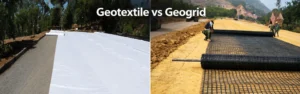
| Structure | Open, grid-like pattern | Continuous woven or nonwoven textile |
| Material | High-strength polymers (HDPE, PP, PET) | Polypropylene or polyester fibers |
| Primary Function | Reinforcement, load distribution, soil stabilization | Weed suppression, soil separation, drainage |
| Typical Strength | 20–200 kN/m (biaxial or uniaxial) | < 10 kN/m |
| Service Life (buried) | 50+ years | 5–10 years |
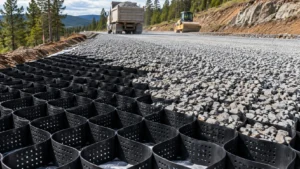
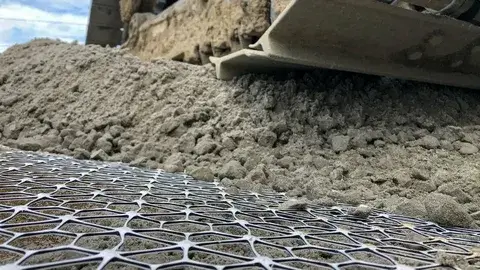
Geogrid fabric is a structural reinforcement layer, designed to interlock with soil or aggregate and prevent movement under load. Landscaping fabric, meanwhile, acts as a protective barrier to block weeds and regulate moisture, but it cannot bear structural stress.
2️⃣ Application Differences

-
Retaining walls and embankments
-
Road base stabilization and parking areas
-
Slope protection and erosion control under heavy loads
-
Foundation reinforcement in weak soil conditions
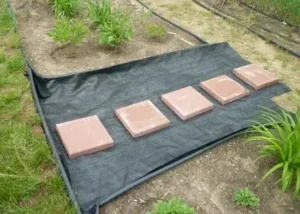
Landscaping Fabric Applications:
-
Garden beds, tree rings, and walkways
-
Decorative gravel areas
-
Erosion control on light slopes
-
Soil separation beneath mulch or decorative stone
In simple terms:
Geogrid strengthens the ground — landscaping fabric protects its surface.
3️⃣ Performance & Design Considerations
| Aspect | Geogrid Fabric | Landscaping Fabric |
|---|---|---|
| Load-bearing Capacity | High – engineered for reinforcement | Low – not load-bearing |
| UV Resistance | Excellent (coated polymers) | Moderate |
| Installation Depth | Buried between soil layers | Near-surface |
| Design Standards | ASTM D6637, AASHTO M288, EN 13250 | ASTM D4491, ASTM D4751 |
A properly designed system with geogrid can reduce aggregate thickness, extend pavement life, and improve slope stability, which translates to measurable cost savings over time. Landscaping fabric, while less technical, can reduce maintenance frequency and keep outdoor spaces visually clean.
4️⃣ Choosing the Right Product
Use Geogrid Fabric when:
-
Structural stability or load transfer is critical.
-
You are designing a retaining wall, roadway, or embankment.
-
Soil reinforcement and creep control are required by design.
Use Landscaping Fabric when:
-
The goal is surface protection, drainage, or weed control.
-
You are working on gardens, residential landscaping, or decorative stonework.
When in doubt, evaluate three factors:
-
Load intensity (How much stress will the material carry?)
-
Soil conditions (Is reinforcement required?)
-
Design life (Temporary landscaping vs. long-term structural use)
5️⃣ Why Specification Matters

In many projects across the Middle East and Southern Africa, premature failures occur not because of poor construction—but because of incorrect material selection.
Using landscaping fabric in place of geogrid for retaining walls, for example, can lead to wall deformation, settlement, or collapse. Conversely, using geogrid for light landscaping unnecessarily increases cost.
Understanding the functional difference allows contractors and designers to balance cost, performance, and durability.
Conclusion
Both geogrid fabric and landscaping fabric belong to the same family of geosynthetics, but they are engineered for completely different performance requirements.
-
Geogrid Fabric: For reinforcement, stability, and load-bearing applications.
-
Landscaping Fabric: For weed control, soil separation, and light drainage.
Choosing the correct product ensures your project remains structurally sound and visually clean for years to come.
If you are working on infrastructure, landscaping, or soil stabilization projects in the Middle East or Southern Africa, ensure your material specification meets the right performance class—because the right fabric choice today defines the strength of your project tomorrow.