Short Answer
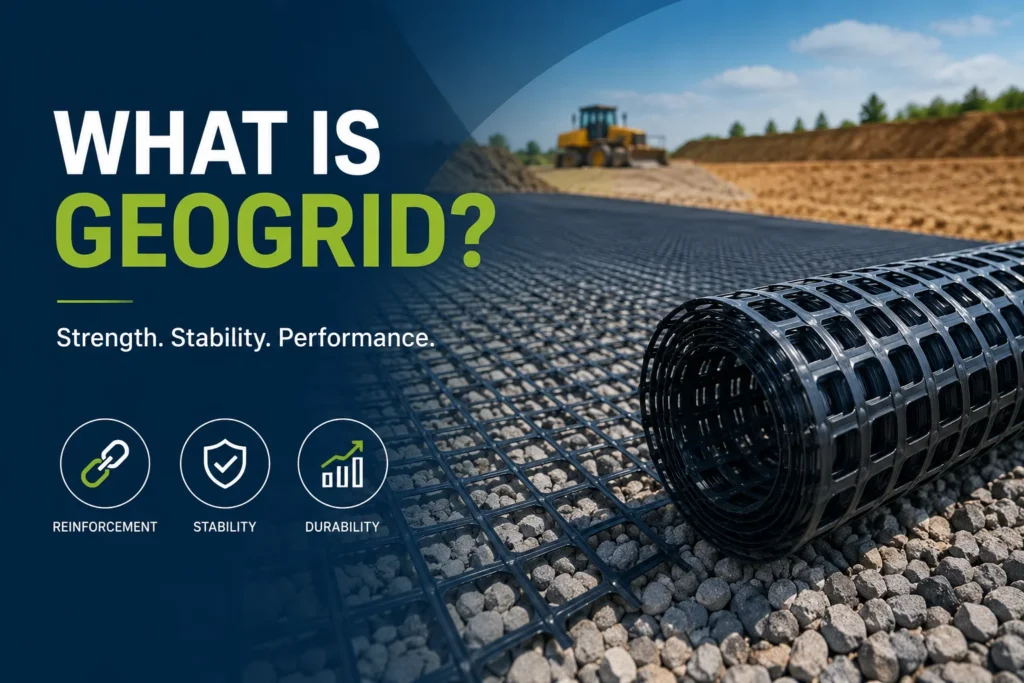
Geogrid is a geosynthetic reinforcement material used in civil engineering to improve the mechanical performance of soil through tensile strength and lateral confinement. It works by interlocking with granular soil or aggregate particles, restricting lateral movement and redistributing applied loads over a wider area.
Unlike geotextiles, which primarily provide separation and filtration, geogrids are structural reinforcement elements used in roads, retaining walls, slopes, and foundation stabilization systems.
The effectiveness of geogrid depends on soil conditions (such as CBR), aggregate size compatibility, tensile modulus, junction efficiency, and installation quality.
To better understand how geogrid is applied in real engineering projects, it is important to look at its main application scenarios in civil infrastructure systems.
1. What Is Geogrid?
Geogrid is a polymer-based geosynthetic material manufactured in a grid or mesh structure designed specifically for soil reinforcement applications.
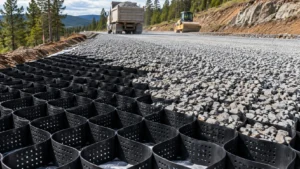
One of the most common engineering applications of geogrid is in road construction, where it is used to reinforce weak subgrades and improve pavement performance under traffic loading.
It is not a drainage or filtration material.
Its core engineering purpose is:
To increase soil stability by improving load distribution and reducing deformation in weak subgrades.
Common materials:
- PP (Polypropylene)
- HDPE (High-Density Polyethylene)
- PET (Polyester)
Each material has different stiffness, creep resistance, and long-term durability characteristics.
2. How Geogrid Works
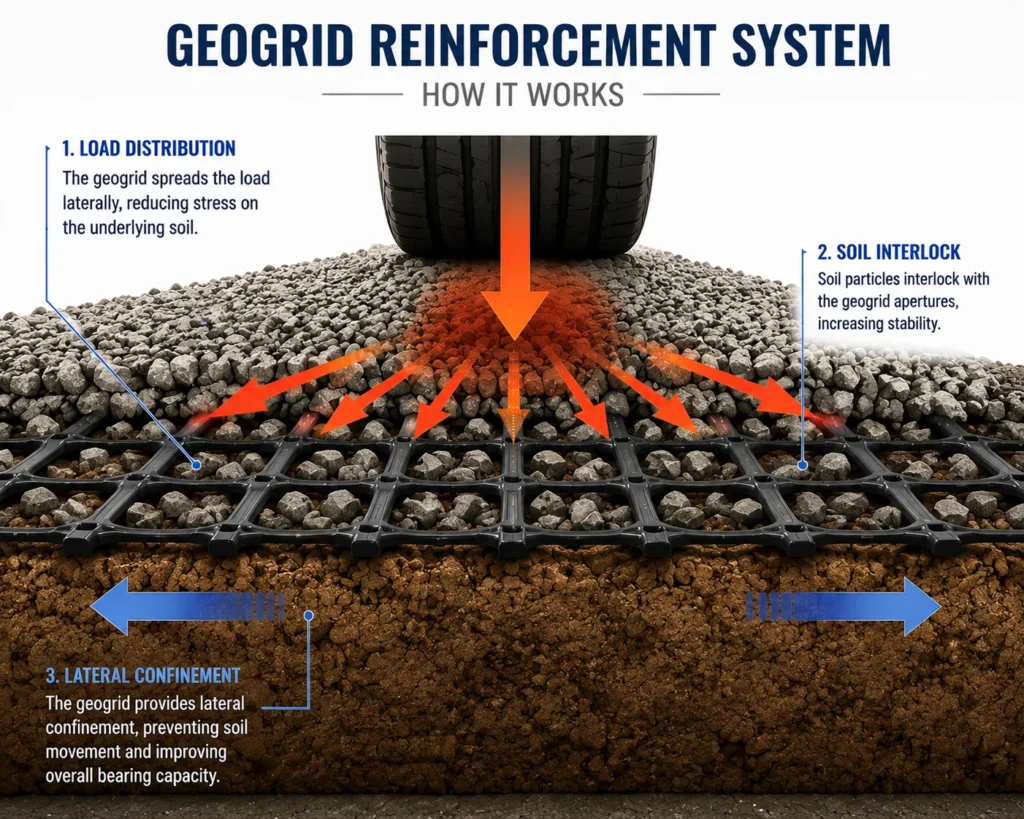
Geogrid improves soil performance through a mechanical process called:
Soil–Geogrid Interlock System
Step-by-step mechanism:
- Geogrid is placed within or beneath aggregate layers
- Soil particles enter and lock into apertures
- Lateral movement of aggregate is restricted
- Load is distributed across a wider soil area
- Differential settlement and rutting are reduced
Engineering effect:
- Increases bearing capacity
- Reduces deformation under traffic load
- Improves long-term structural stability
In retaining wall systems, geogrid is commonly used to reinforce soil behind the wall structure, increasing stability and reducing lateral earth pressure.
3. Main Types of Geogrid
Geogrid is also widely used in slope stabilization and embankment reinforcement, where it improves shear resistance and reduces the risk of soil movement in steep terrain conditions.
3.1 Biaxial Geogrid
- Equal strength in two directions
- Designed for road base reinforcement
- Improves pavement and platform stability
Typical use cases:
- Roads
- Parking lots
- Working platforms
3.2 Uniaxial Geogrid
- High tensile strength in one direction
- Designed for vertical load resistance
Typical use cases:
- Retaining walls
- Steep slopes
- Embankments
3.3 Triaxial Geogrid
- Radial load distribution system
- Improved aggregate confinement efficiency
Typical use cases:
- High-performance pavements
- Heavy load infrastructure
4. Geogrid vs Geotextile
| Feature | Geogrid | Geotextile |
|---|---|---|
| Primary function | Reinforcement | Filtration / separation |
| Structure | Open grid | Continuous fabric |
| Load behavior | Tensile interlock | Passive layer |
| Engineering role | Structural element | Functional barrier |
| Main applications | Roads, walls, slopes | Drainage, separation |
Key principle:
Geogrid = structural reinforcement system
Geotextile = functional separation/filter layer
5. Engineering Properties That Control Performance
Geogrid performance is governed by measurable engineering parameters:
- Tensile strength (kN/m)
- Modulus at low strain (2%–5%)
- Aperture size compatibility
- Junction efficiency (>90% in high-quality grids)
- Creep resistance under long-term load
Why this matters:
These properties determine:
- Soil interlock efficiency
- Load transfer capacity
- Long-term deformation behavior
6. Where Geogrid Is Used
Geogrid is used when soil alone cannot safely support structural loads.
Core applications:
- Road construction & pavement reinforcement
- Retaining wall systems
- Slope stabilization & embankments
- Soft soil foundation improvement
- Working platform stabilization
In low-load applications such as gravel driveways, geogrid is used to improve surface stability and prevent rutting caused by repeated vehicle traffic.
7. When Geogrid Is Required (Design Logic)
Geogrid is typically required under the following conditions:
- Low subgrade strength (low CBR soil)
- Heavy traffic or cyclic loading
- Weak or compressible soil layers
- Settlement control requirements
- Infrastructure requiring long service life
Engineering logic:
If soil shear strength is insufficient → geogrid introduces tensile reinforcement.
8. When Geogrid Should NOT Be Used Alone
Geogrid performance can fail if:
- Subgrade is not properly compacted
- Aggregate size is incompatible with aperture
- Installation damage occurs
- No confinement layer exists
- Design thickness is underestimated
Important principle:
Geogrid is part of a system, not a standalone solution.
9. Key Engineering Insight
Based on real engineering applications:
Most geogrid failures are caused by:
- Improper installation rather than material failure
- Incorrect aggregate selection
- Lack of base layer preparation
- Overestimation of reinforcement effect
Critical conclusion:
Geogrid performance depends more on soil–structure interaction quality than on product strength alone.
10. Why Geogrid Is Important in Modern Engineering
Geogrid is widely used because it:
- Reduces aggregate consumption
- Extends pavement service life
- Improves stability of weak soils
- Enables construction on marginal ground conditions
- Optimizes project cost vs performance balance
11. Common Engineering Mistakes
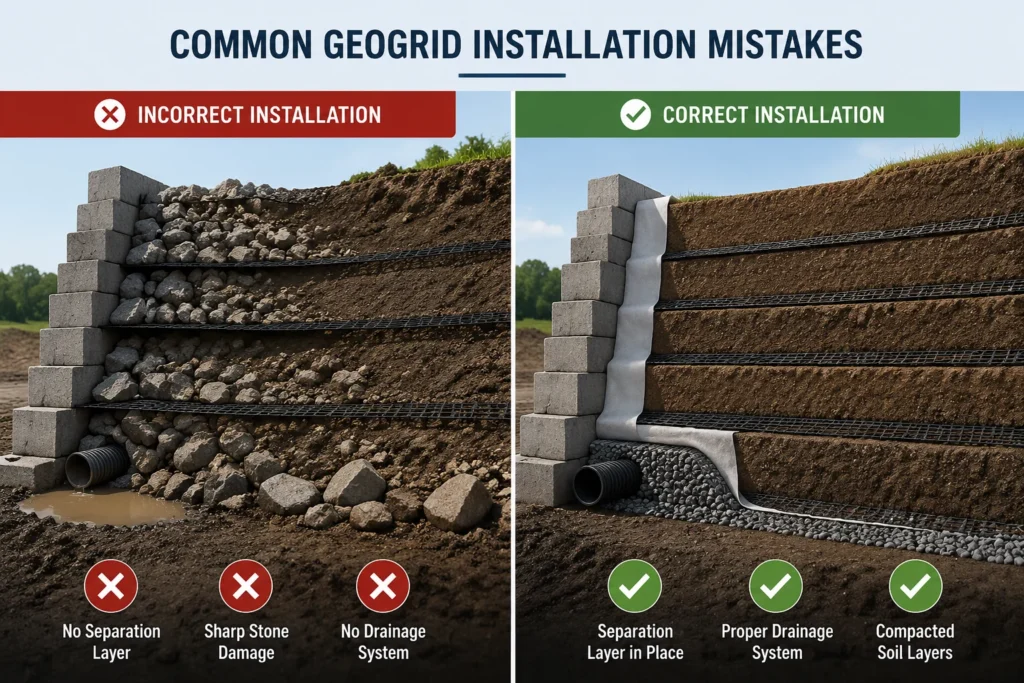
- Selecting wrong type (biaxial vs uniaxial mismatch)
- Ignoring CBR and subgrade conditions
- Insufficient overlap during installation
- Using incorrect aggregate size
- Assuming geogrid alone solves poor soil conditions
12. Definition Summary
Geogrid is a geosynthetic reinforcement material designed to improve soil performance through tensile strength and mechanical interlocking. It is used in civil engineering applications such as roads, retaining walls, and slope stabilization systems.
Its effectiveness depends on proper design, soil conditions, aggregate compatibility, and installation quality. It should always be treated as part of a structural soil system rather than an independent construction layer.