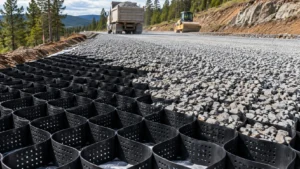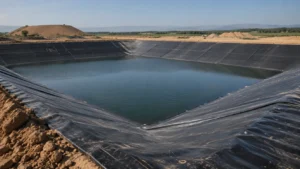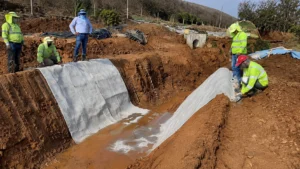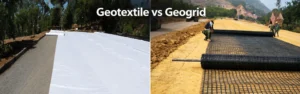
Quick Answer
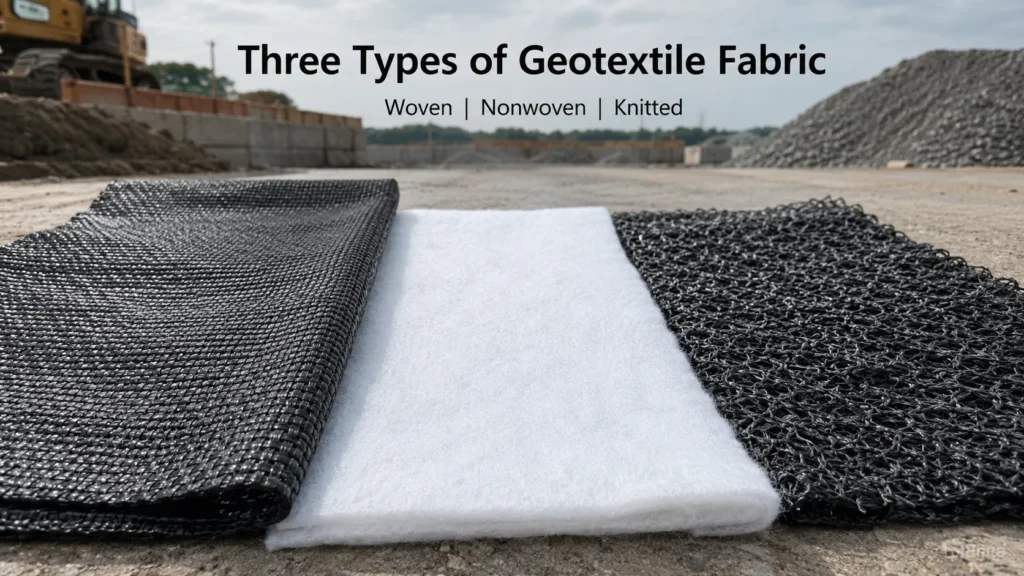
The three main types of geotextile fabric are woven geotextile, nonwoven geotextile, and knitted geotextile.
Each type is made differently and performs differently in soil, drainage, road, erosion control, and liner protection applications.
In simple terms:
Woven geotextile is mainly used for strength, separation, and stabilization.
Nonwoven geotextile is mainly used for filtration, drainage, cushioning, erosion control, and geomembrane protection.
Knitted geotextile is less common, but it can be used in specialized reinforcement, drainage, or erosion control systems where flexibility and engineered performance are required.
For most construction, landscaping, road, drainage, and geomembrane protection projects, the two most common choices are woven and nonwoven geotextiles.
Key Takeaways
- The three main types of geotextile fabric are woven, nonwoven, and knitted.
- Woven geotextile is usually selected for road base separation, soil stabilization, and load support.
- Nonwoven geotextile is usually selected for filtration, drainage, cushioning, and liner protection.
- Knitted geotextile is less common and is usually used for specialized geosynthetic applications.
- Other names such as slit-film, monofilament, needle-punched, heat-bonded, spunbond, and composite often describe subtypes or manufacturing variations.
- Geotextile fabric is permeable. It is not the same as a geomembrane liner.
- In geomembrane systems, nonwoven geotextile is often used as a protection layer to reduce puncture risk.
What Is Geotextile Fabric?
For a broader explanation of geotextile functions such as filtration, separation, drainage, and protection, see our guide on what geotextile is used for.
Geotextile fabric is a permeable geosynthetic material used with soil, aggregate, rock, or other construction layers. It is designed to improve soil performance, manage water movement, separate materials, and protect engineered systems.
Geotextile fabric is commonly used for:
- Soil separation
- Filtration
- Drainage
- Erosion control
- Road base stabilization
- Retaining wall drainage
- Slope protection
- Landscaping
- Pond liner protection
- Geomembrane cushioning
- Subgrade improvement
Unlike a geomembrane, geotextile fabric is not mainly used to stop water leakage. A geomembrane is a low-permeability polymer sheet used as a barrier against liquids and gases, while geotextile is a permeable fabric used to manage soil and water movement. Solmax describes geomembranes as thin polymer sheets that act as barriers against liquids and gases, and Geosynthetics Magazine also classifies geomembranes as low-permeability liners or barriers.
This difference is important:
geomembrane blocks water, while geotextile filters, separates, drains, protects, or reinforces.
The Three Main Types of Geotextile Fabric
Geotextile fabric is usually classified by how it is made. The three main structures are:
| Type | Structure | Main Function | Common Uses |
|---|---|---|---|
| Woven geotextile | Interlaced yarns, tapes, or filaments | Separation, stabilization, reinforcement | Roads, driveways, parking lots, embankments |
| Nonwoven geotextile | Bonded fibers, usually needle-punched or heat-bonded | Filtration, drainage, cushioning, protection | Drainage, erosion control, liner protection, landscaping |
| Knitted geotextile | Interlocking loops of yarn | Specialized reinforcement or flexible support | Slope protection, erosion control, specialty systems |
Palmetto Industries also identifies woven, nonwoven, and knitted geotextiles as the main categories, while listing additional variations such as monofilament, slit film, needle-punched, heat-bonded, spunbond, composite, and drainage geocomposites.
The key point is that not every name is a separate “main type.” Many are subtypes or manufacturing variations under woven, nonwoven, knitted, or composite geotextile systems.
Type 1: Woven Geotextile Fabric
Woven geotextile fabric is made by weaving synthetic yarns, filaments, or slit-film tapes together. The result is a strong, stable fabric structure.
Because of this woven structure, woven geotextile usually has higher tensile strength and lower elongation than many nonwoven fabrics. This makes it useful where the project needs separation, stabilization, and load support.
Main Functions of Woven Geotextile
Woven geotextile is commonly used for:
- Separation
- Stabilization
- Reinforcement
- Load distribution
- Subgrade support
- Aggregate base support
It is especially useful where soft soil may mix with aggregate or where the base layer needs additional stability under traffic or construction loads.
Common Applications
Woven geotextile is commonly used in:
- Road construction
- Gravel driveways
- Parking areas
- Construction access roads
- Embankments
- Railways
- Unpaved roads
- Soft subgrade stabilization
- Aggregate base separation
For example, in a gravel driveway or unpaved road, woven geotextile can be placed between the soft subgrade and the aggregate base. This helps prevent aggregate from sinking into the soil and helps maintain the base layer over time.
Advantages of Woven Geotextile
The main advantages are:
- High tensile strength
- Strong soil separation
- Good load support
- Useful for roads and driveways
- Good dimensional stability
Limitations of Woven Geotextile
Woven geotextile is not always the best choice for filtration or drainage. Some woven fabrics have lower permeability than nonwoven fabrics. If water flow and soil filtration are the main goals, nonwoven geotextile may be more suitable.
Type 2: Nonwoven Geotextile Fabric
Nonwoven geotextile fabric is made by bonding synthetic fibers together instead of weaving them. The fibers may be needle-punched, heat-bonded, chemically bonded, or spunbonded.
This creates a felt-like fabric with many small openings. Water can pass through, while soil particles are controlled or retained.
Main Functions of Nonwoven Geotextile
Nonwoven geotextile is commonly used for:
- Filtration
- Drainage
- Separation
- Cushioning
- Protection
- Erosion control
This type is especially useful when water must pass through the fabric while soil particles are prevented from moving into the drainage layer.
Common Applications
Nonwoven geotextile is commonly used in:
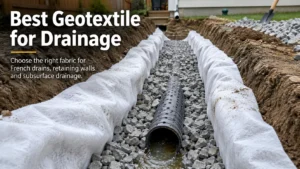
- French drains
- Drainage trenches
- Retaining wall drainage
- Landscape drainage
- Erosion control
- Slope protection
- Under riprap
- Pond liner protection
- Landfill liner protection
- Geomembrane cushioning
- Wastewater lagoon liner protection
For example, in a retaining wall drainage system, nonwoven geotextile can wrap the drainage aggregate or pipe. Water can pass through, but soil particles are filtered out, reducing the risk of clogging.
In geomembrane liner systems, nonwoven geotextile is often placed under or above the geomembrane to reduce puncture risk from stones, rough subgrade, or cover soil. AGRU notes that geomembranes can be combined with other geosynthetics such as geotextiles for additional functionality.
Advantages of Nonwoven Geotextile
The main advantages are:
- Good water permeability
- Strong filtration performance
- Good cushioning and protection
- Flexible and easy to install
- Suitable for drainage systems
- Useful under or above geomembrane liners
Limitations of Nonwoven Geotextile
Nonwoven geotextile may not provide the same tensile strength as woven geotextile in high-load stabilization projects. It is also not waterproof.
If your project needs to stop water leakage, you need a geomembrane liner, not geotextile fabric.
Type 3: Knitted Geotextile Fabric
Knitted geotextile fabric is made by interlocking loops of yarn or fibers. It is less common than woven and nonwoven geotextile, but it can be useful in specialized engineering applications.
Knitted geotextiles can provide flexibility and engineered performance depending on the yarn, structure, and project design.
Main Functions of Knitted Geotextile
Knitted geotextile may be used for:
- Reinforcement
- Drainage support
- Erosion control
- Soil stabilization
- Flexible geosynthetic systems
- Specialty composite products
Because knitted structures can conform more easily to irregular surfaces, they may be used where flexibility and site adaptation are important.
Common Applications
Knitted geotextile may appear in:
- Specialty reinforcement systems
- Drainage composites
- Erosion control systems
- Slope stabilization
- Coastal protection
- Turf reinforcement
- Engineered geosynthetic products
For most buyers and contractors, knitted geotextile is not the first option. Woven and nonwoven geotextiles are much more common in standard road, drainage, landscaping, and liner protection applications.
Advantages of Knitted Geotextile
The main advantages are:
- Flexible structure
- Good conformability
- Specialized performance options
- Potential use in engineered systems
Limitations of Knitted Geotextile
Knitted geotextile is less common and may require more project-specific specification. It is not usually the default choice for standard road base, driveway, drainage, or pond liner protection projects.
Woven vs Nonwoven vs Knitted Geotextile
| Feature | Woven Geotextile | Nonwoven Geotextile | Knitted Geotextile |
|---|---|---|---|
| Structure | Woven yarns or tapes | Bonded fibers | Interlocking loops |
| Main purpose | Separation and stabilization | Filtration, drainage, protection | Specialized reinforcement or flexibility |
| Water flow | Usually lower than nonwoven | Usually higher | Depends on design |
| Tensile strength | Usually high | Moderate to high depending on grade | Depends on design |
| Flexibility | Moderate | High | High |
| Best for roads | Yes | Sometimes | Rarely |
| Best for drainage | Sometimes | Yes | Sometimes |
| Best for geomembrane protection | Sometimes | Yes | Sometimes |
| Best for erosion control | Sometimes | Yes | Sometimes |
| Common availability | Very common | Very common | Less common |
Other Specialized Geotextile Variations
Although woven, nonwoven, and knitted geotextiles are the three main types, many products are further described by material structure, bonding method, or engineering function.
These names are useful, but they should not confuse the main classification.
Monofilament Woven Geotextile
Monofilament woven geotextile is made from single continuous filaments. It can provide both strength and moderate water flow, making it useful in applications where filtration and durability are both important.
Common uses include marine construction, drainage, erosion control, and some road or landfill applications.
Slit-Film Woven Geotextile
Slit-film woven geotextile is made by cutting plastic sheets into flat tapes and weaving them together. It usually provides high tensile strength and good separation, but it often has lower filtration performance.
This type is commonly used for roads, driveways, parking lots, and base stabilization where strength and soil separation are more important than drainage.
Needle-Punched Nonwoven Geotextile
Needle-punched nonwoven geotextile is one of the most common nonwoven types. It has a felt-like structure and is widely used for filtration, drainage, cushioning, and geomembrane protection.
Common uses include French drains, retaining wall drainage, erosion control, pond liner protection, and landfill liner protection.
Heat-Bonded Nonwoven Geotextile
Heat-bonded nonwoven geotextile is made by bonding fibers with heat. It is often used in lightweight separation, filtration, landscaping, agriculture, and surface stabilization applications.
Spunbond Nonwoven Geotextile
Spunbond nonwoven geotextile is made from continuous filaments bonded into a uniform sheet. It is often used where lightweight separation, filtration, weed control, or consistent fabric structure is required.
Composite Geotextiles
Composite geotextiles combine two or more geosynthetic materials to provide multiple functions in one system. For example, a composite may combine filtration, drainage, reinforcement, or barrier support.
Palmetto’s list includes composite geotextiles, geogrid-geotextile composites, drainage geocomposites, and bituminous-coated geotextiles as specialized variations beyond the three main fabric structures.
Why This Topic Appears Under “Geomembrane” Searches
If you are comparing permeable fabric with waterproof liner materials, read our geomembrane vs geotextile guide.
For a basic explanation of HDPE liner materials, you can also read our HDPE and geomembrane comparison guide.
This question often appears when users search for geomembrane because geotextile and geomembrane are frequently used together in liner systems.
A geomembrane is the waterproof or low-permeability barrier. It prevents liquid or gas migration. Geotextile is the permeable protection, filtration, drainage, or separation layer.
Solmax describes geomembranes as containment specialists used to prevent uncontrolled movement of water, leachate, chemicals, or vapors. Western Liner also explains that geomembranes are synthetic membrane liners used to control fluid migration.
In a real project, the system may look like this:
Prepared subgrade
↓
Nonwoven protection geotextile
↓
HDPE geomembrane
↓
Cover geotextile or drainage layer
↓
Soil, aggregate, waste, water, or process liquid- The geomembrane blocks leakage.
- The geotextile protects the liner from puncture.
- The geotextile may also support filtration or drainage.
- The two materials are not competitors; they often work together.
Which Type of Geotextile Is Used Under Geomembrane?
If your project also requires a liner material, compare HDPE vs LLDPE geomembrane before selecting the final liner system.
The most common choice under geomembrane is nonwoven geotextile.
Nonwoven geotextile is usually selected because it provides cushioning and protection. It helps reduce puncture risk from stones, rough soil, uneven subgrade, or cover material.
Use nonwoven geotextile under geomembrane when the project involves:
- Pond liner protection
- Landfill liner protection
- Wastewater lagoon liner protection
- Mining pond liner systems
- Canal lining
- Secondary containment
- Rough subgrade conditions
- Cover soil above geomembrane
Woven geotextile may be used in some separation or stabilization layers, but for cushioning and puncture protection, nonwoven geotextile is usually the more common option.
How to Choose the Right Type of Geotextile Fabric
Choosing geotextile fabric should start with project function, not only product name, thickness, or GSM.
Choose Woven Geotextile When You Need Strength
Use woven geotextile when your project needs:
- Road base support
- Driveway stabilization
- Aggregate separation
- Load distribution
- Soft soil stabilization
- Construction access road support
- Embankment reinforcement
Woven geotextile is usually the better choice when the main problem is weak soil, aggregate movement, or base instability.
Choose Nonwoven Geotextile When You Need Filtration or Protection
Use nonwoven geotextile when your project needs:
- Drainage
- Filtration
- Soil particle retention
- Erosion control
- Retaining wall drainage
- French drain wrapping
- Pond liner protection
- Geomembrane cushioning
Nonwoven geotextile is usually the better choice when water must pass through the fabric while soil particles are controlled.
Choose Knitted Geotextile for Specialized Requirements
Use knitted geotextile when the project specification requires:
- Flexible reinforcement
- Specialty erosion control
- Engineered drainage support
- Composite geosynthetic systems
- Conformability over irregular surfaces
For most standard projects, knitted geotextile is less common than woven and nonwoven fabric.
Geotextile Fabric by Project Type
| Project Type | Recommended Type | Reason |
|---|---|---|
| Gravel driveway | Woven geotextile | Helps separate soil and aggregate |
| Unpaved road | Woven geotextile | Improves base stability |
| Road base separation | Woven geotextile | Prevents aggregate and subgrade mixing |
| Parking lot base | Woven geotextile | Supports stabilization and separation |
| French drain | Nonwoven geotextile | Filters soil while allowing water flow |
| Retaining wall drainage | Nonwoven geotextile | Supports drainage and reduces clogging |
| Erosion control under riprap | Nonwoven geotextile | Allows water flow and retains soil |
| Pond liner protection | Nonwoven geotextile | Cushions geomembrane from puncture |
| Landfill liner protection | Nonwoven geotextile | Protects geomembrane and separates layers |
| Landscaping | Nonwoven geotextile | Supports separation, drainage, and weed control |
| Specialty slope system | Knitted or composite geotextile | Used when specified by design |
For landscaping applications, see how geotextile for garden and landscaping projects helps with separation, drainage, and weed control.
Common Mistakes When Choosing Geotextile Fabric
Mistake 1: Thinking All Geotextiles Are the Same
Woven, nonwoven, and knitted geotextiles are made differently and perform differently. A fabric that works well for road stabilization may not be the best choice for drainage or geomembrane protection.
Mistake 2: Choosing Only by GSM
GSM measures fabric weight, but it does not tell the full performance story. Tensile strength, permeability, puncture resistance, apparent opening size, elongation, and project function also matter.
Mistake 3: Using Woven Geotextile for Every Drainage Project
Woven geotextile can separate soil and aggregate, but it may not provide the same filtration and water flow performance as nonwoven geotextile.
For French drains, retaining wall drainage, and erosion control, nonwoven geotextile is often more suitable.
Mistake 4: Using Nonwoven Geotextile for Every Road Project
Nonwoven geotextile can help with separation and drainage, but for high-strength stabilization and load support, woven geotextile may be more appropriate.
Mistake 5: Confusing Geotextile with Geomembrane
Geotextile is permeable. It is not a waterproof liner.
If the project needs waterproofing, anti-seepage control, pond lining, or chemical containment, a geomembrane liner is usually required.
Is Woven or Nonwoven Geotextile Better?
Neither woven nor nonwoven geotextile is always better. They are used for different functions.
Woven geotextile is usually better for strength, separation, and stabilization.
Nonwoven geotextile is usually better for filtration, drainage, cushioning, and protection.
For example:
A gravel road over weak soil may need woven geotextile.
A drainage trench behind a retaining wall may need nonwoven geotextile.
A pond liner system may need nonwoven geotextile under the geomembrane for protection.
The best choice depends on what the fabric must do in the project.
Final Recommendation
The three main types of geotextile fabric are woven, nonwoven, and knitted.
Use woven geotextile when the project needs strength, separation, and stabilization. It is commonly used under roads, driveways, parking areas, access roads, and aggregate base layers.
Use nonwoven geotextile when the project needs filtration, drainage, cushioning, erosion control, or geomembrane protection. It is commonly used in drainage systems, retaining walls, landscaping, slopes, pond liner protection, and landfill liner systems.
Use knitted geotextile when the project requires specialized flexibility, reinforcement, drainage, or composite performance.
The simplest way to choose is:
Need strength and separation? Choose woven geotextile.
Need filtration and drainage? Choose nonwoven geotextile.
Need liner protection? Choose nonwoven geotextile.
Need special engineered performance? Consider knitted or composite geotextile.
For most standard projects, woven and nonwoven geotextiles are the two main options you will compare.
FAQ
What are the three types of geotextile fabric?
The three main types of geotextile fabric are woven geotextile, nonwoven geotextile, and knitted geotextile. Woven geotextile is mainly used for separation and stabilization, nonwoven geotextile is mainly used for filtration and drainage, and knitted geotextile is used in specialized applications.
What is woven geotextile used for?
Woven geotextile is commonly used for road construction, driveways, parking areas, embankments, construction access roads, and soft subgrade stabilization. It provides high tensile strength and helps separate soil from aggregate.
What is nonwoven geotextile used for?
Nonwoven geotextile is commonly used for filtration, drainage, erosion control, retaining wall drainage, French drains, landscaping, and geomembrane protection. It allows water to pass through while helping retain soil particles.
What is knitted geotextile used for?
Knitted geotextile is used in specialized applications such as reinforcement systems, drainage composites, erosion control, slope stabilization, and engineered geosynthetic products. It is less common than woven and nonwoven geotextile in standard construction projects.
Which is better, woven or nonwoven geotextile?
Woven geotextile is usually better for strength, separation, and stabilization. Nonwoven geotextile is usually better for filtration, drainage, cushioning, and protection. The better choice depends on the project function.
What type of geotextile is best for drainage?
Nonwoven geotextile is usually the best choice for drainage because it allows water to pass through while helping retain soil particles. It is commonly used in French drains, retaining wall drainage, and erosion control systems.
What type of geotextile is best for roads?
Woven geotextile is often used for roads because it provides strong separation and stabilization. It helps prevent aggregate from mixing with weak subgrade soil and supports better base performance.
What type of geotextile is used under geomembrane?
Nonwoven geotextile is commonly used under geomembrane as a protection layer. It cushions the liner and helps reduce puncture risk from stones, rough soil, or uneven subgrade.
Is geotextile fabric waterproof?
No. Geotextile fabric is generally permeable, which means water can pass through it. If your project requires waterproofing or anti-seepage control, a geomembrane liner is usually needed.
Is higher GSM geotextile always better?
No. Higher GSM means heavier fabric, but it does not automatically mean better performance for every project. The correct geotextile should be selected based on tensile strength, permeability, filtration needs, puncture resistance, and project function.