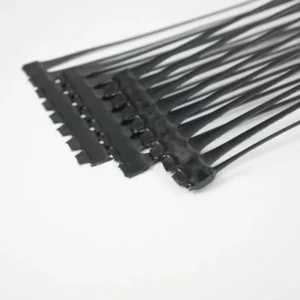
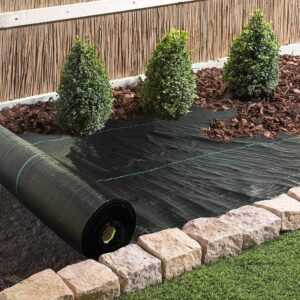
Composite drainage board with a molded HDPE/EVA dimple core and nonwoven geotextile filter layer for below-grade, retaining wall, underground and landscape drainage systems.
Geosynsource supplies composite drainage boards with 8–30 mm dimple heights, 0.8–2.0 mm dimple-sheet thicknesses and multiple technical grades for project procurement and bulk supply.
Available options include PP or PET nonwoven geotextiles, customized roll lengths, and black or white product configurations.
8–30 mm Dimple Height
HDPE / EVA Core Options
PP / PET Nonwoven Geotextile
Technical Data Available
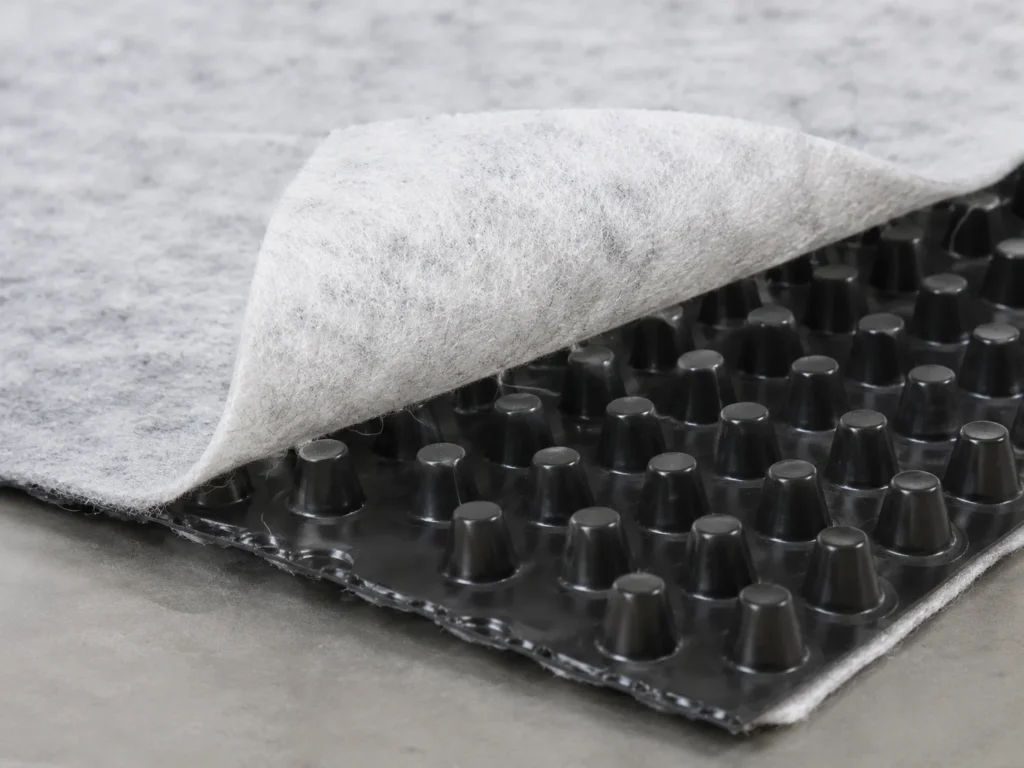
A composite drainage board combines a molded polymer dimple sheet with a nonwoven geotextile filter layer.
The dimpled core creates a continuous drainage space, while the nonwoven geotextile allows water to enter the drainage layer while helping limit the migration of soil particles into the drainage path.
The product is commonly used as part of below-grade drainage, retaining wall, underground structure, roof garden and waterproofing-protection systems.
Important: The drainage board should normally be treated as a drainage and protection layer. It does not automatically replace the primary waterproofing membrane in a below-grade wall system.
| Property | Available Product Data |
|---|---|
| Product Type | Composite Drainage Board |
| Dimple Sheet Material | HDPE / EVA |
| Dimple Sheet Thickness | 0.8–2.0 mm |
| Dimple Height | 8–30 mm |
| Width | 2–3 m |
| Nonwoven Geotextile Weight | >100 g/m² |
| Geotextile Material | PP / PET |
| Length | According to request |
| Color | Black / White / Custom upon request |
| Primary Function | Drainage, filtration and protection |
| Supply Type | Project / Bulk / Customized supply |
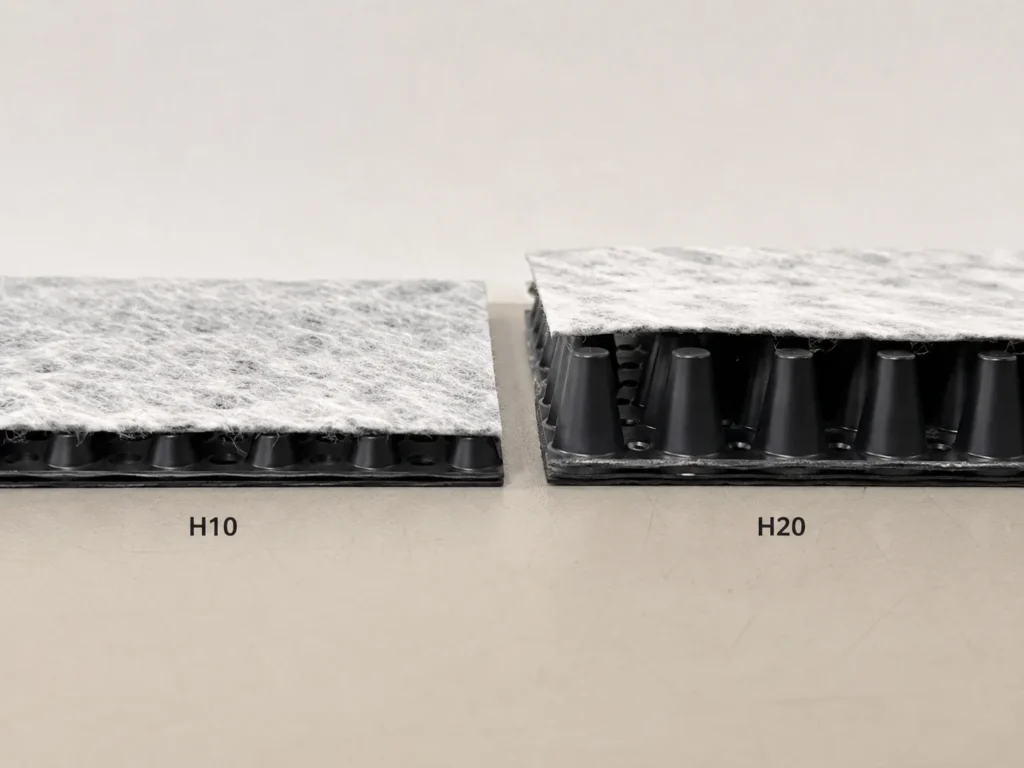
The supplied technical data lists six standard model configurations.
| Model | Tensile Strength | Break Elongation | Stereo Tensile Strength* | Dimensional Stability |
|---|---|---|---|---|
| H10-1.0 | 400 N/5 cm | 200% | 400 | ±2% |
| H20-1.0 | 400 N/5 cm | 200% | 320 | ±2% |
| H10-1.5 | 500 N/5 cm | 300% | 450 | ±2% |
| H20-1.5 | 500 N/5 cm | 300% | 370 | ±2% |
| H10-2.0 | 700 N/5 cm | 400% | 500 | ±2% |
| H20-2.0 | 700 N/5 cm | 400% | 420 | ±2% |
Additional data from the supplied product sheet:
| Property | Technical Data |
|---|---|
| Low-Temperature Bending | No cracking at -35°C |
| Vertical Water Flow Rate at 5 kPa — H10 Models | 5.6 cm³/s |
| Vertical Water Flow Rate at 5 kPa — H20 Models | 8.6 cm³/s |
*Stereo tensile strength is the terminology shown in the supplied technical sheet. The exact test-property name, unit and test method should be confirmed before publication in a formal engineering specification.
The dimple structure forms a continuous void space through which water can move toward the designed drainage outlet.
The supplied technical data reports vertical water-flow values of:
under a stated water pressure of 5 kPa.
These values should be interpreted according to the applicable test setup. They should not automatically be treated as project drainage capacity without considering installation orientation, loading, outlet design and field conditions.
Depending on the model, the supplied sheet reports tensile strength values of:
with break elongation values of:
These values can be used for product comparison and quality-control review when the test method and specimen basis are consistent.
The supplied product data lists dimensional stability at:
±2%
for the referenced model series.
The technical sheet reports:
Bending without cracking at -35°C.
This is useful as a product property, but it should not be presented as proof that the complete installed drainage system will perform identically under every cold-weather project condition.
The molded dimple core creates a continuous channel that allows collected water to move vertically or laterally toward the drainage outlet.
The PP or PET nonwoven geotextile provides the soil-facing filtration layer.
It allows water to pass into the drainage core while helping reduce fine-particle migration into the drainage space.
When installed outside a waterproofed concrete structure, the drainage board can help protect the primary waterproofing layer from direct contact with soil or backfill.
The dimpled core also creates an open space that can allow movement of water and air within the drainage layer.
The supplied product information lists applications including highway and railway waterproofing systems, underground waterproofing and roof-garden projects.
Used outside waterproofed concrete walls to provide vertical drainage and an additional protective layer before backfilling.
Installed behind selected retaining wall systems to collect water and direct it toward a footing drain or other designed outlet.
[Read: Composite Drainage Board for Retaining Walls]
Applicable to selected tunnels, buried structures and underground civil works where drainage and waterproofing protection are required.
Selected drainage-board configurations can be incorporated into roof-garden or landscape drainage assemblies where the complete system design is compatible with the product.
The supplied product sheet also identifies highway and railway waterproofing systems as potential applications.
For these projects, the required product properties should be verified against the actual engineering specification rather than selected only from general product data.
A typical below-grade wall system may include:
Backfill / Soil
↓
Nonwoven Geotextile
↓
HDPE / EVA Dimple Drainage Core
↓
Waterproofing Membrane
↓
Concrete Foundation Wall
↓
Footing Drain / Drainage Outlet
The functions are different:
Waterproofing membrane
→ provides the primary water barrier.
Composite drainage board
→ provides drainage, filtration and physical protection.
Footing drain / outlet
→ removes the collected water from the system.
A drainage board does not make an ineffective waterproofing system unnecessary. Drainage and waterproofing should be evaluated as separate but complementary functions.
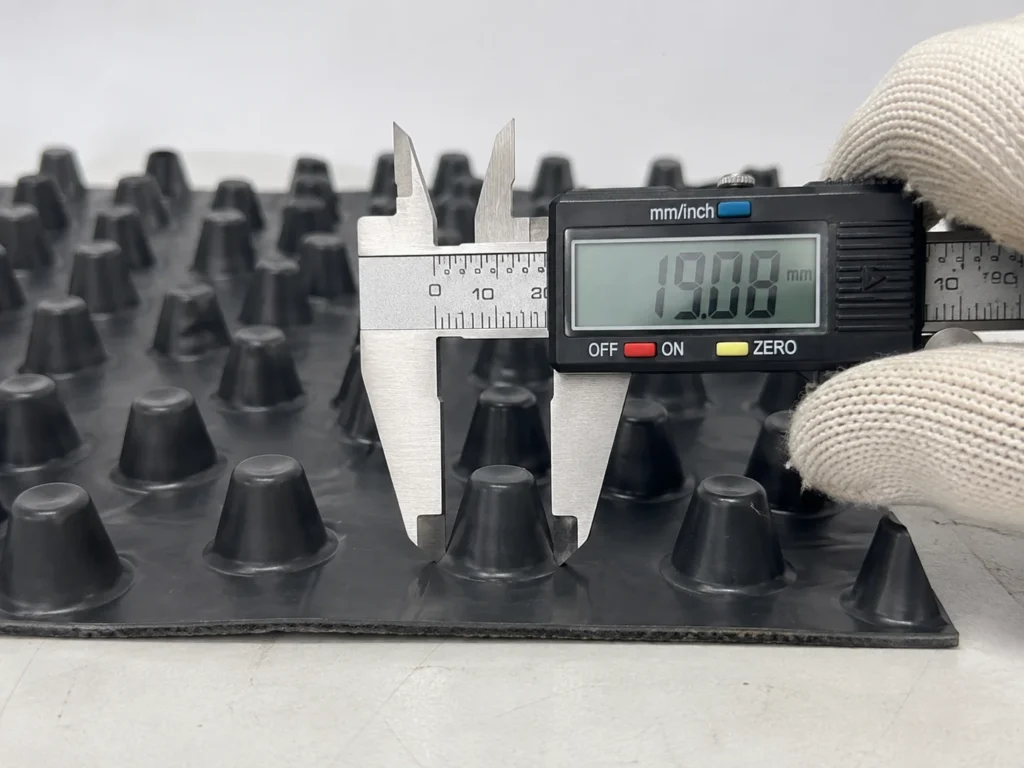
Available dimple heights range from approximately 8 to 30 mm according to the supplied product information.
Higher dimple profiles may create a larger drainage space, but dimple height alone does not determine complete system performance.
Available dimple-sheet thickness is listed as:
0.8–2.0 mm.
The required thickness should be selected together with mechanical loading and project specification.
Compare the available water-flow data under a consistent test condition.
For the referenced models, the technical sheet reports:
Available filter fabrics include:
PP or PET nonwoven geotextile
with the supplied sheet listing a weight above:
100 g/m².
The final geotextile selection should consider the soil and filtration requirements of the project.
The supplied product information lists:
2–3 m width
with roll length available according to customer requirements.
The drainage board should be compatible with the waterproofing system, attachment method and wall detail used in the project.
| Factor | Composite Drainage Board | Gravel Drainage Layer |
|---|---|---|
| Drainage Space | Molded dimple core | Aggregate voids |
| Filter Layer | Can integrate nonwoven geotextile | Usually requires separate filtration design |
| Thickness | Relatively compact | Usually requires larger drainage zone |
| Handling | Supplied in sheets / rolls | Bulk material |
| Wall Protection | Can protect waterproofing | Depends on aggregate and protection layer |
| Flow Performance | Can be supported by product test data | Depends heavily on aggregate gradation and field placement |
| Selection Basis | Product data + system requirements | Aggregate design + system requirements |
Neither system is automatically superior in every project. Selection depends on water conditions, wall geometry, available space, backfill, drainage outlet and project specification.
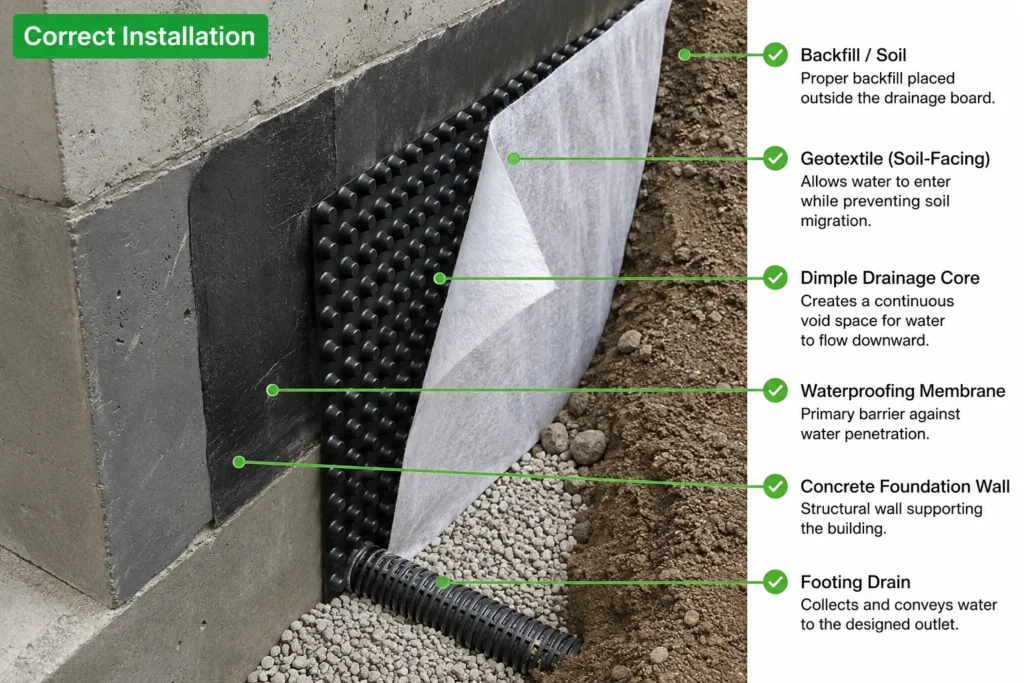
Complete substrate preparation and primary waterproofing before installing the drainage board where required by the wall system.
The nonwoven geotextile normally faces the soil or drainage medium so that water can enter the drainage core while soil particles are filtered.
Position the drainage board to maintain a continuous path from the upper drainage area toward the outlet.
Use attachment methods that are compatible with the drainage board and waterproofing system.
The lower edge of the drainage layer should allow collected water to reach the footing drain or other designed discharge route.
Avoid excessive crushing, puncturing or displacement of the drainage board during construction.
Exact overlap, attachment, termination and outlet details should follow the current product installation instructions and project drawings.
Geosynsource can provide technical information to support product comparison, project review and procurement.
Depending on the selected product and order requirements, documentation may include:

According to the supplied product information, available supply options include:
For project procurement, final model selection and customization should be confirmed against the required technical specification.
For a more accurate quotation, please provide:
Have a BOQ or Technical Specification?
[Send Your Requirements for Review]
Different dimple heights, sheet thicknesses, geotextile materials and product widths are available according to the supplied product range.
Model-level mechanical and drainage data are available for product review.
Product width, roll length and selected product configurations can be matched to purchasing requirements subject to technical confirmation.
Samples, TDS and applicable product documentation can be provided for procurement evaluation.
Bulk-order packaging and international shipping support can be arranged according to order requirements.
Learn how drainage boards work within foundation, basement and below-grade drainage systems.
[Read the Composite Drainage Board Application Guide]
Learn how wall drainage, filtration and drainage outlets work together behind retaining walls.
Understand the differences between drainage, filtration, waterproofing protection and water management.
[Read the Drainage Board Purpose Guide]
→ what-is-the-purpose-of-a-drainage-board
A composite drainage board combines a molded polymer drainage core with a nonwoven geotextile filter layer. It is used to create a continuous drainage path while filtering soil particles and protecting adjacent layers.
The supplied product information lists HDPE and EVA for the dimple sheet and PP or PET for the nonwoven geotextile.
The current product information lists dimple heights from approximately 8 mm to 30 mm.
The supplied specification lists dimple-sheet thicknesses from 0.8 mm to 2.0 mm.
The supplied product data lists widths from 2 m to 3 m, while roll length can be supplied according to order requirements.
The supplied technical sheet reports vertical water-flow rates of 5.6 cm³/s for H10 models and 8.6 cm³/s for H20 models at a stated water pressure of 5 kPa.
Normally, no. It is primarily a drainage, filtration and protection layer. The waterproofing membrane remains the primary water-resisting layer unless a specific engineered system has been designed differently.
The supplied product information identifies roof-garden waterproofing projects as one of the application areas. Final use should be confirmed against the complete roof or landscape drainage-system requirements.
Need composite drainage board for a foundation, retaining wall, underground structure or landscape drainage project?
Send us your:
required model, dimple height, sheet thickness, geotextile requirement, width, quantity and destination.
Geosynsource can provide available configurations, technical data and quotation support for procurement review.
[Request Composite Drainage Board Quote]