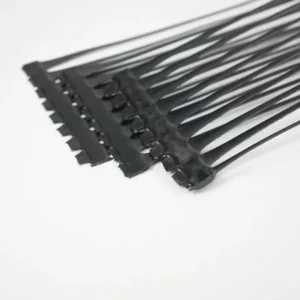
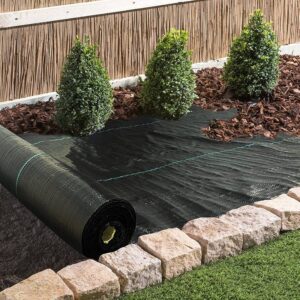
Woven geotextile for soil separation and engineered reinforcement applications.
GeoSynSource supplies polypropylene (PP) and polyester (PET) woven geotextile fabric for civil engineering projects. Our catalogue includes PP flat-yarn woven fabric and high-tenacity PET woven geotextile, with separate specifications for each series.
Choose the product by its required function, directional tensile strength, elongation, opening size and hydraulic performance.
Request Technical Data
Get a Project Quote
| Specification | PP Woven Geotextile | PET Woven Geotextile |
|---|---|---|
| Polymer | Polypropylene | Polyester |
| Structure | Woven flat yarns | Woven high-tenacity polyester yarns |
| Catalogue range | 75–400 g/m² | Listed tensile grades of 35–250 kN/m |
| Catalogue width | 1–6 m | 1–6 m |
| Length | On request | Confirm with quotation |
| Colour | White, black or green; other options on request | Confirm with quotation |
| Selection basis | Required mechanical and hydraulic properties | Required mechanical, hydraulic and long-term design properties |
Catalogue ranges describe the product family. Confirm the exact grade, roll configuration and technical data sheet before ordering.
PP woven geotextile is manufactured by weaving polypropylene flat yarns. It provides a fabric structure for applications requiring separation and specified tensile performance.
The catalogue lists uses in roads, railways, earthworks and other civil engineering projects.
For road separation, the fabric helps limit the mixing of subgrade soil and aggregate. Where reinforcement is required, the proposed product must meet the tensile, deformation and durability requirements of the design.
| Nominal Mass (g/m²) | Breaking Strength, MD (kN/m) | Breaking Strength, CD (kN/m) | Trapezoidal Tear Strength (kN) |
|---|---|---|---|
| 120 | 20 | 15 | 0.20 |
| 160 | 30 | 22 | 0.27 |
| 200 | 40 | 28 | 0.34 |
| 240 | 50 | 35 | 0.41 |
| 280 | 60 | 42 | 0.48 |
| 340 | 80 | 56 | 0.60 |
| 400 | 100 | 70 | 0.72 |
MD: machine direction. CD: cross-machine direction.
The catalogue table lists an elongation rate of 25%. Confirm its test method, direction and acceptance criteria in the technical data sheet.
The broader catalogue description covers 75–400 g/m²; the table above presents the listed grades with corresponding strength values.
PET woven geotextile is manufactured from high-tenacity polyester yarns.
The catalogue identifies reinforcement applications including embankments over soft soil and reinforced slopes. Suitability depends on the project design and the documented properties of the selected product.
For permanent reinforcement, ultimate tensile strength alone is insufficient. The design may also require creep data, installation-damage allowances, durability assessment and soil–geotextile interaction properties.
| Catalogue Strength Grade, MD/CD (kN/m) | Listed Mass (g/m²) | Tear Strength (kN) |
|---|---|---|
| 35 / 35 | 140 | 0.5 |
| 50 / 50 | 220 | 0.8 |
| 65 / 65 | 260 | 1.1 |
| 80 / 80 | 320 | 1.3 |
| 100 / 100 | 390 | 1.5 |
| 120 / 120 | 450 | 1.7 |
| 140 / 140 | 530 | 1.9 |
| 160 / 160 | 600 | 2.1 |
| 180 / 180 | 680 | 2.3 |
| 200 / 200 | 760 | 2.5 |
| 250 / 250 | 950 | 3.0 |
The catalogue lists elongation at break as MD 35% and CD 30%. Confirm whether these are nominal or limiting values and verify the applicable test method before approval.
Catalogue values are provided for product identification. Contractual acceptance requirements should be agreed against the approved technical data sheet.
Request Grade-Specific Technical Data
A woven geotextile can separate prepared subgrade from an aggregate layer, helping limit the intermixing of the two materials.
Potential applications include:
Selection should consider soil condition, aggregate size, installation stresses, construction traffic and water movement.
Separation and reinforcement are different design functions. Where additional structural support is required, assess whether the selected geotextile or another reinforcement product meets the engineering requirements.
For a gravel driveway, woven geotextile may be suitable where separation and specified tensile performance are required.
It should not be selected solely because the fabric is described as woven or heavy duty. Check installation survivability, soil conditions and drainage requirements.
Read our geotextile fabric for driveway guide for a comparison of selection factors.
Selected woven geotextile grades may be specified for reinforced earthworks, including embankments over soft ground and reinforced slopes.
The required information may include:
For directional products, roll orientation must follow the design. The PP catalogue grades have different MD and CD strengths, so the two directions should not be treated as interchangeable.
Send your design specification for product review.
Woven structure alone does not establish filtration suitability.
The catalogue lists an opening-size range of 0.07–0.50 mm, labelled O90 (O95), for both product families. Confirm the exact opening-size designation, test method and value for the proposed grade.
A filtration specification should account for:
If drainage filtration is the main requirement, compare the proposed woven grade with an appropriate nonwoven geotextile.
Woven geotextile is not a waterproof liner.
| Project Requirement | Information to Review |
|---|---|
| Soil–aggregate separation | Opening size, strength, installation survivability and hydraulic properties |
| Directional tensile requirement | MD and CD values, strain behaviour and installation orientation |
| Permanent reinforcement | Long-term design strength, creep, durability and soil interaction |
| Drainage filtration | Soil retention, flow performance and clogging assessment |
| Chemical exposure | Polymer compatibility with the actual chemical environment |
| Procurement | Approved grade, roll dimensions, testing and documentation |
Neither polymer name nor fabric weight alone determines suitability.
For a wider comparison of fabric structures, read our woven vs nonwoven geotextile guide.
Specify your required roll width and length when requesting a quotation. Catalogue widths are 1–6 m, subject to confirmation for the selected grade.
For PP woven fabric, the catalogue lists white, black and green colour options. Confirm other colours and marking requirements before ordering.
Please identify the documentation needed for procurement, such as:
Availability and scope should be confirmed with the quotation.
To help us prepare a suitable proposal, send:
We will review the requirements and confirm the proposed series, grade, available documentation and quotation.
Send Your Specification
Get a Project Quote
It is a geotextile manufactured by interlacing yarns. This product range includes polypropylene flat-yarn fabric and high-tenacity polyester woven fabric.
It can be used for soil separation and, when appropriately specified, engineered reinforcement. Filtration use requires confirmation of the fabric’s opening size and hydraulic properties.
They use different polymers and have separate catalogue specifications. Compare the proposed grades using their mechanical, hydraulic and durability properties rather than the polymer name alone.
It may be suitable for separating soil from aggregate. Selection should also consider subgrade conditions, drainage, construction stresses and required tensile performance.
Water can pass through openings in the fabric, but flow performance varies by product. Confirm the specified hydraulic properties for the selected grade.
No. Use an appropriate geomembrane where waterproof containment is required.
Both PP and PET woven geotextile descriptions list widths of 1–6 m. Confirm the available width for your selected grade.
No. Mass per unit area does not establish tensile strength, filtration suitability or long-term reinforcement performance. Use the full project specification.
Send the application, required technical properties, roll dimensions, quantity and destination. Drawings or a BOQ can help define the product requirement.
Send GeoSynSource your specification for PP or PET woven geotextile fabric.
We will confirm the proposed product grade, roll configuration and available technical information for your procurement review.
To make it easier for you to receive a quote, simply leave your information, and we will contact you as soon as possible.