Author: Geosynsource Technical Team
Reviewed by: Application Engineering Team
Last Updated: July 2026
Short Answer
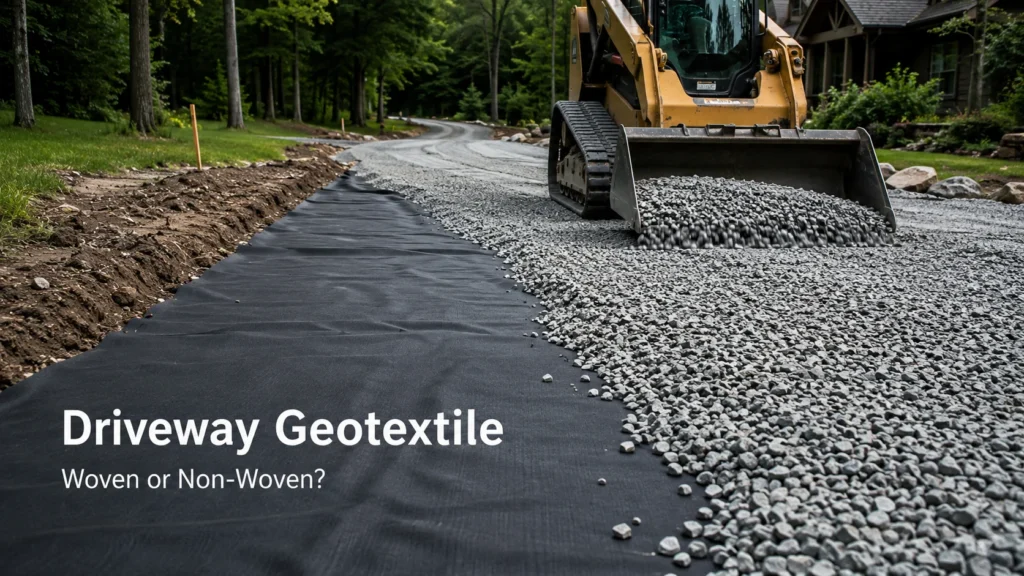
For the main traffic-bearing gravel base of most driveways, woven geotextile fabric is usually the better starting point because the primary function is soil separation and base stabilization. It helps keep crushed stone separated from the subgrade, reducing aggregate contamination and improving the long-term performance of the gravel base.
Non-woven geotextile fabric is usually more suitable for drainage zones, such as French drains, side drains, trench drains, or areas where water filtration is the main function. The final choice should depend on soil condition, water flow, traffic load, aggregate size, base thickness, drainage design, and project requirements.
What Does Geotextile Fabric Do Under a Driveway?
Geotextile fabric is used under a gravel driveway to separate the aggregate base from the soil below. Without a separation layer, crushed stone can gradually sink into soft subgrade, while fine soil particles can migrate upward into the gravel. Over time, this can reduce the effective thickness of the stone base and lead to rutting, soft spots, potholes, and higher maintenance.
In driveway construction, geotextile fabric may help with:
- Soil separation
- Aggregate retention
- Base stabilization
- Rutting reduction
- Subgrade protection
- Long-term maintenance reduction
- Filtration in selected drainage areas
However, geotextile fabric is not a complete driveway design by itself. Driveway performance also depends on subgrade preparation, aggregate thickness, compaction, drainage, traffic load, and installation quality.
Woven or Non-Woven: The Practical Selection Rule
The easiest way to choose is to define the main function first.
| Driveway Condition | Better Starting Point | Why |
|---|---|---|
| Gravel driveway over soil | Woven geotextile | Separation and base stabilization |
| Gravel sinking into soft subgrade | Woven geotextile | Helps keep aggregate and soil separated |
| Repeated vehicle traffic | Woven geotextile | Better suited for traffic-bearing aggregate base |
| Side drain or French drain | Non-woven geotextile | Filtration and water flow |
| Drainage gravel around pipe | Non-woven geotextile | Helps prevent soil fines from entering the drain |
| Ponding or poor surface drainage | Drainage design first | Fabric alone will not solve water problems |
| Heavy trucks or construction access | Woven geotextile or geogrid system | Depends on load, soil and aggregate design |
In simple terms:
Use woven geotextile for the main driveway base when separation and stabilization are the priority.
Use non-woven geotextile in drainage areas where filtration and water movement are the priority.
Why Woven Geotextile Is Commonly Used Under Gravel Driveways
Woven geotextile is commonly selected under gravel driveways because driveway failure is often related to aggregate mixing with the subgrade. When vehicles repeatedly travel over the driveway, the stone base needs to remain clean and separated from the soil below.
A woven geotextile layer helps maintain that separation. This allows the crushed stone layer to perform more consistently as a base instead of being gradually lost into soft or fine-grained soil.
Woven geotextile is commonly considered when the driveway is built over:
- Clay soil
- Silty soil
- Wet or soft subgrade
- Long gravel access roads
- Farm roads
- Residential driveways with repeated vehicle traffic
- Construction access roads
- Parking areas with gravel base
It is important to understand that woven geotextile does not “strengthen” the soil by itself in the same way a structural reinforcement design would. Its main value is helping the aggregate layer remain separated and functional. For very weak subgrade or heavy traffic, additional reinforcement or a thicker aggregate section may be required.
When Non-Woven Geotextile Is Still Useful in Driveway Projects
Non-woven geotextile is not usually the first choice under the main traffic-bearing gravel base. But it can still be important in driveway projects where drainage or filtration is the main concern.
Non-woven geotextile may be used for:
- French drains beside the driveway
- Trench drains
- Side drainage systems
- Underdrains
- Drainage gravel separation
- Erosion control near driveway edges
- Filter wrap around perforated pipe
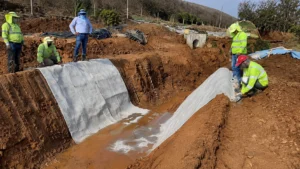
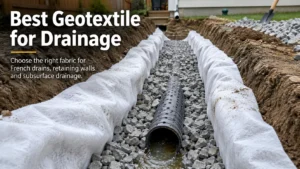
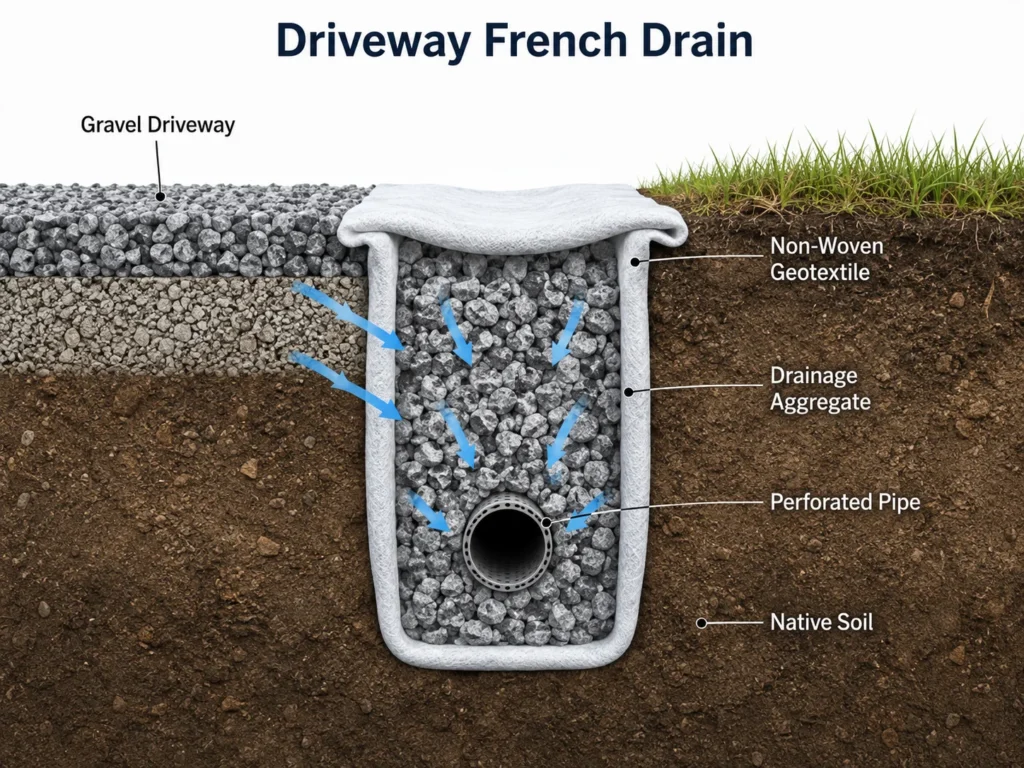
For example, if water collects along the side of a driveway, a French drain may be installed with non-woven geotextile lining the trench. The fabric helps prevent soil fines from entering the drainage gravel and pipe while still allowing water to pass through.
So the better question is not simply “woven or non-woven?” The better question is:
Is this part of the driveway designed for base stabilization or drainage filtration?
Recommended Gravel Driveway Layer Structure
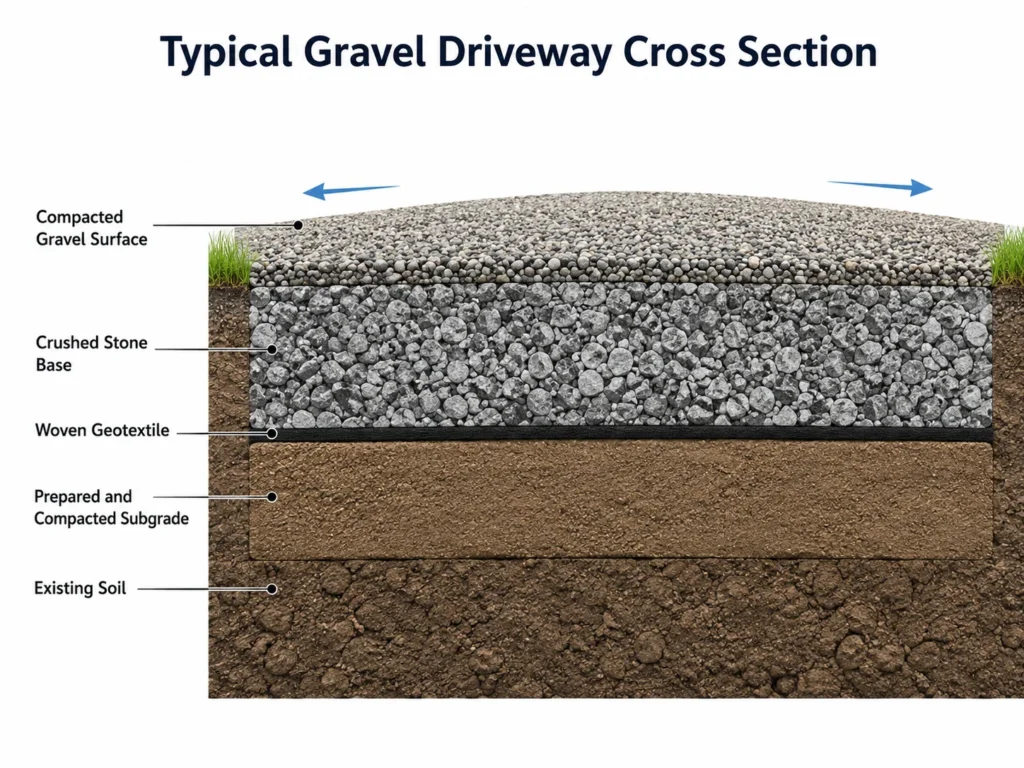
A typical gravel driveway using woven geotextile may include:
- Existing soil or prepared subgrade
- Compacted subgrade
- Woven geotextile fabric
- Crushed stone base
- Compacted gravel surface layer
- Surface grading and side drainage
 a
a
This cross-section shows how woven geotextile is placed between the compacted subgrade and the crushed stone base. Its main role is to keep the aggregate layer separated from the soil below, helping the stone base maintain its thickness and function under repeated traffic loads.When Geotextile Fabric Alone Is Not Enough
Geotextile fabric can improve driveway performance, but it cannot fix every site problem. In some conditions, fabric alone is not enough.
Geotextile fabric may not be enough when:
- The subgrade contains very soft organic soil
- Water remains trapped under or beside the driveway
- There is no outlet for drainage water
- The driveway carries heavy trucks or construction equipment
- The aggregate layer is too thin
- The subgrade is not compacted
- The driveway is built on a steep slope
- The fabric is damaged before being covered
- The project requires engineered road base reinforcement
In these cases, the driveway may require additional drainage, thicker aggregate, geogrid reinforcement, soil improvement, or engineering review.
This section is important because it prevents the article from overpromising. It also makes the page more trustworthy for real engineering buyers.
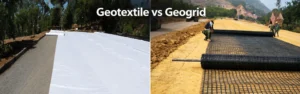
Geotextile vs Geogrid for Driveways
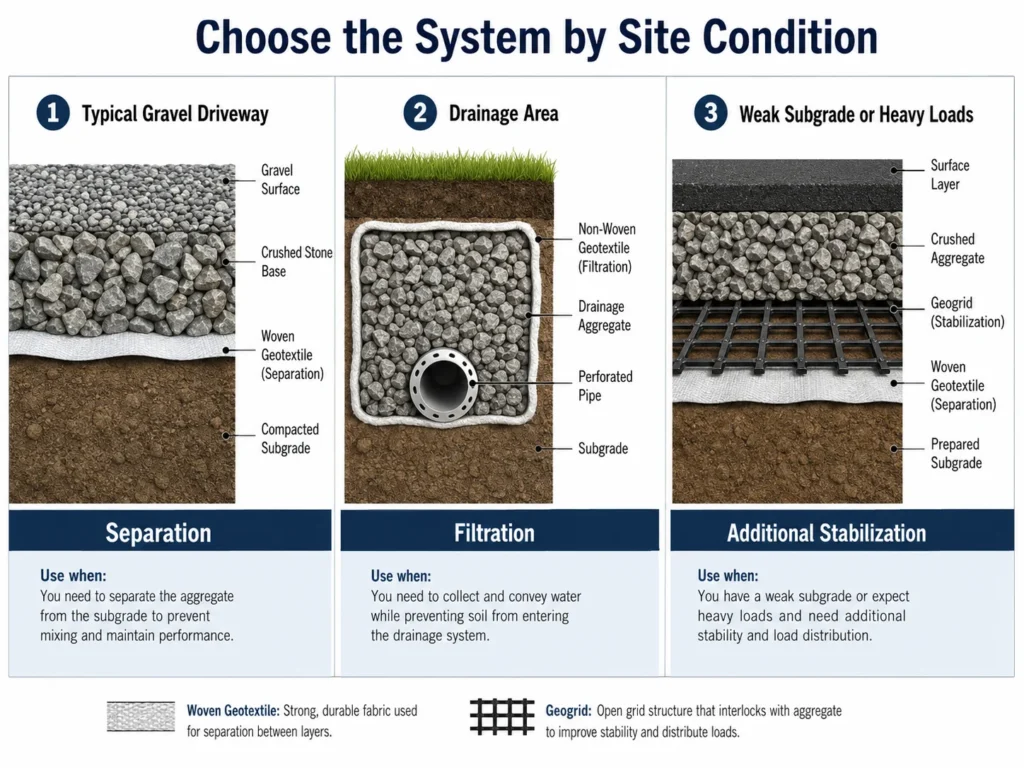
Geotextile and geogrid are both geosynthetic materials, but they are not used for the same primary function.
| Material | Main Function | Typical Driveway Role |
|---|---|---|
| Woven geotextile | Separation and stabilization | Keeps gravel separated from subgrade |
| Non-woven geotextile | Filtration and drainage | Used around drains or filtration zones |
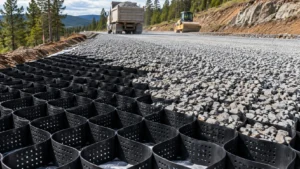
| Geogrid | Reinforcement and aggregate interlock | Helps improve load distribution in weak or heavy-load areas |
For a typical gravel driveway, woven geotextile may be enough when the main problem is aggregate separation. For weak subgrade, repeated truck traffic, commercial yards, or construction access roads, geogrid may be considered as part of a stronger base system.
A combined system may use:
- Woven geotextile for separation
- Geogrid for aggregate interlock and reinforcement
- Crushed stone for structural base
- Drainage design to control water
Do not choose between geotextile and geogrid based only on product name. Soil condition, aggregate quality, traffic load, drainage, base thickness, and installation method all affect performance.
Installation Notes for Geotextile Fabric Under Gravel
Proper installation is as important as material selection. Even the correct fabric can perform poorly if it is placed over an unprepared subgrade or damaged during aggregate placement.
Recommended Installation Steps
- Excavate and grade the driveway area.
- Remove large roots, sharp debris, organic soil, and soft spots.
- Compact the subgrade where possible.
- Roll out the woven geotextile fabric over the prepared subgrade.
- Keep the fabric smooth and avoid large wrinkles.
- Overlap adjacent rolls according to project specifications or manufacturer guidance.
- Place crushed stone over the fabric as soon as practical.
- Avoid driving directly on uncovered geotextile.
- Spread aggregate carefully to avoid fabric displacement.
- Compact the aggregate base in layers.
Professional Note
Do not rely on fabric alone to correct drainage problems, unstable soil, or insufficient aggregate thickness. Driveway performance depends on the full system: subgrade preparation, fabric selection, aggregate quality, compaction, drainage, and traffic load.
Common Mistakes When Using Geotextile Fabric for Driveways
Mistake 1: Using Landscape Fabric Instead of Engineering Geotextile
Ordinary landscape fabric is mainly used for weed control. It may not have the tensile strength, puncture resistance, or durability needed for driveway base stabilization.
Mistake 2: Choosing Non-Woven Fabric for the Main Traffic-Bearing Base
Non-woven geotextile is useful for drainage and filtration, but it is not usually the first choice under the main gravel driveway base when stabilization is the priority.
Mistake 3: Ignoring Drainage
A woven geotextile layer can help with separation, but it will not solve poor drainage. Standing water, poor grading, and blocked side drains can still cause driveway failure.
Mistake 4: Placing Fabric Over Unprepared Soil
If the subgrade contains soft organic soil, sharp debris, roots, or loose material, the driveway may still settle or deform.
Mistake 5: Using Too Little Aggregate
Geotextile fabric should be covered with a suitable thickness of crushed stone. Too little aggregate can reduce load distribution and expose the fabric to damage.
Mistake 6: Poor Overlap Between Rolls
Insufficient overlap can allow soil and aggregate to mix at seams. Overlap requirements depend on soil strength, slope, site condition, and project requirements.
Mistake 7: Driving Directly on Exposed Fabric
Construction traffic can wrinkle, shift, or tear exposed fabric. Aggregate should be placed before regular equipment traffic.
Recommended Product for Gravel Driveways
For most gravel driveway and road base projects, woven geotextile fabric is the recommended starting point because it provides strong separation between the aggregate base and the subgrade.
Recommended product page:products woven-geotextile
Use woven geotextile for:
- Gravel driveways
- Road base
- Construction access roads
- Farm roads
- Parking areas
- Aggregate separation
- Soil stabilization
For drainage trenches, French drains, and filter applications, non-woven geotextile may be more suitable.
Related product page:products nonwoven-geotextile
Need Help Choosing Driveway Geotextile?
To recommend a more suitable geotextile option, the supplier needs more than just the word “driveway.”
Helpful project information includes:
- Driveway length and width
- Soil condition
- Vehicle type and traffic frequency
- Drainage condition
- Aggregate size and planned base thickness
- Required roll size
- Project drawings or site photos
- Destination and quantity
CTA Button:
Request Driveway Geotextile Recommendation
FAQ
Is woven or non-woven geotextile better for a driveway?
Woven geotextile is usually better for the main traffic-bearing gravel driveway base because the primary function is separation and stabilization. Non-woven geotextile is usually better for drainage areas such as French drains, side drains, and filter trenches.
Do I need geotextile fabric under a gravel driveway?
You may need geotextile fabric under a gravel driveway if the driveway is built over soft soil, wet soil, clay, silt, or areas with repeated vehicle traffic. The fabric helps prevent aggregate from mixing with the subgrade and can improve long-term base performance.
Can I use landscape fabric under a gravel driveway?
Ordinary landscape fabric is not usually recommended for gravel driveway base stabilization. Landscape fabric is mainly designed for weed control, while engineering geotextile fabric is designed for separation, filtration, stabilization, or protection.
What type of geotextile should go under gravel?
For gravel driveways and road base applications, woven geotextile is usually preferred because the main function is separation and stabilization. For drainage gravel around pipes or trenches, non-woven geotextile is usually more suitable.
Does geotextile fabric stop driveway rutting?
Geotextile fabric can help reduce rutting by keeping the aggregate base separated from the subgrade. However, it does not replace proper excavation, compaction, aggregate thickness, drainage design, or load-specific engineering.
Should geotextile fabric go above or below gravel?
For a gravel driveway, geotextile fabric is usually placed below the crushed stone base and above the prepared subgrade. The gravel is then placed and compacted over the fabric.
Is geogrid better than geotextile for driveways?
Geogrid is better for reinforcement and aggregate interlock in weak or heavy-load applications. Woven geotextile is better for separation and stabilization. In some driveway or road base projects, geogrid and geotextile may be used together.
Can non-woven geotextile be used under gravel?
Yes, non-woven geotextile can be used under gravel when the main purpose is drainage, filtration, or cushioning. However, for the main traffic-bearing gravel driveway base, woven geotextile is usually the better starting point when stabilization is the main goal.
Conclusion
For the main gravel base of most driveways, woven geotextile fabric is usually the better choice because it helps separate the aggregate from the subgrade and supports a more stable base structure under traffic.
Non-woven geotextile is still useful in driveway projects, but it is mainly used for drainage and filtration areas such as French drains, side drains, and trench drains.
The right choice depends on the whole system: soil condition, water flow, aggregate size, base thickness, traffic load, drainage design, and installation method. For weak subgrade or heavy-load driveways, geogrid or additional engineering measures may also be required.