
How Much Aggregate Can Geogrid Save?
Short Answer
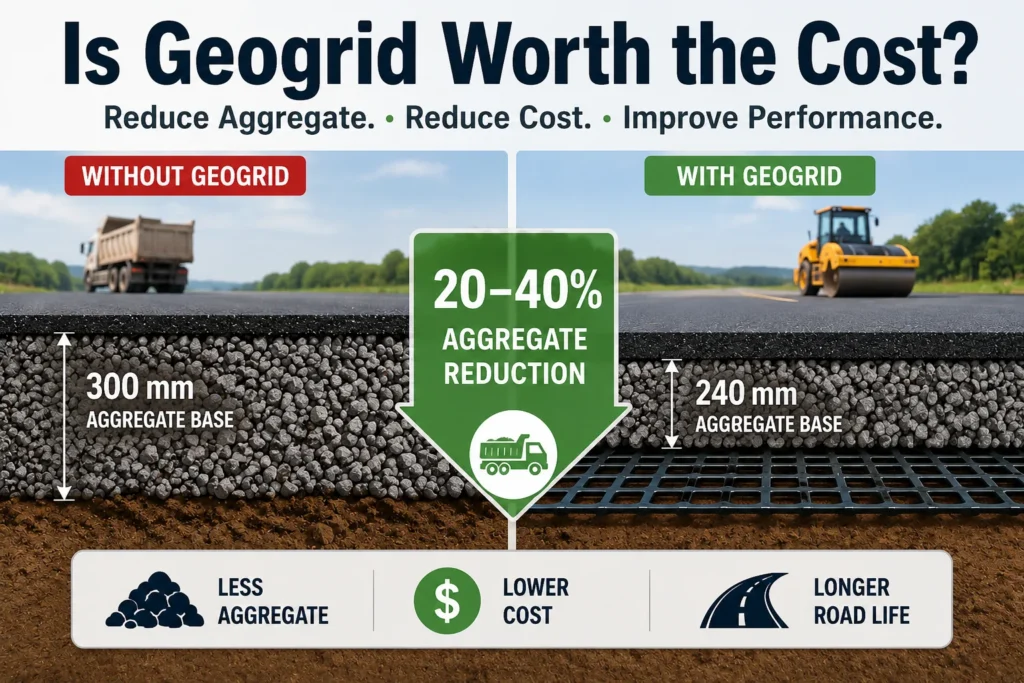
In many road construction projects, geogrid can reduce aggregate requirements by approximately 10% to 40%, depending on subgrade conditions, traffic loads, and design methods.
For weak subgrades (CBR below 3%), geogrid often allows engineers to reduce aggregate thickness while maintaining or improving road performance.
However, the real value of geogrid is not simply aggregate reduction. The greatest savings often come from:
- Reduced aggregate hauling
- Lower construction costs
- Improved pavement performance
- Reduced maintenance requirements
- Longer service life
As of 2026, geogrid is widely used not only as a reinforcement material but also as a cost optimization tool in road construction projects worldwide.
Why Aggregate Is One of the Largest Road Construction Costs
For many road projects, aggregate represents one of the largest cost components.
Typical costs include:
- Quarry material cost
- Transportation cost
- Loading and unloading
- Equipment placement
- Compaction
In remote areas, transportation often costs more than the aggregate itself.
This is why engineers increasingly evaluate whether geogrid can reduce aggregate requirements without sacrificing performance.
How Geogrid Reduces Aggregate Requirements
Geogrid works by improving the interaction between aggregate and subgrade.
Its performance is based on three primary mechanisms:
Mechanical Interlock
Aggregate particles lock into geogrid apertures, creating a reinforced composite layer.
Lateral Restraint
Geogrid limits aggregate movement under traffic loading.
Load Distribution
Traffic loads are spread over a larger area, reducing stress on the subgrade.
As a result, the road structure can often achieve similar performance with less aggregate thickness.
Typical Aggregate Reduction by Subgrade CBR
The amount of aggregate reduction depends heavily on subgrade strength.
| Subgrade CBR | Typical Aggregate Reduction |
|---|---|
| Less than 1% | 25% – 40% |
| 1% – 3% | 20% – 35% |
| 3% – 6% | 10% – 25% |
| Above 6% | 0% – 15% |
Engineering Rule:
- CBR < 3% → geogrid reinforcement is generally recommended
- CBR < 1% → high-modulus geogrid and increased overlap are often required
For more detailed guidance, see:
How to Choose Geogrid Based on CBR
Real Cost Calculation Example
Let’s compare a typical road project.
Project Parameters:
- Road length = 1,000 m
- Road width = 7 m
- Aggregate thickness = 300 mm
- Delivered aggregate cost = $35/m³
Without Geogrid
Aggregate volume:
1,000 × 7 × 0.30
= 2,100 m³
Total aggregate cost:
2,100 × $35
= $73,500
With Geogrid
Assume aggregate thickness is reduced by 20%.
New aggregate thickness:
240 mm
Aggregate volume:
1,000 × 7 × 0.24
= 1,680 m³
Aggregate cost:
1,680 × $35
= $58,800
Aggregate Savings
Aggregate volume saved:
420 m³
Material savings:
$14,700
Even after accounting for geogrid costs, many projects still achieve a positive net saving.
When Geogrid Delivers the Greatest Cost Savings
Geogrid provides the highest economic benefit under the following conditions:
Weak Subgrade
CBR below 3%
Expensive Aggregate
Long haul distances
Remote locations
Island projects
Heavy Traffic
Industrial roads
Mining haul roads
Construction access roads
Challenging Site Conditions
Soft clay
Saturated soils
Peat deposits
When Aggregate Reduction May Be Limited
Geogrid is not always a cost-saving solution.
Aggregate reduction may be limited when:
- Subgrade is already strong
- Aggregate is inexpensive and locally available
- Traffic loads are very light
- Pavement structure is already overdesigned
In these cases, geogrid may still improve pavement performance and service life, but aggregate savings may be smaller.
Is Geogrid Worth the Additional Cost?
This is one of the most common questions asked by engineers and project owners.
The answer depends on total project cost rather than material cost alone.
Many buyers focus only on geogrid price.
However, the more important question is:
“What is the total cost of the road structure?”
Potential benefits include:
✓ Reduced aggregate volume
✓ Reduced transportation costs
✓ Improved load distribution
✓ Reduced rutting
✓ Longer pavement life
✓ Reduced maintenance
In many projects, these benefits outweigh the initial geogrid investment.
How to Maximize Aggregate Savings
Aggregate reduction depends heavily on selecting the correct geogrid.
Key factors include:
Subgrade CBR
Weak soils typically generate the greatest benefit.
Geogrid Stiffness at 2% Strain
Low-strain stiffness is often more important than ultimate tensile strength.
Aggregate Size
Recommended guideline:
Aggregate D50 ≈ 0.5 × geogrid aperture size
Traffic Loading
Higher loads generally justify stronger reinforcement.
Related Guides
- What Strength Geogrid Do I Need?
- How to Choose Geogrid Based on CBR
- Geogrid for Road Construction Guide
- Geogrid Cost Guide
Conclusion
Geogrid can reduce aggregate requirements by approximately 10% to 40%, depending on subgrade conditions and project design.
The greatest savings typically occur on weak subgrades where aggregate transportation costs are high.
For many road projects, geogrid should not be viewed as an additional expense but as a cost optimization tool that can reduce total project costs while improving long-term performance.
FAQ
How much aggregate can geogrid save?
Depending on subgrade conditions, geogrid can reduce aggregate requirements by approximately 10% to 40%.
Can geogrid reduce road base thickness?
Yes. Geogrid reinforcement often allows a thinner aggregate section while maintaining road performance.
Is geogrid cheaper than adding more aggregate?
In many projects with expensive aggregate transportation costs, geogrid can be more economical than importing additional aggregate.
Does geogrid work on weak soils?
Yes. Geogrid is particularly effective on weak subgrades with CBR values below 3%.
Can geogrid reduce road construction costs?
In many cases, yes. Reduced aggregate requirements, lower transportation costs, and improved pavement performance can reduce total project costs.


