Introduction
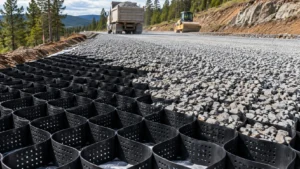
Road infrastructure frequently encounters premature failure due to poor subgrade stability, non-uniform load distribution, and insufficient base layer stiffness. Geogrid integration has become a definitive engineering solution for soil stabilization, optimizing stress distribution and significantly extending pavement service life.
1. Engineering Challenges & Solutions
Modern road projects face three primary stressors: Low CBR (California Bearing Ratio) subgrades, High-amplitude cyclic loading, and Long-term plastic deformation. Geogrid reinforcement mitigates these by establishing a high-modulus composite layer that transforms unbound aggregate into a coherent structural mass.
2. Primary Reinforcement Mechanisms
-
Lateral Restraint (Confinement): The geogrid apertures provide mechanical interlock with aggregate particles, preventing lateral displacement and maintaining the shear strength of the base course.
-
Improved Bearing Capacity: By redistributing vertical stresses over a wider area (the “Tensioned Membrane Effect”), geogrids reduce subgrade pressure, allowing for a reduction in base thickness by 20% to 40% without compromising structural integrity.
-
Base Layer Stiffening: Increases the resilient modulus of the pavement system, effectively reducing rutting depth and fatigue cracking.
Geogrid selection also depends on where reinforcement is required in the pavement structure. Biaxial or multiaxial geogrids are commonly associated with granular base or subgrade stabilization, while fiberglass geogrid for asphalt overlays is used for a different function within the pavement system, particularly where reflective crack control is required.
3. Engineering Selection & Field Design Criteria
To ensure structural performance, the following technical boundary conditions must be met:
| Parameter | Engineering Specification / Boundary Condition |
| Subgrade Threshold | Mandatory reinforcement typically required when Subgrade CBR < 3.0%. |
| Interlock Optimization | Aperture size must be compatible with aggregate gradation ($D_{50} \approx 0.5 \times \text{Aperture Size}$). |
| Tensile Modulus | Design focus must be on Secant Modulus at 2.0% or 5.0% strain rather than ultimate tensile strength. |
| Overlap Requirements | Minimum 300mm for firm subgrades; minimum 900mm for soft/saturated soils (CBR < 1%). |
| Initial Lift Thickness | A minimum compacted lift of 150mm to 300mm is required before allowing heavy construction traffic. |
Technical Note on Missing Parameters
For site-specific implementation, engineers must also define:
-
Long-Term Allowable Design Strength ($T_{al}$): Accounting for installation damage ($RF_{id}$) and creep ($RF_{cr}$).
-
Junction Efficiency: Minimum 90% efficiency to ensure load transfer across the grid nodes.
-
Material Compatibility: Selection of PP (Polypropylene) for chemical resistance or PET (Polyester) for high-load, low-creep applications based on soil pH levels.
What Is a Geogrid and How It Works in Road Construction
A geogrid is a high-strength polymeric reinforcement material with an open grid structure designed to interlock with soil and aggregates.
Through this interlock mechanism, geogrids improve mechanical performance by distributing loads over a wider area and providing lateral confinement.
In road construction, geogrids perform three primary functions:
-
Subgrade stabilization – enhance weak soils by creating a composite structure
-
Load transfer – distribute wheel loads evenly across base and subbase
-
Aggregate confinement – reduce lateral movement of base materials under trafficking
These mechanisms help reduce rutting, settlement, and premature pavement distresses, especially in regions with soft soils or heavy traffic.
Choosing the right geogrid for road construction depends on traffic load, subgrade condition, and project design requirements.
If you are working on a road or highway project and need reliable geogrid solutions, it is important to select products that meet engineering standards and project specifications.
When Should You Use Geogrids in Road Construction?
Geogrids are not required for every pavement, but they deliver significant benefits under the following conditions:
-
Weak or variable subgrade soils (low CBR, high moisture content)
-
Heavy traffic loads where repeated stresses accelerate deformation
-
Aggregate base limit or high material cost situations
-
Temporary or access roads over soft or marginal ground
-
Long-term performance requirements under critical load cycles
In such conditions, geogrids act as a reinforcement layer that enhances structural capacity and reduces the need for overly thick aggregate sections.
Types of Geogrids Suitable for Road Applications

Different geogrid types are designed for specific load conditions and reinforcement requirements.
Biaxial Geogrids – Standard Base Reinforcement
-
Provide strength equally in longitudinal and transverse directions
-
Common choice for paved and unpaved road base reinforcement
-
Suitable for general road constructions with typical traffic
Biaxial geogrids are widely adopted in base and subbase stabilizations due to their balanced mechanical performance.
Triaxial Geogrids – Enhanced Load Distribution
-
Offer multi-directional stiffness and resistance
-
Enhance confinement under heavy loads
-
Ideal for highways, airports, ports, and heavily trafficked industrial roads
Because of their 3D structural geometry, triaxial geogrids deliver improved stability where traffic and soil conditions are demanding.
Uniaxial Geogrids – Targeted Applications
-
Provide high tensile strength in one principal direction
-
Often used in applications such as retaining walls or steep slopes
Uniaxial geogrids are generally not the primary choice for standard road base reinforcement due to directional strength characteristics.
Field Rules for Geogrid Reinforced Roads

While each project should follow a detailed engineering design, experienced engineers and contractors often use practical “rules of thumb”:
-
Place geogrid directly on the prepared subgrade or beneath the first aggregate layer.
-
Ensure adequate aggregate cover over geogrid before trafficking.
-
Maintain consistent overlap between adjacent geogrid rolls.
-
Avoid construction traffic on geogrid until fully embedded.
-
Use angular aggregates that match geogrid aperture sizes for maximum interlock.
These on-site best practices help prevent installation damage and maximize reinforcement performance.
Recommended Aggregate Characteristics
Aggregate selection is critical for effective geogrid performance:
-
Angular or crushed stone – enhances mechanical interlock
-
Appropriate gradation – supports stable confinement
-
Low fines content – prevents clogging and loss of confinement
Rounded aggregates or poorly graded materials reduce the reinforcement effect and may accelerate rutting or deformation.
Common Mistakes in Geogrid Road Construction
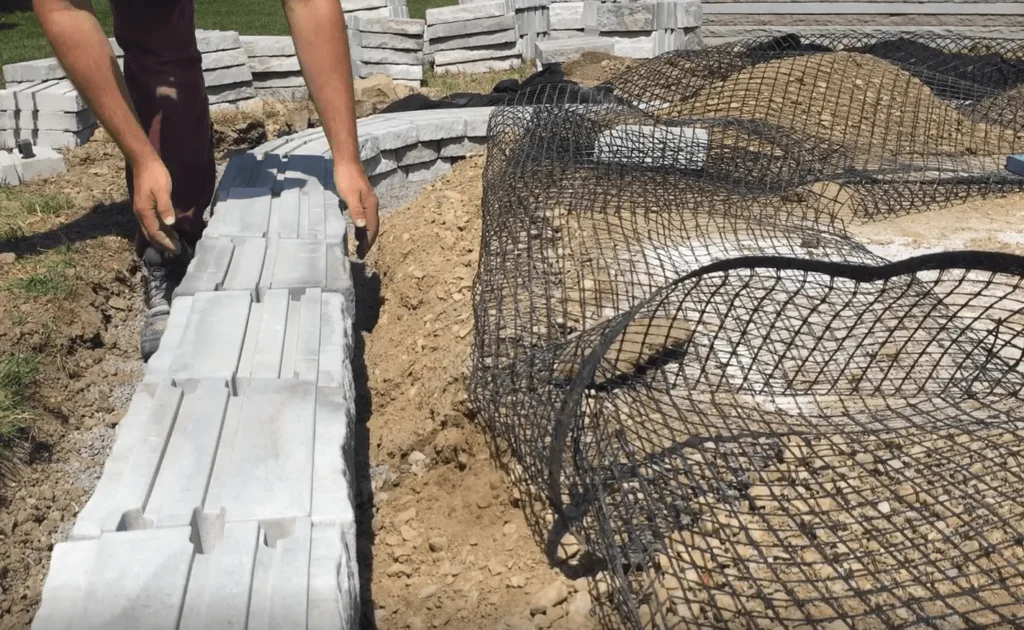
Even high-quality geogrids will underperform if not installed and utilized properly.
Common errors include:
-
Choosing the wrong geogrid type for traffic and subgrade conditions
-
Poor subgrade preparation before geogrid placement
-
Insufficient aggregate depth covering geogrid
-
Improper overlaps or anchor installation
-
Allowing heavy equipment to traffic on geogrid before embedment
Avoiding these mistakes is essential for long-term pavement performance and return on investment.
Cost and Performance: Is Geogrid Worth It?
While geogrids represent an additional material cost, they frequently provide net economic benefits:
-
Reduced aggregate volume requirements
-
Longer service life and reduced maintenance
-
Lower life-cycle costs on weak ground projects
-
Enhanced constructability and schedule efficiency
For roads built over weak soils or high traffic zones, geogrids often improve overall structural performance while reducing long-term expenditures.
How to Choose the Right Geogrid for Your Road Project
Select geogrids based on:
-
Subgrade strength and conditions
-
Traffic type and load repetition
-
Aggregate characteristics
-
Moisture and environmental exposure
Match geogrid tensile strength, aperture dimensions, and performance specifications with your design requirements.
| Road Classification | Typical Subgrade Condition (CBR %) | Recommended Geogrid Type | Aperture Shape | Min. Tensile Strength @ 2% Strain (kN/m) | Min. Ultimate Tensile Strength (kN/m) |
| Heavy Duty / Highway | < 2.0% (Very Soft) | Triaxial / High-Modulus Biaxial | Triangular / Hexagonal | 12 – 16 (MD/CD) | 40 – 60 |
| Collector / Industrial Road | 2.0% – 4.0% (Medium) | Biaxial (Polypropylene) | Square / Rectangular | 7 – 10 (MD/CD) | 30 – 40 |
| Residential / Local Road | 4.0% – 6.0% (Firm) | Biaxial (Standard) | Square | 4 – 6 (MD/CD) | 20 – 30 |
| Temporary / Haul Road | Variable | Biaxial (Lightweight) | Square / Rectangular | 2 – 4 (MD/CD) | 15 – 20 |
Technical Selection Notes:
-
Aperture Shape & Load Distribution: * Square/Rectangular: Best for near-surface reinforcement where stress is primarily longitudinal/transverse.
Triangular/Hexagonal: Provides $360^{\circ}$ radial stiffness, ideal for heavy-duty applications where multi-directional load distribution is critical.
-
Junction Efficiency: All specified grids should maintain a minimum junction efficiency of 90% to ensure effective load transfer from the aggregate to the rib.
-
Strain Control: For permanent road structures, the Tensile Strength at 2% Strain is a more critical design parameter than ultimate strength, as it governs the serviceability limit state (rutting prevention).
👉 Browse our geogrid product range for road construction applications to see strength classes and material options suited for specific project conditions.
Frequently Asked Questions (FAQ)
What is a geogrid used for in road construction?
Geogrids reinforce weak subgrades and base aggregates, improving load distribution, reducing rutting, and prolonging pavement service life.
Which geogrid is best for road construction?
In most road applications, biaxial and triaxial geogrids are preferred. Biaxial is common for general base reinforcement, while triaxial suits high load and weak soil conditions.
What is the rule of thumb for using geogrid in roads?
Place geogrid on prepared subgrade, cover with sufficient aggregate before trafficking, ensure proper overlap, and use angular aggregates to enhance interlock.
Which aggregate works best with geogrid?
Angular, crushed aggregates with compatible gradation are recommended for strong mechanical confinement with geogrids.
What is type 2 geogrid?
Type classifications often relate to stiffness levels and performance grades. Always verify against engineering specifications for the specific application.
Can geogrid reduce the thickness of road base layers?
Yes. In many conditions, geogrids allow reduction of base layer thickness while maintaining or improving structural performance.
Does geogrid work for both paved and unpaved roads?
Yes. Geogrids are effective in both paved and unpaved applications, including highways, access roads, and temporary haul roads.
How long does geogrid last in road construction?
High-quality geogrids are designed for long-term durability, often meeting or exceeding pavement design life.
Is uniaxial geogrid suitable for road construction?
Uniaxial geogrids are typically used for walls or slopes and are not the primary choice for standard road base reinforcement.
What are common mistakes when installing geogrids?
Mistakes include wrong type selection, poor subgrade prep, insufficient cover depth, and premature trafficking on exposed geogrid.