Short Answer
If the subgrade CBR is less than 3%, geogrid reinforcement is generally required.
For very weak soils (CBR < 1%), high-modulus geogrids with stronger tensile stiffness and increased overlap are recommended.
Geogrid selection should be based on:
- CBR value of subgrade
- Required tensile stiffness at low strain (2% strain)
- Aggregate size compatibility
- Traffic loading conditions
👉 For full application guidance, see: geogrid-for-road-construction-guide
What is CBR and Why It Matters

CBR (California Bearing Ratio) is a standard measure of soil strength used in pavement and road design.
It indicates how well the subgrade can support loads from traffic and overlying layers.
- High CBR (>8%) → strong soil, minimal reinforcement needed
- Medium CBR (3–8%) → moderate support
- Low CBR (<3%) → weak subgrade, reinforcement recommended
- Very low CBR (<1%) → extremely soft soil, special design required
How Geogrid Works in Low CBR Conditions
Geogrids improve performance of weak soils through:
1. Mechanical Interlock
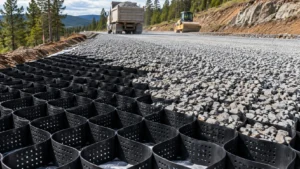
Aggregate particles lock into geogrid apertures, creating a stable composite layer.
2. Lateral Restraint
Geogrid limits lateral movement of aggregate, increasing stiffness.
3. Load Distribution
Loads are spread over a wider area, reducing stress on weak subgrade.
👉 This is why geogrid becomes critical when CBR is low.
Geogrid Selection Guide Based on CBR
CBR < 1%(Extremely Soft Soil)
- Recommended: High-modulus biaxial or triaxial geogrid
- Tensile strength (2% strain): ≥ 12–16 kN/m
- Overlap: ≥ 900 mm
- Use case: marshland, saturated clay, peat
👉 Often combined with thicker aggregate layers
CBR 1% – 3%(Very Weak Subgrade)
- Recommended: Biaxial geogrid (high stiffness)
- Tensile strength (2% strain): 8–12 kN/m
- Overlap: 500–900 mm
- Use case: rural roads, construction access roads
👉 This is the most common scenario for geogrid use
CBR 3% – 6%(Moderate Subgrade)
- Recommended: Standard biaxial geogrid
- Tensile strength (2% strain): 4–8 kN/m
- Overlap: 300–500 mm
👉 Geogrid improves performance but may be optional depending on load
CBR > 6%(Strong Subgrade)
- Geogrid may not be necessary
- Used mainly for:
- Reducing aggregate thickness
- Extending pavement life
Once the required strength and stiffness are determined based on CBR conditions, the next step is selecting a suitable geogrid product.
👉 Explore available biaxial geogrid specifications and product options to match your project requirements.
Key Design Factors Beyond CBR
1. Tensile Modulus at Low Strain
👉 The most important parameter is stiffness at 2% strain, not ultimate strength.
2. Aperture Size vs Aggregate
Rule of thumb:
👉 Aggregate D50 ≈ 0.5 × geogrid aperture size
3. Traffic Load
- Heavy traffic → higher stiffness required
- Temporary road → lighter geogrid acceptable
4. Installation Conditions
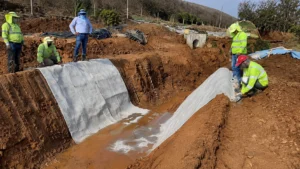
- Soft soil → increase overlap
- Ensure first fill layer ≥ 150 mm before heavy equipment
Common Mistakes When Selecting Geogrid
❌ Choosing based on ultimate tensile strength only
✔ Should focus on low-strain stiffness
❌ Ignoring CBR value
✔ Always test or estimate subgrade strength
❌ Wrong aperture size
✔ Leads to poor interlock
❌ Insufficient overlap
✔ Causes failure in soft soils
When You Should NOT Rely on Geogrid Alone
Geogrid is not a solution if:
- Subgrade is extremely saturated without drainage
- No proper aggregate layer is used
- Installation is poor
👉 In such cases, geotextile or soil improvement may be required.
Conclusion
CBR is the most important starting point for geogrid selection.
- CBR < 3% → reinforcement is generally required
- CBR < 1% → special design and stronger geogrid needed
Choosing the right geogrid improves:
- Load distribution
- Road stability
- Long-term performance
Geogrid selection not only affects performance but also overall project cost.
👉 Learn more about geogrid pricing and cost factors to better plan your project budget.
For smaller-scale applications such as residential access or gravel driveways, geogrid can also significantly improve stability and reduce material usage.
👉 See how geogrid performs in driveway applications.