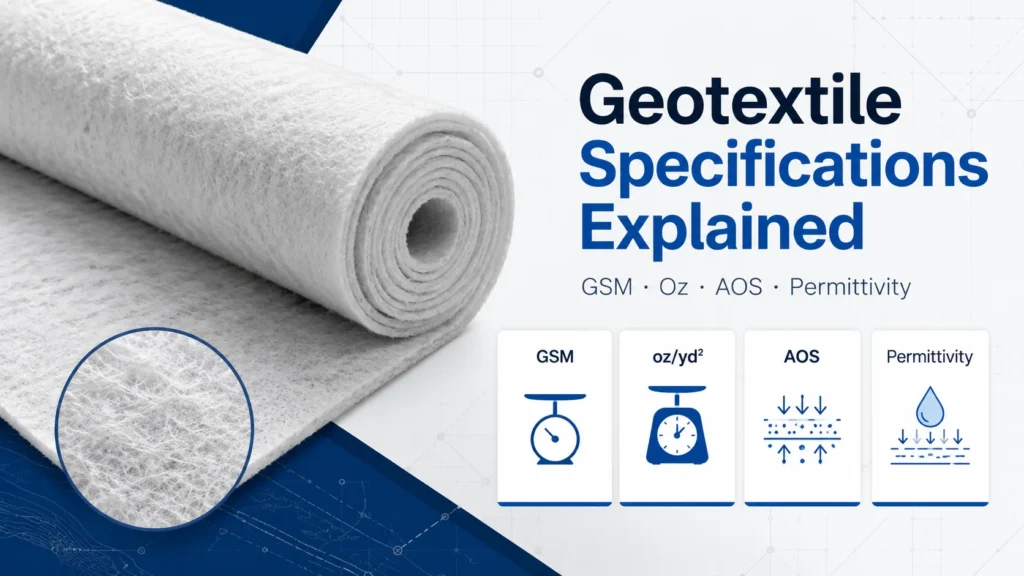
A geotextile data sheet can contain dozens of values, but four terms appear especially often in product enquiries: GSM, oz, AOS and permittivity.
They describe different characteristics:
- GSM and oz/yd² describe mass per unit area.
- AOS is an index used to characterize the apparent opening size.
- Permittivity indicates how readily water passes through the thickness of the isolated fabric under defined test conditions.
None of these values proves that a product is suitable for a project on its own.
A meaningful geotextile specification must also consider the intended function, fabric construction, surrounding soil, installation severity, mechanical properties, reporting basis and applicable project standard.
Author: Geosynsource Technical Team
Reviewed by: Product and Application Team
Last updated: July 2026
This guide is intended for product comparison and procurement. Project-specific filtration, protection, separation and drainage requirements should follow the contract specification and responsible engineer’s design.
The Four Terms at a Glance
| Property | What it tells you | What it does not tell you |
|---|---|---|
| GSM | Mass in grams per square metre | Complete strength or hydraulic performance |
| oz/yd² | Mass in ounces per square yard | A universal product grade |
| AOS | Apparent opening size obtained from a defined test | Complete pore-size distribution or soil compatibility |
| Permittivity | Cross-plane water passage through an isolated geotextile | Long-term drainage performance in contact with soil |
| Water-flow rate | Flow through a defined area under stated test conditions | Soil retention, clogging resistance or system capacity |
| Tensile or puncture value | Response under a specified mechanical test | Overall field survivability in every installation |
The first step in reading a TDS is to identify what each parameter measures. The second is to determine whether it matters for the intended application.
What Does GSM Mean in Geotextile Fabric?
GSM means grams per square metre. It is a measure of the geotextile’s mass per unit area.
ASTM D5261 is used to determine geotextile mass per unit area and describes it as an index property suitable for product identification, quality control and specification comparison.
Examples include:
- 150 GSM nonwoven geotextile;
- 300 GSM protection geotextile;
- 500 GSM needle-punched geotextile.
The number tells the buyer how much material is present over a measured area. It does not directly explain how the fabric will filter soil, transmit water or survive installation.
What Can GSM Suggest?
Within the same product family, made using a similar polymer and manufacturing process, a higher mass may be associated with:
- greater thickness;
- more fibre per unit area;
- increased cushioning;
- higher puncture resistance;
- improved installation robustness.
These relationships should still be confirmed from the current technical data sheet.
A 300 GSM needle-punched polypropylene product should not automatically be treated as equivalent to:
- a 300 GSM polyester geotextile;
- a thermally bonded nonwoven;
- a woven product;
- a product made for geomembrane protection rather than filtration.
What GSM Cannot Confirm
GSM alone cannot confirm:
- AOS;
- permittivity;
- water-flow rate;
- tensile strength;
- elongation;
- tear resistance;
- puncture resistance;
- UV resistance;
- filtration compatibility;
- long-term durability.
For this reason, a request for “200 GSM geotextile” may be enough for an initial quotation, but it is not normally enough to establish technical equivalence.
What Does Oz Mean?
In the United States, nonwoven geotextiles are frequently marketed by ounces per square yard, written as oz/yd².
This is another mass-per-unit-area measurement.
1 oz/yd² is approximately 33.91 g/m².
Approximate Conversion Table
| Nominal weight | Approximate metric equivalent |
|---|---|
| 4 oz/yd² | 136 g/m² |
| 6 oz/yd² | 203 g/m² |
| 8 oz/yd² | 271 g/m² |
| 10 oz/yd² | 339 g/m² |
| 12 oz/yd² | 407 g/m² |
| 16 oz/yd² | 542 g/m² |
These are mathematical conversions, not performance equivalencies.
A product sold as “8 oz” may not have exactly the same technical values as another manufacturer’s nominal 270 GSM product. Manufacturing tolerances, test results, polymer, thickness and fibre structure may differ.
Is an 8 oz Fabric Better Than a 6 oz Fabric?
Not in every application.
An 8 oz product may provide more cushioning or puncture resistance within the same product series. A 6 oz product may still be more suitable when it already satisfies installation requirements and provides hydraulic properties that better match the project.
The correct comparison is not:
Which product has the higher weight?
It is:
Which product has the required hydraulic and mechanical properties for the intended function?
What Is AOS?
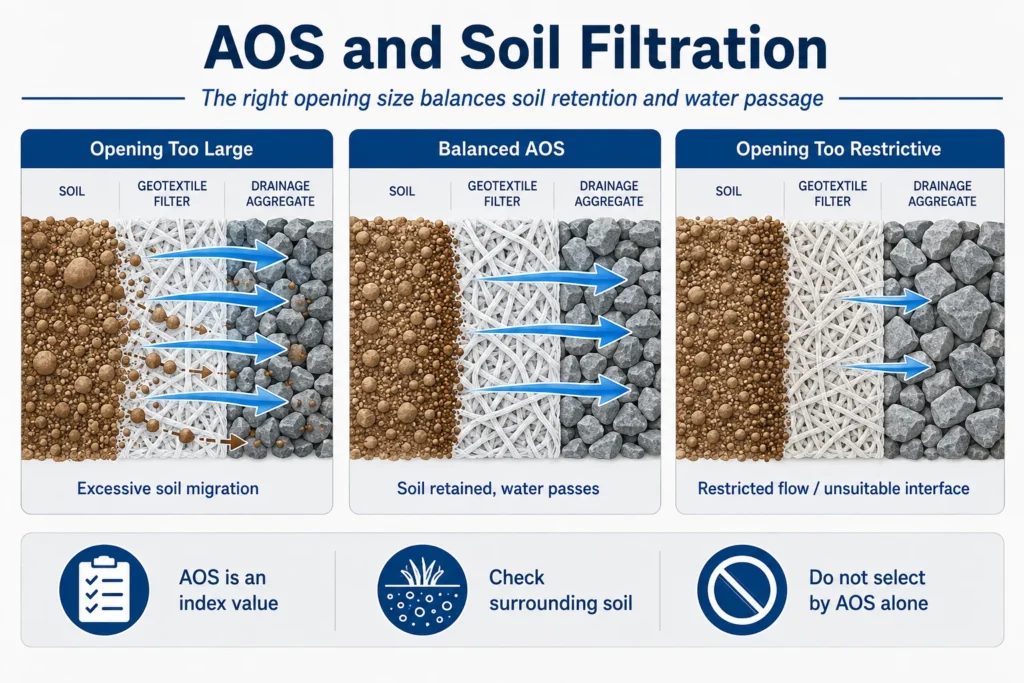
AOS means Apparent Opening Size.
ASTM D4751 determines the apparent opening size of a geotextile using defined laboratory procedures. The result is suitable as an index for product comparison and commercial acceptance testing.
AOS may be reported as:
- a U.S. sieve number;
- millimetres;
- micrometres.
How to Read U.S. Sieve Numbers
A higher U.S. sieve number represents a smaller physical opening.
For example:
- No. 40 is a larger opening than No. 70;
- No. 70 is a larger opening than No. 100.
This inverse numbering system can cause confusion. When comparing international products, the opening dimension in millimetres or micrometres is usually easier to understand.
Is AOS the Same as Actual Pore Size?
Not exactly.
AOS is an index result, not a complete description of every opening in the fabric.
This distinction is particularly important for needle-punched nonwoven geotextiles, which have a three-dimensional and irregular pore structure. A single AOS value does not describe:
- the complete pore-size distribution;
- the number of constrictions through the fabric;
- how the fabric changes under compression;
- the way soil particles interact with the fibre network.
AOS is useful, but it should not be treated as a photograph of the fabric’s pore system.
Is a Smaller AOS Always Better?
No.
A geotextile filter has to balance two requirements:
- retain enough of the surrounding soil to prevent unacceptable piping or migration;
- allow sufficient water flow through the filter interface.
A product that is too open for the soil may allow excessive particle movement. A product that is unnecessarily restrictive may reduce flow or contribute to an unsuitable filter interface.
The correct opening requirement depends on:
- soil-particle distribution;
- percentage and type of fines;
- soil uniformity;
- hydraulic gradient;
- flow direction;
- geotextile structure;
- project design criteria.
FHWA guidance treats AOS, permeability and permittivity as related filtration-selection measures rather than using AOS as an isolated product ranking.
What Is Permittivity?
Permittivity indicates the quantity of water that can pass through the thickness of a geotextile under defined laboratory conditions.
It is normally expressed in reciprocal seconds:
sec⁻¹ or s⁻¹
ASTM D4491/D4491M describes permittivity as an indicator of water passing through an isolated geotextile. The standard also cautions that the result should not automatically be applied as field performance under every environmental or installation condition.
What Does a Higher Permittivity Mean?
When two products are tested using the same method and comparable conditions, a higher value generally indicates that water passes through the isolated fabric more readily.
It does not necessarily mean that the product is the better filter.
A geotextile with high permittivity may still be unsuitable if:
- its opening structure does not retain the surrounding soil;
- it lacks sufficient installation strength;
- it is damaged during aggregate placement;
- it performs poorly when compressed;
- its soil–fabric interface is vulnerable to clogging.
Permittivity and Field Performance
A standard permittivity test does not reproduce the complete installed system.
Field performance can be affected by:
- soil contact;
- suspended particles;
- fabric compression;
- construction damage;
- biological growth;
- chemical precipitation;
- long-term changes at the filter interface.
ASTM also lists a separate method, D5493-23, for permittivity under load, demonstrating that confinement can be a separate consideration in heavily loaded systems.
Permittivity, Permeability and Transmissivity
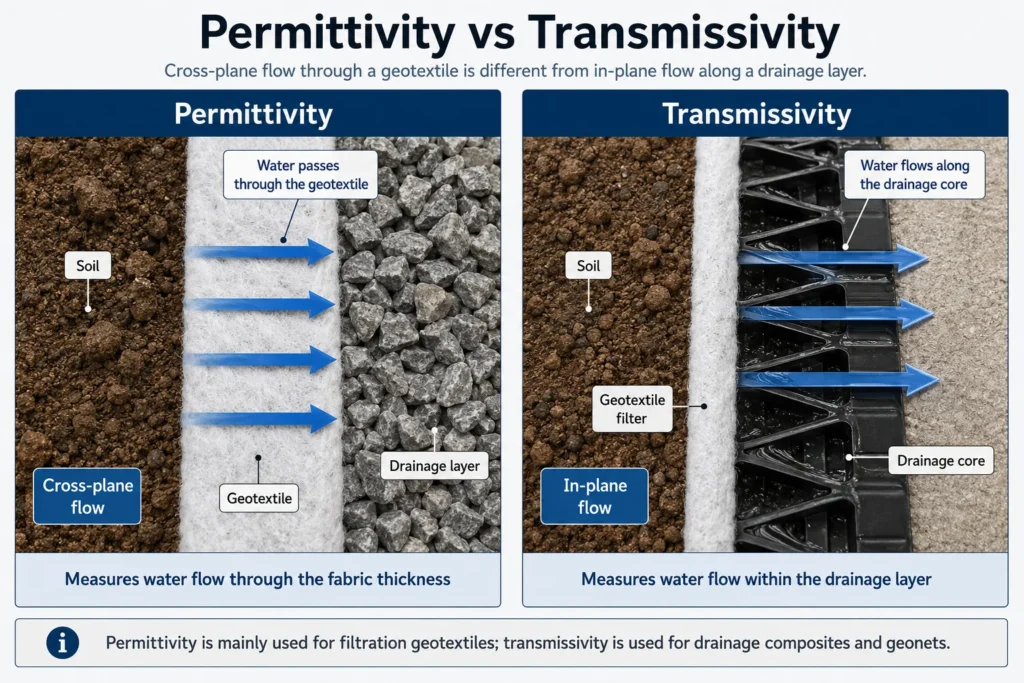
These three terms describe related but different hydraulic properties.
Permeability
Permeability, or hydraulic conductivity, describes water flow through a material and is normally expressed as a length per unit time.
Permittivity
Permittivity describes water flow through the thickness of a geotextile relative to the applied hydraulic head.
It is particularly useful for comparing geotextiles with different thicknesses.
Transmissivity
Transmissivity describes water flow along the plane of a geosynthetic drainage product.
This distinction is important:
- a standalone geotextile usually acts as a filter and allows cross-plane flow;
- a geonet, cuspated drainage core or composite drainage board provides an in-plane drainage path.
ASTM lists D4716/D4716M separately for in-plane flow and hydraulic transmissivity, while D4491 covers geotextile permittivity.
What Is Water-Flow Rate?
Some geotextile data sheets report water-flow rate instead of, or together with, permittivity.
Common units include:
- L/min/m²;
- gal/min/ft².
The reported value depends on:
- the test method;
- hydraulic head;
- sample area;
- water temperature;
- specimen condition.
Permittivity and water-flow rate may originate from the same general cross-plane hydraulic test but be presented in different formats.
Two flow-rate values should not be compared unless the following are consistent:
- test method;
- hydraulic head;
- units;
- specimen condition;
- reporting basis.
A high clean-water flow value does not confirm soil retention or long-term resistance to clogging.
What Is Soil–Geotextile Compatibility?
A filter geotextile does not work independently from the surrounding soil.
Its behavior depends on the complete soil–geotextile system, including:
- soil gradation;
- fines content;
- particle shape;
- hydraulic gradient;
- geotextile opening structure;
- confinement;
- flow direction;
- duration of exposure.
ASTM D5101-23 measures filtration compatibility for water-saturated soil–geotextile systems. It is a system performance test rather than a routine index test for the isolated product.
This type of evaluation may be relevant for:
- fine or internally unstable soils;
- critical permanent filters;
- high hydraulic gradients;
- projects with significant clogging concerns;
- unusual soil chemistry;
- hydraulic structures.
For ordinary commercial procurement, suppliers normally provide index properties from the product TDS. Project-specific soil compatibility testing is usually performed only when required by the design or specification.
Mechanical Properties Still Matter
A fabric can have suitable AOS and permittivity but still fail if it is torn, punctured or displaced during installation.
Depending on the application, the specification may include:
- grab tensile strength;
- elongation;
- trapezoid tear strength;
- puncture resistance;
- seam strength;
- UV resistance.
For road separation and subsurface drainage, FHWA notes that geotextiles must meet filtration requirements as well as survivability and endurance criteria under construction conditions.
Mechanical values should therefore be evaluated against:
- aggregate size and angularity;
- drop height;
- subgrade condition;
- construction equipment;
- initial cover thickness;
- expected construction traffic.
A product should not be selected from hydraulic properties alone.
Typical, Minimum and MARV Values
A technical data sheet should state how each value is reported.
Common terms include:
| Reporting basis | General meaning |
|---|---|
| Typical | Representative production or laboratory value |
| Average | Arithmetic average of the reported samples |
| Minimum | Stated lower limit, subject to the supplier’s definition |
| Maximum | Stated upper limit |
| MARV | Minimum Average Roll Value |
| Guaranteed | Contractually declared limit under specified conditions |
A typical value should not be compared directly with a specification requiring MARV.
Similarly, AOS may be controlled as a maximum rather than a minimum in some specifications. Always read the table headings and footnotes instead of assuming that every higher number represents better performance.
For U.S. highway projects, the 2025 AASHTO Materials Book lists M 288M/M 288-24 as the current geosynthetics standard for highway applications. Project documents may also impose agency-specific requirements.
How to Read a Geotextile Data Sheet
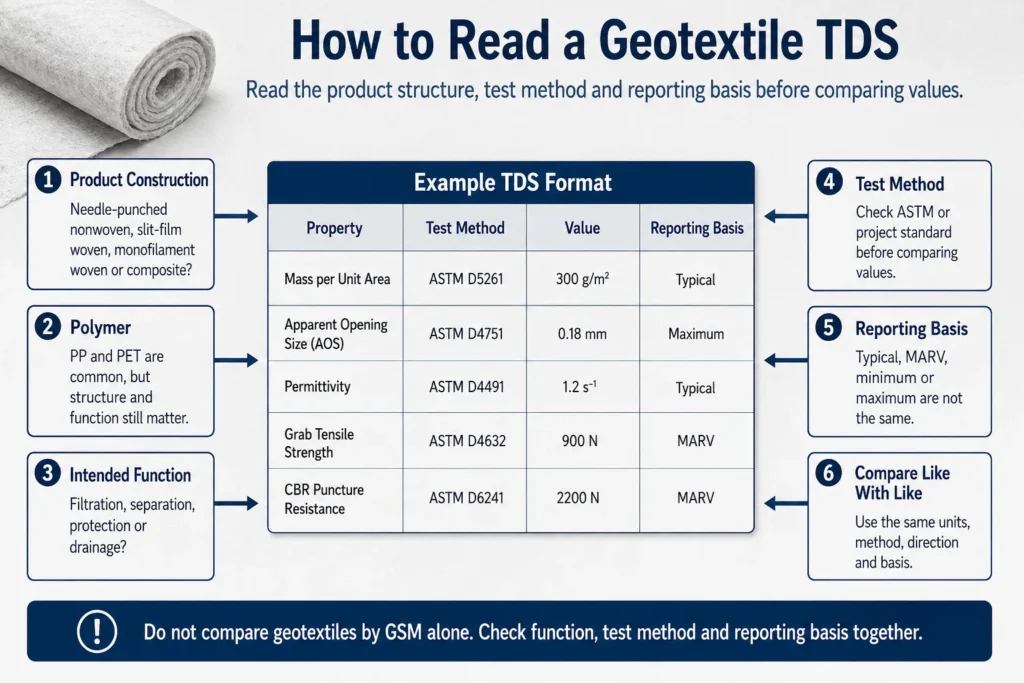
Step 1: Identify the Intended Function
Determine whether the geotextile is intended for:
- filtration;
- separation;
- protection;
- drainage;
- reinforcement;
- erosion control.
Do not compare products designed for different functions using one headline value.
Step 2: Identify the Product Construction
Confirm whether it is:
- needle-punched nonwoven;
- thermally bonded nonwoven;
- slit-film woven;
- woven monofilament;
- woven multifilament;
- knitted or composite.
A 300 GSM woven product and a 300 GSM needle-punched product are structurally different materials.
Step 3: Confirm the Polymer
Common polymers include polypropylene and polyester.
Polymer type is part of product identification, but manufacturing structure and tested properties are usually more useful for immediate product comparison.
Step 4: Check the Test Method
A value without a test method is difficult to verify.
Examples include:
| Property | Common ASTM method |
|---|---|
| Mass per unit area | ASTM D5261 |
| Apparent opening size | ASTM D4751 |
| Permittivity | ASTM D4491/D4491M |
| Soil–geotextile compatibility | ASTM D5101 |
Standard editions can change, so the edition required by the contract or current official catalogue should be confirmed before issuing a compliance statement.
Step 5: Check the Reporting Basis
Determine whether each value is:
- typical;
- minimum;
- maximum;
- MARV;
- guaranteed.
This is often more important than a small numerical difference between two products.
Step 6: Compare Like With Like
Only compare values when the following are consistent:
- test method;
- units;
- reporting basis;
- machine or cross-machine direction;
- product structure;
- test condition.
Which Properties Matter for Different Applications?
Drainage and Filtration
Common considerations include:
- AOS;
- permittivity;
- soil compatibility;
- puncture resistance;
- tensile and tear strength;
- installation survivability.
The objective is to balance water passage, soil retention and construction durability.
Road Separation
Common considerations include:
- tensile and elongation properties;
- puncture and tear resistance;
- seam requirements;
- survivability;
- filtration properties where water passes across the interface.
The geotextile should prevent unacceptable mixing between subgrade and aggregate while surviving placement and construction traffic.
Geomembrane Protection
Common considerations include:
- mass per unit area;
- thickness;
- puncture resistance;
- cushioning behavior;
- subgrade condition;
- aggregate or waste material in contact with the liner.
GSM is useful for product identification, but a fixed GSM should not be presented as a universal protection design.
Riprap and Erosion-Control Filters
Common considerations include:
- soil retention;
- AOS;
- permittivity;
- puncture and tear resistance;
- abrasion and installation exposure;
- hydraulic conditions.
A hydraulically suitable fabric may still be unsuitable if it cannot survive placement beneath coarse stone.
Why Two 300 GSM Fabrics May Not Be Equivalent
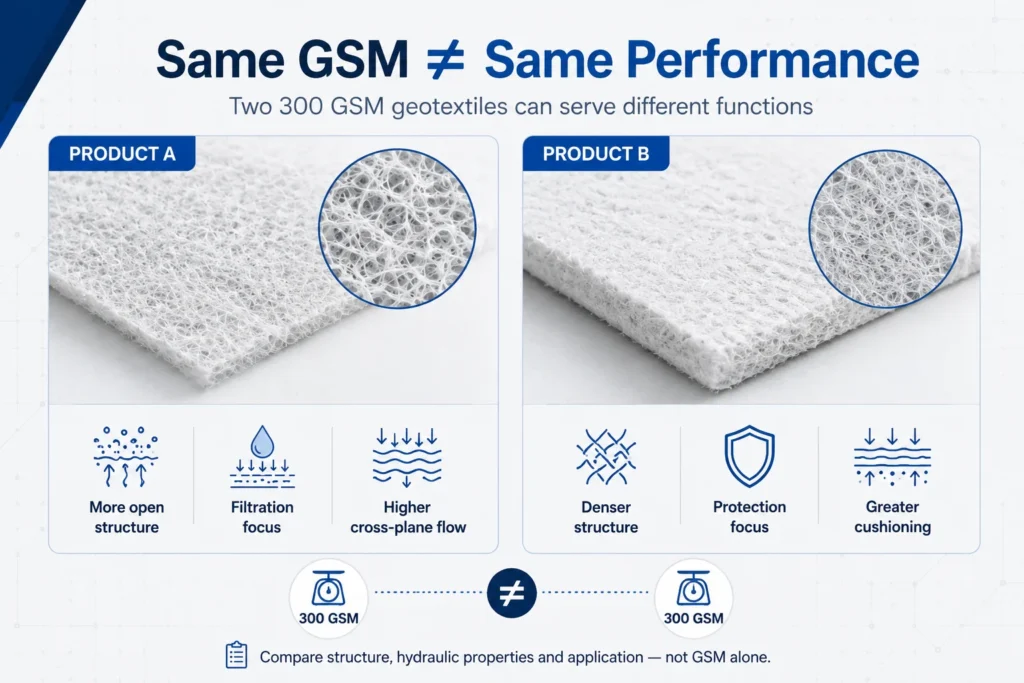
Consider two hypothetical needle-punched nonwoven geotextiles.
Product A
- nominal mass: 300 GSM;
- relatively open fibre structure;
- higher cross-plane water flow;
- intended mainly for filtration.
Product B
- nominal mass: 300 GSM;
- denser structure;
- greater cushioning;
- intended mainly for liner protection.
Both products have the same nominal mass.
They may still differ in:
- AOS;
- permittivity;
- thickness;
- puncture resistance;
- tensile behavior;
- intended application.
This is why GSM should be used to identify a product, not to define its complete performance.
Common Specification Mistakes
Selecting by GSM Alone
Mass per unit area does not define filtration, water flow or installation performance.
Treating Oz as a Universal Grade
A 6 oz product from one supplier is not automatically equivalent to every other 6 oz product.
Assuming Smaller AOS Is Always Better
AOS must be compatible with the soil and hydraulic requirements.
Selecting the Highest Permittivity
Higher clean-water flow does not prove soil retention or long-term compatibility.
Comparing Typical Values With MARV
The reporting basis must be consistent before numerical values are compared.
Ignoring Fabric Construction
Woven slit-film, woven monofilament and needle-punched nonwoven fabrics can have very different functions.
Confusing Permittivity With Transmissivity
Permittivity is cross-plane flow. Transmissivity is in-plane drainage.
Ignoring Installation Conditions
Sharp aggregate or construction traffic may damage a product that appears suitable from its hydraulic data.
What Information Should Be Sent to a Supplier?
For a useful quotation and technical comparison, provide:
| Information | Example |
|---|---|
| Application | French drain, road separation, liner protection |
| Required function | Filtration, separation or protection |
| Fabric construction | Nonwoven, slit-film woven or monofilament woven |
| Polymer | PP, PET or project-specified |
| Required standard | ASTM, AASHTO, ISO or local specification |
| Mass | GSM or oz/yd² |
| AOS | Sieve number, millimetres or micrometres |
| Hydraulic requirement | Permittivity or flow rate |
| Mechanical properties | Tensile, tear and puncture |
| Reporting basis | Typical, MARV, minimum or maximum |
| Roll dimensions | Width and length |
| Quantity | Square metres or rolls |
| Documents | TDS, COA and test reports |
| Destination | Port or delivery address |
Where a specification or BOQ exists, send the complete document rather than extracting only the GSM value.
Final Recommendation
GSM, oz, AOS and permittivity answer different questions.
- GSM and oz/yd² identify mass per unit area.
- AOS characterizes an apparent opening size under a defined test.
- Permittivity indicates cross-plane water passage through an isolated geotextile.
None should be used alone.
For filtration, evaluate soil retention, water passage and clogging risk together.
For separation, evaluate filtration compatibility and installation survivability.
For liner protection, consider cushioning, puncture resistance and contact conditions.
The correct geotextile is not necessarily the heaviest product or the one with the highest test number. It is the product whose construction, verified properties and reporting basis match the required function and project specification.
Need Help Comparing Geotextile Specifications?
GeoCore can provide available product specifications, roll sizes, technical data and quotation support.
For a meaningful comparison, submit:
application + project specification + required test values + quantity + destination.
Final material selection should follow the project specification and responsible engineer’s requirements.
Frequently Asked Questions
What does GSM mean in geotextile fabric?
GSM means grams per square metre. It describes mass per unit area and is mainly useful for product identification and quality control.
How many GSM is an 8 oz geotextile?
Eight ounces per square yard is approximately 271 g/m². This is only a unit conversion and does not prove technical equivalence between two products.
Is higher GSM always better?
No. Higher GSM may provide greater cushioning or installation resistance within the same product family, but it does not automatically provide better filtration or water flow.
What is AOS in geotextile?
AOS means Apparent Opening Size. It is an index obtained from a defined test and is used as part of filtration selection.
Is a smaller AOS always better?
No. The required opening must balance soil retention and water passage. The appropriate value depends on the surrounding soil and design criteria.
What is geotextile permittivity?
Permittivity indicates how readily water passes through the thickness of an isolated geotextile under defined test conditions.
Is permittivity the same as transmissivity?
No. Permittivity describes cross-plane flow through a geotextile. Transmissivity describes in-plane flow along a drainage material.
What does MARV mean?
MARV means Minimum Average Roll Value. It is a specification and quality-control reporting basis and should not be confused with a typical average value.