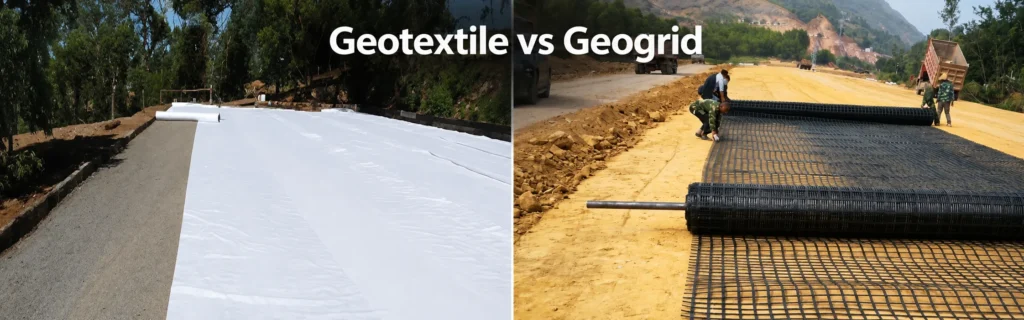
Geotextile and geogrid are different geosynthetic materials and should not be treated as interchangeable products. Geotextile is commonly used where separation, filtration, drainage support or protection is required. Geogrid is more commonly used where granular-layer stabilization or soil reinforcement is the main function.
In some roads, working platforms and weak-subgrade applications, both products may be used in the same system: the geotextile provides separation or filtration, while the geogrid interacts with the aggregate or reinforced soil.
The correct choice depends on the required function, soil, aggregate, drainage, loading, construction conditions and project specification—not simply on GSM or tensile strength.
Engineering Note: This page explains material functions and selection logic. Final reinforcement layout, design strength, layer thickness and structural configuration should follow the project specification and responsible engineer’s design.
Author: Geosynsource Technical Team
Reviewed by: GeoCore Product & Application Team
Last Updated: August 2026
Geotextile vs Geogrid at a Glance
The easiest way to understand the difference is to start with what the material must do, rather than which product appears stronger.
| Factor | Geotextile | Geogrid |
|---|---|---|
| Basic structure | Continuous woven or nonwoven fabric | Open grid structure |
| Separation | Common function | Not normally a complete fine-soil separator |
| Filtration | Common function | Not a conventional soil filter |
| Water passage | Relevant for selected geotextiles | Not normally selected for filtration |
| Protection | Common with suitable nonwoven products | Not a primary function |
| Granular-layer stabilization | Product and system dependent | Common application |
| Soil reinforcement | Possible in selected engineered systems | Major application |
| Aggregate interaction | Depends on fabric/system | Important in stabilization applications |
| Typical selection question | Can it separate or filter the surrounding materials? | Can it provide the required reinforcement or aggregate interaction? |
Quick decision
Need filtration?
Start by evaluating a geotextile.
Need separation between fine soil and aggregate?
Geotextile is commonly the starting point.
Need aggregate stabilization?
Evaluate an appropriate geogrid system.
Need soil reinforcement?
Geogrid or another designed reinforcement product may be required.
Need both separation and stabilization?
A geotextile + geogrid system may be considered.
These are selection directions, not final project specifications.
Internal link:
Anchor:
geotextile fabric products and applicationsWhat Does Geotextile Actually Do?
A geotextile is a permeable geosynthetic fabric that can perform one or more functions depending on its construction and surrounding materials.
The important point is that woven and nonwoven geotextiles do not all behave the same way. Product construction, mechanical properties and hydraulic properties should be reviewed against the intended function.
Separation
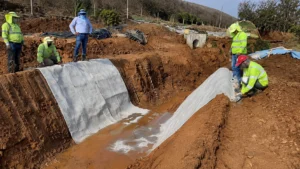
A geotextile can be installed between two different materials, such as fine subgrade soil and granular aggregate, to limit excessive intermixing.
In road construction, this can help preserve the distinction between the subgrade and aggregate layer.
Separation does not mean that the geotextile makes a weak subgrade structurally adequate by itself. Aggregate quality, drainage, loading and construction still matter.
Filtration
A properly selected geotextile may allow water to pass while limiting unacceptable migration of soil particles.
Important properties can include:
- Apparent Opening Size (AOS);
- permittivity or specified water-flow properties;
- product structure;
- mechanical survivability.
A smaller opening is not automatically better. The fabric has to be considered together with the surrounding soil.
Internal link:
Drainage Support
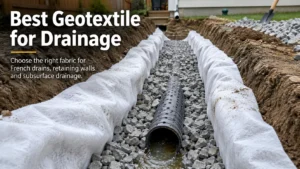
Geotextile is commonly used around drainage aggregate, perforated pipe or other drainage components as a filter layer.
It does not replace:
- drainage aggregate;
- collector pipe;
- drainage core;
- gradient;
- an effective outlet.
The fabric supports the drainage system by filtering the interface.
Protection
Selected nonwoven geotextiles can also be used as protective layers where cushioning or puncture protection is required, such as between prepared ground and another geosynthetic material.
The required protection level depends on the contact materials, installation conditions and project specification.
What Does Geogrid Actually Do?
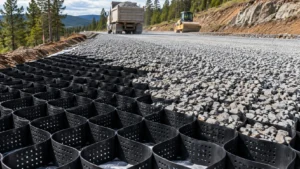
Geogrid is an open-grid geosynthetic commonly used to improve the mechanical performance of soil or granular layers.
Two terms are especially important:
Stabilization
Often used in:
- roads;
- aggregate bases;
- working platforms;
- temporary access roads;
- granular layers.
Reinforcement
Often used in:
- mechanically stabilized earth walls;
- reinforced slopes;
- embankments;
- other reinforced-soil structures.
These two functions should not be treated as identical.
Your technical knowledge base specifically distinguishes reinforcement, where tensile forces are carried within a soil structure, from stabilization, where the geogrid works with aggregate, supporting soil and the complete granular-layer system.
Granular-Layer Stabilization
In a granular layer, the geogrid and surrounding aggregate act together as a system.
Performance may involve:
- particle restraint;
- reduced lateral aggregate movement;
- load distribution;
- improved service performance under suitable conditions.
However, road performance depends on more than the grid itself.
Relevant variables include:
- subgrade strength;
- aggregate gradation and angularity;
- base or subbase thickness;
- traffic;
- drainage;
- construction procedure;
- geogrid–aggregate interaction.
A higher nominal tensile strength does not automatically mean better road performance.
Soil Reinforcement
In reinforced-soil structures, tensile forces can be transferred between the soil and reinforcement through interaction along the embedded reinforcement.
Important considerations may include:
- soil properties;
- reinforcement tensile behavior;
- long-term strength;
- pullout behavior;
- connection performance;
- geometry;
- drainage;
- construction quality.
Therefore:
Geogrid strength, length and spacing are design outputs—not universal product recommendations.
This distinction follows the technical risk boundary in your Geogrid knowledge base: material test values must not be presented as project design values.
The Most Important Difference Is Function, Not Appearance
Two materials can both be installed beneath aggregate and still be performing completely different jobs.
That is why the question:
“Which is stronger, geotextile or geogrid?”
is usually less useful than:
“What function does this layer need to perform?”
A practical selection sequence is:
1. Define the problem
Is the project mainly dealing with:
- soil–aggregate mixing?
- movement of fines?
- water filtration?
- drainage?
- aggregate deformation?
- reinforcement?
- puncture protection?
2. Define the required function
Then identify whether the project primarily needs:
Separation
Filtration
Protection
Stabilization
Reinforcement
3. Select the material family
Only after the required function is clear should the product type and specifications be compared.
This prevents a common purchasing mistake: selecting a product because it has a higher GSM or tensile number without confirming that it performs the required function.
Geotextile vs Geogrid by Application
The correct choice changes by application.
Geotextile vs Geogrid for Road Construction
For roads, geotextile and geogrid can perform different functions in the same pavement structure.
| Road requirement | Common starting point |
|---|---|
| Separate fine subgrade from aggregate | Geotextile |
| Limit migration of fines | Geotextile |
| Provide filtration | Geotextile |
| Filter an edge-drain system | Geotextile |
| Stabilize a granular base | Geogrid |
| Improve aggregate confinement | Geogrid |
| Fine subgrade + stabilization requirement | Geotextile + geogrid may be evaluated |
A road should not be treated as a “geogrid-only” or “geotextile-only” system.
Performance depends on:
- subgrade;
- aggregate;
- layer thickness;
- loading;
- drainage;
- construction.
That system-based approach is also one of the main verified conclusions in the Geogrid technical library.
Related Guides
Geogrid for Road Construction
→ geogrid-for-road-construction-guide
Geotextile vs Geogrid for a Gravel Driveway
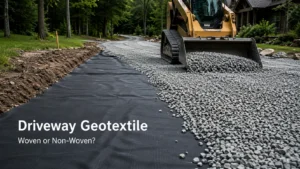
For a gravel driveway, start with the problem you are trying to solve.
Consider geotextile where:
- fine subgrade is mixing with the gravel;
- separation is required;
- filtration is important;
- soil migration needs to be controlled.
Consider geogrid where:
- aggregate movement is a primary concern;
- granular-layer stabilization is required;
- the project design calls for grid–aggregate interaction.
Consider both where:
the project needs separation between the fine soil and aggregate and a separate stabilization function.
Using both products simply because the subgrade is “soft” is not automatically necessary.
Internal link:
geotextile fabric for driveways→ geotextile-fabric-for-driveway-woven-or-non-woven
Geotextile vs Geogrid for Soft Subgrade
A weak or moisture-sensitive subgrade does not by itself determine which geosynthetic should be used.
Geotextile may address:
- soil–aggregate separation;
- filtration;
- contamination of granular material.
Geogrid may address:
- granular-layer stabilization;
- selected reinforcement requirements.
Other measures may still be necessary:
- drainage improvement;
- thicker granular layers;
- replacement of unsuitable material;
- staged construction;
- other ground-improvement methods.
A fixed CBR value alone should not be used to determine a universal geogrid specification or road section. This is explicitly treated as a high-risk design conclusion in your technical knowledge base.
Geotextile vs Geogrid for Retaining Walls
A retaining wall is a good example of why these products should not be treated as substitutes.
Geogrid
May form part of the reinforced-soil system and carry tensile forces within the reinforced zone.
Geotextile
May be used in selected drainage or filtration details, depending on the wall system.
A reinforced wall can involve:
Facing
Reinforced Fill
Geogrid Reinforcement
Drainage Aggregate
Geotextile Filter — where specified
Foundation
Drainage OutletLikewise, a filter geotextile does not replace structural reinforcement where reinforcement is required.
Internal link:
geogrid retaining wall guide→ geogrid-retaining-wall-ultimate-guide
Geotextile vs Geogrid for Drainage
For conventional soil filtration around drainage aggregate or pipe, geotextile is normally the relevant material family to evaluate.
A geogrid’s open apertures do not provide the same continuous filtration interface as a geotextile.
The drainage system may contain:
Soil
↓
Geotextile Filter
↓
Drainage Aggregate
↓
Perforated Pipe / Drainage Path
↓
OutletGeotextile vs Geogrid Under Geomembrane
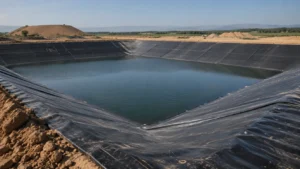
Where the objective is cushioning or puncture protection for a geomembrane, a suitable protective geotextile is normally more relevant than an open-grid reinforcement product.
However, the complete lining system may require other geosynthetics for other functions.
The material placed beneath a geomembrane should be selected according to:
- subgrade condition;
- sharp stones or protrusions;
- contact pressure;
- liner thickness;
- installation conditions;
- required protection performance.
This is another example where the required function should determine the product—not the product name.
Can Geotextile and Geogrid Be Used Together?
Yes. Geotextile and geogrid can be used together when a project requires functions that one product alone does not provide.
A common conceptual arrangement in a granular application may be:
Aggregate Layer
───────────────
Geogrid
───────────────
Geotextile
───────────────
Fine-Grained Subgrade
In this example:
Geotextile
→ separation / filtration
Geogrid
→ granular-layer stabilization
But this should not be interpreted as a universal installation detail.
The actual arrangement can depend on:
- soil;
- aggregate;
- project function;
- product type;
- construction procedure;
- design method.
Important
Do not automatically add both materials because:
“More geosynthetics must mean a stronger road.”
Every layer should have a defined function.
When Geotextile Is Usually the Better Starting Point
Start by evaluating geotextile where the main requirement is:
Separation
Fine soil needs to be separated from aggregate.
Filtration
Water needs to pass through while soil migration is controlled.
Drainage Filtration
A drainage aggregate or perforated pipe needs a filter interface.
Protection
Another geosynthetic requires cushioning against a prepared substrate or adjacent material.
Fine-Soil Retention
The system must limit unacceptable migration of fine particles.
That does not mean every geotextile is suitable for every one of these applications.
The correct construction and specification must still be selected.
When Geogrid Is Usually the Better Starting Point
Start by evaluating geogrid where the primary requirement is:
Granular-Layer Stabilization
For example:
- roads;
- working platforms;
- aggregate bases;
- temporary access roads.
Reinforced Soil
For example:
- MSE retaining walls;
- reinforced slopes;
- selected embankment applications.
Aggregate Interaction
Where the design relies on the interaction between the grid structure and surrounding granular material.
The product should not be selected by nominal tensile strength alone.
For most projects, selection begins with:
application → function → project conditions → required evidence → product.
Not:
highest tensile strength → purchase.
When Neither Material Alone Solves the Problem
This is an important engineering boundary.
Adding a geotextile or geogrid does not automatically correct every soil or road problem.
Poor Drainage
A project may still require:
- drainage aggregate;
- perforated pipe;
- drainage board;
- crossfall;
- collector drains;
- a functioning outlet.
Neither geogrid nor geotextile makes trapped water disappear.
Extremely Weak or Variable Foundation Soil
Other measures may include:
- removal and replacement;
- ground improvement;
- staged construction;
- drainage;
- additional granular thickness;
- engineered reinforcement.
Unsuitable Aggregate
Neither product compensates for inappropriate fill or uncontrolled contamination.
Aggregate gradation, angularity, cleanliness and placement still influence performance.
Poor Compaction
Geosynthetics should not be treated as a substitute for controlled construction.
Wrinkles, displacement, inadequate cover and inappropriate traffic can reduce system performance.
Which Specifications Should You Compare?
Do not compare geotextile and geogrid using one common parameter table. Their functions are different, so the relevant properties are also different.
Geotextile Data to Review
Depending on the application:
- product construction;
- polymer;
- mass per unit area;
- tensile strength;
- elongation;
- tear resistance;
- puncture resistance;
- AOS;
- permittivity;
- water-flow data;
- roll dimensions.
Important
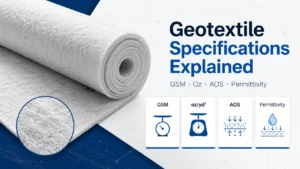
GSM is useful for product identification and comparison, but GSM alone does not prove filtration, separation or road suitability.
Internal link:
geotextile GSM, oz, AOS and permittivity→ geotextile-gsm-oz-aos-permittivity-guide
Geogrid Data to Review
Depending on the application:
- product structure;
- polymer;
- tensile properties;
- tensile response at relevant strain levels;
- aperture geometry;
- junction properties;
- pullout or interface data where relevant;
- long-term reinforcement data where required;
- installation-damage information;
- roll dimensions.
Important
Ultimate tensile strength is an index property and should not automatically be treated as allowable project design strength.
Likewise:
- junction strength is not pullout resistance;
- aperture geometry alone does not prove road performance;
- short-term tensile data do not establish long-term reinforcement performance.
These distinctions come directly from the parameter/test hierarchy in the Geogrid knowledge base.
Internal link:
what strength geogrid do I need→ what-strength-geogrid-do-i-need
Quick Selection Guide
This table gives the most practical summary of the page.
| Project need | Material to evaluate first | Why |
|---|---|---|
| Soil–aggregate separation | Geotextile | Creates a continuous separation interface |
| Soil filtration | Geotextile | Can balance soil retention and water passage |
| Drainage filter | Geotextile | Used around aggregate or drainage components |
| Geomembrane protection | Nonwoven geotextile | Cushioning/protection function |
| Granular-layer stabilization | Geogrid | Interacts with surrounding aggregate |
| Reinforced retaining wall | Geogrid | Reinforcement function within reinforced soil |
| Reinforced slope | Geogrid | May provide tensile reinforcement |
| Separation + stabilization | Both may be considered | Different products perform different functions |
| Severe drainage problem | Neither alone | A complete drainage system is required |
| Very weak foundation | Project evaluation required | Other ground-improvement measures may also be needed |
This table identifies a material direction. It does not determine a final specification or structural design.
Common Geotextile vs Geogrid Selection Mistakes
Mistake 1 — Choosing Geotextile by GSM Alone
A heavier geotextile does not automatically provide the correct filtration, opening size, hydraulic behavior or installation survivability.
Better approach: compare the complete technical requirements.
Mistake 2 — Choosing Geogrid by Tensile Strength Alone
Higher ultimate tensile strength does not automatically mean better performance in every road or soil application.
Better approach: consider the application, soil or aggregate interaction, relevant test data, installation and design requirements.
This matches the technical library’s explicit warning that a higher value in one test does not necessarily establish better performance in every application.
Mistake 3 — Using Geogrid as a Soil Filter
An open geogrid should not automatically be treated as a replacement for a geotextile filter where fine-soil retention is required.
Mistake 4 — Assuming Every Geotextile Reinforces the Road
Geotextile can perform several functions, but not every geotextile should automatically be treated as structural reinforcement.
Define the function before assigning the performance claim.
Mistake 5 — Installing Both Without Defining Why
Using both materials is justified when they perform complementary functions—not simply because two products sound safer than one.
Mistake 6 — Ignoring Drainage
Neither geotextile nor geogrid replaces adequate drainage.
Water, subgrade condition and drainage should be reviewed as part of the complete system.
Mistake 7 — Treating TDS Values as Design Values
A TDS describes product properties under specified test methods.
It does not independently determine:
- allowable traffic;
- aggregate thickness;
- wall height;
- geogrid spacing;
- reinforcement length;
- project safety.
Geotextile and Geogrid Installation Are Also Different
The installation principles depend on their function.
Geotextile
Typical concerns include:
- wrinkles and folds;
- damage during aggregate placement;
- overlap or seam requirements;
- puncture;
- contamination;
- exposed construction traffic.
Geogrid
Typical concerns include:
- correct orientation where required;
- contact with surrounding fill or aggregate;
- wrinkles or slack;
- construction damage;
- initial cover;
- placement and compaction procedure.
Do not use one universal overlap, cover thickness or reinforcement spacing for every project.
These details should follow the relevant project specification and product guidance.
What Information Should You Prepare Before Choosing?
For a meaningful product comparison or quotation, prepare more than:
“I need geotextile.”
or:
“I need 40 kN geogrid.”
Provide:
| Information | Examples |
|---|---|
| Application | Road, driveway, wall, slope, drainage, working platform |
| Required function | Separation, filtration, stabilization, reinforcement, protection |
| Soil | Type, gradation, available strength information |
| Aggregate | Type, gradation, maximum particle size |
| Water | Groundwater, drainage requirements, saturation |
| Loading | Traffic or project loading information where available |
| Specification | ASTM, ISO, AASHTO, owner or local requirement |
| Required properties | Mechanical / hydraulic / reinforcement requirements |
| Roll requirements | Width, length and quantity |
| Documentation | TDS, COA, test reports |
| Destination | Port / project location |
| Schedule | Required shipment or arrival date |
This procurement-first structure also follows your GEO Gap Map: users should be able to move from definition and comparison all the way to TDS/Test → application boundary → installation → procurement → evidence, instead of stopping at a generic material definition.
Geotextile or Geogrid — Which Should You Choose?
Do not select between geotextile and geogrid by asking which one is “better.”
Select according to the required function.
Choose a geotextile direction when the main problem involves:
- separation;
- filtration;
- drainage filtration;
- protection.
Choose a geogrid direction when the main problem involves:
- granular-layer stabilization;
- reinforced soil;
- tensile reinforcement.
Consider both when:
the project genuinely requires two complementary functions, such as separation plus granular-layer stabilization.
The final product and specification should then be checked against:
- project conditions;
- verified product data;
- applicable specifications;
- responsible design requirements.
Related Products and Technical Guides
Geotextile Fabric Products
Learn about woven, staple-fiber nonwoven and continuous-filament nonwoven geotextile options.
Geotextile for Road Construction
Understand separation, filtration and stabilization considerations beneath road aggregate.
→ geotextile-for-road-construction
Woven vs Nonwoven Geotextile
Compare fabric structure, filtration, drainage and common applications.
→ woven-vs-non-woven-geotextile-fabric
Geotextile Specifications Explained
Learn how GSM, AOS and permittivity should be interpreted.
→ geotextile-gsm-oz-aos-permittivity-guide
Geogrid for Road Construction
Review granular-layer stabilization, selection factors and road-system considerations.
→ geogrid-for-road-construction-guide
Geogrid Retaining Wall Guide
Understand reinforcement, connection, fill, foundation and drainage considerations.
→ geogrid-retaining-wall-ultimate-guide
Common Geogrid Mistakes
Review product-selection and installation mistakes before specifying geogrid.
Frequently Asked Questions
What is the main difference between geotextile and geogrid?
Geotextile is a continuous woven or nonwoven fabric commonly used for separation, filtration, drainage support and protection. Geogrid has an open-grid structure and is commonly used for granular-layer stabilization or soil reinforcement. The correct material depends on the function required by the project.
Can geogrid replace geotextile?
Not automatically. Geogrid does not normally provide the same continuous filtration or fine-soil separation interface as geotextile. If filtration or control of fine-soil migration is required, an appropriate geotextile may still be needed.
Can geotextile replace geogrid?
Not automatically. A geotextile may provide separation and filtration, but it should not automatically be treated as a substitute for a geogrid where the design requires granular-layer stabilization or soil reinforcement.
Can geotextile and geogrid be used together?
Yes. They may be used together when different functions are required. For example, geotextile may provide separation or filtration while geogrid contributes to granular-layer stabilization. The need for both should be based on the project requirements rather than used as a universal detail.
Should geotextile go under geogrid?
It can in selected systems, but there is no universal rule that geotextile must always be installed below geogrid. Layer arrangement depends on the required functions, soil, aggregate, product type and project design.
Which is better for a road, geotextile or geogrid?
Neither is universally better. Geotextile is commonly considered where separation or filtration is required. Geogrid is commonly considered where granular-layer stabilization is required. Some road systems may use both.
Which is better for a gravel driveway?
It depends on the problem. If the main concern is fine soil mixing into the gravel, geotextile may be the appropriate starting point. If aggregate movement and stabilization are the primary concerns, geogrid may be evaluated. Drainage, subgrade and traffic conditions should also be considered.
Is stronger geogrid always better than geotextile?
This is not a useful direct comparison because the materials may perform different functions. A higher tensile value does not establish that one product is more suitable for filtration, separation or a particular road system.
Need Help Comparing the Two Materials?
The most useful starting point is not a product name.
Send us:
- application;
- required function;
- available project specification;
- soil or aggregate information;
- required properties;
- quantity;
- roll size;
- destination.
GeoCore can help compare available product data, test documentation and supply options. Final project design and structural selection should follow the responsible engineer’s requirements.
CTA 1
CTA 2
Request Product Data