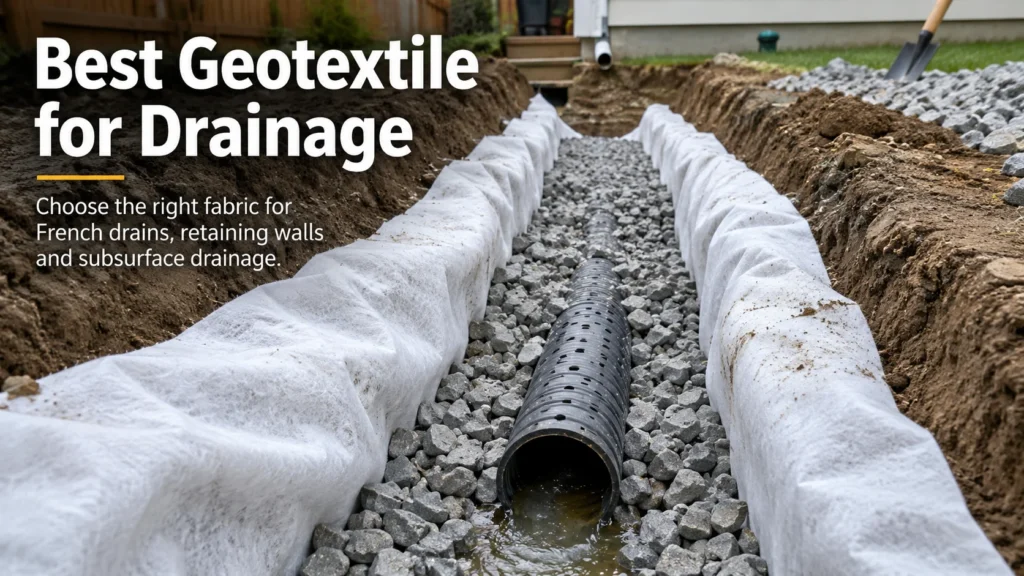
For many conventional French drains, trench drains and retaining-wall drainage zones, a needle-punched nonwoven geotextile is the most practical starting point. It allows water to pass through the fabric while helping prevent surrounding soil from migrating into the drainage aggregate.
However, it is not automatically the best choice for every project. The correct geotextile depends on the soil gradation, filtration requirement, apparent opening size, permittivity, clogging risk, installation severity and project specification. Woven monofilament geotextiles may also be used in engineered filters where controlled openings, higher tensile properties or specific hydraulic performance are required.
The important question is therefore not simply “woven or nonwoven?” It is:
Can the selected fabric retain the surrounding soil, pass the required water flow and survive installation in the proposed drainage system?
Author: Geosynsource Technical Team
Reviewed by: Product and Application Team
Last updated: July 2026
This article provides general product-selection guidance. Final filtration criteria and installation details should follow the project specification and responsible engineer’s design.
Quick Selection Guide
| Application | Common starting option | Main points to verify |
|---|---|---|
| French drain | Needle-punched nonwoven geotextile | Soil compatibility, AOS, permittivity, aggregate and outlet |
| Retaining-wall drainage | Nonwoven filter fabric or drainage geocomposite | Filter location, drainage aggregate, pipe and discharge |
| Foundation drain | Nonwoven geotextile or composite drain | Soil fines, waterproofing interface and drainage capacity |
| Road edge drain | Specification-compliant geotextile | AASHTO or local requirements and installation survivability |
| Riprap or hydraulic filter | Robust nonwoven or woven monofilament | Soil retention, puncture, abrasion and hydraulic exposure |
| High-flow wall or landfill drainage | Drainage geocomposite | Filter compatibility, core transmissivity and compressive loading |
This table provides a starting point rather than a final product specification.
What Does a Geotextile Do in a Drainage System?
A geotextile used around drainage aggregate usually performs two main functions.
Filtration
The fabric allows water to move from the soil into the drainage zone while limiting unacceptable loss of soil particles.
A successful filter does not need to stop every fine particle. It needs to maintain a stable soil–filter interface while allowing sufficient water flow.
Separation
The fabric keeps the natural soil and drainage aggregate from mixing.
Without effective separation, fine soil can enter the stone voids, gradually reducing the effective drainage space and contaminating the aggregate.
In many systems, the geotextile does not transport the collected water over a long distance. The drainage aggregate, perforated pipe, drainage core and outlet provide the main flow path.
This distinction matters because the commercial term geotextile drainage fabric often describes a product whose main engineering role is filtration rather than drainage within the plane of the material.
Why Is Nonwoven Geotextile Commonly Used for Drainage?
Needle-punched nonwoven geotextiles consist of randomly oriented synthetic fibres mechanically entangled into a permeable fabric.
Their structure is often useful in ordinary subsurface drainage because they can provide:
- filtration through the fabric;
- separation between soil and stone;
- flexibility around irregular trenches;
- cushioning against coarse aggregate;
- puncture resistance during placement;
- conformability around drainage details.
AASHTO guidance identifies subsurface drains as a common use for nonwoven geotextiles, particularly where the fabric separates drainage stone from the surrounding soil and helps limit the migration of fines. The current AASHTO Materials Book lists M 288M/M 288-24 for geosynthetics used in highway applications.
However, nonwoven is only a product category. It is not a full specification.
Two needle-punched nonwoven fabrics with the same mass per unit area can have different:
- pore-size distributions;
- apparent opening sizes;
- permittivity;
- thicknesses;
- puncture properties;
- manufacturing consistency.
The product should therefore be assessed using its technical data rather than appearance or weight alone.
Can Woven Geotextile Be Used for Drainage?
Yes, but the woven structure must be identified.
Slit-Film Woven Geotextile
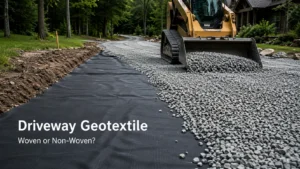
Slit-film woven geotextiles are commonly used for separation and stabilization beneath roads, driveways and aggregate platforms.
They often provide useful tensile properties, but they should not automatically be selected where filtration and cross-plane water flow are the dominant requirements.
Woven Monofilament Geotextile
Woven monofilament geotextiles are produced from individual yarns that form more defined openings.
They may be specified for:
- permanent erosion-control filters;
- filtration beneath riprap;
- shoreline or hydraulic structures;
- some subsurface drainage systems;
- applications requiring controlled openings and higher tensile properties.
It is therefore inaccurate to state that woven geotextile does not drain. Slit-film woven and woven monofilament products can behave very differently.
Nonwoven vs Woven Geotextile for Drainage
| Consideration | Needle-punched nonwoven | Slit-film woven | Woven monofilament |
|---|---|---|---|
| Common role | Filtration, separation and protection | Separation and stabilization | Engineered filtration |
| Pore structure | Random fibre network | Openings between flat tapes | More defined yarn openings |
| Conformability | Generally high | Moderate | Moderate |
| Cushioning | Generally good | Relatively limited | Product-specific |
| Water flow | Product-specific; often suitable for general drainage | Must be checked carefully | Product-specific and often designed for filtration |
| Typical use | French drains, trench drains and wall drainage | Roads and aggregate separation | Riprap, hydraulic filters and specified drains |
| Main selection basis | Soil, AOS, permittivity and survivability | Separation, strength and hydraulic data | Soil retention, opening size, flow and strength |
The correct conclusion is not that one category is always better.
For ordinary drainage trenches, nonwoven geotextile is often the simpler option. For engineered filtration, the project may require woven monofilament or another specifically tested product.
The Three Checks That Matter Most
1. Soil Retention
The geotextile must limit unacceptable migration of the surrounding soil.
This depends on more than the fabric itself. Important factors include:
- soil-particle distribution;
- amount and behaviour of fines;
- soil uniformity;
- hydraulic gradient;
- expected direction of flow;
- fabric pore structure.
ASTM D4751 determines the apparent opening size of a geotextile. The standard also notes that a geotextile used to retain soil must be compatible with the adjacent soil. AOS is therefore a product index used in selection, not proof that the product will perform with every soil.
2. Water Flow
The fabric must pass enough water for the drainage system to function.
ASTM D4491/D4491M measures geotextile water permeability in terms of permittivity under defined laboratory conditions. ASTM describes permittivity as an indication of water flow through the isolated geotextile and cautions against treating that value as universal field performance.
Once installed, the geotextile is affected by:
- soil contact;
- suspended particles;
- confinement;
- compression;
- biological growth;
- installation damage;
- changes in water chemistry.
A clean-water laboratory value is useful for comparing products tested by the same method, but it is not a complete drainage design.
3. Installation Survivability
The fabric must remain intact during installation.
Potential damage can come from:
- sharp drainage aggregate;
- rough excavation surfaces;
- aggregate dropped from excessive height;
- wrinkles and folds;
- construction traffic;
- insufficient initial cover;
- dragging rolls across the ground.
Grab tensile, tear and puncture properties may therefore be as important as hydraulic data in a severe installation.
A hydraulically suitable fabric that is damaged during backfilling may no longer provide reliable separation or filtration.
Why Fabric Weight Is Not Enough
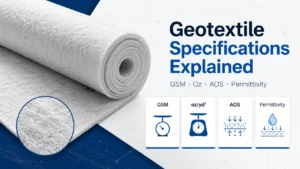
Geotextile is often sold by GSM or oz/yd² because these values are easy for buyers to understand.
However, mass per unit area does not directly define:
- AOS;
- permittivity;
- pore-size distribution;
- soil-retention performance;
- long-term clogging behaviour.
A heavier fabric may provide greater thickness, cushioning or puncture resistance. It does not automatically provide better drainage.
Likewise, a lighter fabric may have a high clean-water flow rate but insufficient survivability for coarse aggregate or demanding construction.
For this reason, statements such as “6 oz is the best French-drain fabric” or “300 GSM is suitable for all retaining walls” are not technically reliable without supporting product data and project conditions.
Use weight as a product-identification parameter, not as the sole selection criterion.
What Is the Best Geotextile for a French Drain?
For a conventional French drain in reasonably understood soil, a needle-punched nonwoven geotextile is commonly used around the drainage aggregate.
Its role is to separate the surrounding soil from the clean stone while allowing water to enter the drainage zone.
The complete drain still depends on:
- suitable trench geometry;
- adequate fall;
- clean drainage aggregate;
- a perforated pipe where required;
- a continuous outlet;
- sufficient discharge capacity;
- correct filter location;
- proper overlaps and installation.
The fabric cannot compensate for a blocked pipe, an inadequate outlet or a trench that does not direct water toward the discharge point.
Should the Fabric Wrap the Pipe or the Whole Trench?
There is no universal detail for every French drain.
Depending on the design, the geotextile may:
- line part of the trench;
- form an envelope around the drainage aggregate;
- separate one soil or aggregate interface;
- be incorporated into a prefabricated drain.
It should not automatically be installed as a tight sock directly around every perforated pipe.
FHWA details show that the required location depends on the drainage arrangement. One pavement drainage detail specifies wrapping only part of the trench and not covering the interface between the permeable base and drainage aggregate. FHWA soil-nail guidance also describes wrapping the aggregate trench while avoiding a geotextile sock directly over the slotted pipe in that application.
For a civil project, follow the approved drawing instead of relying on a generic online installation diagram.
What Is the Best Geotextile Behind a Retaining Wall?
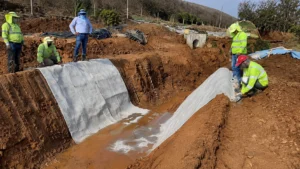
Behind a retaining wall, geotextile commonly separates retained soil from the drainage aggregate.
The filter fabric helps reduce the migration of soil fines into the free-draining stone.
A complete wall drainage arrangement may also contain:
- selected drainage aggregate;
- a perforated collector pipe;
- outlets or weep holes;
- surface-water control;
- waterproofing;
- a prefabricated drainage board or geocomposite.
FHWA retaining-wall guidance describes drainage details in which aggregate surrounding a perforated pipe is enclosed by a filter, commonly a geotextile.
The fabric does not remove water on its own. There must still be a functioning path that collects the water and discharges it safely.
Wall drainage requirements also depend on the wall type, retained soil, groundwater, surface runoff and design conditions. A general blog article should not prescribe a universal fabric grade or drainage detail.
When Is Standalone Geotextile Not Enough?
A standalone geotextile is suitable when the main need is for water to pass through the thickness of the fabric into an adjacent drainage layer.
It may not be sufficient where water must travel a significant distance within the plane of a drainage product.
Examples include:
- basement-wall drainage;
- deep retaining walls;
- green roofs;
- landfill drainage layers;
- tunnel drainage;
- heavily loaded foundation drainage.
In these cases, a drainage geocomposite may be more appropriate.
The system normally combines:
- a geotextile filter;
- a geonet or cuspated drainage core;
- a discharge connection.
ASTM distinguishes cross-plane permittivity testing from in-plane transmissivity testing because they describe different hydraulic functions.
The filter fabric should be evaluated for soil compatibility, while the drainage core should be evaluated for transmissivity and compressive conditions.
What About Clogging?
Clogging is not simply a property of “cheap fabric” or “heavy fabric.”
It can develop when:
- the fabric openings are incompatible with the soil;
- fine particles accumulate at the interface;
- soil piping occurs;
- biological growth develops;
- chemical precipitation occurs;
- the geotextile is compressed;
- flow conditions change over time.
ASTM D5101 evaluates the filtration compatibility of a water-saturated soil–geotextile system with respect to particle retention and flow capacity. ASTM also states that this is a site-specific performance test, not an index value that should routinely be requested from every supplier.
For ordinary procurement, the buyer normally requests the geotextile’s index properties and confirms compliance with the project specification.
For difficult soils or critical filtration systems, additional soil–geotextile compatibility evaluation may be necessary.
Common Selection and Installation Mistakes
Selecting Only by GSM or Ounces
Weight does not provide enough information about filtration or water flow.
Assuming Every Nonwoven Product Is Suitable
Needle-punched, thermally bonded and other nonwoven products can have different structures and performance.
Assuming All Woven Fabrics Block Water
Woven monofilament and slit-film woven geotextiles should not be treated as the same product.
Selecting the Highest Flow Rate
High clean-water flow does not prove adequate soil retention or long-term compatibility.
Using Weed-Control Fabric for Civil Drainage
Landscape fabric may not provide verified AOS, permittivity, puncture or survivability data.
Ignoring the Surrounding Soil
A geotextile filter cannot be selected correctly without considering the soil it will contact.
Placing the Fabric in the Wrong Location
Incorrect placement can block an intended interface, isolate drainage aggregate or concentrate fines near a pipe.
Installing the Fabric Over Sharp or Uneven Surfaces
Punctures and tears can compromise filtration and separation.
Treating the Fabric as the Entire Drainage System
Geotextile does not replace the drainage aggregate, pipe, drainage core or outlet.
What Data Should a Supplier Provide?
A useful geotextile drainage fabric data sheet should identify:
| Information | Why it matters |
|---|---|
| Product construction | Confirms needle-punched nonwoven, woven monofilament or another type |
| Polymer | Identifies the main raw material |
| Mass per unit area | Supports product identification and consistency |
| AOS and test method | Supports preliminary soil-retention assessment |
| Permittivity | Describes cross-plane water flow under defined conditions |
| Water-flow rate | Helps compare products tested on the same basis |
| Grab tensile strength | Indicates handling and survivability characteristics |
| Tear strength | Helps assess installation resistance |
| Puncture resistance | Relevant around angular stone and rough surfaces |
| UV resistance | Relevant where the fabric may remain exposed |
| Roll width and length | Affects installation, overlaps and waste |
| Reporting basis | Confirms typical, minimum, MARV or guaranteed values |
| Test reports | Supports verification of the declared properties |
| Sample COA | Shows how batch quality may be documented |
For U.S. highway work, project documents may reference AASHTO M 288M/M 288-24 or agency-specific requirements. Do not assume that a general commercial fabric meets a named class unless the relevant properties and reporting basis have been verified.
Information Needed Before Requesting a Recommendation
A supplier can provide a more useful product comparison when the buyer submits:
- project application;
- soil description or gradation;
- required standard;
- specified AOS;
- specified permittivity or flow rate;
- tensile, tear and puncture requirements;
- drainage aggregate size;
- installation conditions;
- roll dimensions;
- quantity;
- destination;
- required documentation;
- project specification or BOQ.
A request for “200 GSM drainage fabric” is usually not enough to confirm suitability.
Final Recommendation
For many ordinary French drains, trench drains and retaining-wall drainage zones, a needle-punched nonwoven geotextile is the most reasonable product type to evaluate first.
It is not automatically the best product for every drainage application.
The final selection should confirm that the fabric:
- retains the surrounding soil;
- passes the required water flow;
- is not unnecessarily vulnerable to clogging;
- survives installation;
- matches the project specification;
- works with the complete drainage system.
Where soil conditions are difficult, filtration is safety-critical or the drainage detail is heavily loaded, selection should be based on project-specific engineering requirements rather than fabric weight or a generic online recommendation.
Need a Geotextile Drainage Fabric Quotation?
GeoCore can provide product specifications, available roll sizes, test documentation and commercial quotations for woven and nonwoven geotextiles.
For an accurate comparison, submit the application, project specification, required test values, quantity and destination.
Final filtration design and installation details should follow the responsible engineer’s requirements.
Frequently Asked Questions
Is woven or nonwoven geotextile better for drainage?
Needle-punched nonwoven geotextile is commonly used for French drains, trench drains and retaining-wall drainage because it can provide filtration, separation and conformability.
Woven monofilament geotextile may be more appropriate in some engineered filters requiring controlled openings or higher tensile properties. The correct choice depends on the soil, hydraulic requirements and project specification.
What weight of geotextile is best for a French drain?
There is no universal weight.
Fabric weight helps identify the product, but AOS, permittivity, installation strength and soil compatibility are more important for drainage filtration. Two fabrics with the same GSM can have different hydraulic properties.
Can geotextile drainage fabric become clogged?
Yes.
Clogging or blinding can occur when the fabric pore structure is incompatible with the soil or when fines accumulate at the interface. Difficult soils may require soil–geotextile compatibility evaluation.
Should geotextile wrap the drainage pipe?
Not necessarily.
In many systems, the geotextile separates the soil from the drainage aggregate rather than being tightly wrapped around the pipe. The correct position should follow the drainage detail or approved drawing.
Is geotextile drainage fabric the same as landscape fabric?
No, not automatically.
Some landscape fabrics are intended mainly for weed control and may not provide the verified AOS, permittivity, puncture or filtration properties needed for a civil drainage system.
Can geotextile replace drainage gravel?
No.
Geotextile provides filtration and separation. Drainage aggregate, perforated pipe, an outlet or a drainage core is still needed to collect and transport water where required.
Does heavier geotextile always have lower water flow?
No.
Hydraulic performance depends on the fabric structure, pore distribution, thickness, compression and test conditions. Weight alone does not determine permittivity.