What Should You Consider When Choosing Geomat?
Choosing the right geomat is not simply about selecting the thickest product or the highest strength value.
In erosion control projects, geomat works together with the soil, vegetation, drainage system, and installation method. The most suitable product depends on the actual site conditions, including slope angle, soil type, rainfall, runoff conditions, and the expected service environment.
Before selecting a geomat, the first question should not be:
“Which geomat is the strongest?”
A better question is:
“What erosion problem needs to be controlled, and what level of protection does the site require?”
What Does Geomat Actually Do?
Geomat is a three-dimensional erosion control material designed to protect soil surfaces and support vegetation establishment.
Its main functions include:
- reducing surface erosion caused by rainfall and runoff
- retaining topsoil during vegetation growth
- creating a stable environment for plant roots
- improving long-term surface protection through vegetation development
However, geomat is mainly used for surface erosion control.
It is not designed to replace:
- slope stability analysis
- retaining structures
- deep soil reinforcement
- drainage systems
For slopes with potential instability or structural loading requirements, additional solutions such as geocell or geogrid may need to be considered.
How to Evaluate Your Project Before Choosing Geomat
1. Check the Slope Condition
Slope geometry is one of the first factors to consider.
A gentle slope with stable soil and good vegetation conditions has very different requirements from a steep exposed embankment.
Gentle Slopes
Typical conditions:
- low erosion risk
- stable soil surface
- easier vegetation establishment
The main purpose is usually maintaining surface soil and helping vegetation grow.
Moderate Slopes
As slope angle increases, rainfall runoff can create stronger erosion forces.
Important considerations include:
- better soil retention capability
- reliable anchoring
- proper drainage management
Steep Slopes
Steep slopes require more careful evaluation.
Before selecting geomat, consider:
- Is the soil itself stable?
- Is there concentrated water flow?
- Is additional reinforcement required?
A stronger geomat may improve surface protection, but it cannot solve deep slope failure.
2. Consider Soil Conditions
The same geomat product may perform differently on different soil types.
Sandy Soil
Sandy soils are more easily washed away because particles have less cohesion.
Important considerations:
- soil retention capability
- vegetation establishment
- runoff control
Clay Soil
Clay soils may have lower permeability and can experience surface runoff concentration.
Important considerations:
- drainage conditions
- surface cracking
- water movement
Loose Fill or Newly Constructed Slopes
New embankments often require attention to:
- compaction quality
- surface stability
- drainage paths
Geomat can help control surface erosion, but it should work together with proper earthwork practices.
3. Understand Rainfall and Runoff Conditions
Rainfall alone does not determine erosion risk.
The actual concern is how water moves across the slope.
Two slopes in the same climate may require different protection because of differences in:
- slope length
- drainage paths
- runoff concentration
- soil erosion resistance
A geomat system should be selected according to the expected erosion mechanism, not only local rainfall data.
How to Compare Different Geomat Products
When comparing suppliers, do not look at only one specification.
A practical evaluation should include several factors.
Polymer Material
Common geomat materials include:
- HDPE
- PP
Material selection affects:
- outdoor durability
- UV resistance
- flexibility
- long-term exposure performance
For exposed applications, UV stabilization is an important consideration.
Thickness and Three-Dimensional Structure
The thickness and structure of geomat influence:
- soil retention capacity
- available space for vegetation growth
- overall surface protection capability
However, a thicker product is not automatically the best choice.
The correct selection depends on the erosion conditions and project requirements.
Weight per Square Meter
The unit weight provides information about material density and structure.
It should be considered together with:
- polymer type
- thickness
- opening structure
- tensile properties
A single value should not be used as the only selection criterion.
Tensile Properties
Tensile strength can provide useful information about material quality and handling resistance.
However, it should not be interpreted as a direct indicator of complete project performance.
Actual performance also depends on:
- soil interaction
- installation quality
- anchoring method
- environmental conditions
Opening Structure and Void Ratio
The three-dimensional structure of geomat affects:
- soil filling
- root development
- water movement
For vegetation-based slope protection, the ability to support plant growth is an important consideration.
Understanding EM2, EM3 and EM4 Geomat
Some manufacturers classify geomat products using terms such as EM2, EM3, or EM4.
However, these classifications are not universal international grades. Different suppliers may use different naming systems.
When comparing these products, it is better to review the actual technical data, including:
- material type
- thickness
- weight
- tensile properties
- UV resistance
- structure design
The model name alone should not determine product selection.
Geomat Selection by Application
Highway Slope Protection
Typical considerations:
- slope angle
- rainfall exposure
- vegetation requirements
- maintenance conditions
Geomat is commonly used to reduce surface erosion and support slope greening.
Railway Embankments
Important factors:
- long-term erosion protection
- drainage conditions
- construction quality
Riverbank and Channel Protection
The main concern is often hydraulic erosion.
Important factors:
- water velocity
- flow concentration
- soil loss potential
In high-flow areas, additional protection measures may be required.
Landscaping and Residential Slopes
The focus is usually:
- appearance
- vegetation establishment
- easy installation
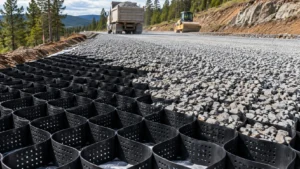
Geomat vs Geocell: Which One Should You Choose?
Geomat and geocell solve different problems.
| Geomat | Geocell | |
|---|---|---|
| Main function | Surface erosion control | Soil confinement |
| Typical use | Vegetated slopes | Reinforced slopes and load areas |
| Vegetation support | Excellent | Possible |
| Structural reinforcement | Limited | Higher |
If the main problem is surface erosion, geomat may be suitable.
If the project requires soil confinement or additional structural support, geocell may be considered.
When Is Geomat Not Enough?
Geomat is not a substitute for proper geotechnical design.
Additional solutions may be required when the project involves:
- unstable slopes
- landslide risks
- high structural loads
- severe water flow conditions
Possible supporting systems include:
- geocell
- geogrid
- drainage systems
- retaining structures
The correct solution depends on the complete site condition.
Common Mistakes When Selecting Geomat
Choosing Only by Price
A lower material cost does not always mean a lower project cost.
Poor selection may result in:
- vegetation failure
- repeated repairs
- additional installation work
Selecting Based Only on Tensile Strength
Higher tensile strength does not automatically mean better erosion control performance.
The complete system should be considered.
Ignoring Installation Requirements
Even suitable geomat may fail if:
- anchoring is insufficient
- slope preparation is poor
- drainage problems are ignored
Assuming One Product Fits Every Slope
Different slopes have different erosion mechanisms.
A product suitable for landscaping may not be suitable for a highway embankment or riverbank project.
A Practical Geomat Selection Process
Before requesting a quotation, prepare the following information:
Project Information
- Application type
- Slope angle
- Slope height and length
- Soil condition
- Rainfall environment
- Vegetation requirements
Product Requirements
- Required material
- Roll size
- Installation method
- Technical standards if applicable
Providing this information allows suppliers to recommend products based on actual project needs rather than only price comparison.
Conclusion
Choosing the right geomat is not about finding the strongest product available.
The correct choice depends on matching the geomat structure with the actual erosion conditions, soil characteristics, environmental exposure, and installation requirements.
For most projects, successful erosion control comes from the combination of:
- suitable geomat selection
- proper slope preparation
- correct installation
- vegetation establishment
- effective drainage management
Related Articles
- Geomat Fabric Guide: Types, Applications and Installation
- Best Geomat Fabric for Highway Slope Protection
- Geomat vs Geotextile for Slope Protection
- How Long Does Geomat Fabric Last?
FAQ
How do I choose the right geomat?
The right geomat depends on slope angle, soil condition, rainfall, runoff, vegetation requirements, and installation conditions.
Is thicker geomat always better?
No. Thickness is only one product factor. The suitable geomat depends on the actual erosion conditions and project requirements.
Can geomat replace geocell?
No. Geomat mainly controls surface erosion, while geocell provides soil confinement and reinforcement.
What specifications should I compare when buying geomat?
Important specifications include material type, thickness, weight, tensile properties, opening structure, UV resistance, and installation requirements.
Can geomat be used on steep slopes?
Geomat can be used on many steep slopes, but the project should first be evaluated for slope stability, drainage conditions, and whether additional reinforcement is required.