Short Answer
Geogrid and gravel grid are not the same — and neither is universally better.
The right choice depends on what problem you are trying to solve:
-
If the issue is weak soil, base failure, or repeated loading, geogrid is usually the better solution.
-
If the issue is gravel spreading, rutting, or surface instability, gravel grids (cellular paving systems) are often more effective.
This guide explains the practical differences, use cases, and decision logic so you can choose correctly.

Why This Comparison Matters
Many projects fail not because the wrong material was used, but because the right solution was applied to the wrong problem.
Gravel surfaces typically fail in two very different ways:
-
Structural failure – the base or subgrade deforms under load
-
Surface failure – gravel moves laterally, forms ruts, or washes out
Geogrids and gravel grids address different failure mechanisms, which is why understanding the distinction is critical.
Geogrid
Here, geogrid refers to a base reinforcement solution designed to address weak soils and repeated loading.
Its role is structural — improving load transfer and reducing deformation — rather than surface stabilization.
Geogrids are typically installed within or directly above the base layer, where they work through mechanical interaction with aggregate.
👉 For deeper engineering context, see: Geogrid for Road Construction
Gravel Grid (Cellular Paving System)
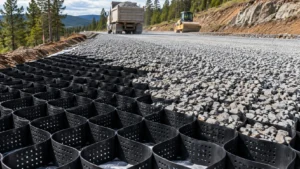
A gravel grid, often called a cellular paving system, is a three-dimensional plastic grid designed to hold gravel in place at the surface.
Installed beneath a layer of gravel, gravel grids:
-
Confine aggregate within individual cells
-
Reduce lateral movement and rutting
-
Improve surface evenness and appearance
-
Help limit gravel washout and erosion
Gravel grids focus on surface stability, not base reinforcement.
The Key Difference
The difference is not the material — it is where and how the system works.

-
Geogrid strengthens the structure below the surface.
-
Gravel grid stabilizes the gravel at the surface.
Once this distinction is clear, most design decisions become straightforward.
Side-by-Side Comparison
| Aspect | Geogrid | Gravel Grid |
|---|---|---|
| Primary role | Structural reinforcement | Surface confinement |
| Installed location | Base or subbase layer | Surface or near-surface |
| Main problem addressed | Weak soil, deformation | Gravel movement, rutting |
| Improves load transfer | Yes | Limited |
| Controls gravel spread | Indirectly | Directly |
| Typical traffic | Moderate to heavy | Light to moderate |
| Visibility after install | Hidden | Often visible |

When You Should Use Geogrid

Choose geogrid when:
-
The subgrade is soft, clay-rich, or moisture-sensitive
-
Rutting originates from base deformation, not just loose gravel
-
Loads are repeated or heavier than residential traffic
-
Long-term structural performance is critical
Geogrids are commonly used in gravel roads, access roads, industrial yards, and road construction projects.
When You Should Use Gravel Grid
Choose gravel grid when:
-
Gravel spreads, shifts, or forms wheel tracks
-
Traffic is light to moderate (e.g. residential driveways, parking pads)
-
Surface appearance and usability matter
-
You want to reduce routine maintenance and regrading
Gravel grids are especially effective for driveways, pathways, landscaped areas, and permeable parking surfaces.
👉 Related reading: Is Geogrid Good for Driveways?
Can Geogrid and Gravel Grid Be Used Together?
Yes — and in some cases, this is the best-performing solution.
A combined approach may include:
-
Geogrid within the base layer to improve structural capacity
-
Gravel grid at the surface to control aggregate movement
This strategy is useful where both weak soil and surface instability are present.

Common Misconceptions
“Gravel grids replace geogrids”
❌ No. Gravel grids do not significantly improve base strength.
“Geogrids stop gravel from spreading”
⚠️ Not directly. They improve structural behavior but do not physically confine surface gravel.
“One solution works everywhere”
❌ Site conditions, traffic, and performance goals always matter.
A Simple Rule of Thumb
Ask these three questions:
-
Is the ground weak or deforming?
→ Start with geogrid. -
Is gravel moving or rutting at the surface?
→ Consider gravel grid. -
Are both issues present?
→ A combined system may be appropriate.
Frequently Asked Questions
Is a gravel grid the same as a geogrid?
No. Gravel grids are cellular surface systems, while geogrids are flat reinforcement layers used within the base.
Which is better for driveways?
For most residential gravel driveways, gravel grids work well. If soil is weak or traffic is frequent, geogrid may be required.
Can geogrid be used without a gravel grid?
Yes. Geogrids are commonly used alone in gravel roads and base reinforcement applications.
Can gravel grids handle heavy vehicles?
Gravel grids are typically designed for light to moderate traffic. Heavier loads often require geogrid reinforcement.
Conclusion
Geogrid vs gravel grid is not a competition — it is a selection problem.
Choosing the right system depends on whether your priority is structural reinforcement or surface stability.
Understanding this difference helps avoid unnecessary cost, poor performance, and premature failure.
Used correctly, both systems deliver value. Used incorrectly, neither will.