Short Answer
Geogrid slope stabilization is one of the most common applications of geosynthetic reinforcement in civil engineering. While slopes are a major use case, geogrids are also widely used in road construction, retaining wall systems, and ground stabilization projects. A broader overview of these engineering uses can be found in our guide on geogrid applications, which explains where geogrids work best and when other solutions may be more appropriate.
This technique is widely used in highway embankments, infrastructure slopes, and reinforced soil structures where natural soil strength is insufficient.
What Is Slope Stabilization?
Slope stabilization refers to engineering methods used to prevent soil slopes from failing due to gravity, water pressure, or weak soil conditions.
Common causes of slope failure include:
-
Low soil shear strength
-
Excessive slope angles
-
Surface erosion
-
Poor drainage
-
Heavy surcharge loads
When slopes become unstable, they may experience landslides, erosion, or gradual deformation.
To prevent these issues, engineers use reinforcement systems such as geogrids to improve soil stability and increase the safety factor of the slope.
How Geogrid Stabilizes Slopes

Geogrids stabilize slopes through a combination of mechanical interactions between soil and reinforcement layers.
The stabilization mechanism involves three main effects.
1. Soil Confinement
Geogrids interlock with surrounding aggregate and soil particles, restricting lateral movement.
This confinement increases the internal stability of the soil mass.
2. Load Distribution
Reinforcement layers distribute loads over a wider area, reducing localized stress and deformation.
3. Tensile Reinforcement
Geogrids provide tensile strength that soil alone cannot offer.
This tensile resistance helps maintain slope stability under gravitational and external forces.
Together, these mechanisms transform loose soil into a reinforced soil structure capable of supporting steeper slopes.
Applications of Geogrid Slope Stabilization

Geogrid slope stabilization is used in a wide range of civil engineering projects where long-term slope performance is critical.
Highway Embankments
Geogrid slope stabilization is frequently used in highway embankments and transportation infrastructure where long slopes must remain stable under traffic loads and environmental conditions. In many road engineering projects, geogrid reinforcement is also applied within the base layers to improve load distribution and reduce deformation. You can learn more about these design principles in our guide on geogrid for road construction.
Railway Slopes
Railway infrastructure often requires reinforced soil slopes to maintain long-term stability.
Landfill Slopes
Waste containment systems frequently rely on geogrid reinforcement to stabilize landfill embankments.
Infrastructure Projects
Bridges, dams, and earth structures commonly use reinforced soil slopes to reduce construction costs while maintaining safety.
Reinforced Soil Slopes vs Traditional Slope Protection

Different slope protection systems are used depending on project conditions.
| Method | Typical Application |
|---|---|
| Geogrid Reinforcement | Reinforced soil slopes and embankments |
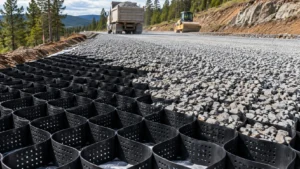
| Geocell Systems | Surface stabilization and erosion control |
| Gabion Walls | Riverbank and hydraulic structures |
| Shotcrete | Rock slope stabilization |
Compared with rigid systems, geogrid reinforced slopes are flexible and can accommodate small ground movements without structural damage.
Reinforced soil slopes share many design principles with reinforced earth structures such as retaining walls. Both systems rely on geogrid layers embedded within compacted soil to create a stable reinforced soil mass. For vertical or near-vertical earth structures, geogrid reinforcement is widely used in geogrid retaining wall systems, which allow engineers to build taller and more stable walls while reducing construction costs.
Design Considerations for Geogrid Slope Stabilization

Successful slope reinforcement requires careful engineering design.
Key design factors include:
Slope Angle
Steeper slopes require stronger reinforcement and closer spacing between geogrid layers.
Soil Strength
The shear strength and compaction of the soil determine the overall stability of the reinforced slope.
Reinforcement Length
Geogrid layers must extend sufficiently into the stable soil mass behind the slope face.
Drainage Conditions
Proper drainage prevents water pressure buildup that can weaken soil stability.
Load Conditions
External loads such as traffic, structures, or heavy equipment must be considered during design.
Engineering calculations typically evaluate the slope’s factor of safety before and after reinforcement.
Reinforcement Spacing
Closer vertical spacing between geogrid layers generally improves slope performance, especially in steeper or more heavily loaded structures.
Factor of Safety
Engineering design typically evaluates the factor of safety of the slope before and after reinforcement to confirm long-term stability.
Common Mistakes in Slope Reinforcement

Improper installation or design can reduce the effectiveness of geogrid systems.
Typical mistakes include:
-
Using the wrong type of geogrid
-
Insufficient reinforcement length
-
Poor soil compaction
-
Inadequate drainage design
-
Improper layer spacing
Avoiding these issues ensures long-term slope performance.
Advantages of Geogrid Reinforced Slopes
Geogrid reinforcement offers several important advantages over traditional slope stabilization methods, especially in projects where flexibility, cost control, and long-term durability are important.
-
Increased slope stability
-
Reduced construction cost
-
Improved load distribution
-
Flexible structural behavior
-
Longer infrastructure lifespan
Because reinforced soil slopes use locally available materials, they are often more economical than rigid retaining structures.
In reinforced-slope systems where tensile reinforcement is required within the soil mass, PET geogrid for reinforced slopes may be considered when its tensile properties, long-term performance data and project requirements are compatible with the design.
Related Geogrid Applications
Geogrid slope stabilization is only one of several major engineering applications of geogrid reinforcement.
Other common applications include geogrid for road construction, where geogrids improve pavement performance and base stability; geogrid retaining wall systems, which reinforce vertical soil structures; and soil stabilization geogrid solutions used to improve weak subgrades. In smaller-scale projects, similar reinforcement principles are also used in geogrid for gravel driveways to reduce rutting and improve aggregate confinement.
Each application uses geogrid reinforcement to improve soil performance under different loading conditions.
Conclusion
Although geogrid reinforcement is commonly associated with large infrastructure projects, the same reinforcement principles are also used in smaller ground stabilization applications. For example, geogrids are often installed beneath aggregate layers to prevent rutting and improve load distribution in residential access roads. These systems are commonly discussed in projects involving geogrid for gravel driveways, where stabilization of loose aggregates is the primary objective.
Geogrid slope stabilization is a proven engineering solution for reinforcing soil slopes and embankments. By combining soil confinement, load distribution, and tensile reinforcement, geogrids significantly improve slope stability and reduce the risk of failure.
When properly designed and installed, reinforced soil sl
opes provide a cost-effective and durable solution for infrastructure projects, transportation systems, and environmental engineering applications.
What is geogrid slope stabilization?
Geogrid slope stabilization is a reinforcement technique where geogrid layers are installed within compacted soil to improve slope stability and prevent failure.
When should geogrid be used for slope stabilization?
Geogrids are typically used when slopes are steep, soil strength is weak, or additional reinforcement is needed to increase the slope’s factor of safety.
What is the difference between geogrid and geocell for slope protection?
Geogrids reinforce the internal soil mass, while geocells mainly st
abilize the surface layer and control erosion.
For slopes where the primary requirement is surface confinement and erosion-control support rather than internal tensile reinforcement, a HDPE geocell system may be considered depending on slope geometry, infill, drainage and anchorage requirements.
How long does geogrid last in slopes?
High-quality geogrids are designed for long-term durability and can last several decades when properly installed and protected within soil.
owners with a clear technical foundation for making informed decisions.