Short Answer:
A cement blanket is a flexible, roll-supplied cementitious composite that is installed while dry and then hardened by adding water. It combines a dry cement-based material with a textile or fiber structure that keeps the composite together during transportation, installation and curing.
In technical terminology, this product category is commonly referred to as a Geosynthetic Cementitious Composite Mat (GCCM). ASTM D8364/D8364M covers requirements and properties for GCCM materials used in different applications.
Cement blankets are commonly used for applications such as erosion control, slope surface protection, drainage channels, ditches and other civil-engineering surface lining works.
The important feature is simple:
Flexible before hydration → hardened after hydration.
Cement Blanket at a Glance
| Question | Answer |
|---|---|
| What is it? | A flexible cementitious composite supplied in roll form |
| Technical term | Geosynthetic Cementitious Composite Mat (GCCM) |
| Before hydration | Flexible and suitable for positioning on the substrate |
| After hydration | The cementitious component hardens |
| Typical appearance | Gray, fibrous or textile-like roll |
| Reference thickness | Common reference range: 6–10 mm |
| Reference roll width | 1 m / 2 m / customized |
| Reference roll length | 5–20 m / customized |
| Common uses | Slopes, channels, ditches and erosion-prone surfaces |
| Basic installation | Prepare → Unroll → Fix → Hydrate → Harden |
| Structural concrete? | Not automatically |
| Concrete curing blanket? | No |
The dimensional figures above are based on a current comparable commercial product and should be treated as reference specifications rather than universal GCCM dimensions.
What Is a Cement Blanket Made Of?
A cement blanket is a composite material, not simply conventional concrete rolled into a sheet.
A current commercial product describes the material as a three-dimensional engineering composite containing cementitious materials together with a textile structure; its listed material components include concrete, PP and PE.
The exact construction varies by product, but the following components explain the basic structure.
Textile Surface
The outer surface normally has a fibrous or textile appearance.
Before hydration, the textile structure helps keep the cementitious material contained while the blanket is:
- manufactured,
- rolled,
- transported,
- cut,
- positioned,
- overlapped,
- anchored.
This is one reason similar products are sometimes marketed as concrete cloth or concrete fabric.
A dry cement blanket therefore looks much more like a heavy industrial textile roll than a conventional concrete slab.
Cementitious Core
Within the textile structure is a dry cement-based mixture.
The reference product describes this portion as a combination of special cement, aggregate and other cementitious materials contained within the three-dimensional fabric structure.
After water is added, hydration begins and this cementitious component develops into a hardened layer.
The exact formulation can vary between products, so properties such as:
- water requirement,
- curing behavior,
- flexural strength,
- compressive behavior,
- long-term durability,
should be confirmed using the specific product’s current technical documentation.
Fiber or Three-Dimensional Matrix
The fiber structure is not simply packaging around loose cement.
It forms part of the composite and helps retain the dry cementitious material before hydration.
The three-dimensional textile structure also helps the material remain manageable as a flexible roll before curing.
For procurement purposes, this is an important reason why two materials called “cement blanket” may not necessarily have identical performance.
Backing Layer
Some cement blanket constructions include an additional polymer or textile backing.
Its purpose depends on the particular product design.
A backing may affect handling, separation or hydraulic behavior, but the presence of a backing should not automatically be interpreted as proof that the complete installed system is waterproof.
Where the application involves permanent containment or seepage control, the following should be checked separately:
- backing construction,
- seams,
- overlaps,
- penetrations,
- edge details,
- relevant hydraulic test data.
What Does a Real Cement Blanket Look Like?
Before hydration, cement blanket normally arrives at the project as a thick gray roll.
A real product can typically be identified by:
- a fibrous gray surface,
- visible composite thickness,
- tightly rolled layers,
- a roll core,
- a flexible sheet when unfolded,
- a backing or different-colored underside on some specifications.
Unlike precast concrete, the product can be unrolled and fitted to the site geometry before it hardens.
Recommended image:
Use your real Cement Blanket Roll + unfolded product photo here.
ALT:cement blanket roll and unfolded GCCM material
This image is especially important because it allows buyers and AI systems to connect the written definition with an actual product appearance rather than a generic illustration.
What Sizes Does Cement Blanket Come In?
Cement blanket dimensions vary between manufacturers and product series.
For this page, a comparable market product provides the following useful reference:
| Parameter | Reference Specification |
|---|---|
| Product | Cement Blanket |
| Material reference | Cementitious material + PP / PE textile components |
| Main thickness range | 6–10 mm |
| Roll width | 1 m / 2 m / customized |
| Roll length | 5–20 m / customized |
| Weight | Approx. 8–18 kg/m² depending on specification |
| Color | Gray |
| Packaging | Roll form |
The same competitor page contains a broader 5–15 mm value in its detailed table, while its main product specification states 6–10 mm. For clarity, this article uses 6–10 mm as the main reference range rather than mixing the two figures.
These dimensions are commercial reference values, not universal GCCM requirements. Actual supply specifications should be confirmed before ordering.
How Does a Cement Blanket Work?
The working principle can be summarized in five stages:
Prepare → Unroll → Fix → Hydrate → Harden
ASTM D8173-23 specifically addresses site preparation, layout, installation and hydration of GCCM materials, confirming that successful use involves more than simply adding water.
Step 1 — Prepare the Substrate
The area should first be prepared so that the blanket can sit reasonably close to the underlying surface.
Depending on the site, this may include removing:
- loose soil,
- debris,
- large stones,
- sharp projections,
- unsuitable vegetation,
- unstable local areas.
The reference installation guide also emphasizes leveling the substrate before laying the material.
A cement blanket is flexible, but it cannot compensate for major ground instability or unsuitable foundation conditions.
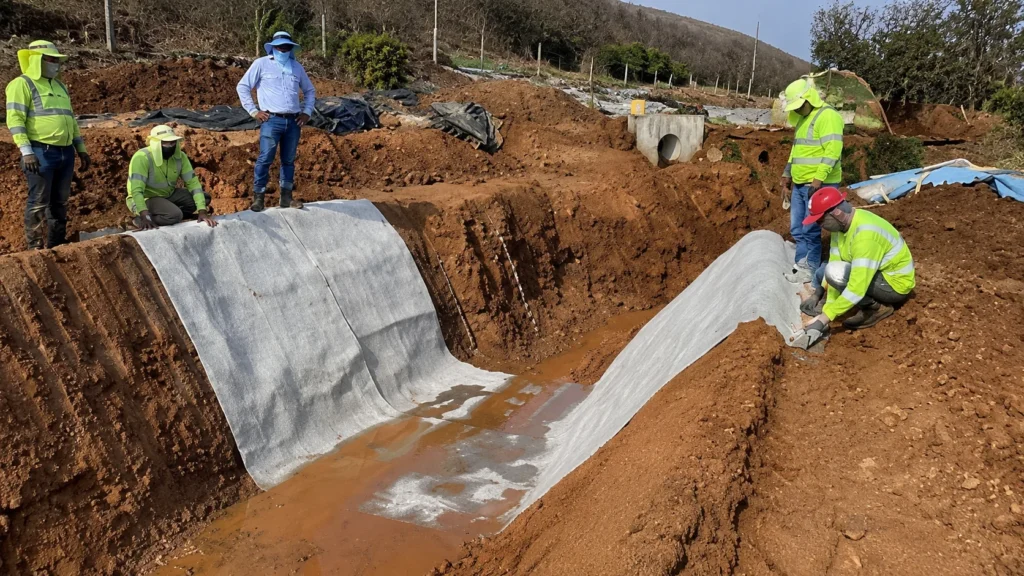
Step 2 — Unroll and Position the Blanket
The dry material is then unrolled over the prepared surface.
Because it has not yet hardened, it can conform to many:
- slopes,
- drainage channels,
- ditch profiles,
- embankment surfaces,
- irregular ground shapes.
The material should be positioned according to the planned direction of installation and water flow.
Step 3 — Overlap, Join and Fix
Adjacent sections need to be connected and restrained.
A current reference installation procedure uses overlaps and mechanical fixing; for that particular product, the published procedure specifies an overlap of at least about 100 mm and recommends arranging the upper blanket in the direction of water flow.
However, this should be understood as a product-specific installation reference, not a universal overlap requirement for every GCCM.
Final joint design should follow the actual product installation manual and project drawings.
Step 4 — Hydrate With Water
After the material has been positioned and secured, water is applied.
This is why buyers often encounter phrases such as:
cement blanket just add water
or
concrete cloth just add water.
The expression is useful for explaining the basic principle, but it can be misleading if taken too literally.
“Just add water” does not mean:
- no substrate preparation,
- no fixing,
- no joint treatment,
- no hydration control,
- no curing requirements.
The amount of water required is related to the particular product and thickness.
Step 5 — Allow the Cementitious Material to Harden
After hydration, the cementitious component begins to cure.
The material gradually changes from a flexible sheet into a hardened cement-based surface that follows the shape of the prepared substrate.
The specific water quantity and curing procedure should be taken from the applicable installation instructions rather than assumed to be the same for every cement blanket.
What Is Cement Blanket Used For?
The most relevant uses of cement blanket are applications where a thin hardened surface lining or erosion-protection layer is needed and roll-based installation offers practical advantages.
The reference manufacturer lists uses across water conservancy, highways, railways, slope protection and erosion-control works.
Cement Blanket for Erosion Control
Erosion control is one of the most natural applications for cement blanket.
The material creates a hardened covering over exposed ground and can reduce direct contact between the soil surface and:
- rainfall,
- runoff,
- flowing water,
- local surface erosion.
Typical locations may include:
- embankments,
- drainage channels,
- cut slopes,
- infrastructure sites,
- erosion-prone soil surfaces.
However, erosion protection should always be distinguished from deeper soil stabilization.
A hardened surface may protect the soil surface while deeper instability still requires another engineering solution.
Cement Blanket for Slope Protection
Because the blanket remains flexible during installation, it can follow many slope profiles before hydration.
Potential applications include:
- highway slopes,
- railway slopes,
- cut slopes,
- embankments,
- industrial slopes.
For these applications, the cement blanket mainly acts as a surface-protection or lining system.
It should not automatically be described as a structural slope-reinforcement system.
Where a slope has problems involving:
- deep-seated instability,
- groundwater,
- weak foundation soils,
- surcharge,
- structural reinforcement requirements,
additional engineering measures may be required.
Cement Blanket for Drainage Channels
Drainage channels and open ditches are another important application.
The material can be fitted to the sides and bottom of a prepared channel and then hydrated in place.
Potential uses include:
- roadside drainage,
- stormwater channels,
- industrial drainage,
- irrigation channels,
- open watercourses.
For hydraulic applications, selection should consider more than blanket thickness.
Important factors may include:
- water velocity,
- concentrated flow,
- scour,
- substrate stability,
- anchoring,
- joints,
- edge protection.
Cement Blanket for Ditch Lining
Roadside and infrastructure ditches often experience repeated erosion from rainfall and surface runoff.
Cement blanket can provide a hardened lining over selected ditch surfaces without requiring conventional wet concrete placement over the entire area.
This can be particularly useful where site access or surface geometry makes traditional lining operations less convenient.
Cement Blanket for Culvert Areas
Cement blanket may also be considered around selected culvert inlets, outlets and adjacent drainage areas.
These zones often experience localized flow and erosion.
However, high-flow outlet areas may also involve substantial scour forces.
The material therefore should not be selected simply because the area is “near a culvert”; hydraulic conditions and anchoring remain important.
Cement Blanket for Reservoirs and Water-Conservancy Projects
Current commercial GCCM products are also marketed for reservoirs, dams and water-conservancy projects.
Here, one distinction is especially important:
erosion protection is not automatically the same as permanent water containment.
If the design requires a low-permeability containment liner, buyers should separately confirm whether the selected cement blanket system—and especially its backing and seams—can meet the hydraulic requirement.
A cement blanket should therefore not automatically be presented as a substitute for an HDPE geomembrane.
Is Cement Blanket the Same as Concrete Cloth?
The terms:
- cement blanket,
- concrete cloth,
- concrete fabric,
- cement composite mat,
are often used commercially for related roll-based cementitious materials.
However, the names alone do not prove that two products have the same construction or engineering properties.
Different products may vary in:
- textile structure,
- cement formulation,
- thickness,
- mass per unit area,
- backing,
- joint system,
- tensile behavior,
- flexural behavior,
- hydration requirements.
ASTM currently lists separate GCCM test methods for properties including tensile strength, peel strength and flexural strength.
For B2B procurement, the correct comparison is therefore:
product name + construction + test method + technical data
rather than product name alone.
Cement Blanket vs Concrete Curing Blanket
The search term concrete blanket can refer to two very different materials.
| Cement Blanket / GCCM | Concrete Curing Blanket |
|---|---|
| Contains cementitious material | Does not act as a cementitious lining |
| Installed as a composite sheet | Placed over fresh concrete |
| Water initiates cement hydration | Helps manage curing conditions |
| Becomes hardened | Remains a blanket |
| Used for lining and erosion protection | Used during concrete curing |
If the product is supplied as a roll, installed over a slope or channel, hydrated and then hardened, it belongs to the cement blanket / GCCM category.
Cement Blanket vs Traditional Poured Concrete
Cement blanket and conventional concrete should not be treated as identical materials.
| Cement Blanket | Traditional Poured Concrete |
|---|---|
| Supplied as a dry flexible roll | Delivered or mixed as wet concrete |
| Positioned before hydration | Placed while fluid |
| Can conform to ground profile before curing | Usually requires placement and finishing |
| Often reduces the need for conventional formwork in thin lining applications | Formwork may be required |
| Intended for selected lining and protection works | Can be designed for many structural uses |
| Finished thickness is relatively thin | Structural thickness can be much greater |
The correct choice depends on the required function.
Cement blanket may be attractive for certain:
- erosion-control,
- lining,
- channel,
- slope-surface applications.
Traditional reinforced or mass concrete may remain more appropriate where significant structural thickness or load resistance is required.
What Are the Main Characteristics of Cement Blanket?
Flexible Before Hydration
The material can be transported and installed as a roll.
This allows it to follow many ground profiles before curing.
Hardens After Hydration
Once properly hydrated, the cementitious component develops into a hardened surface.
This transition is the defining feature of the product.
Factory-Produced Composite
The cementitious mixture and textile structure are incorporated during manufacturing rather than assembled from loose cement and textile layers at the jobsite.
Suitable for Roll-Based Installation
For selected surface-lining applications, roll installation may reduce some of the conventional operations associated with wet concrete placement.
However, this should not automatically be translated into claims such as:
“50% cheaper”
or
“10× faster.”
Actual construction cost and time depend on project conditions.
What Are the Limitations of Cement Blanket?
Cement blanket is not a universal solution.
Additional engineering review or a different material may be necessary where the project involves:
- significant structural loading,
- heavy vehicle traffic,
- major slope instability,
- severe hydraulic scour,
- substantial groundwater pressure,
- thick structural concrete requirements,
- permanent fluid containment,
- unsuitable substrate conditions,
- difficult anchoring.
ASTM D8364/D8364M also notes that different GCCM applications can require different physical properties.
Therefore, a useful selection question is not:
Is cement blanket better than concrete?
It is:
Does a roll-applied cementitious lining match the required function and site conditions?
Common Cement Blanket Installation Mistakes
Treating “Just Add Water” as the Entire Installation Process
Hydration is only one stage.
Subgrade preparation, material layout, fixing and joints matter as well.
Ignoring Water Flow Direction
In channels and drainage applications, sheet orientation and overlaps should be considered in relation to water flow.
The reference supplier’s own installation procedure specifically addresses overlap direction in flowing-water applications.
Installing Over an Unstable or Poorly Prepared Surface
A cement blanket can follow irregular geometry, but large voids, loose soil or unstable areas may affect the installed lining.
Assuming Every Product Is Waterproof
Backing construction and seam performance differ by product.
Where containment is required, these characteristics should be verified separately.
Selecting Only by Thickness
A 10 mm blanket is not automatically the correct choice simply because it is thicker than a 6 mm blanket.
Selection should also consider:
- application,
- substrate,
- water exposure,
- anchoring,
- joint requirements,
- relevant test data.
What Should Buyers Check Before Comparing Cement Blankets?
Even though this article is mainly a definition guide, B2B buyers should understand one basic rule:
Compare equivalent technical specifications, not only price per square meter.
Useful documents or information include:
- product TDS,
- material structure,
- thickness,
- roll dimensions,
- mass per unit area,
- relevant GCCM test results,
- installation instructions,
- backing configuration,
- packaging,
- project application.
ASTM currently lists dedicated GCCM standards covering specification, installation, tensile strength, peel strength, sample preparation and flexural strength.
These provide a better technical framework than comparing products only from marketing descriptions.
Frequently Asked Questions About Cement Blanket
What is a cement blanket?
A cement blanket is a flexible cementitious composite supplied in roll form. It contains cement-based material within a textile or fiber structure and hardens after hydration.
What does GCCM mean?
GCCM stands for Geosynthetic Cementitious Composite Mat. ASTM D8364/D8364M is the current ASTM specification covering requirements and properties for GCCM materials.
What is a cement blanket made of?
Typical cement blankets combine dry cementitious material with textile or fiber components. The current reference product describes special cement, aggregate and other cementitious materials together with a three-dimensional fabric structure, and lists concrete, PP and PE among its material components.
How does a cement blanket work?
The material is prepared, unrolled and secured while dry. Water is then applied, causing the cementitious component to hydrate and eventually harden.
What thickness does cement blanket come in?
Thickness varies by product. The current market reference used for this article lists 6–10 mm as its main thickness range, although its detailed table also lists a broader 5–15 mm range. Actual supply should therefore be confirmed against the final product specification.
What size are cement blanket rolls?
The reference product lists 1 m and 2 m roll widths, with customized options, and 5–20 m roll lengths or customized dimensions.
Is cement blanket waterproof?
Not every cement blanket should automatically be described as waterproof. Hydraulic behavior depends on the material construction, backing, seams and installation details.
Can cement blanket be used for slope protection?
Yes, it is used in selected slope surface-protection and erosion-control works. However, it should not be assumed to solve deeper geotechnical slope-stability problems by itself. The reference commercial product specifically lists slope applications.
Can cement blanket be used in drainage channels?
Yes. Channel and ditch lining are common applications for this type of cementitious composite. Hydraulic conditions, scour, joint details and anchoring should still be evaluated.
Is cement blanket the same as a concrete curing blanket?
No.
A cement blanket contains cementitious material and hardens after hydration. A concrete curing blanket is placed over newly cast concrete to help control curing conditions.
Can cement blanket replace conventional concrete?
It may replace or reduce conventional concrete operations in selected thin lining and erosion-protection applications, but it is not a universal replacement for structural concrete.
Final Takeaway
A cement blanket is best understood as a flexible cementitious composite that is supplied as a roll, installed before hydration and then hardened with water.
Its value comes from the combination of:
flexible installation + textile composite structure + cementitious hardening.
This makes the material particularly relevant to selected:
- erosion-control,
- slope-protection,
- drainage-channel,
- ditch-lining,
- embankment-surface applications.
But product names alone are not enough for engineering procurement.
Before selecting a cement blanket, buyers should confirm the actual:
structure, thickness, roll size, backing, installation method, relevant test data and project conditions.
Learn More About Cement Blanket
For available product specifications and project enquiries:
View Cement Blanket Products →
建议内链:
/products/cement-blanket/
For slope, channel and runoff applications:
Cement Blanket for Erosion Control →
建议未来页面:
/cement-blanket-for-erosion-control/
For installation details:
How to Install Cement Blanket →
Author & Technical Note
Published by: GEOSYN Content Team
Last Updated: August 2026
This article provides a general overview of cement blanket / GCCM materials. Product dimensions, construction, hydration requirements and performance vary by specification. Project-specific suitability should be evaluated using the current product technical data, installation requirements and applicable engineering criteria.
Technical References
- ASTM D8364/D8364M-21(2026) — Standard Specification for Geosynthetic Cementitious Composite Mat (GCCM) Materials.
- ASTM D8173-23 — Standard Guide for Site Preparation, Layout, Installation, and Hydration of GCCM Materials.
- ASTM currently also lists GCCM methods including D8480-23 tensile strength, D8479-24 peel strength, D8030/D8030M-24 sample preparation and D8058-25 flexural strength.
- Commercial dimensions and construction references in this article were benchmarked against the current Taian Nuolian Cement Blanket listing you specified.