Short Answer
Geocell height, also called geocell depth, determines how deep the cellular confinement layer extends after the panel is expanded and filled.
A 50 mm geocell provides shallow confinement, while 100 mm is a practical medium-depth option often considered for driveways, access roads and general ground stabilization. 150 mm and 200 mm geocell create progressively deeper confined layers and may be evaluated where the subgrade is weaker, loading is heavier or erosion conditions are more demanding.
However, cell height should never be selected by project name alone.
The correct geocell system also depends on subgrade condition, vehicle loading, infill material, drainage, total granular-layer depth, cell geometry and project requirements.
Geocell height defines confinement depth. It is not a standalone load rating.
Key Takeaways
- 50, 100, 150 and 200 mm refer to the vertical depth of the expanded geocell.
- Increasing geocell depth creates a deeper confined infill layer but also requires more fill.
- 100 mm is a useful comparison point for many geocell driveway and road applications, but it is not a universal specification.
- 150 mm or 200 mm may be considered for weaker ground or more demanding loading when deeper confinement has a clear purpose.
- Two geocells with the same nominal height can still differ in cell dimensions, strip construction and weld configuration.
- Drainage, infill and subgrade preparation can be just as important as cell height.
- Structural and high-load projects should follow project-specific engineering requirements.
GeoSynSource’s current HDPE geocell range includes cell depths beyond the four sizes discussed here, but this article focuses on 50, 100, 150 and 200 mm because they provide useful reference points for comparing shallow, medium and deep cellular confinement systems.
What Does Geocell Height Mean in a Cellular Confinement System?
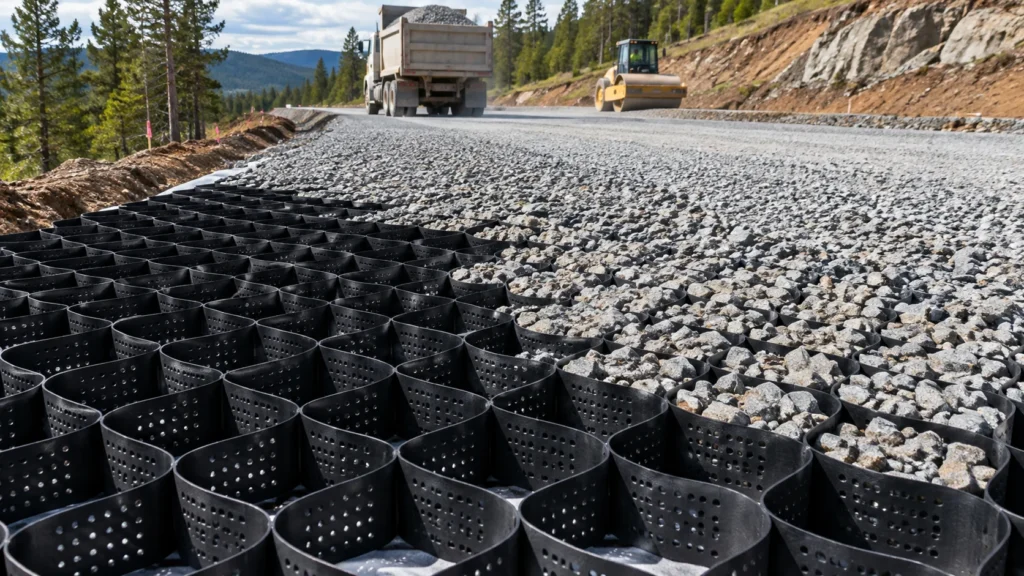
Geocell is a three-dimensional cellular confinement system made from interconnected strips that form individual cells when expanded.
Once those cells are filled with aggregate, soil or another suitable material, the cellular structure helps restrict lateral movement of the infill.
The geocell height or geocell depth is the vertical depth of this expanded cellular layer.
For example:
- 50 mm creates approximately 50 mm of cellular confinement.
- 100 mm creates approximately 100 mm.
- 150 mm creates a deeper confined zone.
- 200 mm surrounds an even greater depth of infill.
But height is only one geometric parameter.
Two 150 mm geocell products can still have different:
- expanded cell dimensions;
- strip thickness;
- weld spacing;
- surface texture;
- polymer properties;
- junction configuration.
Therefore:
Geocell size should be evaluated as a complete product specification, not by cell height alone.
For full available dimensions and current technical data, use the dedicated HDPE geocell product page rather than this selection guide.
Geocell Height: mm vs Inches
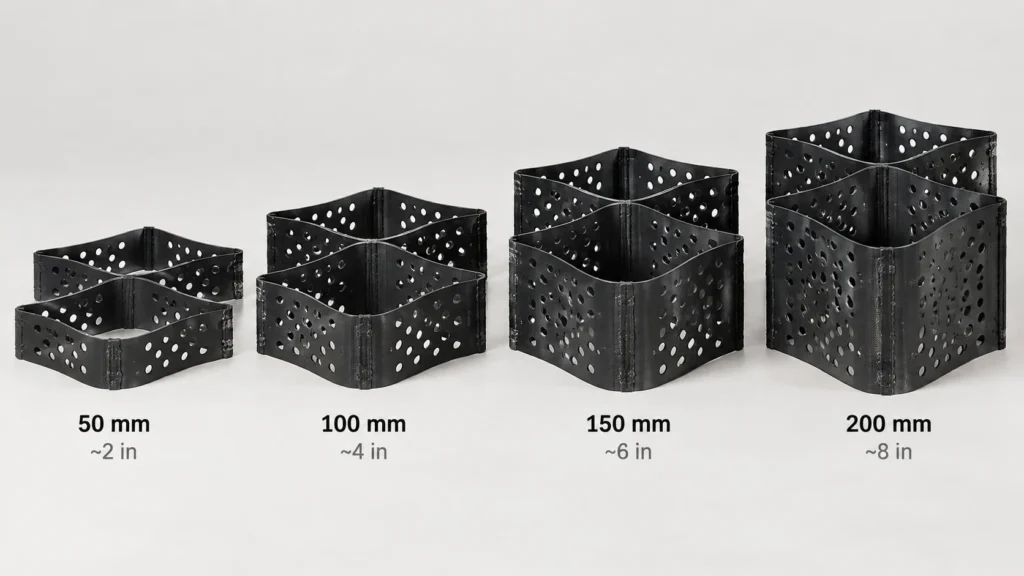
U.S. buyers often describe geocell depth in inches instead of millimeters.
| Metric Height | Approx. Imperial Height | Common Expression |
|---|---|---|
| 50 mm | 1.97 in | approximately 2 inch geocell |
| 100 mm | 3.94 in | approximately 4 inch geocell |
| 150 mm | 5.91 in | approximately 6 inch geocell |
| 200 mm | 7.87 in | approximately 8 inch geocell |
This matters because a buyer searching for a 4 inch geocell is usually looking at roughly the same depth category as a 100 mm product.
However, these are rounded conversions.
Always confirm the manufacturer’s nominal cell depth before placing an order.
GeoSynSource’s current HDPE geocell range includes additional cell-depth and product configurations. See our HDPE geocell products for current dimensions and technical data.
Quick Comparison: 50mm vs 100mm vs 150mm vs 200mm Geocell
| Geocell Height | Relative Confinement | Typical Preliminary Selection Context | Main Consideration |
|---|---|---|---|
| 50 mm / ~2 in | Shallow | Surface stabilization, shallow aggregate confinement, selected erosion-control systems | Limited confinement depth |
| 100 mm / ~4 in | Medium | Driveways, access roads, parking areas, general road and slope applications | May not suit weak ground or demanding loads |
| 150 mm / ~6 in | Deep | Weak subgrade, heavier access roads, working areas, deeper granular confinement | More infill and installation effort |
| 200 mm / ~8 in | Very deep | Selected demanding load-support, weak-ground and erosion-control systems | High fill volume; needs a clear project reason |
Important
This table is for preliminary selection, not final engineering design.
The same 100 mm geocell ground grid may behave very differently over firm granular soil and saturated weak subgrade.
What Changes When Geocell Depth Increases?
Increasing geocell height does more than change the physical size of the panel.
1. Confinement Depth Increases
A deeper cell surrounds a greater depth of infill.
That can be useful where the system requires a deeper zone of laterally confined aggregate or soil.
However, the benefit still depends on the quality and behavior of the infill itself.
A deeper cell filled with unsuitable material is not automatically better than a properly designed shallower system.
2. Infill Volume Increases
Increasing geocell depth also increases the amount of fill required per square meter.
That affects:
- aggregate consumption;
- trucking;
- placement time;
- compaction;
- handling;
- total installed cost.
This is why specifying 200 mm everywhere simply because it is deeper is usually poor procurement logic.
3. Installation Becomes More Demanding
Deeper geocells can require more attention to:
- expansion;
- maintaining cell geometry;
- filling sequence;
- anchoring;
- staged placement;
- compaction.
This becomes particularly important in slope applications.
4. The Geocell Still Depends on the Subgrade
A geocell system does not work independently of the foundation beneath it.
If the subgrade is extremely soft, saturated or highly variable, simply increasing from 100 to 200 mm may not solve every problem.
Other system measures may also need to be evaluated.
50mm Geocell: When Does Shallow Confinement Make Sense?
A 50 mm geocell, approximately 2 inches deep, provides shallow cellular confinement.
It may be considered where:
- foundation conditions are relatively favorable;
- loads are comparatively light;
- only a shallow confined aggregate layer is required;
- surface erosion rather than deep stabilization is the primary concern.
Potential uses can include selected landscape stabilization, shallow gravel confinement and lower-demand erosion-control systems.
When 50 mm May Not Be Enough?
Be cautious where the project involves:
- weak soil;
- repeated heavy vehicles;
- deep loose aggregate;
- construction equipment;
- severe runoff or erosion.
The goal should not be to use the shallowest geocell possible.
The goal is to use enough confinement depth for the actual project conditions.
100mm Geocell: A Practical General-Purpose Comparison Point
A 100 mm geocell, approximately 4 inches deep, sits between shallow 50 mm confinement and deeper 150–200 mm systems.
That makes it a useful starting point for evaluating many:
- geocell driveways;
- gravel access roads;
- parking areas;
- road-base applications;
- general ground-grid systems;
- slope stabilization projects.
This does not mean 100 mm is automatically the correct height.
100 mm May Be Worth Considering When
- subgrade conditions are moderate;
- passenger vehicles or moderate traffic are expected;
- suitable aggregate is available;
- drainage is controlled;
- a medium-depth confined layer is appropriate.
Consider Other Options When
- the soil is very weak;
- heavy trucks are expected;
- the aggregate section needs to be deeper;
- construction equipment will use the surface;
- erosion conditions are more demanding.
150mm Geocell: When Is Deeper Confinement Useful?
A 150 mm geocell provides 50% more cell depth than a 100 mm product.
That additional depth can be useful when the project requires a larger confined volume of aggregate or soil.
Typical reasons to evaluate 150 mm include:
- weaker subgrade;
- heavier access traffic;
- working platforms;
- deeper gravel stabilization;
- demanding slope conditions;
- greater erosion-control requirements.
The important question is not:
Is 150 mm stronger?
It is:
Why does this project need an extra 50 mm of confinement depth?
If that question cannot be answered, another design variable may be more important than cell height.
200mm Geocell: When Should Very Deep Cells Be Considered?
A 200 mm geocell, approximately 8 inches deep, creates a substantial cellular confinement layer.
It may enter the preliminary comparison for selected:
- very weak ground;
- heavy-duty access;
- deep granular stabilization;
- demanding working areas;
- severe erosion-control systems.
But 200 mm also requires significantly more infill than 50 or 100 mm options.
It therefore affects:
- material quantity;
- trucking;
- installation effort;
- finished layer depth;
- total system cost.
Use 200 mm because the project requires deeper confinement—not because it is the largest common size.
100mm vs 150mm Geocell: Which Should You Choose?
This is one of the most useful practical comparisons.
| Factor | 100 mm | 150 mm |
|---|---|---|
| Cell depth | Moderate | Deeper |
| Approx. imperial size | 4 in | 6 in |
| Infill volume | Lower | Higher |
| Driveway / access-road use | Common preliminary comparison | More demanding conditions |
| Weak subgrade | Depends on complete section | More likely to be evaluated |
| Heavy traffic | Requires project review | More commonly considered |
| Installation | Less fill | More fill and handling |
| Cost influence | Lower confined depth | Higher material demand |
The decision should start with:
subgrade + loading + aggregate + drainage
and only then move to cell height.
150mm vs 200mm Geocell
The difference between 150 and 200 mm is another 50 mm of cellular depth.
That may matter where the design requires a deeper confined granular layer.
But moving from 150 to 200 mm will not automatically fix:
- poor drainage;
- unsuitable aggregate;
- uncontrolled water;
- inadequate foundation preparation;
- insufficient total road section;
- poor installation.
Before moving to 200 mm, ask:
What specific project problem is the extra 50 mm intended to address?
What Geocell Height Is Best for a Gravel Driveway?
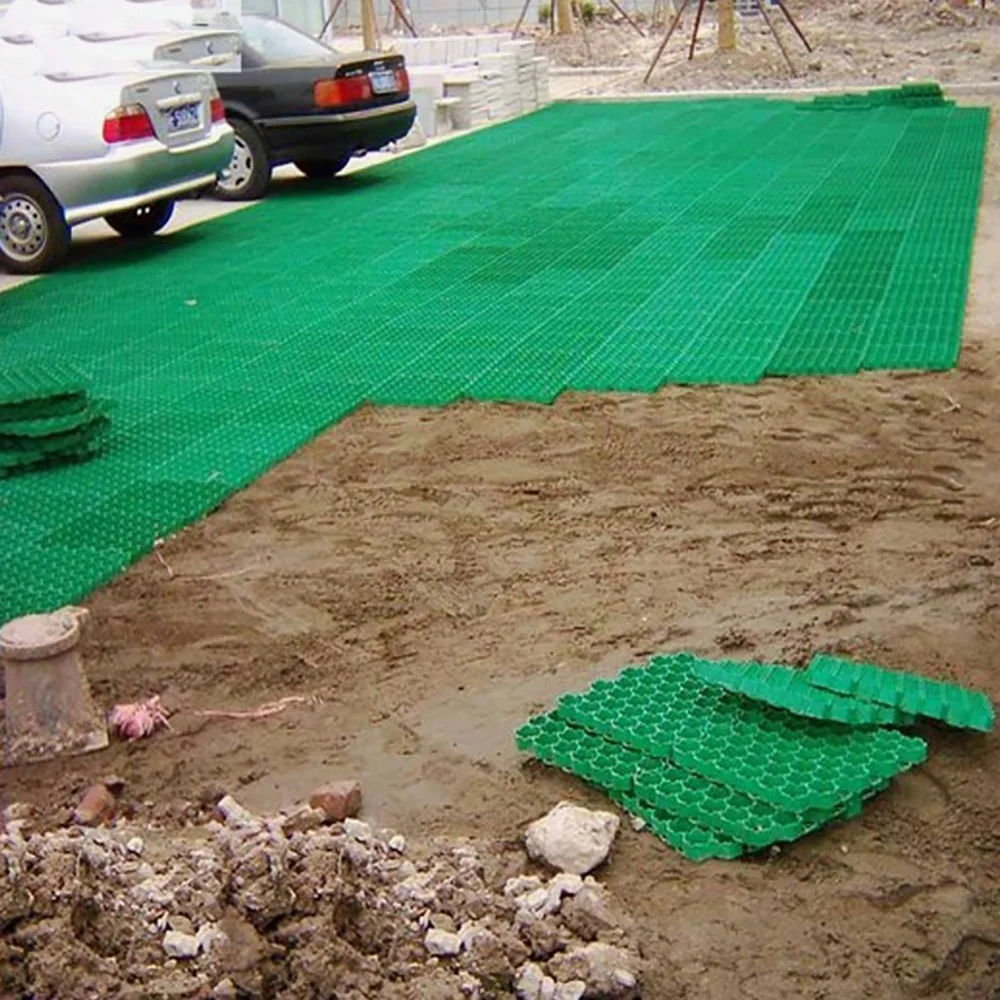
Searches for a geocell driveway, geocells for driveways or a geocell ground grid for driveway all lead to the same practical question:
How deep should the cells be?
There is no universal driveway height.
A residential gravel driveway carrying passenger cars is very different from an industrial access road carrying loaded trucks.
Where separation between aggregate and fine subgrade is also needed, see our geotextile fabric for driveway guide
Start With These Factors
Subgrade condition
↓
Vehicle loading
↓
Aggregate
↓
Drainage
↓
Required granular depth
↓
Geocell height
For moderate conditions, 100 mm / approximately 4 inch geocell is often a useful preliminary option to compare.
Where the foundation is weaker or traffic is more demanding, 150 mm or another deeper configuration may need to be evaluated.
50 mm may suit lighter applications where the support conditions are already favorable.
Important
Do not choose a geocell driveway grid based only on product height or online reviews.
The surrounding pavement system still determines how well it performs.
During geocell driveway installation, proper expansion, filling and compaction also matter, but detailed installation procedures are outside the scope of this height guide.
How to Choose Geocell Height for Road Construction
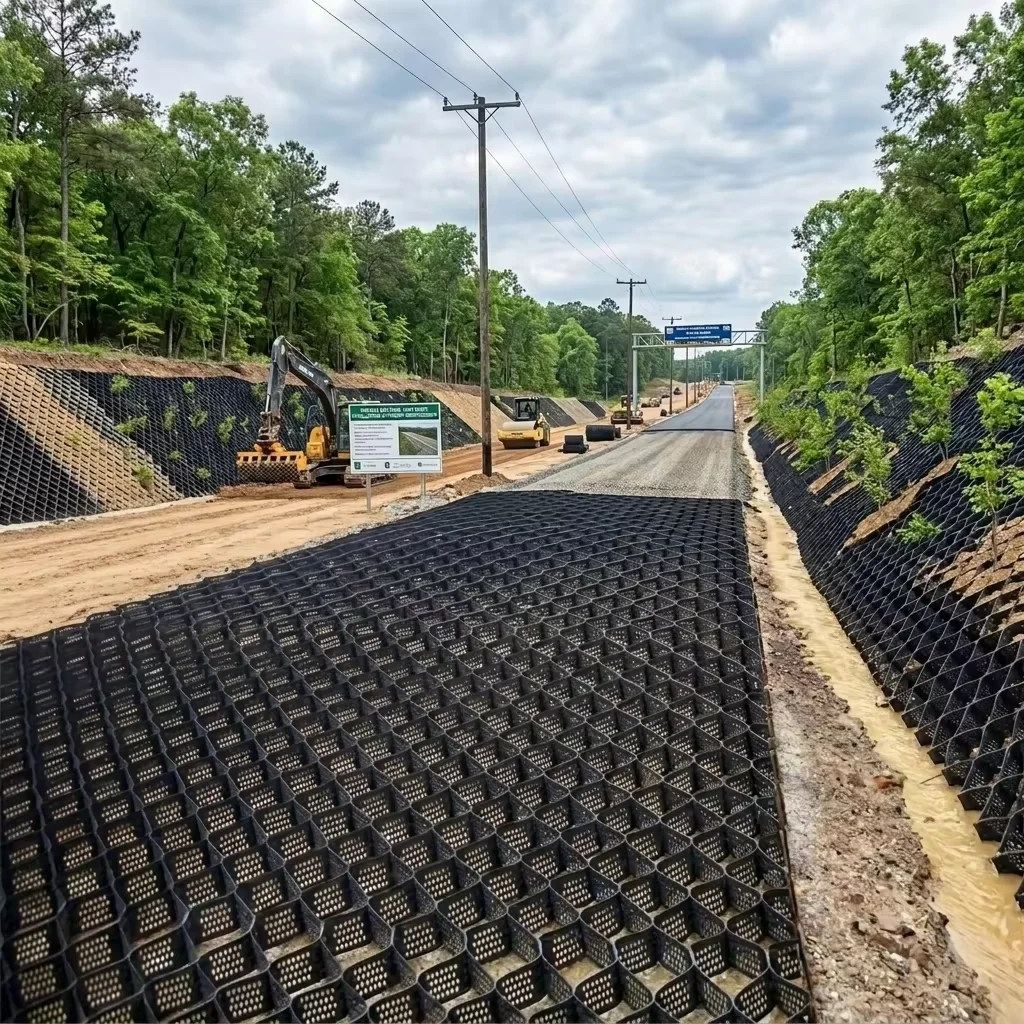
In geocell road construction, cell depth is only one part of the pavement or access-road system.
Before selecting the height, review:
- subgrade strength;
- water and drainage;
- aggregate quality;
- traffic type;
- traffic frequency;
- required granular-layer thickness;
- construction conditions.
A medium-depth geocell may be reasonable for some light or moderate roads.
Weak ground or more demanding traffic may justify reviewing deeper cellular confinement.
However, there is no responsible universal rule such as:
“A certain CBR always requires 150 mm geocell.”
That conclusion requires project-specific design information.
Geocell also does not replace adequate drainage or the rest of the road structure.
Geocell Height for Weak Subgrade
Weak soil is one of the main reasons buyers begin comparing deeper geocell systems.
But selecting the deepest available product is not enough.
For weak ground, consider:
- soil strength;
- moisture;
- variability;
- soft spots;
- groundwater;
- expected traffic;
- aggregate;
- acceptable rutting or deformation.
A deeper cell can create a deeper zone of confined granular material.
But if the underlying soil is extremely weak or saturated, the system may also require:
- additional aggregate;
- drainage;
- separation;
- other ground-improvement measures.
Where separation or filtration is required below the geocell layer, a geotextile separation layer may also be considered.
How to Choose Geocell Height for Slope Protection
For geocell slope protection, the purpose of the cells is different from road-base stabilization.
The cellular structure is used to help retain soil, aggregate or vegetated infill on the surface.
Relevant factors include:
- slope angle;
- slope length;
- rainfall;
- runoff;
- erosion intensity;
- infill;
- vegetation;
- anchoring;
- drainage.
50–100 mm
May be evaluated for lower-demand surface erosion-control applications.
100–150 mm
May be considered where deeper infill retention is required.
150–200 mm
May enter the comparison under more demanding erosion or slope conditions.
But:
Geocell height alone does not establish overall slope stability.
Anchoring, drainage and broader slope conditions still need to be considered.
Geocell for Erosion Control
Geocell is also widely described as a geocell erosion control or cellular confinement solution.
The cells can help retain soil or aggregate and reduce lateral movement of surface materials.
However, erosion-control selection should consider:
- runoff velocity;
- rainfall;
- surface material;
- soil;
- slope;
- anchoring;
- drainage.
A deeper geocell retains more infill volume, but greater depth is not automatically the correct solution for every erosion environment.
Is Geocell Ground Grid the Same as Geocell?
In driveway and ground-stabilization searches, geocell is often described as a:
geocell ground grid
or:
geocell grid
These terms generally refer to the same cellular-confinement concept.
However, products marketed under similar names can have very different:
- cell dimensions;
- heights;
- strip construction;
- panel size;
- junction configuration.
Therefore, buyers should compare actual specifications rather than assuming every ground grid is technically equivalent.
Does Taller Geocell Always Mean Better Performance?
No.
Cell height is a geometric property, not a complete performance rating.
Two 150 mm products can differ in:
- cell opening;
- strip thickness;
- surface type;
- weld spacing;
- polymer properties;
- junction quality.
Your current GeoSynSource HDPE geocell product range, for example, includes multiple cell depths and different available configurations.
That is why quotations should not be compared only as:
150 mm geocell — price per square meter.
Once you have selected a preliminary height, the actual product specification still needs to be reviewed.
Why Geocell Junction Quality Matters
Geocell panels rely on connected strips to maintain their three-dimensional cellular shape after expansion and filling.
For this reason:
Cell height and junction quality are separate considerations.
A taller cell does not make poor junction quality acceptable.
The technical material available for the GeoSynSource product range includes seam/junction quality information, but such product test references should not be confused with road or platform bearing capacity.
For procurement, review the current TDS and applicable testing information for the exact product configuration being quoted.
Do You Need Geotextile Under Geocell?
Sometimes.
A geotextile may be used beneath a geocell system where separation or filtration is required between granular infill and fine or weak soil.
A typical arrangement may be:
Aggregate-Filled Geocell
↓
Geotextile Separation Layer
↓
Fine or Weak Subgrade
The products perform different functions.
Geocell
provides cellular confinement.
Geotextile
may help control material mixing or filtration.
A geotextile is therefore not automatically necessary under every geocell system, but it can be valuable where the project conditions require separation or filtration.
Related Page:
View our Geotextile Supplier for Civil Engineering Projects page for woven and nonwoven options.
Common Geocell Height Selection Mistakes
1. Choosing 200 mm Because It Is “Stronger”
Height alone is not a complete strength rating.
2. Assuming Every Driveway Needs 100 mm
Driveway traffic and subgrade conditions vary significantly.
3. Ignoring Infill Material
Geocell performance depends partly on the material contained inside the cells.
4. Ignoring Drainage
Water can weaken both the subgrade and aggregate system regardless of cell height.
5. Comparing Only Height and Price
Two 150 mm products may not have the same geometry or construction.
6. Copying Another Project
A height used successfully on one road or slope may not suit another site.
7. Treating Height as a Load Rating
100, 150 or 200 mm does not directly tell you how much vehicle load the completed system can carry.
8. Ignoring Installation Conditions
Expansion, anchoring, filling and compaction still influence the completed system.
A Simple Geocell Height Selection Framework
Step 1 — Define the Function
Is the project a:
- driveway;
- road;
- working area;
- slope;
- erosion-control system?
Step 2 — Review the Subgrade
Provide available information on:
- soil type;
- strength or CBR if available;
- moisture;
- weak spots.
Step 3 — Define Loading
Consider:
- passenger cars;
- trucks;
- construction equipment;
- traffic frequency.
Step 4 — Confirm Infill
Will the cells contain:
- crushed stone;
- gravel;
- soil;
- vegetated topsoil?
Step 5 — Review Drainage
Determine whether water is likely to weaken the foundation or wash the infill.
Step 6 — Determine the Required Confinement Depth
Only now compare:
50 / 100 / 150 / 200 mm
Step 7 — Review the Actual Geocell Specification
Check more than height.
Confirm the current cell dimensions, strip construction, junction configuration and available technical data.
Compare Available HDPE Geocell Specifications
Once the preliminary cell depth has been identified, the next step is to compare the actual product options.
For example, if the project is currently comparing:
100 mm vs 150 mm
the final decision should also consider the available cell geometry, strip configuration and project requirements.
View our HDPE geocell products to compare available cell depths and technical specifications:
View HDPE Geocell Products
This keeps the roles of the two pages clear:
This guide:
Which geocell height should I consider?
Product page:
What HDPE geocell specifications are available?
What Information Should You Send Before Asking Which Height to Use?
For a useful preliminary recommendation, provide:
| Information | Example |
|---|---|
| Application | Driveway / road / slope |
| Project area | m² |
| Subgrade | Soil type / CBR if available |
| Loading | Cars / trucks / equipment |
| Infill | Gravel / crushed aggregate / soil |
| Required granular depth | If known |
| Drainage | Good / poor / unknown |
| Slope geometry | If applicable |
| Specified height | If already listed in BOQ |
| Quantity | m² / panels |
| Destination | Country + port |
| Project documents | Drawing / specification / BOQ |
If you already have a project drawing or BOQ, send the original document rather than copying only the geocell height.
Final Recommendation
Use geocell height as a confinement-depth decision, not as a simple product ranking.
50 mm / ~2 in
Best considered when only shallow confinement is needed.
100 mm / ~4 in
A useful general comparison point for many geocell driveway, road and ground-grid projects.
150 mm / ~6 in
Worth evaluating when the project needs a deeper confined layer because of weaker ground or more demanding service conditions.
200 mm / ~8 in
Suitable for consideration where very deep confinement has a clear project-specific purpose.
The decision should always return to:
Subgrade + Loading + Infill + Drainage + Required Layer Depth + Actual Product Specification
rather than simply:
50 vs 100 vs 150 vs 200 mm.
Need Help Comparing Geocell Heights?
If you are deciding between 50, 100, 150 or 200 mm geocell, send us:
Application + Area + Subgrade + Loading + Infill + Quantity + Destination
Our team can compare available HDPE geocell options against your procurement requirements.
Send Your Project Specification
Frequently Asked Questions
What is the best geocell height?
There is no universal best height. The correct geocell depth depends on the subgrade, loading, infill, drainage, required granular depth and project conditions.
Is 100 mm geocell enough for a driveway?
A 100 mm or approximately 4 inch geocell can be a practical starting point for many moderate gravel-driveway projects, but suitability depends on vehicle loading, foundation strength, aggregate and drainage.
What is the difference between 100 mm and 150 mm geocell?
A 150 mm geocell provides 50 mm more confinement depth and requires more infill. It may be evaluated where weaker ground or more demanding loading requires a deeper confined granular layer.
When should 200 mm geocell be used?
A 200 mm geocell may be considered where a deep confined layer is required for demanding ground-support or erosion-control conditions. It should not be selected only because it is deeper.
Is 50 mm geocell suitable for roads?
Road suitability cannot be determined from cell height alone. Traffic, subgrade, aggregate, drainage and the complete road section also need to be considered.
Is a 4 inch geocell the same as 100 mm?
Approximately. 100 mm equals about 3.94 inches, so it is commonly treated as approximately 4 inches. Always confirm the nominal manufacturer dimension.
Does a taller geocell carry more load?
Greater height creates a deeper confined layer, but load-support performance cannot be predicted from height alone. Infill, subgrade, cell geometry, junctions and the complete structural section also matter.
Does geocell need geotextile underneath?
Not always. Geotextile may be used where separation or filtration is needed between the geocell infill and fine or weak subgrade soil.
What is a geocell ground grid?
Geocell ground grid is a common market term for a cellular confinement system used to confine gravel, soil or other infill. Actual product specifications can vary, so height alone should not be used to compare different ground-grid products.