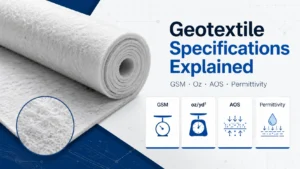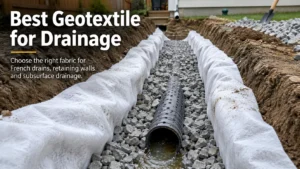
Geotextile fabric can act as a filter between soil and drainage aggregate behind a retaining wall. Its purpose is to allow water passage while limiting harmful soil migration into the drainage layer.
The correct fabric and its location depend on the wall system, soil conditions and drainage design. A needle-punched nonwoven geotextile is one option to evaluate, but neither “nonwoven” nor a particular GSM is a complete specification. Check opening size, hydraulic performance, installation survivability and durability.
Filter fabric does not replace structural reinforcement, drainage outlets or waterproofing. Follow the approved wall detail rather than applying the same fabric arrangement to every retaining wall.
What Does Geotextile Do Behind a Retaining Wall?
Soil and drainage aggregate have different functions.
The soil forms part of the retained ground or engineered fill. Drainage aggregate provides a relatively open route for water to reach a collection or discharge system.
Where these materials meet, a compatible filter may be needed to limit soil migration without excessively restricting water movement.
Filtration
The fabric allows water to cross the soil–drainage interface while helping retain the soil.
Successful filtration does not mean capturing every fine particle. The objective is a stable interface with acceptable soil retention and water passage over the required service period.
Separation
The fabric helps limit intermixing between soil and drainage stone.
This is particularly relevant during backfilling, when soil can otherwise enter the aggregate voids.
What Filter Fabric Does Not Do
A drainage filter does not:
- Provide a discharge route on its own.
- Correct an obstructed collector pipe.
- Replace geogrid specified for reinforcement.
- Make a concrete wall waterproof.
- Establish the wall’s structural stability.
FHWA guidance treats geotextile filtration as a soil-compatible function within the retaining structure, with attention to retention, water passage and continued performance.
Do All Retaining Walls Need Geotextile Fabric?
No single fabric detail applies to every wall.
The need for a geotextile depends on whether filtration is required at a particular interface and how that function is provided. Some designs use a geotextile filter, others use a properly designed granular filter or a drainage composite.
Wall type also matters:
| Wall System | Questions to Resolve |
|---|---|
| Concrete retaining wall | How are drainage, waterproofing and discharge arranged? |
| Gravity segmental block wall | Which soil–aggregate interfaces require filtration? |
| Geogrid-reinforced segmental wall | How will filtration work with reinforced fill, wall rock and geogrid connections? |
| Gabion wall | Is filtration required between retained soil and the stone-filled structure? |
| Waterfront or periodically submerged wall | How do changing water levels and flow conditions affect filtration and stability? |
Do not infer that a short wall needs no drainage or that a tall wall simply needs heavier fabric. Height is only one part of the design.
Where Does Geotextile Go Behind a Retaining Wall?
The useful starting question is:
Which interface needs to retain soil while allowing water to pass?
The answer determines fabric placement.
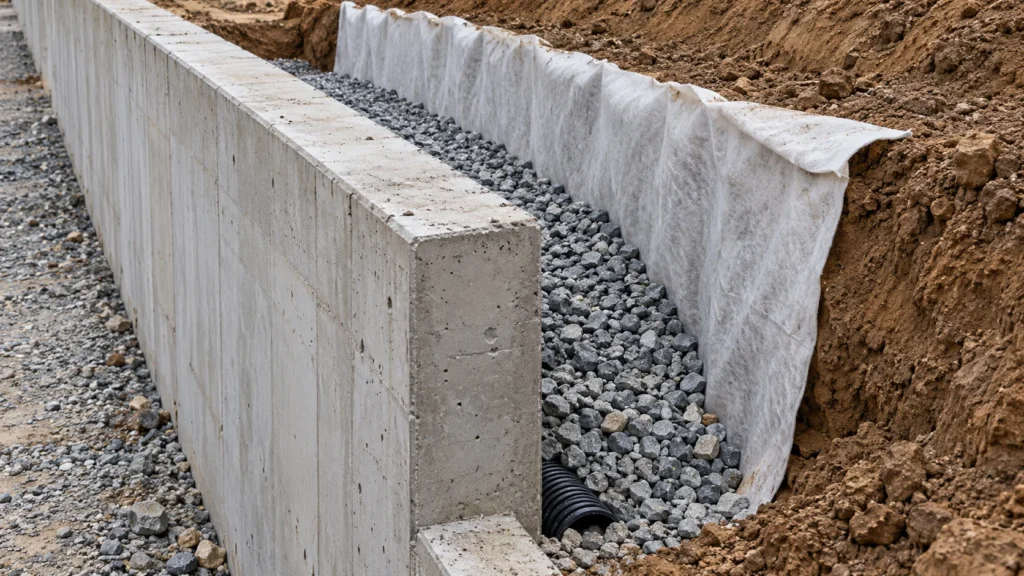
Between Soil and Drainage Aggregate
Where specified, geotextile can separate soil from the drainage stone behind a wall.
The fabric should maintain the intended filter boundary without leaving gaps through which soil can enter the drainage zone.
However, its extent and orientation must follow the wall detail. A fabric layer should not be added indiscriminately across every contact surface.
Around a Drainage Aggregate Envelope
Some details enclose the drainage aggregate and collector pipe within a filter envelope.
The filter acts at the boundary between the surrounding soil and aggregate. This differs from placing a fabric sock directly around the pipe.
CMHA sample specifications describe a geotextile filter around pipe and gravel as an available drainage arrangement. It is an option within a specified system, rather than a universal requirement.
At the Top of a Drainage Stone Zone
A specified filter layer may separate overlying soil from drainage stone.
Its position must work with the surface-water design. A filter layer is not a substitute for grading, a specified low-permeability cap or another measure intended to limit water entering the wall system.
Within a Drainage Composite
A prefabricated drainage composite may include a geotextile bonded to a drainage core.
The geotextile filters water entering the core. The core conveys that water towards a collection point.
Confirm the product orientation and discharge connection using the approved detail.
Special Care for Reinforced Segmental Walls
A continuous fabric layer directly behind facing units is not automatically appropriate for every reinforced wall.
For example, Allan Block’s system guidance makes vertical filter placement conditional on soil and water conditions and the design engineer’s assessment. It also identifies clogging concerns in reinforced structures.
This is why a generic “wrap all the gravel” illustration should not replace a wall-system drawing.
Woven or Nonwoven Geotextile for Retaining Walls?
A needle-punched nonwoven fabric is an option for filtration because it can provide a permeable, conformable structure.
However, filtration suitability depends on the actual grade.
Woven products also differ. A woven monofilament filter fabric should not be treated as equivalent to a slit-film woven separation fabric.
| Product Type | What to Check |
|---|---|
| Needle-punched nonwoven | Soil retention, hydraulic properties, puncture resistance and installation conditions |
| Woven monofilament | Opening characteristics, hydraulic performance and specified mechanical properties |
| Slit-film woven | Whether the proposed product meets filtration requirements, rather than assuming separation strength is sufficient |
Choose by documented performance and the project specification.
For the broader material comparison, read our woven vs nonwoven geotextile guide.
How to Select Retaining-Wall Filter Fabric
1. Identify the Soil at the Filter Interface
Obtain the available soil information, including particle-size distribution and relevant fines characteristics.
Identify which soil actually contacts the fabric. Retained ground, reinforced fill and surface soil may differ.
A product selected for one interface should not automatically be assumed suitable for another.
2. Define Opening-Size Requirements
Opening size helps assess the fabric’s ability to limit soil migration.
The specification should identify the required value, reporting convention and test method.
Terms such as AOS, O90 and O95 should not be substituted solely because the values use the same units.
Avoid choosing the smallest opening available without evaluating hydraulic performance and clogging compatibility.
3. Check Water-Flow Performance
Confirm the required hydraulic measurement, such as normal-to-plane permeability or permittivity.
Compare values obtained using compatible test methods and conditions.
A clean-water laboratory result describes the tested material. The installed filter also interacts with soil, loading and the service environment.
4. Assess Clogging Compatibility
Clogging risk depends on the soil–filter system.
For difficult soils, unusual water conditions or critical structures, the designer may require further compatibility assessment or testing.
Increasing fabric weight is not a reliable substitute for this evaluation.
5. Specify Installation Survivability
The fabric must withstand the proposed construction process.
Check the mechanical requirements against:
- Aggregate size and angularity.
- Placement method.
- Receiving-surface condition.
- Construction access.
- Compaction operations.
- Joining and connection details.
6. Confirm Durability Requirements
Review the polymer and documented properties against the anticipated exposure.
PP and PET products should not be assumed interchangeable solely because they share the same nominal mass.
See our geotextile GSM, oz, AOS and permittivity guide for help interpreting technical data.
What GSM Geotextile Should You Use Behind a Retaining Wall?
There is no universal GSM for retaining-wall filtration.
Mass per unit area identifies a fabric grade, but it does not independently establish:
- Soil-retention performance.
- Opening size.
- Water-flow capacity.
- Clogging resistance.
- Installation survivability.
Two fabrics with the same nominal GSM can have different properties.
A procurement request should therefore state the required performance and test methods, rather than simply requesting “heavy-duty retaining-wall fabric.”
GeoSynSource supplies PP and PET staple-fiber nonwoven geotextile. Request the technical data for the proposed grade and compare it with the project requirements.
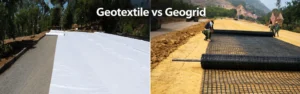
Geotextile, Geogrid and Drainage Board: Different Functions
| Material | Main Role in This Context | Important Limit |
|---|---|---|
| Geotextile filter fabric | Soil retention and filtration at a drainage interface | Does not replace structural reinforcement |
| Geogrid | Specified soil reinforcement | Open grid structure does not provide an equivalent fine-soil filter |
| Drainage board or geocomposite | Water conveyance through a drainage core, often with a filter facing | Requires suitable loading performance and an outlet |
| Waterproofing membrane | Limiting water passage through the protected structure | Does not replace water collection and discharge |
Some engineered geotextiles can serve as reinforcement. That does not mean ordinary drainage filter fabric can replace a designed reinforcement product.
Read our geotextile vs geogrid comparison for the distinction.
Where a drainage core is being considered, see our composite drainage board for retaining walls guide.
Installation Checks Before Backfilling
Use the approved wall drawing to establish fabric location, termination, overlaps, seams and drainage connections.
Before covering the material:
- Confirm the delivered grade. Check roll identification against the approved specification.
- Prepare the receiving surface. Remove objects that could tear or puncture the fabric.
- Maintain contact. Avoid unsupported spans that may pull tight during backfilling.
- Keep the filter boundary continuous. Inspect joints, corners and penetrations.
- Protect drainage connections. Do not introduce unapproved layers across intended flow paths.
- Place aggregate carefully. Prevent dragging, displacement and damage.
- Inspect and repair. Follow the specified repair procedure before concealment.
- Check discharge provisions. Confirm that pipes and outlets remain clear.
Overlap requirements depend on the application, ground conditions and joining method. Use the specified detail rather than a single dimension taken from a general guide.
Common Retaining-Wall Fabric Mistakes
| Mistake | Why It Matters | Better Approach |
|---|---|---|
| Selecting only by GSM | Weight does not define filter compatibility | Review the complete performance specification |
| Assuming every wall needs the same fabric layout | Wall systems have different drainage and reinforcement details | Follow the wall-specific drawing |
| Replacing geogrid with filter fabric | The materials have different design roles | Use the specified reinforcement |
| Treating fabric as waterproofing | Filter fabric permits water passage | Specify waterproofing separately where required |
| Leaving gaps in the filter boundary | Soil can bypass the fabric | Inspect joints and terminations |
| Adding layers without review | Extra layers can alter intended flow paths | Obtain approval for changes |
| Contaminating the fabric and stone with mud | Construction sediment can impair the drainage interface | Keep materials and placement areas clean |
| Installing a pipe without a functioning outlet | Collected water cannot discharge as intended | Verify the full drainage route |
What If Water Still Accumulates Behind the Wall?
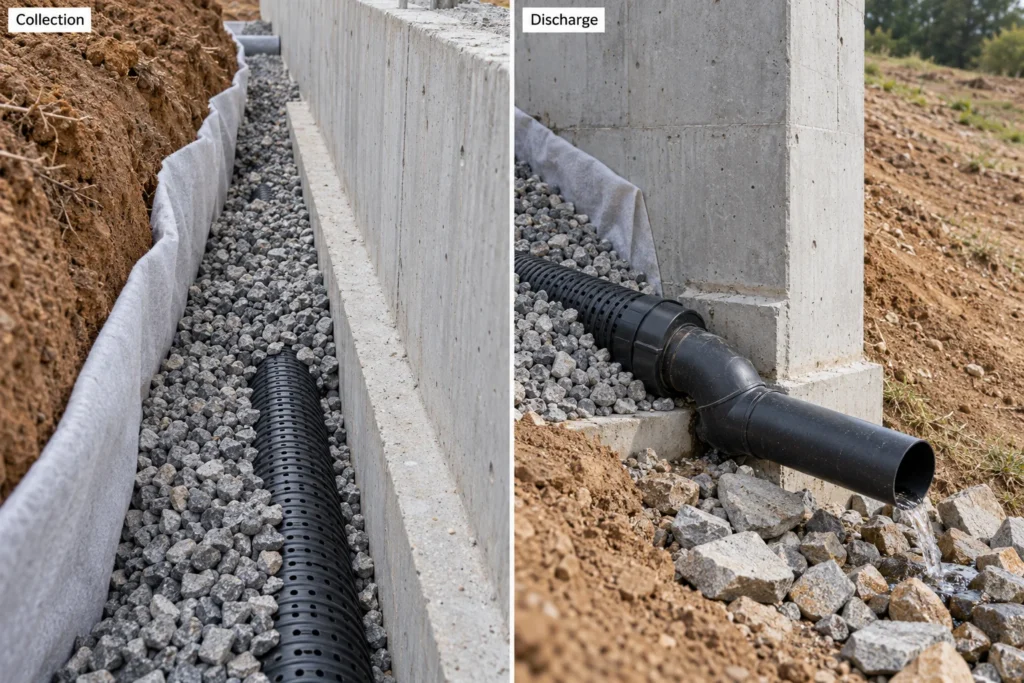
Do not assume that changing the fabric will solve the problem.
Items to investigate include:
- Surface runoff entering the backfill.
- Groundwater conditions.
- Collector-pipe blockage or damage.
- Outlet condition and capacity.
- Aggregate contamination.
- Incorrect drainage connections.
- Fabric damage or soil–filter incompatibility.
Where water accumulation accompanies wall movement, obtain a site assessment. Avoid excavation or drainage alterations that could affect the wall without an appropriate plan.
For a broader explanation of drainage-filter selection, read What Is the Best Geotextile Fabric for Drainage?.
What to Send When Requesting a Quotation
A retaining-wall geotextile RFQ should include:
| Information | Details to Provide |
|---|---|
| Wall system | Concrete, gravity block, reinforced segmental, gabion or another system |
| Drawings | Wall section and drainage detail |
| Soil | Available grading and investigation information |
| Filter location | The interface identified by the design |
| Required performance | Opening size, hydraulic and mechanical requirements |
| Test methods | Applicable standards and acceptance criteria |
| Material | Required polymer or approved product specification |
| Supply | Quantity, roll width and roll length |
| Delivery | Destination and required schedule |
| Documentation | Technical data and required inspection or test records |
If filtration criteria are not yet defined, identify that before selecting a product. A supplier can review product options against requirements, but product matching does not establish the wall’s design.
Frequently Asked Questions
Do I need geotextile fabric behind a retaining wall?
It depends on the filtration and drainage design. A geotextile may be specified at soil–drainage interfaces, while other designs use granular filters or drainage composites.
Where should retaining-wall geotextile be placed?
At the filter interfaces identified in the approved detail. These may include boundaries between soil and drainage aggregate, but the arrangement varies by wall system.
Is nonwoven geotextile better than woven fabric behind a wall?
Not automatically. Needle-punched nonwoven is an option to evaluate, but the selected product must meet the soil-retention, hydraulic and installation requirements.
What GSM is suitable for a retaining wall?
There is no universal value. Specify opening size, hydraulic performance, installation survivability and durability alongside any mass requirement.
Can filter fabric replace geogrid?
Ordinary drainage filter fabric cannot replace geogrid specified for reinforcement. Any substitution requires evaluation of the structural design and product properties.
Should I wrap the drainage pipe or the gravel?
Follow the wall’s drainage detail. A pipe sock and a filter around an aggregate envelope act at different interfaces and are not automatically interchangeable.
Is retaining-wall geotextile waterproof?
No. Filter fabric is intended to allow water passage. Waterproofing, when required, is a separate function.
Can I use landscape fabric instead?
Only if the proposed material has documented properties that satisfy the engineering specification. A landscape or weed-control label is not evidence of filter suitability.
Request Geotextile for Your Retaining-Wall Project
Send GeoSynSource your wall section, drainage detail, required fabric properties and quantity.
We will review the product requirements and confirm the proposed grade, roll configuration and available technical information.
View Nonwoven Geotextile and Request Technical Data