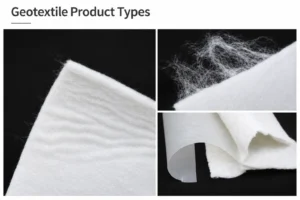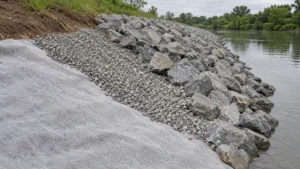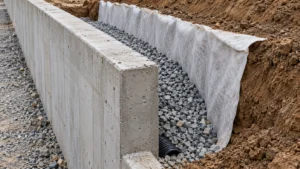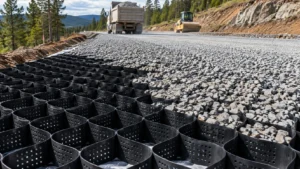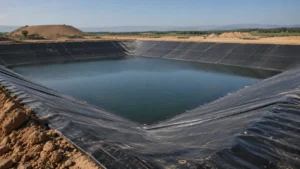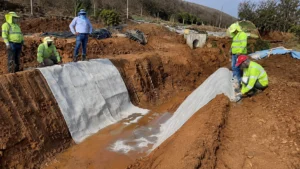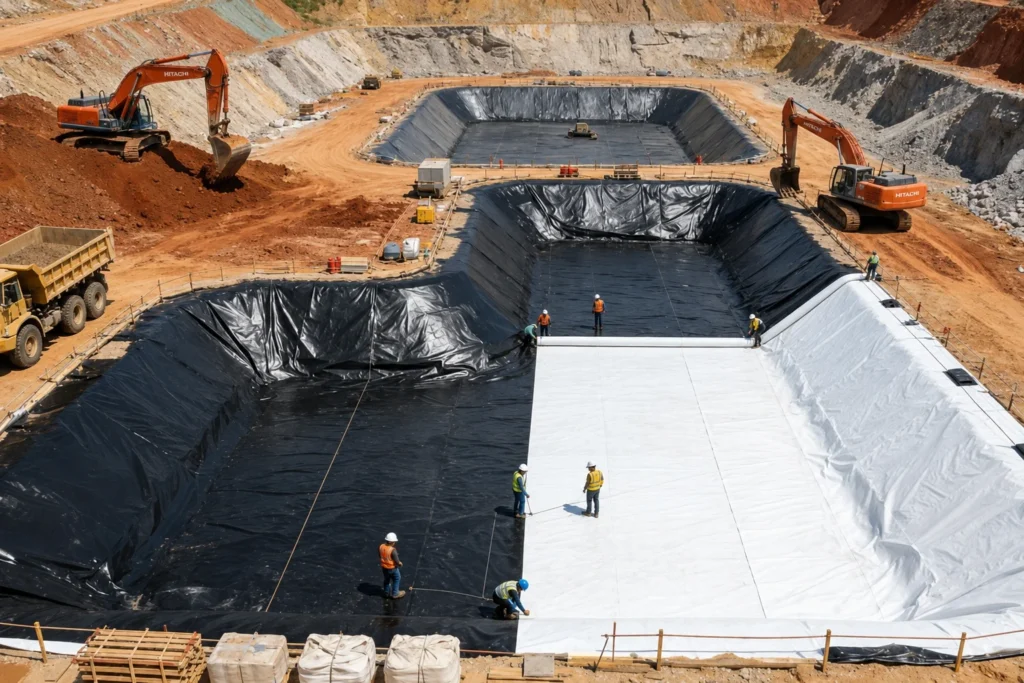
Geotextile underlayment is used beneath a geomembrane to help protect the liner from damage caused by the supporting surface, concentrated contact points and installation conditions.
The geomembrane provides the low-permeability barrier, while the geotextile acts as a cushioning and protective layer at the interface.
Needle-punched nonwoven geotextile is commonly considered for this application. Both polypropylene (PP) and polyester (PET) nonwoven fabrics are used in geotechnical engineering, but the appropriate material and grade depend on the lining-system design.
A heavier geotextile does not automatically provide better geomembrane protection. Selection should consider the geomembrane, supporting materials, applied loads, contact conditions and installation method together.
For buyers and engineers, the correct starting point is the complete lining-system cross-section—not a GSM requirement in isolation.
1. Does Your Geomembrane Need Geotextile Underlayment?
Not every geomembrane installation requires a separate geotextile underlayment.
The need for protection depends on the approved design, the condition of the supporting surface and the materials in contact with the liner.
A properly prepared soil bedding layer may provide suitable support in some installations. Other projects require a geotextile protection layer to reduce the risk of localized damage.
Common Conditions That Require Protection Assessment
| Project condition | Potential concern | What should be checked |
|---|---|---|
| Stones beneath the geomembrane | Localized stress or puncture | Subgrade preparation and lower protection requirements |
| Uneven supporting surface | Concentrated contact points | Surface profile and bedding quality |
| Aggregate above the liner | Damage during covering | Separate upper protection requirements |
| Geomembrane on a slope | Interface movement and system stability | Slope design and interface properties |
| Groundwater beneath the liner | Water accumulation or uplift | Separate drainage and pressure-relief design |
| Geomembrane over clay or GCL | Changes to the designed barrier interface | Whether direct contact must be maintained |
Exposed stones, sharp particles and unsuitable surface conditions should be addressed during subgrade preparation.
Installing a geotextile over an inadequately prepared foundation does not automatically make the surface acceptable.
An Important Consideration for Composite Barrier Systems
In some composite lining systems, the contact between the geomembrane and an underlying low-permeability clay layer or geosynthetic clay liner (GCL) is part of the leakage-control design.
Adding a separate permeable geotextile layer at this interface may change the intended system configuration.
Therefore, do not insert an additional underlayment into a specified geomembrane–clay or geomembrane–GCL interface without design approval.
The protective layer must be considered as part of the complete lining system, not as an independent product addition.
2. Underlayment and Upper Protection Are Different Layers
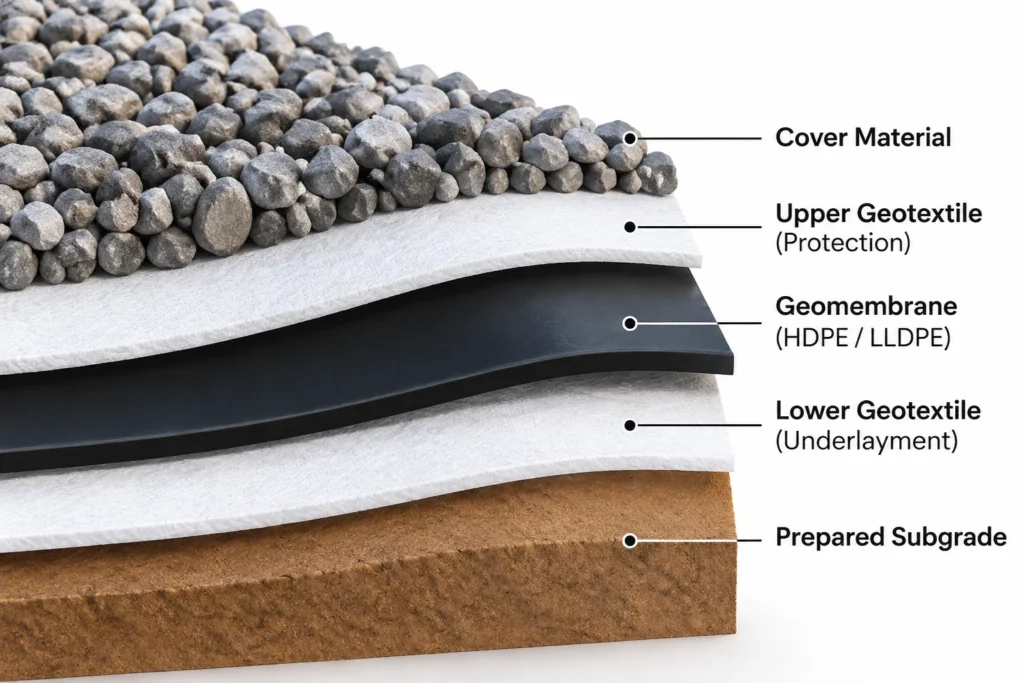
One of the most important points in geomembrane procurement is distinguishing protection beneath the liner from protection above it.
Geotextile underlayment protects the lower interface. It does not automatically protect the upper surface of the geomembrane.
A typical lower protection arrangement may be:
Prepared Subgrade → Geotextile Underlayment → Geomembrane
Where the design requires upper protection, the arrangement may include:
Geomembrane → Upper Geotextile Protection → Cover Material
These are illustrative configurations. The approved engineering cross-section determines the actual materials, positions and sequence.
Functions of Each Layer
| System component | Primary function | Main consideration |
|---|---|---|
| Prepared subgrade | Provides support for the lining system | Surface preparation and stability |
| Lower geotextile | Cushions and protects the lower geomembrane interface | Contact conditions and mechanical protection |
| Geomembrane | Provides the low-permeability barrier | Polymer, thickness, surface and seam integrity |
| Upper geotextile | Protects the liner from specified overlying materials | Aggregate, cover loads and placement conditions |
| Drainage layer | Collects and conveys water or gas where designed | Flow capacity, pressure conditions and discharge arrangement |
The lower and upper geotextile layers may encounter different materials and loads.
For example, the lower layer may contact compacted soil, while the upper layer may contact aggregate or other cover materials.
Consequently, the same geotextile grade should not automatically be assumed suitable for both positions.
Is Geotextile Underlayment Also a Drainage Layer?
No. A permeable geotextile cushion is not automatically an underdrain.
The geotextile may allow water to pass through its thickness, but an actual drainage system requires sufficient flow capacity and an appropriate discharge arrangement.
Where groundwater accumulation, gas pressure or liner uplift is a concern, evaluate the drainage or venting system separately.
3. How to Select Geotextile Underlayment for HDPE and LLDPE Geomembranes
The selection process should begin with the geomembrane and the materials surrounding it.
Before requesting a quotation, identify the liner specification and describe the contact conditions at both interfaces.
Step 1: Confirm the Geomembrane Specification
Important information includes:
- Geomembrane polymer: HDPE or LLDPE.
- Nominal thickness.
- Surface type: smooth or textured.
- Installation position and slope conditions.
- Required service environment.
- Applicable project standards.
The liner thickness and surface condition are important because the protection system must be evaluated against the actual geomembrane being supplied.
For product information, see GeoCore’s HDPE and LLDPE geomembrane product range.
Step 2: Identify the Supporting and Cover Materials
The material contacting the geotextile affects the required protection performance.
| Contact material | Information to confirm |
|---|---|
| Prepared soil | Soil type, grading and surface condition |
| Compacted subgrade | Surface profile and possible protrusions |
| Sand bedding | Material quality, grading and specified thickness |
| Gravel or aggregate | Particle size, angularity and placement conditions |
| Concrete or other rigid surfaces | Surface finish and localized irregularities |
| Cover material | Weight, contact conditions and construction sequence |
The proposed geotextile should be assessed against the actual contact materials rather than selected from a general pond-liner recommendation.
Step 3: Establish Whether Protection Is Required Below, Above or Both
A project may require:
- Lower protection only.
- Upper protection only.
- Both lower and upper protection.
- A separate drainage or cushioning system.
These requirements should be clearly identified in the project drawing and technical specification.
If the drawing does not identify the required protection layer, obtain clarification before finalizing the product grade.
4. PP vs. PET Nonwoven Geotextile for Geomembrane Protection
Needle-punched nonwoven geotextiles can be manufactured using different polymer materials and fiber structures.
Polypropylene (PP) and polyester (PET) are two common polymer options in geosynthetic manufacturing.
Both are used in geotechnical applications, but neither should be selected solely by its polymer name.
Polypropylene (PP) Nonwoven Geotextile
PP nonwoven geotextile is manufactured from polypropylene fibers.
Its suitability for geomembrane protection should be assessed using the actual product properties and project exposure conditions.
Relevant considerations include:
- Mass per unit area.
- Thickness.
- CBR puncture resistance.
- Tensile and elongation properties.
- Chemical exposure.
- Installation and temperature conditions.
Polyester (PET) Nonwoven Geotextile
PET nonwoven geotextile is manufactured from polyester fibers.
Continuous-filament and staple-fiber needle-punched structures are among the manufacturing options used in geotechnical applications.
The proposed PET grade should be evaluated against the same project-specific requirements as PP.
Particular attention should be given to the specified mechanical performance, chemical exposure and long-term service conditions.
PP vs. PET: What Should Buyers Compare?
| Comparison item | PP nonwoven | PET nonwoven |
|---|---|---|
| Polymer | Polypropylene | Polyester |
| Manufacturing structure | Depends on the product | Depends on the product |
| Mechanical properties | Grade-specific | Grade-specific |
| Chemical compatibility | Must match actual exposure | Must match actual exposure |
| Protection performance | Requires product and assembly assessment | Requires product and assembly assessment |
| Selection basis | Project specification and TDS | Project specification and TDS |
Neither material is universally superior for every geomembrane protection application.
The correct choice depends on the required performance, exposure conditions and the complete lining-system design.
5. Why GSM Alone Cannot Determine Geomembrane Protection Performance
GSM describes the mass of a geotextile per unit area.
It is useful for identifying and comparing product grades, but it does not independently establish the level of protection provided to a geomembrane.
Two products with the same GSM may have different:
- Fiber structures.
- Thicknesses.
- Puncture resistance.
- Tensile properties.
- Compressibility.
- Surface characteristics.
- Performance under specific contact and loading conditions.
For this reason, a request such as “300 GSM geotextile for HDPE pond liner” is not a complete technical specification.
Technical Data to Request
| Property | What to verify |
|---|---|
| Product identification | Exact grade and polymer |
| Mass per unit area | GSM, test method and tolerance |
| Thickness | Measurement method and applied pressure |
| CBR puncture resistance | Test method and declared result |
| Tensile strength | Test direction and method |
| Elongation | Reported value and method |
| Tear resistance | Applicable test method and result |
| Reporting basis | Typical, minimum, MARV or another defined basis |
| Protection assessment | Whether testing applies to the actual liner assembly |
| Product traceability | Roll identification and available batch documentation |
Why a Heavier Fabric Is Not Automatically Better
Increasing fabric weight may be associated with higher mechanical properties within a particular product series.
However, the relationship depends on the manufacturing structure and the actual product grade.
A higher GSM does not automatically establish:
- Better protection for every geomembrane.
- Higher resistance under every loading condition.
- Compatibility with every supporting surface.
- Approval for a particular landfill, pond or containment project.
Product selection should follow the required performance criteria, not a universal weight recommendation.
6. CBR Puncture Resistance vs. Actual Geomembrane Protection
This is an important technical distinction when reviewing supplier data.
A geotextile’s CBR puncture resistance is a product-level mechanical test result. It does not directly establish how well the complete geotextile–geomembrane assembly performs under actual project conditions.
What Does ASTM D6241 Measure?
ASTM D6241 is commonly referred to as the CBR puncture test.
It measures the force required for a defined probe to puncture a geotextile under specified laboratory conditions.
The result is useful for comparing product properties and evaluating compliance with a specified requirement.
However, the test does not reproduce every possible combination of:
- Supporting soil particles.
- Aggregate contact.
- Geomembrane thickness and surface.
- Applied loading.
- Long-term contact conditions.
A high CBR puncture value should not automatically be interpreted as proof that the geotextile will provide adequate protection for every geomembrane installation.
When Is Assembly Testing Necessary?
Where a project requires verification of geomembrane protection performance, the assessment may need to consider the actual material combination.
Relevant information includes:
- The proposed geomembrane type and thickness.
- The proposed geotextile grade.
- The supporting or overlying materials.
- The specified loading conditions.
- The duration and acceptance criteria of the test.
ASTM D5514 includes large-scale hydrostatic puncture procedures, while GRI-GS11 addresses test pads for evaluating protection materials.
The appropriate test method should be determined by the project specification and responsible engineer.
The key difference is that a product test describes the geotextile, while an assembly test evaluates protection under a defined combination of materials and conditions.
7. How to Read Geotextile TDS and MARV Values
A technical data sheet should identify the proposed grade and explain the basis of its reported properties.
When comparing suppliers, do not assume that every published value represents a guaranteed minimum.
Three Reporting Terms Buyers Should Understand
| Term | Meaning | Procurement implication |
|---|---|---|
| Typical Value | A representative value reported by the manufacturer | Not automatically a guaranteed minimum |
| Minimum Specified Value | A declared minimum requirement | Confirm the applicable test method and acceptance conditions |
| MARV | Minimum Average Roll Value | A defined statistical reporting basis used in applicable geotextile specifications |
If a project requires MARV values, the supplier should explicitly identify the relevant declared properties and provide the appropriate supporting documentation.
A typical catalogue value must not be relabeled as MARV.
What Should Be Included in a Technical Submission?
For a geomembrane protection application, request:
- Exact product grade.
- Polymer and manufacturing structure.
- GSM and thickness.
- Relevant mechanical properties.
- Applicable test methods.
- Reporting basis.
- Supporting test reports, where required.
- Product identification and available quality records.
GRI-GT12 provides a relevant specification reference for nonwoven geotextiles used as protection or cushioning materials.
However, conformity with a material specification does not automatically establish suitability for every lining-system configuration.
The actual project requirements remain the basis for acceptance.
8. Installation Requirements for Geotextile Underlayment
A suitable product can still fail to provide the intended protection if the installation method is inadequate.
The installation procedure should maintain a clean, continuous protective interface until the geomembrane has been placed and inspected.
Step 1: Accept the Prepared Subgrade
Before laying the geotextile:
- Confirm the specified surface profile.
- Remove or address exposed stones and damaging protrusions.
- Check for unsuitable debris and soil clumps.
- Verify that the supporting surface meets the approved requirements.
The geotextile should not be used to conceal an inadequately prepared foundation.
Step 2: Position the Geotextile
Lay the fabric according to the approved panel arrangement.
Avoid excessive stretching, unnecessary folds and local material buildup that could interfere with the geomembrane placement.
The installation method should keep the geotextile in its intended position without damaging the material.
Step 3: Check Overlaps and Seams
Do not assume one overlap dimension is appropriate for every project.
Confirm the following before installation:
- Required overlap or seam type.
- Panel orientation.
- Joint continuity.
- Treatment around penetrations and transitions.
- Temporary restraint and anchoring details.
Where sewing is specified, the seam requirements should be considered separately from the base fabric properties.
Step 4: Keep the Interface Clean
Stones, soil clumps and other debris trapped between the geotextile and geomembrane can create localized contact points.
Inspect the surface before placing the geomembrane.
The protective layer should remain clean and correctly positioned during liner deployment.
Step 5: Coordinate with Geomembrane Welding
Geotextile fibers, dirt and loose material should be kept clear of geomembrane seam preparation and welding areas.
Coordinate the placement sequence with the liner installation team so that welding surfaces remain accessible and clean.
Step 6: Inspect Before Covering
Where upper protection or cover material is required, complete the specified geomembrane inspection before the next layer is installed.
Damage, repairs and seam acceptance should be documented according to the project quality plan.
Installation Inspection Checklist
| Inspection item | What to confirm |
|---|---|
| Subgrade acceptance | Supporting surface meets project requirements |
| Geotextile grade | Matches the approved product submission |
| Panel placement | Correct position and continuous coverage |
| Joints | Approved overlaps or seams completed |
| Interface cleanliness | No damaging stones, debris or trapped material |
| Welding areas | Clean and accessible for geomembrane seam preparation |
| Damage | Tears, punctures and displacement addressed |
| Inspection records | Required hold points and approvals completed |
9. Special Considerations for Sloping Geomembrane Systems
On slopes, the interaction between the geotextile, geomembrane and adjacent materials becomes particularly important.
The system may be affected by:
- Slope angle.
- Liner surface characteristics.
- Interface friction.
- Overlying cover materials.
- Anchorage details.
- Construction sequence.
- Long-term loading conditions.
A textured geomembrane surface may influence interface behavior, but it does not independently establish the stability of the complete lining system.
Where a slope is involved, evaluate the complete system using the applicable engineering design and interface information.
Do not treat a heavier geotextile as a substitute for a slope-stability assessment.
10. How to Evaluate Alternative Geotextile Products
A project may specify a particular geotextile manufacturer, product grade or protection requirement.
An alternative may be considered, but it should be evaluated against the complete technical specification.
A product with the same GSM is not automatically equivalent.
Recommended Product Comparison
| Comparison item | Original specified product | Proposed alternative |
|---|---|---|
| Polymer | PP / PET / specified material | Confirm |
| Manufacturing structure | Specified nonwoven construction | Confirm |
| GSM | Required value and tolerance | Declared value |
| Thickness | Specified value and method | Supporting data |
| CBR puncture resistance | Required test and criterion | Comparable result |
| Tensile properties | Required values and method | Supporting results |
| Reporting basis | Typical / minimum / MARV | Explicit declaration |
| Protection assessment | Required assembly or test evidence | Relevant supporting evidence |
| Documentation | Project acceptance requirements | Available technical submission |
A useful comparison should contain four elements:
Project Requirement → Proposed Product Value → Supporting Document → Deviation or Item Requiring Confirmation
If a result is unavailable, it should remain marked as unresolved.
Where required, submit the proposed alternative for review and approval by the responsible engineer or approving authority.
11. Product Identification and Batch Traceability
For projects with strict quality-control requirements, buyers should confirm how the delivered geotextile rolls can be identified.
A technical data sheet describes a product grade, but it does not automatically establish the identity of every delivered roll.
Depending on the agreed supply arrangement, documentation may include:
- Product name and grade.
- Polymer and manufacturing structure.
- Roll width and length.
- Roll identification labels.
- Batch or lot references, where available.
- Applicable quality or test records.
- Packing list and shipment documents.
If the project requires batch-specific traceability, confirm whether the supplier can connect the delivered roll identification to the relevant production and quality records.
This requirement should be agreed before shipment rather than assumed from a general product catalogue.
12. How to Calculate Geotextile and Geomembrane Quantities
Geotextile and geomembrane cover related areas, but their purchase quantities may differ.
Prepare separate take-offs for each material.
Information to Include in the Quantity Calculation
- Actual pond or containment bottom area.
- Slope surface area.
- Panel layout and roll widths.
- Required joint allowances.
- Anchorage and termination details.
- Penetrations and irregular boundaries.
- Agreed cutting and repair allowances.
- Separate quantities for lower and upper protection layers.
If both sides of the geomembrane require geotextile protection, calculate the two layers independently.
Do not automatically assume that the same roll layout or quantity applies to both sides.
The final material quantity should follow the approved drawings and installation layout.
Frequently Asked Questions
What is geotextile underlayment for geomembranes?
Geotextile underlayment is a protective fabric installed beneath a geomembrane to help reduce damage from the supporting surface and contact conditions. Needle-punched nonwoven geotextile is commonly considered for this purpose, subject to the project specification.
Is geotextile always required beneath an HDPE liner?
No. The requirement depends on the subgrade, geomembrane, applied loads and approved lining-system design. Some projects use prepared bedding without a separate geotextile layer, while others specify lower protection or additional protection layers.
What GSM geotextile is suitable for HDPE pond liners?
There is no universal GSM recommendation for every HDPE pond liner. The appropriate grade depends on the liner thickness, supporting surface, contact materials, loading conditions and required protection performance. Compare the actual TDS and project requirements rather than selecting by weight alone.
Is PP or PET geotextile better for geomembrane protection?
Both PP and PET nonwoven geotextiles are used in geotechnical applications. Neither is universally superior for every geomembrane protection system. Evaluate the polymer, manufacturing structure, mechanical properties and environmental conditions against the project specification.
Can I use the same geotextile above and below a geomembrane?
Possibly, if the product satisfies the requirements at both interfaces. However, the supporting soil beneath the liner and the cover materials above it may create different contact and loading conditions. Assess each protection layer separately.
Can a heavier geotextile replace a specified geomembrane protection layer?
Not automatically. Higher GSM does not prove equivalent protection under the project conditions. Any substitution should be supported by appropriate technical data and the required engineering approval.
What is the difference between CBR puncture resistance and geomembrane protection performance?
CBR puncture resistance is a geotextile product-level index property measured using a defined test. Geomembrane protection performance concerns the interaction between the geotextile, liner, contact materials and applied loads. Assembly-level testing may be required for specific projects.
Can two lighter geotextile layers replace one heavier layer?
Not automatically. Equal combined mass does not establish equivalent protection. Two layers also introduce an additional interface and may behave differently under loading. Submit the proposed configuration for technical review.
Can sand replace geotextile underlayment?
A specified soil or sand bedding layer may provide suitable support in some designs. Its material quality, thickness, preparation and placement requirements must be confirmed. It should not be treated as an automatic replacement for a specified geotextile protection layer.
Can landscape fabric be used beneath an HDPE geomembrane?
A general-purpose landscape fabric does not establish engineering suitability. For containment projects, use an identifiable geotextile product with relevant technical data and acceptance documentation.
Does geotextile underlayment compensate for a thinner geomembrane?
No. The geomembrane and geotextile have different functions. Changing the specified liner thickness requires a review and approval of the complete lining-system design.
What documents should I request from a geotextile supplier?
Request a product-specific technical data sheet, relevant test methods, declared reporting basis, supporting reports where required, roll identification and agreed batch documentation. For protection-critical applications, also confirm whether the available evidence represents the actual geomembrane assembly.
Request Geotextile Underlayment and Geomembrane Product Information from GeoCore
GeoCore provides geosynthetic product information for geomembrane lining and geotextile protection applications.
Our product portfolio includes geotextile, geomembrane and composite geosynthetic material categories. The exact product grade and available technical documentation should be confirmed for each project.
To help evaluate your requirements, send the information available at your current purchasing stage.
| Purchasing stage | Information to provide | What to request |
|---|---|---|
| Initial enquiry | Application, liner type, approximate GSM and quantity | Preliminary product information and clarification of missing requirements |
| Technical evaluation | Drawings, liner thickness, contact materials and required properties | Grade-specific TDS and technical comparison |
| Formal quotation | Approved specifications, separate layer quantities, roll dimensions and destination | Commercial quotation and available supporting documentation |
Information to Include in Your Enquiry
- Project application: Pond, reservoir, landfill, wastewater containment or other lining system.
- Geomembrane specification: HDPE or LLDPE, thickness and surface type.
- Protection position: Beneath the liner, above it or both.
- Supporting materials: Soil, sand, aggregate or other contact materials.
- Design conditions: Slope, loading and environmental exposure.
- Procurement requirements: GSM, quantity, roll dimensions and delivery destination.
- Documentation requirements: TDS, test reports, declared values and batch records.
For preliminary planning: provide your available project drawings and identify the requirements that are still undecided.
For technical comparison: request the exact proposed grade, supporting test information and a list of any deviations.
For formal procurement: confirm the approved specification and calculate the geomembrane and each geotextile protection layer separately.
Contact GeoCore to discuss your geomembrane protection requirements and request product information or a project quotation.
Explore Geotextile Products on GeosynSource
Explore HDPE and LLDPE Geomembranes
Final product selection, technical acceptance and installation details should follow the project specification and the responsible engineer’s design.
Technical References
- GRI-GT12 — Specification reference for nonwoven geotextiles used as protection or cushioning materials.
- GRI-GS11 — Guidance related to test pads for evaluating geosynthetic protection materials.
- ASTM D6241 — CBR puncture resistance testing of geotextiles.
- ASTM D5514/D5514M — Large-scale hydrostatic puncture testing of geomembranes and related materials.
- USDA NRCS Pond Sealing or Lining Standard — Guidance on geomembrane and geosynthetic clay liner installations.
- National Academies: Geosynthetic Barriers — Technical discussion of composite barrier interfaces.
- US Bureau of Reclamation Design Standards — Guidance relevant to drainage and pressure considerations in lining systems.
GRI-GT12: A Technical Reference for Geomembrane Protection Geotextiles
GRI-GT12(a) is a specification developed for nonwoven geotextiles used as geomembrane protection or cushioning materials.
It provides different mechanical property requirements according to mass per unit area.
The following values are reproduced from the GRI-GT12(a), Revision 2 (2016), SI-unit table.
| Property | Test Method | 340 GSM | 406 GSM | 542 GSM | 812 GSM | 1,080 GSM | 2,000 GSM |
|---|---|---|---|---|---|---|---|
| Grab tensile strength (kN) | ASTM D4632 | 1.02 | 1.33 | 1.64 | 2.00 | 2.25 | 2.80 |
| Grab tensile elongation (%) | ASTM D4632 | 50 | 50 | 50 | 50 | 50 | 50 |
| Trapezoidal tear strength (kN) | ASTM D4533 | 0.42 | 0.51 | 0.64 | 0.89 | 0.96 | 1.27 |
| CBR puncture strength (kN) | ASTM D6241 | 3.11 | 3.56 | 4.00 | 4.90 | 7.56 | 10.60 |
| UV resistance (%) | ASTM D7238 | 70 | 70 | 70 | 70 | 70 | 70 |
Important reporting note: Under GRI-GT12(a), the specified values are MARV except for UV resistance, which is a minimum value.
These figures are reference specification requirements, not measured results from GeoCore products and not universal recommendations for every geomembrane installation.