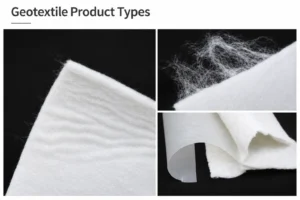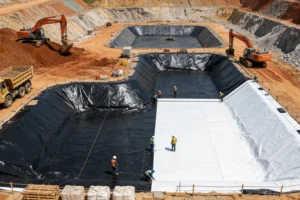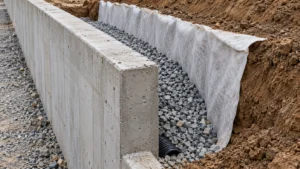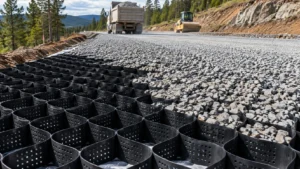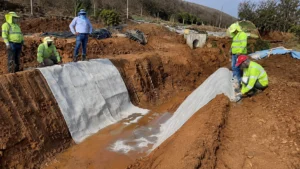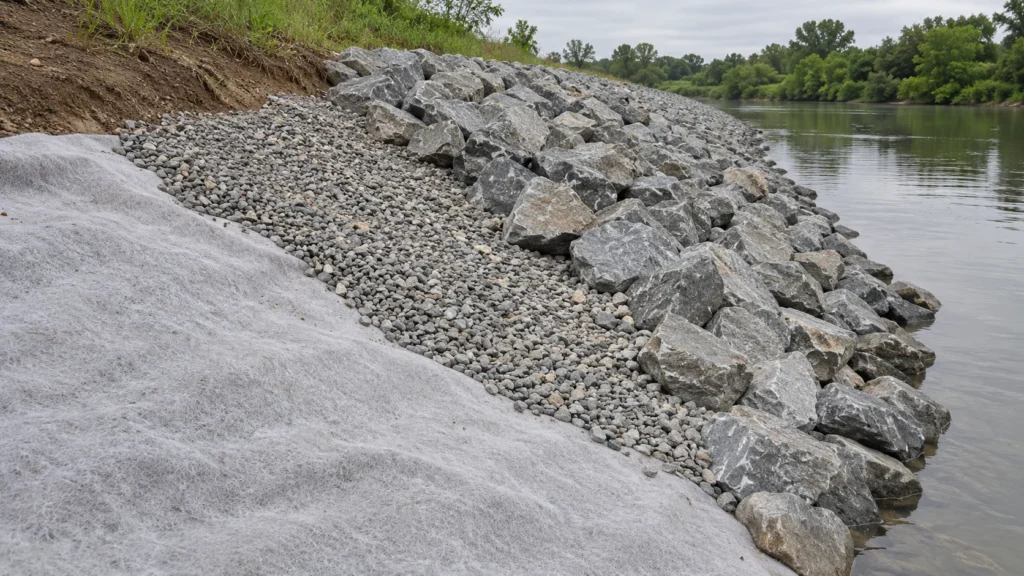
Geotextile fabric placed beneath riprap acts as a filter between the underlying soil and the rock protection layer. Its job is to limit soil migration while allowing water to pass through the system. The fabric must also survive placement of the rock and any specified bedding materials.
Needle-punched nonwoven geotextile is commonly evaluated for riprap filtration. Woven monofilament geotextile may also be suitable where its opening characteristics, hydraulic performance and installation properties meet the project requirements.
However, choosing a heavier geotextile or a product marketed as “heavy-duty riprap fabric” does not automatically improve filter performance.
For a riprap project, evaluate four things before confirming a product:
- Soil retention: What soil must the geotextile retain?
- Hydraulic performance: What water passage and pressure-relief conditions must the filter accommodate?
- Installation survivability: What mechanical damage could occur during placement?
- System compatibility: How will the geotextile interact with the bedding, rock armour and termination details?
The appropriate selection starts with the approved riprap cross-section, soil information, hydraulic design and proposed installation method.
1. What Does Geotextile Fabric Do Under Riprap?
Riprap is a layer of stone used to protect exposed soil and engineered slopes against erosion caused by flowing water, waves or other hydraulic action.
It is used in applications such as riverbank protection, channel lining, shoreline revetments, bridge approaches and embankment protection.
Because riprap contains voids between individual stones, an underlying filter is often needed to prevent excessive movement of the base soil into the armour layer.
A geotextile filter serves two principal functions:
Soil retention: It helps limit the migration of soil particles from beneath the rock protection system.
Water passage: It allows water to move through the filter so that excessive hydraulic pressure does not develop beneath the armour.
A suitable filter must balance these functions. A fabric that restricts water flow too much may be unsuitable even if it retains fine soil particles.
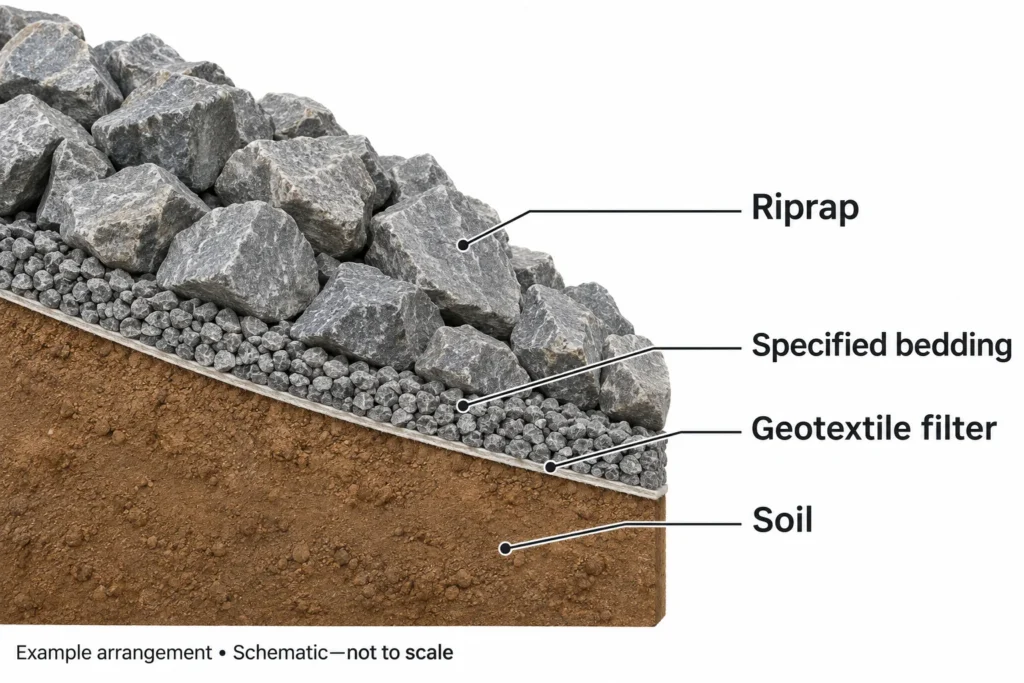
Geotextile Filter vs. Bedding Layer
A riprap protection system may contain several layers:
| Component | Primary function | Main design consideration |
|---|---|---|
| Riprap armour | Resist the specified hydraulic action | Rock sizing, grading, thickness and stability |
| Bedding or cushioning layer | Provide support and reduce damage to underlying materials where specified | Aggregate grading, thickness and installation |
| Geotextile filter | Retain soil while allowing water passage | Filtration compatibility, hydraulic performance and survivability |
| Granular filter | Provide a graded filtration transition | Particle-size compatibility and hydraulic requirements |
| Prepared subgrade | Support the filter and armour system | Surface preparation, stability and contact |
These components should not be treated as interchangeable.
A bedding layer may protect the geotextile against damage from large or angular stones, but it is not automatically a properly designed granular filter.
Similarly, a stronger geotextile does not necessarily eliminate the need for bedding.
The riprap system must be evaluated as a complete assembly rather than as a single fabric layer.
2. Check the Riprap Cross-Section Before Choosing a Fabric
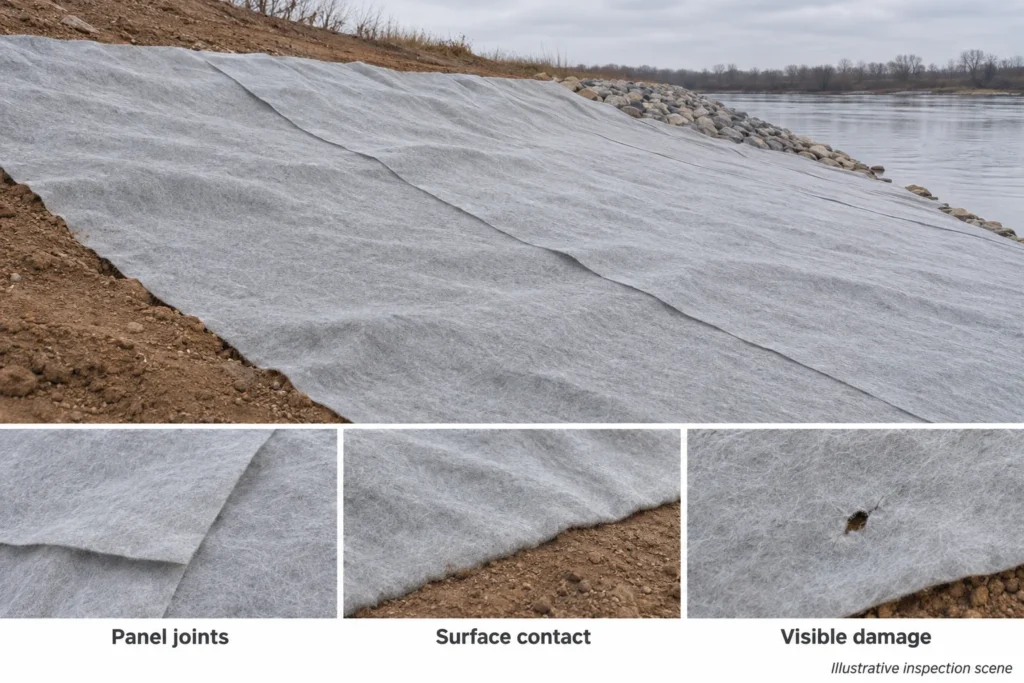
Before comparing geotextile products, identify the actual layer arrangement in the engineering drawings.
For example, one design may place geotextile directly between prepared soil and appropriately selected stone.
Another may require a separate bedding or cushioning layer between the fabric and larger riprap.
A third design may use a graded granular filter rather than geotextile.
These configurations create different filtration and installation requirements.
Information Required for Product Selection
| Project information | Why it matters |
|---|---|
| Approved cross-section | Identifies the position of the geotextile and adjacent materials |
| Soil gradation | Helps establish filtration compatibility |
| Hydraulic conditions | Defines relevant seepage, flow, drawdown or water-level requirements |
| Riprap grading | Helps assess stone size and mechanical damage risks |
| Bedding detail | Establishes whether an intermediate layer is required |
| Slope geometry | Affects installation, anchoring and material quantity |
| Placement method | Determines handling and construction considerations |
| Project specification | Defines required properties and acceptance criteria |
When the Drawing and Bill of Quantities Do Not Match
A common procurement problem is incomplete or inconsistent project documentation.
For example, the construction drawing may show a bedding layer, while the bill of quantities lists only riprap and geotextile.
In this situation, the correct approach is to clarify the discrepancy before finalizing the material specification or quotation.
The supplier should not assume that the bedding layer has been intentionally removed.
Any proposed change to the approved filter system requires the appropriate engineering review.
3. Nonwoven or Woven Geotextile for Riprap?
Different geotextile constructions can provide different filtration, hydraulic and mechanical characteristics.
For riprap filtration, the fabric type is an important starting point, but the actual grade and test results determine whether a product meets the specified requirements.
Needle-Punched Nonwoven Geotextile
Needle-punched nonwoven geotextiles are manufactured by mechanically bonding fibers into a fabric structure.
They can conform to irregular ground surfaces and are commonly considered for filtration and separation applications.
Potential riprap-related applications include:
- Riverbank and channel protection
- Engineered shoreline revetments
- Embankment erosion protection
- Drainage and filtration beneath rock protection layers
Both polypropylene (PP) and polyester (PET) nonwoven geotextiles are used in geotechnical engineering, subject to the environmental and project requirements.
For riprap protection, verify that the proposed grade provides the required soil retention, water passage and installation survivability.
A fabric described only as “nonwoven 300 GSM” cannot be approved on weight alone.
For product information, see the nonwoven geotextile category.
Woven Geotextile
Woven geotextiles are manufactured using interlaced yarns or tapes.
Different constructions have different opening structures and mechanical characteristics.
Woven monofilament geotextiles may be specified for certain engineered filtration applications when their opening characteristics and hydraulic properties satisfy the design.
Slit-film woven geotextiles are often associated with separation and stabilization, but high tensile strength alone does not demonstrate suitability for riprap filtration.
Not all woven geotextiles should be classified as equivalent drainage or filtration materials.
Quick Material Comparison
| Fabric construction | Potential advantage | What must be verified |
|---|---|---|
| Needle-punched nonwoven | Flexibility and common use in filtration systems | AOS/O90, hydraulic performance, puncture and installation criteria |
| Woven monofilament | Defined woven opening structure for certain engineered filters | Exact product availability, filtration criteria and hydraulic results |
| Slit-film woven | Strength characteristics useful in specified separation applications | Whether the actual construction meets filtration requirements |
Important: Woven monofilament is presented here as a technical option, not as a confirmed standard-stock GeoCore product. Availability and product-specific specifications must be established before quotation.
For a broader discussion of fabric types, read our woven vs nonwoven geotextile guide.
4. Technical Properties That Matter Beneath Riprap
A geotextile filter should meet the specified filtration, hydraulic and mechanical requirements.
Each property answers a different engineering question.
A. Apparent Opening Size and Soil Retention
Apparent Opening Size (AOS) describes the opening characteristics of a geotextile using the applicable test method.
ASTM D4751 provides methods for determining AOS.
Some technical data sheets instead report O90, a characteristic opening size determined using ISO 12956.
Although these properties address geotextile openings, their results should not be treated as directly interchangeable without an appropriate technical basis.
The relevant soil information may include:
- Particle-size distribution
- Fines content
- Soil classification
- Plasticity characteristics where relevant
- Conditions at the soil–geotextile interface
The applicable engineering criteria establish the opening-size requirements.
A smaller opening size is not automatically better.
Excessively restrictive filtration characteristics may contribute to hydraulic problems, while unsuitable openings may allow excessive soil migration.
The product must satisfy the required balance between retention and water passage.
B. Permittivity and Hydraulic Performance
Riprap filters must allow water to move through the protection system under the relevant hydraulic conditions.
Technical data sheets may describe several different water-passage properties.
| Hydraulic property | What it represents | Typical reporting information |
|---|---|---|
| Permittivity | Through-thickness water passage per unit head difference | s⁻¹, test method and conditions |
| Hydraulic conductivity | Coefficient describing water permeability | m/s or cm/s |
| Water-flow rate | Volumetric water passage under defined test conditions | Flow units and test configuration |
| In-plane flow capacity | Water transported along the material | Flow, hydraulic gradient and loading conditions |
ASTM D4491/D4491M covers geotextile water-permeability testing in terms of permittivity.
A reported hydraulic conductivity value must not be presented as a permittivity value without addressing the relevant testing basis.
Clean-water laboratory results also do not independently establish long-term performance at the actual soil–geotextile interface.
C. Puncture and Mechanical Resistance
The filter must withstand the loads and mechanical actions encountered during installation.
Potential damage sources include:
- Sharp or angular stone edges
- Rough ground surfaces
- Rock placement and impact
- Fabric handling and tension
- Movement during bedding or armour placement
Relevant properties may include:
| Property | Why it matters |
|---|---|
| Wide-width tensile strength | Describes tensile performance under a defined test |
| Elongation | Helps characterize deformation behavior |
| CBR puncture resistance | Provides an index of resistance to a defined puncture mechanism |
| Tear resistance | Helps assess resistance to tear propagation under the specified test |
| Seam strength | Required when sewn joints form part of the approved system |
No single laboratory puncture value can establish a universal safe rock-drop height.
Installation suitability depends on the interaction between the fabric, ground surface, bedding, rock size and construction method.
If a design requires bedding, increasing the fabric weight is not an automatic substitute.
D. Durability and Exposure
River, coastal and marine projects may expose materials to prolonged water contact, chemical conditions, ultraviolet radiation during installation or other environmental factors.
The required polymer and durability properties should be established from the project conditions.
Do not assume that two fabrics have equivalent durability merely because their GSM and tensile strength are similar.
5. What Weight of Geotextile Should Be Used Under Riprap?
There is no universal GSM or ounce-based recommendation for every riprap installation.
GSM measures mass per unit area. It does not uniquely determine filtration, hydraulic performance or puncture resistance.
A heavier fabric may provide higher mechanical strength within a particular product series, but it may also have different opening and water-passage characteristics.
Example: How Properties Can Change Between Geotextile Grades
The following values are taken from a manufacturer-published high-performance geotextile catalogue and are provided to illustrate why product weight is not a complete specification.
| Property | 150 GSM | 200 GSM | 300 GSM |
|---|---|---|---|
| Reported thickness | 1.8 mm | 2.1 mm | 2.8 mm |
| Reported tensile strength | 11.2 kN/m | 15.2 kN/m | 22.5 kN/m |
| Equivalent opening size (O90) | 0.18 mm | 0.15 mm | 0.13 mm |
| Reported vertical permeability coefficient | 0.45 cm/s | 0.41 cm/s | 0.35 cm/s |
| CBR puncture resistance | 1,750 N | 2,400 N | 3,400 N |
Source note: Figures are from a third-party manufacturer’s technical catalogue for a high-performance geotextile series. They are included for technical illustration only and are not presented as independently verified GeoCore product specifications, project-approved values or MARV declarations.
The original test-method references and value classifications require verification. O90 is not the same declared property as ASTM AOS, and the listed permeability coefficients are not ASTM permittivity values.
What Does This Comparison Show?
Within this particular product series, increasing the nominal mass per unit area is associated with higher reported tensile and puncture values, smaller reported O90 values and lower reported vertical permeability coefficients.
This does not mean that 300 GSM is always more suitable than 150 GSM or 200 GSM.
For a riprap project, a product with higher mechanical resistance may still be unsuitable if it fails the required filtration or hydraulic criteria.
The final grade should be selected against the complete engineering specification.
What About 6 oz or 8 oz Riprap Filter Fabric?
Ounce-based descriptions are widely used in some markets.
Like GSM, oz/yd² describes mass per unit area, not a complete geotextile performance classification.
Two products described as “8 oz nonwoven geotextile” may have different AOS, permittivity, puncture resistance and reporting bases.
Use the actual technical data sheets to compare the proposed grades.
For terminology and test-data interpretation, read our GSM, AOS and permittivity guide.
6. Can Riprap Be Placed Directly on Geotextile?
Direct placement may be permitted in some engineered arrangements, but it should not be assumed suitable for every project.
Whether bedding is required depends on the approved design, underlying surface, stone characteristics, selected fabric and construction procedure.
When a Bedding Layer May Be Required
An intermediate bedding or cushioning layer may be specified to provide a suitable transition or reduce the risk of mechanical damage to the geotextile.
The need for this layer can be influenced by:
- Stone size and angularity
- Condition of the prepared subgrade
- Mechanical properties of the geotextile
- Placement equipment and sequence
- Whether installation takes place in the dry or underwater
Before placing stone directly onto the fabric, confirm that the design and method statement permit the proposed arrangement.
Do not remove a specified bedding layer simply because an alternative geotextile has a higher GSM or puncture-test result.
7. Installation Checks Before the Riprap Covers the Geotextile
Once rock armour has been installed, inspecting the filter becomes difficult.
Establish inspection and hold points before placement begins.
Step 1: Prepare the Subgrade
The supporting ground should be prepared to the specified lines, grades and surface conditions.
Remove or address protrusions, debris and unsuitable material in accordance with the project requirements.
The geotextile should maintain appropriate contact with the prepared surface rather than bridge unsupported depressions.
Step 2: Position the Geotextile
Place the fabric according to the approved panel arrangement.
Avoid unnecessary stretching, displacement, folds or wrinkles that could interfere with the filter system.
The installation method should keep the fabric stable until the specified overlying materials are placed.
Step 3: Verify Overlaps and Seams
Do not assume one standard overlap dimension is suitable for every riprap project.
Confirm:
- Required overlap or seam type
- Panel orientation and placement sequence
- Continuity at joints
- Seam specifications where sewing is required
- Anchorage and termination details
A base-fabric tensile result does not automatically establish the strength of a sewn seam.
Where joint requirements are missing from the drawings, obtain clarification before installation.
Step 4: Place Bedding and Riprap
Follow the approved construction sequence and equipment restrictions.
Avoid placement practices that could pull, displace, puncture or excessively stretch the fabric.
Where the design limits rock-drop height or specifies controlled placement, those requirements must be followed.
If visible damage occurs, the affected area should be assessed and repaired or replaced as required before covering continues.
Pre-Cover Inspection Checklist
| Inspection item | Required confirmation |
|---|---|
| Subgrade | Surface preparation accepted |
| Geotextile grade | Matches approved technical submission |
| Panel positioning | Matches approved layout |
| Joints | Overlap or seams accepted |
| Terminations | Anchorage and edge details completed |
| Damage | Tears, punctures and displacement addressed |
| Bedding | Specified layer accepted where required |
| Documentation | Installed product identification recorded as required |
8. Special Considerations for Underwater Riprap Installation
Underwater geotextile placement introduces additional difficulties compared with dry installation.
Water movement and buoyancy may cause the fabric to lift, fold or move before it is covered.
Joints and panel continuity may also be more difficult to inspect underwater.
These issues should be considered during construction planning, not after the geotextile has arrived on site.
What Must the Installation Plan Address?
Panel positioning: How will panels be deployed and aligned on the underwater surface?
Temporary restraint: How will the fabric remain in position until bedding or rock is placed?
Joint continuity: How will overlaps or specified seams be maintained?
Rock placement: How will placement avoid excessive movement or mechanical damage?
Inspection: How will the contractor verify that the filter remains continuous before and after covering?
Underwater filter installation may require specialist equipment, diver operations or other project-specific methods.
A geotextile grade accepted for dry riprap installation is not automatically approved for an underwater construction procedure.
FHWA HEC-23 and NCHRP Research Report 887 provide further technical context for the installation and evaluation of underwater filter systems.
9. How Much Geotextile Fabric Is Needed for a Riprap Project?
The purchase quantity should be based on the actual surface to be covered and the approved panel layout.
Horizontal plan area is not necessarily equal to the surface area of a sloping bank or embankment.
Check These Quantities Before Ordering
The material take-off should consider:
- Actual slope length and covered width
- Specified overlaps or seam allowances
- Anchor trenches and termination details
- Changes in slope geometry
- Available roll width and length
- Cutting and handling requirements
- Agreed repair or spare material allowance
Example: Why Roll Width Matters
Consider a riprap project with a sloping surface that requires several geotextile panels.
Two proposed products may have similar technical properties but different roll widths.
The narrower roll may require more panel joints, increasing cutting, joining and handling work.
The wider roll may reduce some joints but create additional lifting or positioning requirements.
Therefore, the purchase decision should consider both material performance and installation logistics.
Do not apply a universal waste percentage without an actual panel layout.
For quotation comparison, request the total supplied area, number of rolls, dimensions per roll and any applicable allowances.
10. How to Evaluate a Riprap Geotextile Supplier
A technically acceptable quotation should identify the proposed product and the evidence supporting its use.
Comparing only the price per square meter can conceal important differences in performance and scope.
Technical Compliance Comparison
| Project requirement | Proposed grade | Supporting evidence | Review status |
|---|---|---|---|
| Polymer and construction | Exact product description | TDS | Confirmed / unresolved |
| Mass per unit area | Declared GSM | TDS or test report | Confirmed / unresolved |
| AOS or O90 | Value with method and units | Applicable test data | Meets / deviation / unresolved |
| Permittivity or permeability | Required hydraulic property | Comparable test data | Meets / deviation / unresolved |
| Mechanical properties | Specified strength and puncture values | Supporting reports | Meets / deviation / unresolved |
| Seam requirements | Specified joint performance | Applicable seam documentation | Meets / deviation / unresolved |
| Reporting basis | Typical, minimum, MARV or other | Supplier declaration | Confirmed / unresolved |
| Roll dimensions | Width, length and quantity | Quotation | Agreed / pending |
| Traceability | Required roll and batch identification | Available supply documentation | Confirmed / pending |
Typical Values vs. MARV
Manufacturer catalogue values should not automatically be treated as guaranteed minimum values.
MARV refers to Minimum Average Roll Value, a statistical reporting basis used in certain geotextile specifications.
If the project requires MARV, confirm that the submitted figures have been declared on that basis.
A catalogue value should not be relabeled as MARV without supporting documentation.
Can Delivered Rolls Be Traced to the Approved Product Grade?
For specification-controlled projects, buyers should confirm the availability of:
- Product grade identification
- Roll labels
- Batch or lot references
- Relevant quality records
- Packing and shipment documentation
Where batch-specific traceability is required, the ability to link delivered rolls to the applicable records should be established before shipment.
A general product brochure alone is not evidence of roll-by-roll traceability.
11. How to Evaluate an Alternative Geotextile Brand or Grade
A project may specify an existing geotextile brand, grade or performance schedule.
If an alternative product is proposed, equivalence must be established against the required performance criteria.
A matching GSM or higher tensile strength does not, by itself, demonstrate equivalence.
Recommended Comparison Process
Step 1: Identify the original specification.
Obtain the specified product grade, polymer, construction, performance requirements and testing methods.
Step 2: Compare the proposed alternative.
Evaluate filtration, hydraulic, mechanical and durability properties using comparable methods and reporting bases.
Step 3: Record deviations.
Missing data, different test methods or unverified requirements should be identified rather than marked as compliant.
Step 4: Submit the required documentation.
Provide the relevant technical data and comparison materials for review.
Step 5: Obtain approval where required.
A proposed substitute should not be described as an approved equivalent until the applicable approval process is complete.
A practical comparison format is:
Project requirement → Proposed value → Supporting document → Compliance status or deviation
This makes the submission easier for contractors, procurement teams and engineers to review.
12. What If the Buyer Only Has GSM or a Bill of Quantities?
Some riprap enquiries begin with limited information, such as:
“Please quote 300 GSM nonwoven geotextile for riverbank protection.”
Or:
“We need 20,000 m² of geotextile under riprap.”
These details can support a preliminary purchasing discussion but do not confirm technical suitability.
Information to Request
| Information | Purpose |
|---|---|
| Project application | Identifies the intended filter function |
| Cross-section or drawing | Confirms layer arrangement |
| Soil information | Supports filtration evaluation |
| Riprap size or grading | Helps assess placement and damage risks |
| Bedding requirement | Clarifies protection-layer configuration |
| GSM or strength requirement | Helps identify possible grades |
| Test standards | Establishes the appropriate comparison methods |
| Installation method | Identifies dry or underwater construction requirements |
| Quantity and destination | Supports commercial quotation |
Where information is missing, the supplier can identify preliminary product options and the technical items requiring clarification.
The final product should not be approved solely from an indicative quotation based on GSM.
Frequently Asked Questions
What geotextile fabric is used under riprap?
Needle-punched nonwoven geotextile is a common option for riprap filtration. Woven monofilament may also be appropriate for certain engineered filters. The selected grade must meet the required soil-retention, hydraulic and mechanical performance criteria.
Is geotextile always required beneath riprap?
No. Depending on the approved design, a riprap system may use a granular filter, geotextile filter or combined arrangement. The specified filter system should not be changed without the required engineering review.
What weight of geotextile is best under riprap?
There is no universal GSM or ounce rating for all riprap installations. Weight alone does not define filtration performance or installation survivability. The product should be selected against the relevant soil, hydraulic and mechanical specifications.
Can riprap be placed directly on geotextile?
Only when the approved design and construction method allow it. Some installations require a bedding or cushioning layer to reduce the risk of fabric damage. A heavier fabric is not automatically a substitute for that layer.
Can I use 8 oz nonwoven geotextile under riprap?
An 8 oz product may be considered for preliminary evaluation, but the description does not establish whether it meets the required AOS, permittivity, strength or installation criteria. Request the actual product data sheet.
Is woven or nonwoven geotextile better for riprap?
Neither construction is universally better. Needle-punched nonwoven is commonly evaluated for filtration, while selected woven monofilament products may be appropriate for engineered applications. Compare the specified performance of the exact grades.
How much overlap is required for riprap geotextile?
Overlap requirements depend on the project specification, soil conditions, joint arrangement and construction method. Underwater installation may require different measures from dry installation. Use the approved details rather than a universal overlap dimension.
Can geotextile be installed underwater?
Yes, underwater installation is possible when the fabric and construction system are designed and approved for it. Panel restraint, joint continuity, water movement, placement methods and inspection require particular attention.
Can a heavier geotextile replace the specified bedding layer?
Not without the required design approval. The fabric and bedding can perform different functions, and removing a layer may alter installation damage risks and system performance.
Can landscape fabric be used under riprap?
A landscape or weed-control label does not establish suitability as an engineered riprap filter. The specific product must satisfy the relevant filtration, hydraulic, mechanical and durability requirements.
Can GeoCore provide a quotation if I only know the GSM?
A preliminary product enquiry can begin with GSM, estimated quantity and project application. Additional information, such as the riprap cross-section, soil conditions and applicable standards, is needed to evaluate technical suitability before final approval.
Can an alternative geotextile replace a specified brand?
A replacement may be considered where its properties satisfy the specified requirements and the relevant approval process is followed. Equivalent weight or tensile strength alone is not proof of compliance.
Request Riprap Geotextile Specifications or a Quotation from GeoCore
GeoCore provides geosynthetic product information and specification-based sourcing support for civil engineering, filtration, erosion control and related infrastructure applications.
For riprap geotextile enquiries, send the project information available at your current purchasing stage.
| Purchasing stage | Information to provide | What to request |
|---|---|---|
| Initial enquiry | Application, estimated GSM, quantity and destination | Preliminary product information and clarification of missing requirements |
| Technical evaluation | Drawings, soil conditions, riprap details and specifications | Proposed grade data and technical comparison |
| Formal quotation | Confirmed product requirements, roll dimensions, quantity and delivery schedule | Commercial quotation and available supporting documentation |
Our team can review the supplied information and identify product specifications or documentation items that need confirmation.
Contact GeoCore to discuss your riprap geotextile requirements or request a quotation.
View Nonwoven Geotextile Products
Final filter selection, product approval and installation methods must follow the project specification and the responsible engineer’s design.
Technical References
- FHWA HEC-23, Volume II — Riprap and filter system design and installation guidance.
- FHWA HEC-23, Volume I — Riprap filter requirements and underwater installation considerations.
- NCHRP Research Report 887 — Guidance for Underwater Installation of Filter Systems.
- ASTM D4751 — Apparent opening size of geotextiles.
- ASTM D4491/D4491M — Geotextile water permeability by permittivity.
- ASTM D5101 — Soil–geotextile filtration compatibility testing.
Use the applicable editions and acceptance criteria adopted by the project specification.