If you’ve ever sourced geogrid for a road, embankment, or foundation project, you’ve probably asked this question:
“How long will it actually last?”
Most suppliers will tell you a number — 50 years, 100 years, sometimes even more.
But as someone who’s been in geosynthetics for years, I can tell you the real answer depends on more than a lab test.
It depends on what it’s made of, where it’s used, how it’s installed, and how it’s protected.
Let’s break it down, so you can make your next purchase with confidence.
1. What “Lifespan” Really Means in Geogrids
When people say “lifespan,” they usually mean how long the material can keep its strength — without losing too much performance due to aging, UV light, moisture, or load stress.
In real projects, that could be 20 years or 100 years — the difference comes from the details.
2. Material Type Matters Most
There are several types of geogrids, and each behaves differently over time:
| Material | Typical Service Life | Notes |
|---|---|---|
| Fiberglass Geogrid | 25–75 years | Very strong and stable, but needs a good coating to resist UV and alkali. |
| Polyester Geogrid | 25–100 years | More flexible, good in chemically stable soils. |
| Polypropylene (PP) | 20–50 years | Cost-effective but can creep under long-term loads. |
| Steel-Plastic Composite | 30–80 years | High strength, but coating quality is critical to avoid corrosion. |
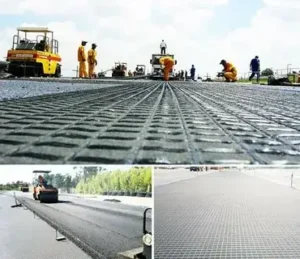
Fiberglass is one of the best for asphalt reinforcement because of its high tensile strength and low elongation.
That’s why you’ll often see it in road rehabilitation projects to prevent reflective cracking.
3. Environment and Installation — The Hidden Factors
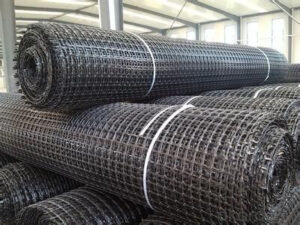
Even the best geogrid can fail early if it’s not handled right.
Here’s what really affects its lifespan in the field:
-
UV Exposure: direct sunlight before or after installation can break down unprotected fiberglass.
-
Chemical Environment: alkaline or acidic soils slowly attack the fibers if not coated properly.
-
Temperature: asphalt paving temperatures can exceed 160°C — coatings must survive that.
-
Installation Damage: folding, dragging, or uneven compaction can cut years off its service life.
A well-coated fiberglass geogrid, properly installed and protected, can easily last 30 to 40 years in asphalt overlays — and over 75 years when buried in soil.
4. What Reliable Suppliers Should Show You
When you ask about lifespan, you’re not just asking for a number.
You’re asking for proof — and a professional supplier should have it.
Here’s what you should expect to see:
-
Third-party test reports — ASTM D6637 (tensile strength), EN ISO 13431 (creep test), and UV resistance results.
-
Accelerated aging tests — showing performance after long exposure to heat, moisture, and sunlight.
-
Residual strength curves — data showing how much strength remains after 10,000 hours of creep.
-
Field case studies — real projects still performing after 10+ years.
If your supplier only gives you a product brochure, ask for these reports.
That’s how you know whether their “100-year lifespan” claim is real or marketing.
5. How to Think About “Lifespan” as a Buyer
Here’s something many project owners overlook:
Even if two geogrids both claim “50 years,” their effective lifespan might differ because of installation and environmental factors.
Think of it like this:
The lab gives you potential.
The site conditions decide the reality.
That’s why the design life of most fiberglass geogrids is conservatively set between 25–75 years, even though the fibers themselves could last much longer if fully protected.
6. What You Should Ask Before You Buy
If you’re in charge of procurement, here are a few questions that instantly tell you whether a supplier really knows their product:
-
What’s the expected service life in my specific environment (temperature, UV, soil pH)?
-
What kind of protective coating do you use, and how thick is it?
-
Do you have third-party durability testing or field data?
-
What warranty or performance guarantee can you offer?
-
Any project references similar to mine (climate, soil, load)?
If they can answer those clearly — not just with marketing terms — you’re probably talking to the right partner.
7. A Quick Reality Check
Geogrids can last anywhere from 20 to 120 years, depending on conditions.
That’s a wide range — and it’s true.
The key is to make sure your project sits on the right end of that range.
How?
By using quality coating, correct installation, and verified testing data.
That’s where experienced suppliers make the difference.
8. Final Thoughts
Geogrid lifespan isn’t just a number — it’s a relationship between material, environment, and workmanship.
When you choose a fiberglass geogrid with strong protective coating, handle it right during installation, and verify its test data, you’re not just buying a roll of material —
you’re buying decades of performance and peace of mind.
That’s what good engineering — and good procurement — is really about.
✅ Takeaway for Buyers
Ask for data, not just claims.
Choose coating over price.
And think lifespan, not just delivery time.