Choosing the right geogrid is a critical step in soil reinforcement design.
Among all geogrid types, biaxial and uniaxial geogrids are the most commonly compared—and also the most frequently misunderstood.
Many articles explain the difference in a single sentence:
biaxial geogrids work in two directions, while uniaxial geogrids work in one.
This explanation is technically correct, but engineering decisions require more than a simplified definition.
In practice, geogrid selection depends on load transfer mechanisms, stiffness requirements, and soil–reinforcement interaction, not direction alone.
This article provides a clearer, engineering-based comparison to help you choose the right solution for your project.
Geogrids interact with surrounding soil or aggregate through interlock, friction, and tensile resistance, forming a reinforced soil system rather than acting as a standalone structural element.
Uniaxial vs Biaxial Geogrid: The Basic Difference
Uniaxial Geogrid

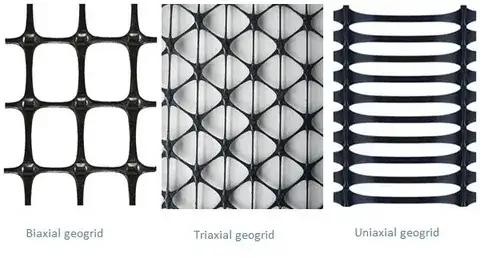
Uniaxial geogrids are designed to provide high tensile strength and stiffness primarily in one direction, typically along the machine direction.
They are commonly used in structures where reinforcement forces are clearly aligned, such as:
-
Reinforced soil retaining walls
-
Steep slopes
-
Embankments
Biaxial Geogrid

Biaxial geogrids provide tensile strength and stiffness in two perpendicular directions.
They are widely used in applications where loads are distributed across a plane, including:
-
Pavement base reinforcement
-
Working platforms
While these definitions are useful for classification, they do not fully explain why one type performs better than the other in certain applications.
Why Tensile Direction Alone Is Not Enough
1. Load Transfer Mechanism Is the Key Factor
Geogrids function by controlling soil deformation, not simply by resisting tension.
The primary design question should be:
How are loads transferred through the soil–geogrid system?
-
In reinforced soil walls and slopes, loads generate a dominant horizontal tensile force.
Uniaxial geogrids efficiently resist this force along a defined reinforcement length. -
In pavement and base layers, loads are repetitive and spread radially.
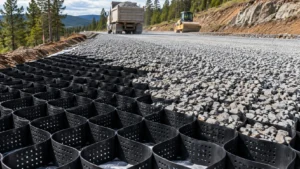
Biaxial geogrids improve performance by confining aggregate and limiting lateral spreading.
2. Stiffness at Working Strain Matters More Than Ultimate Strength
While tensile strength is often highlighted, tensile stiffness at low strain levels is usually more relevant to real-world performance.
-
Uniaxial geogrids typically offer:
-
High stiffness along the primary load direction
-
Efficient force mobilization in reinforced soil structures
-
-
Biaxial geogrids provide:
-
Balanced stiffness in two directions
-
Improved load distribution and confinement under traffic loading
-
A geogrid with high ultimate strength but insufficient stiffness may not deliver the expected reinforcement benefit.
3. Soil–Geogrid Interaction Defines Performance
The effectiveness of a geogrid depends heavily on how it interacts with surrounding materials:
-
Biaxial geogrids rely on aggregate interlock and lateral restraint to improve base layer stability.
-
Uniaxial geogrids develop tensile resistance through friction and pullout resistance over their embedded length.
Understanding this interaction is essential for selecting the appropriate reinforcement type.
Typical Applications Explained with Engineering Logic
Reinforced Soil Retaining Walls
-
Load direction is predictable and primarily horizontal
-
Reinforcement layers carry tensile forces
-
Uniaxial geogrids are generally preferred
Pavement Base and Subgrade Reinforcement
-
Loads are cyclic and multi-directional
-
Aggregate confinement is critical
-
Biaxial geogrids are commonly used
When the Choice Is Not Absolute

In projects with complex stress conditions, standard uniaxial or biaxial geogrids may not fully meet performance requirements.
In such cases, alternative reinforcement systems or customized designs should be considered.
A Practical Selection Framework
Instead of asking “biaxial or uniaxial?”, consider the following:
| Design Consideration | Key Question |
|---|---|
| Load orientation | Is there a dominant tensile direction? |
| Deformation control | Is stiffness at low strain critical? |
| Soil type | Granular or cohesive? |
| Long-term performance | Creep and durability requirements |
Direction is a design parameter, not the design criterion.
Conclusion
The difference between biaxial and uniaxial geogrids goes far beyond tensile direction.
Effective selection requires understanding how loads are transferred, how stiffness is mobilized, and how the geogrid interacts with soil.
For reliable performance, geogrid choice should always be based on engineering principles rather than simplified rules of thumb.