When engineers evaluate geomembranes for containment structures, most attention naturally goes to material specifications—tensile strength, thickness, density, or chemical resistance. These numbers are essential, but real-world performance depends on far more than what appears on a technical sheet.
In actual projects, geomembranes behave as part of a system that includes the ground, the environment, the liquids they contain, and—critically—the people who handle and install them.
This article outlines the practical factors that have the greatest impact on how a geomembrane performs over its entire service life.
1. Material Selection and Polymer Behavior
The first layer of decision-making is choosing the appropriate polymer. HDPE, LLDPE, and PVC each respond differently to stress, temperature, and long-term exposure.
-
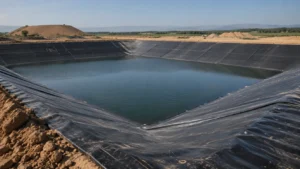
HDPE offers high chemical resistance and long-term durability, making it common in landfills, wastewater ponds, and mining applications.
-
LLDPE is more flexible and adapts better to subgrade movement or differential settlement.
-
PVC is often selected for irregular shapes or smaller installations where ease of handling matters more than extreme chemical resistance.
The correct material is not simply the one with the “strongest” properties, but the one that fits the specific environmental and structural conditions of the project.
2. Subgrade Conditions and Preparation
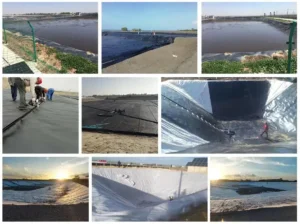
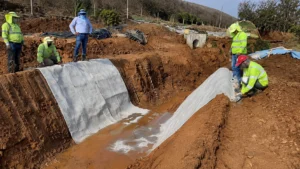
Even a high-quality liner can fail prematurely if it is installed over a poorly prepared surface.
In the field, most mechanical damage happens before the liner is even welded.
Critical considerations include:
-
Removing sharp stones and debris
-
Ensuring smooth transitions between different soil types
-
Compacting soft areas that might cause differential settlement
-
Preventing erosion channels that could stretch or puncture the liner
A geomembrane is only as reliable as the surface beneath it. Proper preparation significantly reduces risk throughout the life of the system.
3. Welding and Field Installation Quality
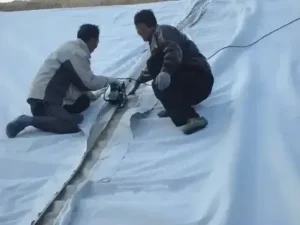
Installation quality is one of the strongest predictors of long-term performance.
Two materials with identical specifications can have dramatically different outcomes depending on how carefully the seams were welded.
Key influences include:
-
Weather conditions during welding
-
Technician skill and training
-
Calibration of hot wedge or extrusion welders
-
Use of destructive testing for trial seams
-
Air-pressure and vacuum box testing on production seams
-
Cleanliness of the surfaces before welding
Many failures attributed to “material defects” are actually installation issues that could have been avoided with better field control.
This is why experienced installers are an essential part of any high-reliability lining system.
4. Environmental Exposure: UV, Temperature, and Movement
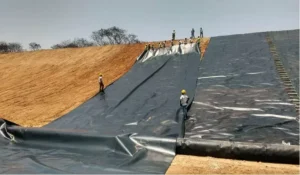
Once installed, a geomembrane faces a range of environmental stresses.
Exposure to sunlight, temperature cycles, and structural movement all influence how the liner behaves over time.
-
UV radiation breaks down polymers unless they have adequate carbon black and antioxidants.
-
Daily and seasonal temperature swings cause expansion and contraction, stressing seams or creating wrinkles if not managed properly.
-
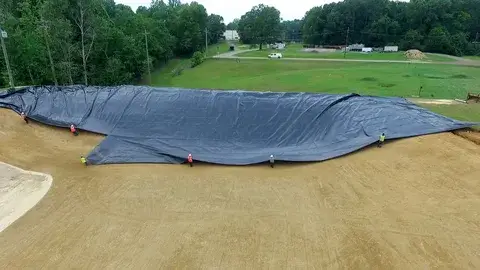
Wind uplift can disturb the liner during installation if anchoring is insufficient.
-
Differential settlement can stretch the liner beyond its design limits, especially in steeper areas.
Choosing thickness and material type is important, but adapting installation methods and anchor systems to site conditions is equally critical.
5. Chemical and Biological Compatibility
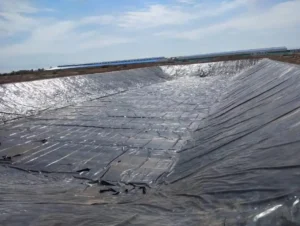
In containment projects, especially in mining, industrial wastewater, or agricultural lagoons, the stored liquid may interact with the polymer in subtle but meaningful ways.
Influence factors include:
-
pH levels
-
Temperature of stored fluid
-
Hydrocarbons or solvents
-
Microbial activity in organic ponds
-
Long-term exposure to fertilizers or manure effluent
Compatibility testing or referencing established chemical-resistance data is vital for long-term reliability.
6. Quality Control and Documentation
Large projects rely heavily on consistent record-keeping.
A well-managed installation will include:
-
Material certificates
-
Factory test reports
-
Field seam logs
-
Destructive sample results
-
As-built drawings
-
Inspection photos
These documents form a traceable history that can identify issues early, rather than years later when repairs are far more complicated.
7. Long-Term Maintenance and Inspection
Even the best installations benefit from periodic inspections. Simple practices—checking for erosion around anchor trenches, monitoring settlement, cleaning debris off exposed sections, or repairing animal damage—can significantly extend the liner’s lifespan.
Most geomembrane problems do not occur suddenly; they develop slowly and can often be prevented with routine monitoring.
⭐ Conclusion
Geomembrane performance is shaped by a combination of material science, installation practices, environmental exposure, and long-term management.
Choosing the right polymer—HDPE, LLDPE, PVC, or others—is only one part of the equation. Real-world outcomes depend on what happens on the ground: the subgrade conditions, the expertise of the installation team, and the environment in which the system operates.
A liner selected wisely and installed with care can provide decades of reliable service in applications ranging from ponds and reservoirs to complex environmental containment systems.
If you need support evaluating material options or preparing for a project, our team can assist with specifications, samples, and technical guidance.