Technical Review:
Geosynsource Editorial Team
This guide is written for general material selection and retaining wall reinforcement understanding. Final wall design should be reviewed by a qualified engineer based on site-specific soil, drainage, load and local code requirements.
Author:
L. Zhang, P.E.
Licensed Structural & Geotechnical Engineer
-
10+ years designing MSE walls, geogrid-reinforced systems, and slope stabilization
-
Designed 120+ segmental & reinforced soil retaining structures
-
Member of ASCE / IGS
-
Specializes in soil–structure interaction and reinforced soil mechanics
1. Direct Answer
Geogrid is commonly required for many retaining walls around or above 4 ft, especially when weak soils, surcharge loads, slopes, poor drainage or long-term stability requirements are present.
For smaller residential walls, you can also check this guide on whether a 4 ft retaining wall needs geogrid before deciding on reinforcement.
FHWA guidance for mechanically stabilized earth walls and reinforced soil slopes emphasizes project-specific design based on wall geometry, soil properties, reinforcement, drainage and loading conditions. The NCMA / CMHA segmental retaining wall design manual also provides design guidance for both gravity SRW structures and geosynthetically reinforced SRW systems.
2. What Geogrid Actually Does
Geogrid provides tensile reinforcement that compacted soil alone cannot supply. In a reinforced retaining wall, the geogrid interacts with compacted backfill to create a stable reinforced soil mass behind the wall facing.
Core functions:
-
Interlocks with backfill to form a composite reinforced soil mass
-
Resists lateral earth pressure & ground movement
-
Increases shear resistance of weak soils
-
Improves global stability, sliding resistance & overturning resistance
-
Improves long-term wall performance when properly selected, installed and protected from damage.
For transportation and high-load retaining wall projects, MSE wall design is typically evaluated for external stability, internal stability and overall stability according to applicable engineering standards.
For engineered reinforced-soil walls, the reinforcement product should be selected according to the complete wall design rather than wall height alone. Polyester geogrid for reinforced soil walls is one option where the specified tensile and long-term reinforcement requirements match the selected product data.
3. When Geogrid Is Usually Needed?
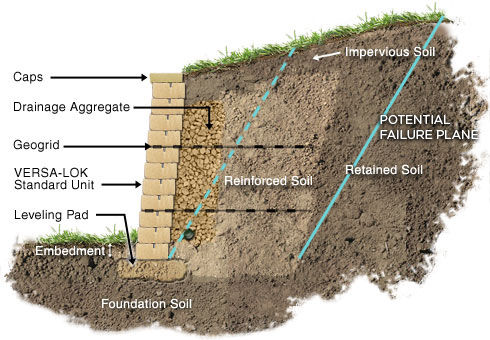
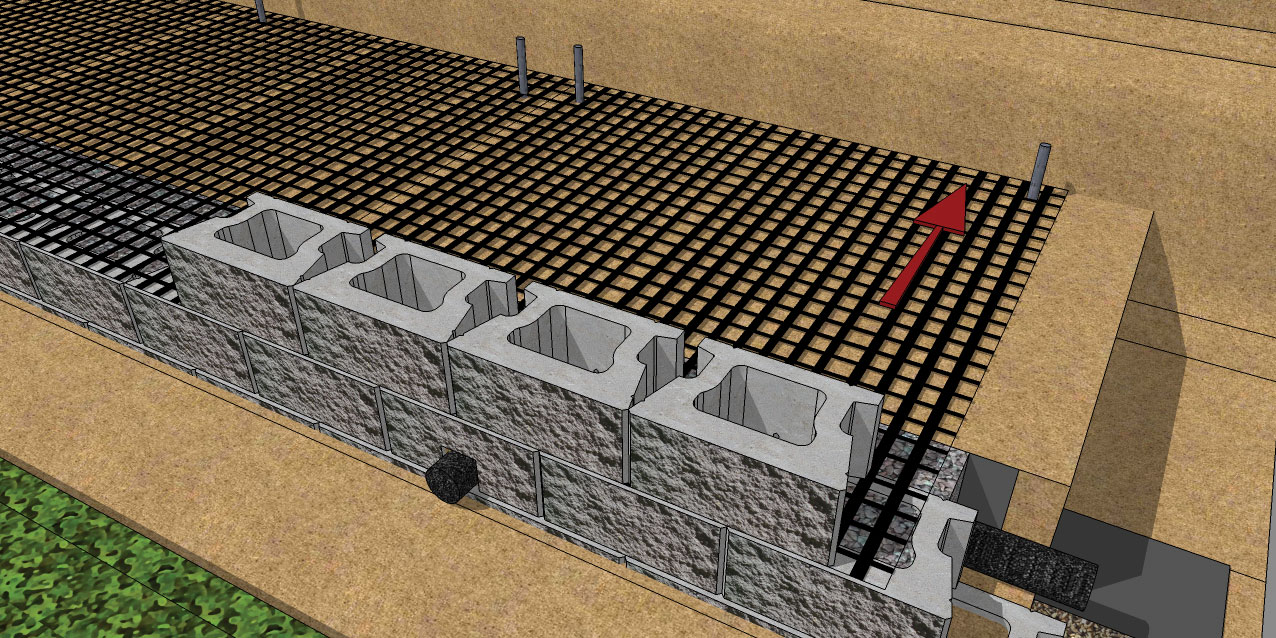

Walls around or above 4 ft are more likely to require geogrid, especially when additional risk factors are present.
1. Wall height exceeds 4 ft (1.2 m)
Soil pressure increases with the square of the height.
Even a small increase greatly increases lateral force.
2. Driveways, parking areas, slopes, fences, buildings or other surcharge loads can increase lateral pressure behind the wall and often require reinforced design.
Examples:
-
Driveways
-
Parking areas
-
Slopes
-
Buildings or fences
-
Hot tubs / heavy planters
Surcharge = higher earth pressure → geogrid required.
3. Weak or cohesive soils (clay, silt, organic)
These soils have low friction angles and high movement potential.
Weak, clayey, silty or organic soils can increase movement risk and reduce wall stability. These conditions often require engineering review and reinforcement.
4. Retained slope above the wall
Sloped backfill dramatically increases lateral pressure.
5. Poor drainage or hydrostatic pressure
Even a small amount of trapped water can double soil pressure.
Geogrid does not remove hydrostatic pressure. Poor drainage must be corrected together with reinforcement.
6. Long-term design life
Geogrids (PET or HDPE) offer controlled creep behavior & durability.
Whether geogrid is necessary also depends on the type used. Our biaxial vs uniaxial geogrid comparison explains this in detail.
If your retaining wall project requires reinforcement, our HDPE geogrid can be used for soil reinforcement behind retaining walls when properly designed and installed.
4. When Geogrid Might Not Be Needed
Geogrid may not be required when the wall is low, well-drained, built with granular backfill and not affected by surcharge loads. However, the final decision should still consider local codes, wall system recommendations and site-specific conditions.
Geogrid may not be required when:
-
Wall is under 2–3 ft (0.6–0.9 m)
-
No surcharge loads
-
Granular (gravel/sand) backfill is available
-
Wall is purely decorative
-
Site is well-drained
Still, the NCMA recommends engineering review for heights above 3 ft.
5. What Happens if You Skip Geogrid?
If geogrid is omitted where reinforcement is needed, the wall may develop bulging, leaning, block separation, sliding or excessive movement over time. These problems are more likely when weak soils, surcharge loads, poor compaction or drainage problems are present.
-
Outward bulging
-
Tilting or leaning
-
Cracks between blocks
-
Base sliding
-
Drainage failures
-
Heave during freeze–thaw cycles
-
Sudden failure during rainfall or saturation
Gravity-only walls may not be suitable for many taller or loaded retaining wall projects unless the wall system, soil condition, drainage and geometry are specifically designed for that application.
6. Recommended Geogrid Spacing & Embedment
Typical Geogrid Layout Reference:
The values below are general reference ranges only. Actual geogrid length, spacing and tensile strength should be determined by the wall system, soil properties, surcharge load, drainage condition and project-specific engineering design.
| Parameter | Common Reference Range |
|---|---|
| Geogrid embedment length | Often about 0.7H or more, depending on design |
| Vertical spacing | Commonly around 18–24 in, depending on wall system |
| Geogrid type | Uniaxial HDPE or PET geogrid for retaining walls |
| Tensile strength | Selected according to wall height, soil and load requirements |
Based on FHWA-NHI-10-024 Table 11-1 & NCMA Design Manual.
7. Real Engineering Cases
Case 1:5 ft backyard retaining wall failed after 18 months (No geogrid)
Location: Oregon
Soil: High-plasticity clay
Wall: 5 ft (1.5 m), no geogrid
Observed issues:
-
1–1.5 in bulging
-
Leaning 3°
-
Block separation
Root causes:
-
Clay backfill → high pressure
-
No drainage
-
Gravity-only system inadequate
-
Freeze–thaw impacts
Outcome:
Wall partially collapsed. Rebuilt with 2 geogrid layers, performing well after 4+ years.
Case 2:8 ft geogrid wall in Colorado performs flawlessly for 10 years
Design:
-
8 ft wall
-
3 geogrid layers (PET)
-
0.75H embedment
-
24 in spacing
-
Gravel backfill
Results after 10 years:
-
Zero movement
-
No bulging
-
Drainage intact
-
Meets FHWA long-term performance criteria
A textbook example of proper MSE wall design.
8.Why Wall Height Matters: A Simplified Concept
Wall height is one of the most important factors in retaining wall design because lateral earth pressure increases rapidly as the wall becomes taller.
In simplified earth pressure theory, the total lateral force behind a retaining wall is related to the square of the wall height. This means that a 6 ft wall does not carry only slightly more pressure than a 4 ft wall — the increase can be much greater under similar soil conditions.
A simplified concept can be expressed as:
P = 0.5 × Ka × γ × H²
Where:
P = total lateral earth pressure
Ka = active earth pressure coefficient
γ = soil unit weight
H = wall height
Because H is squared in the equation, a small increase in wall height can create a much larger increase in lateral force.
For example, under similar soil and backfill conditions:
A 4 ft retaining wall may be manageable as a gravity wall when soil, drainage and loading conditions are favorable.
A 6 ft retaining wall is much more likely to require geogrid reinforcement, especially when surcharge loads, weak soil, slopes or poor drainage are present.
This is why wall height should not be evaluated alone. The final decision should also consider soil type, backfill quality, drainage design, surcharge load, wall system and local engineering requirements.
In practical terms, as retaining wall height increases, geogrid reinforcement becomes more important because the wall often needs a reinforced soil mass behind it, not just wall weight in front of it.
9. Cost Comparison: Geogrid vs. Concrete Wall
Geogrid-reinforced segmental walls are often more economical because:
-
Less excavation
-
No rebar
-
No concrete forms
-
Faster installation
-
Less labor & equipment
-
Smaller foundation required
Geogrid-reinforced segmental retaining walls can be more economical than some cast-in-place concrete walls because they may reduce formwork, rebar, foundation size, installation time and equipment needs.
However, cost depends on wall height, site access, soil condition, drainage, labor cost, material availability and engineering requirements.
10. Common Retaining Wall Geogrid Installation Mistakes
Common Retaining Wall Geogrid Installation Mistakes
Incorrect geogrid orientation
The strong direction of the geogrid should be placed perpendicular to the wall face. For retaining wall reinforcement, materials such as HDPE geogrid are commonly selected because they provide tensile strength in the main direction of soil movement.
Insufficient embedment length
Geogrid length should follow the project design or wall system recommendation. Insufficient embedment may reduce the reinforced soil mass behind the retaining wall and weaken long-term stability.
Driving equipment directly on exposed geogrid
Heavy equipment should not be driven directly on exposed geogrid. A soil cover layer should be placed before equipment traffic to reduce the risk of material damage.
Poor backfill compaction
Backfill should be placed and compacted in controlled lifts. Poor compaction can reduce the interaction between the geogrid and the backfill, limiting the reinforcement effect.
No drainage or clogged drainage pipe
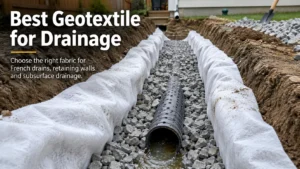
Geogrid reinforces soil, but it does not replace drainage. A proper retaining wall drainage system may include clean gravel, drainage pipe, composite drainage board, and geotextile filter fabric to help control water pressure behind the wall.
Using clay or organic backfill in the reinforced zone
Clay or organic backfill can reduce drainage performance and increase movement risk. Granular structural fill is usually preferred in the reinforced soil zone, and a geotextile filter fabric may be used where separation or filtration is needed.
11. References and Design Resources
References and Design Resources
FHWA: Mechanically Stabilized Earth Walls and Reinforced Soil Slopes
CMHA / NCMA: Design Manual for Segmental Retaining Walls
AASHTO LRFD Bridge Design Specifications
BS 8006-1: Reinforced Earth Structures
Local building codes and wall system manufacturer recommendations
12. Final Recommendation
If your retaining wall:
-
Exceeds 4 ft (1.2 m)
-
Has any surcharge
-
Contains poor soils
-
Retains a slope
-
Requires durability
-
Sits in a wet or freeze–thaw environment
Then geogrid reinforcement should be strongly considered and verified through engineering review.
If your retaining wall exceeds 4 ft, supports surcharge loads, contains weak soil, retains a slope, sits in a wet or freeze–thaw environment, or requires long-term structural performance, geogrid reinforcement should be strongly considered.
For walls above 4 ft and all geogrid-reinforced retaining walls, the final layout should be reviewed according to local codes, wall system recommendations and project-specific engineering requirements.
13. Professional Disclaimer (Trustworthiness)
Professional Disclaimer
This guide provides general information for understanding retaining wall geogrid reinforcement. It does not replace project-specific engineering design.
Final retaining wall design should consider soil type, retained height, drainage, surcharge loads, wall system, local building codes and manufacturer recommendations. For commercial, roadway, high-load or safety-critical retaining walls, consult a qualified engineer.
1. Do retaining walls over 4 feet require geogrid?
Many retaining walls higher than 4 ft require geogrid, especially when weak soil, surcharge loads, slopes or poor drainage are present. However, final reinforcement requirements depend on wall system, soil condition, drainage, loads and local design requirements.
2. Can I build a retaining wall without geogrid?
Small walls (2–3 ft) with no surcharge, good drainage, and granular backfill may not require geogrid. Taller walls or those with clay soils, slopes, or driveways above them should not be built without reinforcement.
3. How far should geogrid extend behind a retaining wall?
A common reference range for geogrid embedment is about 0.7H or more, but the final length should be determined by project-specific design, soil condition, surcharge load and wall system recommendations.
4. How many layers of geogrid do I need?
Many reinforced retaining walls use multiple geogrid layers, but the actual number and spacing depend on wall height, soil, load and design requirements.
5. What type of geogrid is best for retaining walls?
Uniaxial HDPE or PET geogrid is recommended. It provides strong tensile reinforcement along the direction of loading, which is essential for MSE retaining wall systems.
6. What happens if geogrid is omitted from a wall that needs it?
Common failures include bulging, sliding, leaning, cracking between blocks, and collapse during heavy rain or freeze–thaw cycles.
7. Do I need a drainage system even if I use geogrid?
Yes. Geogrid improves structural stability, but drainage prevents hydrostatic pressure. Both are required for a long-lasting retaining wall.
If you’re still deciding which wall material suits your project best, our 2025 Retaining Wall Material Guide provides a full breakdown of the strengths and limitations of each material
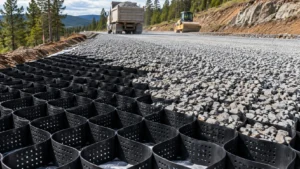
For gravel surfacing projects, see our guide on gravel driveway grid lifespan to understand how long these systems typically perform in real use.
Related Guides
Do You Need Geogrid for a 4 ft Retaining Wall?
Disadvantages of Geogrids
Gravel Driveway Grid Lifespan
Biaxial vs Uniaxial Geogrid