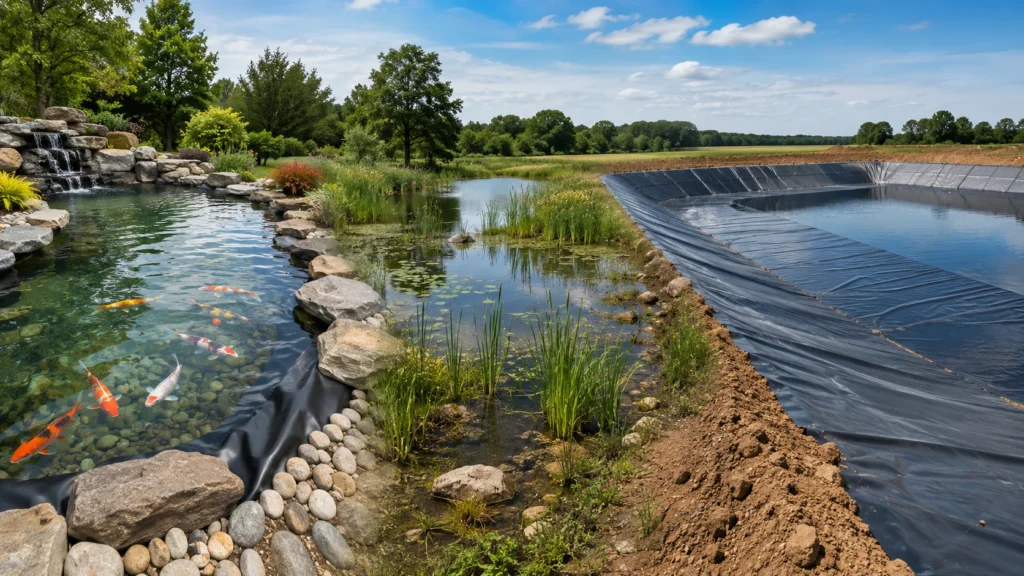
Best Pond Liner for Koi, Wildlife and Farm Ponds
Choosing the best pond liner depends on what type of pond you are building, how large it is, whether fish or wildlife will live in it, and how long you expect the liner to perform.
For small koi ponds and garden ponds with irregular shapes, EPDM is often the easiest material to install because it is soft and flexible. For large ponds, farm ponds, reservoirs, aquaculture ponds, and long-term water containment projects, HDPE or LLDPE geomembrane liners are usually more suitable because they offer strong puncture resistance, low permeability, and better cost efficiency over large areas.
In simple terms, there is no single “best pond liner” for every project. The best choice depends on the application.
- Best pond liner for koi ponds: EPDM or fish-safe geomembrane liner
- Best pond liner for wildlife ponds: EPDM, RPE, or LLDPE depending on shape and site condition
- Best pond liner for farm ponds: HDPE or LLDPE geomembrane
- Best pond liner for large ponds and reservoirs: HDPE geomembrane
- Best budget pond liner: PVC for small, low-risk ponds
- Best liner for irregular shapes: EPDM or LLDPE
This guide compares the most common pond liner materials, including EPDM, HDPE, LLDPE, PVC, Butyl, and RPE, so you can choose the right liner for your project.
Quick Answer: Which Pond Liner Is Best?
The best pond liner depends on the pond type. A small backyard koi pond and a large farm pond do not need the same liner material. Flexibility, puncture resistance, seam strength, UV resistance, installation method, and total project size all affect the final choice.
| Pond Type | Best Liner Choice | Why It Works |
|---|---|---|
| Koi pond | EPDM or fish-safe pond liner | Flexible, safe for aquatic life when specified correctly, and easy to fit around shelves and curves |
| Wildlife pond | EPDM, RPE, or LLDPE | Good flexibility and suitable for natural pond shapes |
| Farm pond | HDPE or LLDPE geomembrane | Strong, weldable, durable, and cost-effective for larger areas |
| Large reservoir | HDPE geomembrane | High puncture resistance, low permeability, and strong long-term containment performance |
| Small decorative pond | EPDM or PVC | Easy to handle and suitable for simple garden installations |
| Temporary or low-budget pond | PVC | Lower initial cost, but shorter service life than higher-grade materials |
If your project is a small backyard pond, flexibility may be more important than strength. If your project is a farm pond, irrigation pond, aquaculture pond, or reservoir, long-term seepage control and seam reliability are usually more important.
Pond Liner Material Comparison
The most common pond liner materials are EPDM, HDPE, LLDPE, PVC, Butyl rubber, and RPE. Each material has different strengths and limitations, so the best option should be selected according to pond size, shape, exposure, water type, and installation requirements.
| Material | Flexibility | Puncture Resistance | UV Resistance | Best For | Cost Level |
|---|---|---|---|---|---|
| EPDM | Excellent | Medium to High | Good | Koi ponds, garden ponds, irregular shapes | Medium to High |
| HDPE | Low to Medium | Very High | Excellent | Farm ponds, reservoirs, aquaculture, containment projects | Medium |
| LLDPE | High | High | Good to Excellent | Uneven ground, ponds with settlement risk, prefabricated panels | Medium |
| PVC | Good | Low to Medium | Moderate | Small ponds, budget projects, short-term use | Low |
| Butyl Rubber | Excellent | High | Good | Premium garden ponds and formal ponds | High |
| RPE | Medium to High | High | Good | Wildlife ponds, lightweight lining projects | Medium to High |
Best Pond Liner for Koi Ponds
For koi ponds, the best liner is usually a flexible, fish-safe liner that can fit shelves, corners, curves, and deeper pond sections without excessive stress.
EPDM is commonly used for koi ponds because it is flexible and easy to install around irregular shapes. This makes it suitable for decorative koi ponds, backyard ponds, and water gardens where appearance and easy handling matter.
However, material choice should not stop at the word “EPDM.” For koi ponds, you should also check:
- Whether the liner is specified as fish-safe
- Whether the material contains harmful additives
- Whether the liner thickness is suitable for the pond depth
- Whether underlayment is needed to protect against stones and roots
- Whether seams or joints are required
For small and medium koi ponds, EPDM is often a practical choice. For larger koi ponds, aquaculture ponds, or commercial fish ponds, HDPE or LLDPE geomembrane may also be considered when the liner is specified for aquatic use and installed correctly.
Best Pond Liner for Wildlife Ponds
A wildlife pond usually has a more natural shape than a formal pond. It may include shallow edges, planting shelves, uneven ground, stones, and natural vegetation. Because of this, flexibility and protection are very important.
For small wildlife ponds, EPDM is often a good option because it can follow irregular shapes easily. RPE can also be useful when a lightweight but strong liner is needed. For larger wildlife ponds or natural water storage areas, LLDPE may be a better choice because it offers more flexibility than HDPE while still providing strong containment performance.
For wildlife ponds, the liner should be protected with a suitable underlay. This helps reduce damage from roots, stones, and ground movement.
Best Pond Liner for Farm Ponds
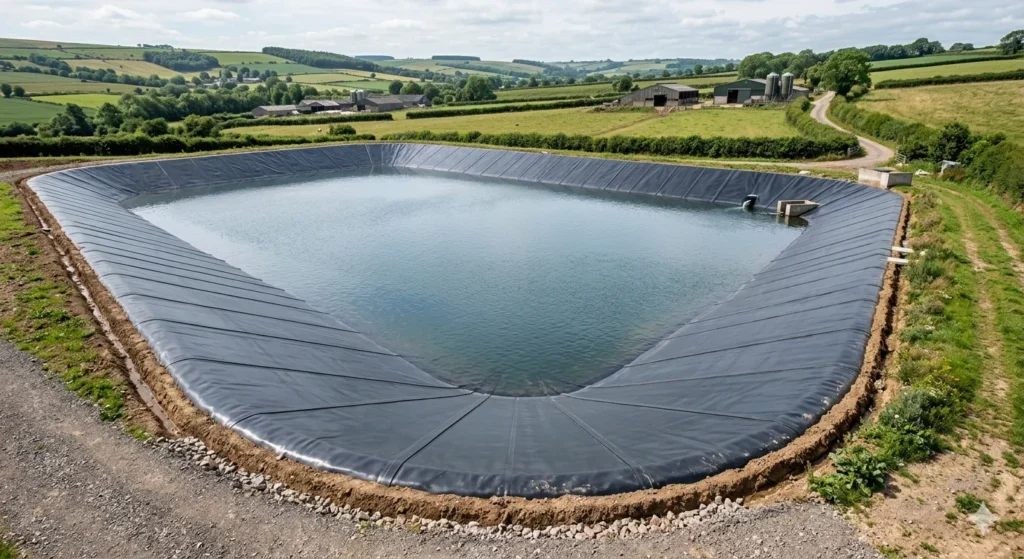
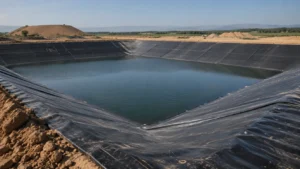
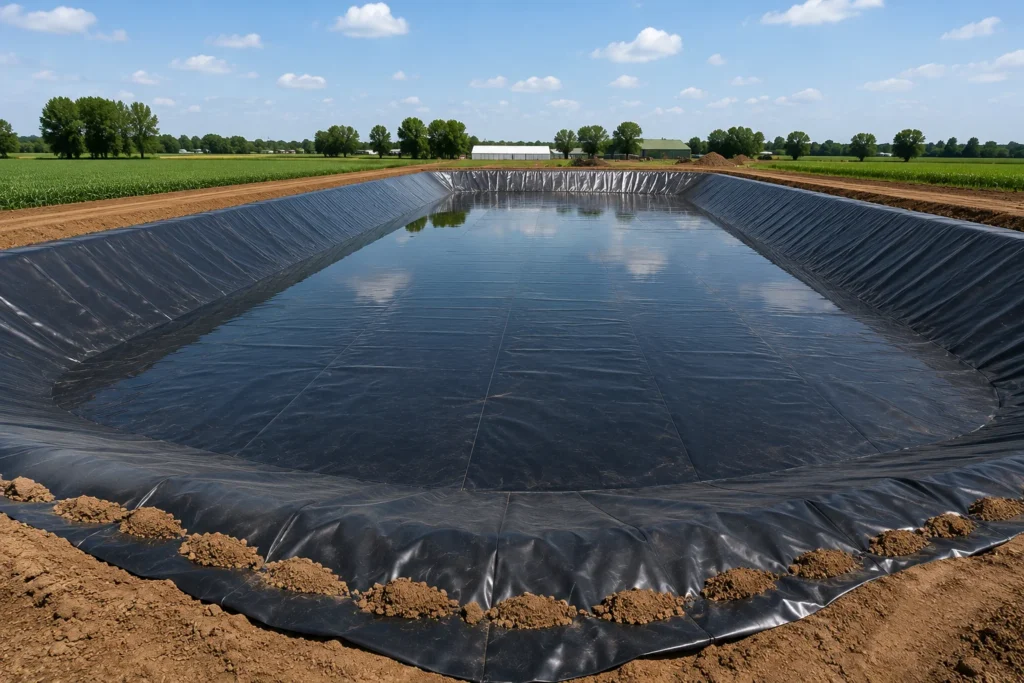
For farm ponds, the best liner is usually HDPE or LLDPE geomembrane. Farm ponds are often larger than backyard ponds, so the liner must provide reliable seepage control across a wide area.
HDPE geomembrane is widely used for farm ponds, irrigation ponds, reservoirs, wastewater ponds, and aquaculture projects because it offers:
- Strong puncture resistance
- Low permeability
- Good UV resistance
- High chemical resistance
- Heat-weldable seams for large projects
- Cost efficiency for large-area installation
LLDPE geomembrane is another strong option when the pond base is uneven or when the project requires better flexibility. Compared with HDPE, LLDPE can better adapt to settlement, irregular surfaces, and prefabricated liner panels.
If you are sourcing liner material for a farm pond, irrigation pond, reservoir, or aquaculture pond, you can view our pond liner products or compare our HDPE, LLDPE and EVA geomembrane liners.
Suggested internal links:
Best Pond Liner for Large Ponds and Reservoirs
Large ponds and reservoirs require a different selection standard from small decorative ponds. In large-area lining projects, seam strength, installation quality, puncture resistance, and long-term seepage control are more important than hand flexibility.
HDPE geomembrane is usually one of the most practical materials for large ponds and reservoirs because it can be heat-welded on site and installed over large areas. This makes it suitable for:
- Irrigation reservoirs
- Farm water storage ponds
- Aquaculture ponds
- Industrial wastewater ponds
- Artificial lakes
- Water containment projects
For projects where ground settlement, uneven subgrade, or prefabricated panels are important concerns, LLDPE may be a better alternative because it provides more flexibility than HDPE.
HDPE vs EPDM Pond Liner: Which Is Better?
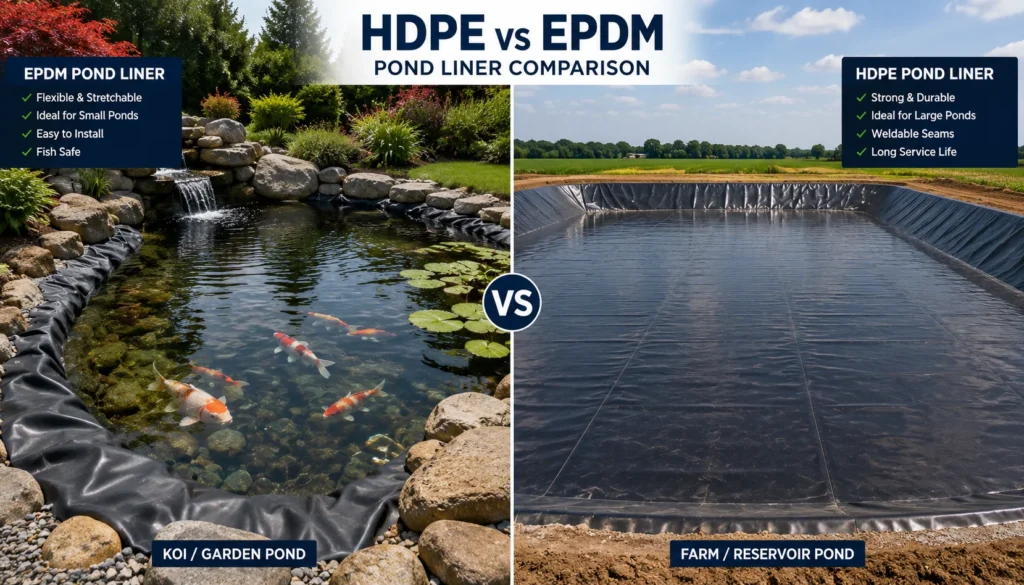
HDPE and EPDM are both common pond liner materials, but they are used for different types of projects.
| Comparison Point | EPDM Pond Liner | HDPE Pond Liner |
|---|---|---|
| Flexibility | Very flexible | Stiffer |
| Installation | Easier for small and irregular ponds | Better for large, engineered projects |
| Puncture Resistance | Good | Very high |
| Seaming | Usually adhesive or tape-based | Heat-weldable |
| Best Use | Koi ponds, garden ponds, irregular shapes | Farm ponds, reservoirs, aquaculture, containment |
| Large Project Cost Efficiency | Less cost-effective for very large areas | More cost-effective for large-area lining |
Choose EPDM if your pond is small, decorative, curved, or difficult to shape. Choose HDPE if your pond is large, exposed, engineered, or designed for long-term water containment.
If your project needs both flexibility and geomembrane performance, LLDPE may be worth evaluating.
Suggested internal link:
HDPE vs LLDPE Geomembrane: Key Differences and Applications
HDPE vs PVC Pond Liner
PVC is often selected for small ponds because it is lightweight and affordable. It can be easier to handle than HDPE, especially for small garden ponds or simple decorative water features.
However, PVC usually has lower puncture resistance and shorter long-term durability compared with HDPE. For demanding outdoor exposure, large ponds, farm ponds, reservoirs, wastewater ponds, or chemical containment applications, HDPE is usually the stronger material to evaluate first.
For small ponds where budget is the main concern, PVC may be acceptable. For long-term containment, HDPE is usually the better choice.
Suggested internal link:
HDPE vs PVC: Which Is Stronger?
EPDM vs PVC Pond Liner
EPDM and PVC are both flexible pond liner materials, but they are not equal in long-term performance.
PVC is usually cheaper and lighter, which makes it attractive for small budget ponds. However, it may become brittle over time, especially when exposed to sunlight, temperature changes, and outdoor weathering.
EPDM usually provides better flexibility and longer service life than PVC, making it more suitable for koi ponds, garden ponds, and decorative ponds where the liner needs to fit curves, shelves, and irregular shapes.
If the pond is temporary or low-risk, PVC can be considered. If the pond is expected to last for many years, EPDM is usually the better choice between the two.
What Thickness Pond Liner Do You Need?
Pond liner thickness depends on pond size, water depth, soil condition, installation method, and expected service life.
| Project Type | Common Thickness Range | Typical Material Choice |
|---|---|---|
| Small decorative pond | 20–30 mil | PVC, EPDM, or lightweight liner |
| Koi pond | 30–45 mil or higher | EPDM or fish-safe liner |
| Wildlife pond | 30–45 mil or project-based | EPDM, RPE, or LLDPE |
| Farm pond | 0.5 mm–1.5 mm or higher | HDPE or LLDPE geomembrane |
| Reservoir or containment pond | 1.0 mm–2.0 mm or project-based | HDPE geomembrane |
For large or commercial projects, thickness should not be selected only by price. You should also consider slope condition, subgrade preparation, expected water pressure, installation equipment, and whether the liner will be covered or exposed.
Suggested internal link:
How Many Mils Do You Need for a Pond Liner?
Do You Need Underlay for a Pond Liner?
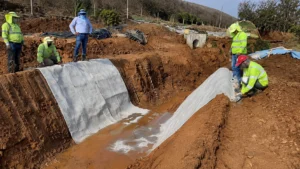
In most pond projects, yes. Underlay helps protect the liner from sharp stones, roots, rough soil, and ground movement.
Even a strong liner can fail early if it is installed directly over sharp objects or poorly prepared ground. A suitable geotextile underlay can improve the long-term reliability of the pond lining system.
Underlay is especially important for:
- Koi ponds with shelves and decorative stones
- Wildlife ponds with roots and natural soil
- Farm ponds with rough subgrade
- Large ponds with high water pressure
- Projects where the liner will be exposed during installation
How to Choose the Right Pond Liner
Before choosing a pond liner, answer these questions:
- What type of pond are you building?
Koi pond, wildlife pond, garden pond, farm pond, aquaculture pond, reservoir, or wastewater pond? - How large is the pond?
Small ponds often need flexibility. Large ponds usually need stronger, weldable geomembrane liners. - Will fish or aquatic life live in the pond?
Choose a liner specified as fish-safe or suitable for aquaculture use. - Is the pond shape simple or irregular?
Irregular shapes need more flexible materials such as EPDM or LLDPE. - Will the liner be exposed to sunlight?
Outdoor exposed liners need good UV resistance. - What is the subgrade condition?
Rough soil, stones, roots, or settlement risk may require thicker liner and geotextile underlay. - Is the project residential or commercial?
Commercial and large-area projects usually require technical data sheets, welding, quality control, and project-specific material selection.
Recommended Pond Liner by Application
| Application | Recommended Liner | Key Reason |
|---|---|---|
| Koi pond | EPDM or fish-safe liner | Flexible and suitable for shaped ponds |
| Wildlife pond | EPDM, RPE, or LLDPE | Good balance of flexibility and durability |
| Garden pond | EPDM or PVC | Easy to install for small projects |
| Farm pond | HDPE or LLDPE geomembrane | Better for large-area seepage control |
| Aquaculture pond | HDPE or LLDPE geomembrane | Durable, weldable, and suitable for engineered lining systems |
| Reservoir | HDPE geomembrane | Strong long-term containment performance |
| Temporary pond | PVC | Lower cost for short-term use |
Common Mistakes When Choosing a Pond Liner
1. Choosing only by price
The cheapest pond liner may cost more in the long run if it cracks, punctures, shrinks, or requires early replacement.
2. Using one material for every pond
EPDM may be excellent for small koi ponds, but that does not mean it is the best choice for a large farm pond. HDPE may be excellent for reservoirs, but it may not be the easiest material for a small pond with many curves.
3. Ignoring underlay
Many liner failures are caused by poor subgrade preparation, not by the liner material itself. Underlay is a small part of the total system but can make a big difference in durability.
4. Forgetting about seams
Large ponds often require seaming. For engineered projects, heat-weldable geomembrane materials such as HDPE or LLDPE can provide stronger seam control when installed correctly.
5. Not checking fish safety
If the pond will contain koi, goldfish, frogs, or aquatic plants, always confirm that the liner is suitable for aquatic life before installation.
When Should You Choose HDPE Geomembrane Instead of EPDM?
EPDM is usually easier to work with on small and irregular pond shapes, but HDPE geomembrane is often more suitable when the project becomes larger, more technical, or more demanding.
You should consider HDPE geomembrane when:
- The pond is large or commercial
- The project requires low permeability
- The liner must be heat-welded on site
- The pond will be exposed to sunlight for a long time
- The project involves aquaculture, irrigation, wastewater, or containment
- You need a cost-effective solution for large-area installation
For large pond construction, HDPE is not only a material choice. It is part of a complete lining system that should include subgrade preparation, geotextile protection, welding quality control, and proper anchoring.
Final Recommendation
The best pond liner is the one that matches your pond’s size, shape, exposure, soil condition, and service life requirement.
For small koi ponds and decorative garden ponds, EPDM is often the easiest and most practical option because of its flexibility. For wildlife ponds, EPDM, RPE, or LLDPE can all be suitable depending on the shape and ground condition.
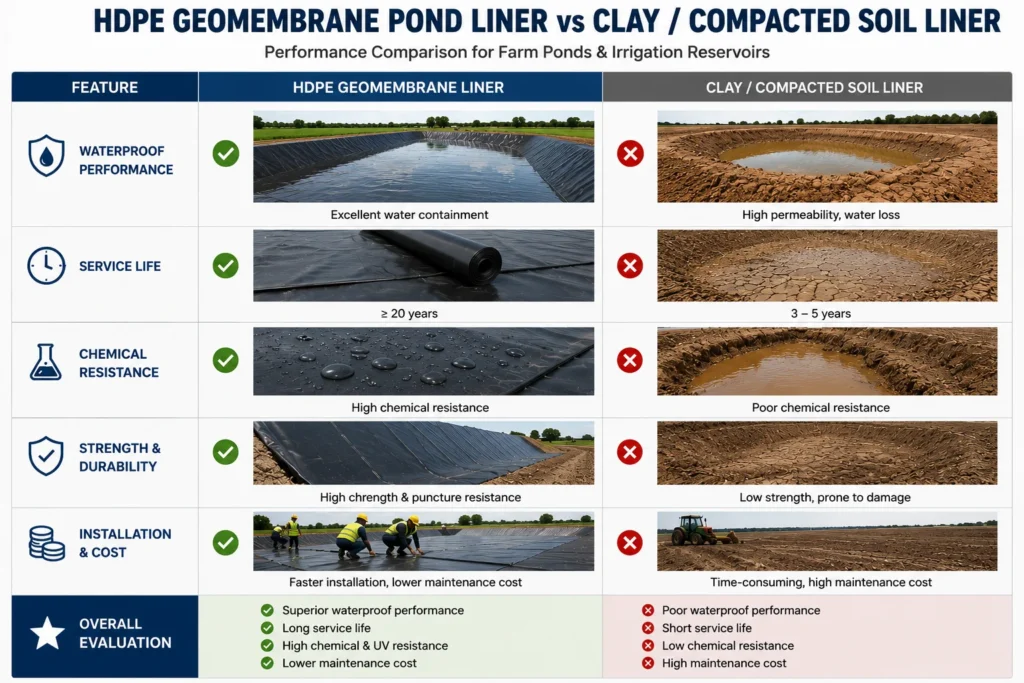
For farm ponds, aquaculture ponds, reservoirs, irrigation ponds, and long-term containment projects, HDPE or LLDPE geomembrane liners are usually better choices because they provide strong seepage control, puncture resistance, weldable seams, and better cost efficiency for large-area projects.
If you are not sure which pond liner material or thickness is suitable for your project, GeosynSource can help you compare HDPE, LLDPE, PVC, EPDM, and other liner options based on your pond size, application, site condition, and budget.
FAQ
What is the best pond liner for koi ponds?
EPDM is often used for koi ponds because it is flexible and easy to install around shelves, curves, and irregular shapes. However, the liner should be specified as fish-safe before use. For larger koi or aquaculture ponds, HDPE or LLDPE geomembrane may also be considered when suitable for aquatic applications.
What is the best pond liner for wildlife ponds?
For small wildlife ponds, EPDM is often a practical choice because it is flexible and easy to shape. RPE and LLDPE can also be suitable depending on pond size, subgrade condition, and installation requirements.
Is HDPE or EPDM better for a pond liner?
EPDM is better for small, irregular, decorative, or koi ponds where flexibility matters most. HDPE is better for large ponds, farm ponds, reservoirs, aquaculture ponds, and long-term containment projects where puncture resistance, weldable seams, and low permeability are more important.
Is PVC a good pond liner?
PVC can be used for small or budget pond projects, but it is usually not the best choice for demanding long-term applications. It generally has lower puncture resistance and shorter service life than higher-grade materials such as EPDM, HDPE, or LLDPE.
What is the best pond liner for a farm pond?
HDPE or LLDPE geomembrane is usually recommended for farm ponds because these materials are durable, weldable, and cost-effective for large-area lining projects.
Do I need underlay for a pond liner?
Yes, underlay is recommended for most pond liner installations. It helps protect the liner from stones, roots, rough soil, and long-term ground movement.
What thickness pond liner should I use?
Small decorative ponds may use thinner liners, while koi ponds, wildlife ponds, farm ponds, and reservoirs usually require thicker and more durable liners. The right thickness depends on pond depth, soil condition, liner material, exposure, and expected service life.
Can HDPE pond liner be used for fish ponds?
HDPE geomembrane can be used in aquaculture and fish pond projects when the material is specified for aquatic use and installed correctly. For small decorative fish ponds, EPDM is often easier to shape and install.