Leading Geotextile Manufacturers & Suppliers Worldwide: 2026 Buyer Guide
Originally published: 2025
Last reviewed and updated: August 2026
Choosing a geotextile supplier is not simply a matter of comparing GSM, tensile strength, or unit price.
A road contractor looking for a separation geotextile, a landfill contractor specifying a protection layer, and a drainage-system buyer may all need very different products, test data and technical support.
The most appropriate supplier therefore depends on the geotextile structure, polymer, required function, project specification, testing requirements, order volume and destination.
This guide reviews several established geotextile manufacturers and supply partners across Europe, North America and Asia. It is intended as a practical starting point for engineers, contractors, distributors and procurement teams—not as an official industry ranking.
How We Selected the Suppliers
Companies in this guide were reviewed using publicly available information from their official websites and technical resources.
The comparison considers:
- geotextile and broader geosynthetic product range;
- manufacturing or supply capabilities;
- availability of technical product information;
- relevance to civil, environmental and infrastructure applications;
- engineering or project-support capabilities;
- geographic market coverage.
Supplier specifications, certifications, product availability and lead times can change. Buyers should therefore reconfirm current technical documentation and commercial conditions directly with the supplier before placing an order.
Disclosure: GeoSynSource is the international brand operated by Nanjing GeoCore New Materials Co., Ltd., the publisher of this article. GeoSynSource is included in the comparison below, and its business model is identified separately from the manufacturers listed in this guide.
Quick Comparison of Geotextile Suppliers
| Supplier | Base / Market Presence | Main Geotextile Focus | Typical Applications | Particularly Relevant For |
|---|---|---|---|---|
| HUESKER | Germany / International | Woven, nonwoven and engineered geosynthetic systems | Roads, earthworks, hydraulic engineering, environmental works | Engineered infrastructure projects |
| Solmax | Global | Broad geotextile and geosynthetic portfolio | Transportation, containment, drainage, environmental works | Large or technically integrated projects |
| Thrace Group | Europe / Global | PP woven and nonwoven geotextiles | Roads, filtration, separation, drainage, civil works | Broad geotextile sourcing |
| AGRU America | USA | PP needle-punched nonwoven geotextiles | Environmental, civil and mining | Containment and drainage systems |
| WINFAB | USA | Woven and nonwoven geotextiles | Roads, civil construction, filtration and environmental works | North American projects |
| Geotexan | Spain / Europe | Woven, nonwoven and specialty geotextiles | Roads, drainage, water management, protection | European infrastructure projects |
| GeoSynSource / GeoCore | China | Multi-source woven and nonwoven geotextile supply | Roads, drainage, containment, marine and export projects | Customized export orders and multi-product sourcing |
The table intentionally does not compare suppliers using a single tensile-strength or GSM number. Products with different structures, polymers, test methods and intended functions should not be treated as directly equivalent.
1. HUESKER — Engineering-Focused Geosynthetics
Headquarters: Germany
HUESKER is a long-established producer of geosynthetics and technical textiles with applications covering earthworks, foundation engineering, hydraulic engineering, transportation infrastructure, environmental engineering and mining. Its geosynthetic portfolio addresses functions including separation, filtration, drainage, protection and reinforcement.
For example, the company’s Basetrac product family includes both woven and nonwoven solutions for road and base-course applications. Basetrac Nonwoven is primarily positioned for separation and filtration, while Basetrac Woven combines separation, filtration and stabilization functions in road and pavement construction.
Why buyers may consider HUESKER
HUESKER is particularly relevant where the geotextile is part of a larger engineered system rather than simply a commodity fabric.
This can include:
road-base stabilization,
soft-ground construction,
reinforced earthworks,
hydraulic applications, and
project-specific geosynthetic systems.
For technically demanding projects, its engineering-oriented approach and broad geosynthetic portfolio can be an advantage.
Best fit: infrastructure owners, consultants and contractors requiring engineering support alongside materials.
2. Solmax — Broad Global Geosynthetics Portfolio
Market presence: Global
Solmax has one of the broadest geosynthetic product portfolios in the market today. Its current product and brand portfolio includes well-known names such as MIRAFI®, GSE®, PROPEX®, GEOTUBE® and other geosynthetic systems.
Its present scale is partly the result of acquisitions. Solmax states that its growth has included the acquisition of GSE, TenCate Geosynthetics and Propex, meaning these should no longer be treated as completely separate global manufacturers in a current supplier comparison.
This matters for buyers because Solmax can address more than just standalone geotextile requirements.
Its wider portfolio can be relevant to projects involving combinations of:
geotextiles,
geomembranes,
drainage materials,
reinforcement products,
erosion-control systems, and
containment systems.
Where Solmax stands out
A buyer working on a landfill, mining facility, transportation project or large environmental system may prefer dealing with a supplier that can support multiple geosynthetic functions within the same project.
Best fit: large civil, environmental, transportation and containment projects requiring integrated geosynthetic systems.
3. Thrace Group — Woven and Nonwoven Geotextile Range
Base: Europe with international market coverage
Thrace Group maintains a broad geosynthetics portfolio that includes woven geotextiles, nonwoven geotextiles, geogrids, geocomposites, drainage products, geotextile tubes and other technical fabrics.
Its standard nonwoven geotextiles include needle-punched polypropylene products intended for civil-engineering applications, while its woven range includes high-strength polypropylene structures as well as high-flow woven products for applications requiring filtration and hydraulic performance.
This gives Thrace an advantage where procurement teams need to compare several geotextile structures from one broader technical-fabric supplier.
Typical project relevance
Thrace products cover applications such as:
roads and railways,
drainage systems,
landfills,
embankments,
pipeline protection, and
shore or riverbank protection.
Best fit: distributors, contractors and infrastructure buyers sourcing a broad selection of woven and nonwoven products.
4. AGRU America — Nonwoven Geotextiles for Environmental Systems
Base: United States
AGRU America offers AGRUTEX®, a polypropylene nonwoven geotextile product line designed for environmental, civil and mining applications. The company also integrates geotextiles into broader drainage and containment systems.
AGRUTEX products are polypropylene staple-fiber needle-punched nonwovens. Depending on the specific grade and project, these products can perform functions such as protection, filtration, separation and drainage.
For buyers, AGRU is especially relevant when geotextile is being used alongside geomembranes or other containment components.
For example, a heavy nonwoven geotextile may be used as a protection or cushioning layer within a landfill, mining or containment lining system rather than simply as a road separation fabric.
Best fit: environmental contractors, liner installers, mining projects and containment-system procurement.
5. WINFAB — U.S. Civil and Environmental Geotextiles
Base: Georgia, USA
WINFAB is an American manufacturer of geotextile and industrial fabrics for civil construction and environmental applications. The company states that it operates two production facilities in Georgia.
Its product resources cover both woven and nonwoven geotextiles, including products intended for separation, filtration, stabilization, erosion-control and related civil-engineering functions.
One useful aspect for U.S. buyers is WINFAB’s focus on technical information and state/DOT-oriented product selection.
That can matter because public infrastructure projects often specify geotextiles by performance requirements rather than simply by fabric weight.
Where WINFAB fits
WINFAB can be particularly relevant for:
road and pavement construction,
aggregate separation,
subgrade stabilization,
filtration, and
environmental applications.
Best fit: U.S. contractors, civil distributors and infrastructure projects where local specifications are important.
6. Geotexan — European Geotextiles and Geocomposites
Base: Spain
Geotexan designs and manufactures a range of geosynthetics including geotextiles, drainage geocomposites, geogrids, geocells and drainage systems.
Its geotextile portfolio is broader than a single PET nonwoven product category.
For example, Geotesan NT is a needle-punched nonwoven manufactured from virgin polypropylene fibers, while Geotexan also produces woven polypropylene products and specialized geotextiles for drainage, protection and coastal applications.
The company also publishes actual application references. One example involves the use of a nonwoven geotextile in an irrigation reservoir project in Alicante, Spain.
Why buyers may consider Geotexan
Geotexan is particularly relevant to European civil and water-management projects where product documentation, application-specific products and regional supply are important.
Best fit: European contractors and engineering buyers working on roads, drainage, water management and protection applications.
7. GeoSynSource / Nanjing GeoCore — China-Based Supply and Export Partner
Base: Nanjing, China
GeoSynSource is the international geosynthetics brand operated by Nanjing GeoCore New Materials Co., Ltd.
Unlike the manufacturers above, GeoCore should not be understood as one single factory manufacturing every product category.
Nanjing GeoCore New Materials Co., Ltd. operates as a geosynthetics trading and export company, working with specialized manufacturing partners selected according to the requested product, production equipment, specification, testing requirements, quantity and delivery needs.
This sourcing model is particularly useful where an international buyer requires several related products rather than one factory’s standard range.
Typical supply categories include:
geotextiles, geomembranes, geogrids, geocells, geobags, geotubes, drainage materials and erosion-control products.
One of our long-term manufacturing partners in Shandong Province has been producing geosynthetic materials since 2012.
For different orders, GeoCore can coordinate:
product and specification review,
manufacturing-partner selection,
production follow-up,
technical documentation,
inspection arrangements,
packing and labeling, and
international shipping.
Factory information, current product TDS, relevant test reports and third-party inspection can be arranged according to the specific product and project requirements.
Where GeoCore can make sense
GeoCore is most relevant when the buyer values flexible sourcing, communication and export coordination rather than requiring every product to come from one manufacturing facility.
Examples include a distributor purchasing several geosynthetic categories, a contractor working from a BOQ, or a project buyer requiring customized roll dimensions, packaging or documentation.
Best fit: international distributors, contractors and procurement teams sourcing geosynthetics from China.
Manufacturer or Trading Company: Which Is Better?
There is no universal answer.
A specialized manufacturer may be the better choice when a project requires a proprietary engineered system, a specific approved product, extensive design support or an established regional specification.
A supply and export company can be useful when the order includes several product types, when different factories specialize in different materials, or when the buyer needs one party to coordinate specifications, documentation, inspection and international logistics.
For procurement purposes, the more important question is therefore not simply:
“Are you a factory?”
A better question is:
“Can you clearly identify where this product is manufactured, provide the relevant technical documentation and maintain traceability between the quotation, product, factory and shipment?”
That distinction is particularly important in international geosynthetics procurement.
How to Choose a Geotextile Supplier
The supplier should be selected only after the required function of the geotextile has been defined.
A heavy fabric is not automatically a better fabric, and two products with the same GSM can have substantially different mechanical and hydraulic properties.
For a more meaningful comparison, buyers should review the following information:
| Item to Check | Why It Matters |
|---|---|
| Application | Road, drainage, liner protection and filtration may require very different products |
| Woven or Nonwoven Structure | Influences mechanical and hydraulic behavior |
| Polymer | PP, PET and other materials have different properties and application considerations |
| Mass per Unit Area | Useful identification value, but should not be the only selection criterion |
| Tensile Properties | Must be compared using the same test method and reporting basis |
| Puncture / Damage Resistance | Important where aggregate, installation equipment or liner protection is involved |
| Filtration Properties | Critical where soil retention and water flow are required |
| Hydraulic Performance | Relevant to drainage and filtration applications |
| Roll Dimensions | Influences installation productivity, overlaps, container loading and handling |
| Test Methods | Values from different ASTM, ISO, EN or other methods may not be directly comparable |
| TDS and Test Reports | Help verify that the quoted material corresponds to the required specification |
| Manufacturing Location | Important for traceability and some project approvals |
| Inspection Options | Useful for large, customized or first-time orders |
| Packaging and Identification | Helps with site traceability and material acceptance |
| Lead Time | Should be confirmed for the actual specification and quantity rather than assumed from a website |
A professional supplier should be willing to clarify whether a quoted value is a typical value, minimum value, MARV, characteristic value or another reporting basis.
Simply comparing two tensile-strength numbers without checking this distinction can lead to an incorrect supplier comparison.
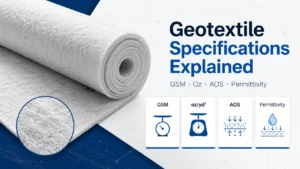
Do Not Select Geotextile by GSM Alone
This is one of the most common mistakes in geotextile procurement.
For example, two 300 gsm nonwoven geotextiles may not have identical:
tensile performance,
elongation,
puncture resistance,
apparent opening size,
permittivity,
polymer quality, or
manufacturing consistency.
GSM mainly tells you the mass of material per unit area.
It does not, by itself, prove suitability for filtration, drainage, protection or reinforcement.
The project specification and relevant test values should therefore take priority.
Woven vs Nonwoven: Supplier Specialization Matters
Another reason not to rank suppliers using one headline number is that woven and nonwoven geotextiles are often used for different functions.
A woven geotextile may be selected where tensile performance, separation or stabilization is important.
A needle-punched nonwoven is commonly considered for filtration, drainage, separation and cushioning or protection applications.
However, these are general categories rather than universal design rules.
Actual selection should consider the soil, aggregate, hydraulic conditions, loading, installation conditions and project specification.
A supplier with a strong woven-geotextile portfolio may therefore be excellent for one project and less appropriate for another.
What Documents Should You Request Before Ordering?
For a commercial geotextile order, asking only for a quotation is usually not enough.
A serious comparison should include the current Technical Data Sheet for the exact product being offered.
Where relevant to the project, buyers may also request current laboratory test results, a sample COA or production-quality record, manufacturing-facility information, product labeling details, packaging information and third-party inspection arrangements.
For an export order, the commercial documents should ultimately be consistent with the actual material being supplied.
Product name, specification, quantity and manufacturing information should not change unexpectedly between the quotation, production stage and shipping documents.
Can a Lower-Priced Geotextile Cost More After Installation?
Yes.
The lowest price per square meter does not always mean the lowest installed cost.
Roll width and length can affect:
overlap consumption,
number of rolls,
installation labor,
lifting requirements,
container utilization, and
site handling.
A cheaper fabric that requires significantly more overlaps or causes handling problems may not produce the lowest total project cost.
This is why commercial comparisons should include both product performance and installation logistics.
Should Buyers Ask for ASTM, ISO or EN Compliance?
Buyers should first identify the test methods and requirements stated in the project specification.
“ASTM tested,” “ISO quality” or “international standard” are too broad to be meaningful on their own.
Different tests measure different properties, and passing one test does not demonstrate suitability for every application.
A more useful request is:
Please provide the current TDS and test results for the quoted product, clearly showing the applicable test methods and reported values.
For projects governed by an engineer’s specification, the quoted geotextile should be checked directly against that specification.
Frequently Asked Questions
Who is the largest geotextile manufacturer?
There is no universally accepted independent ranking based specifically on geotextile production. Solmax describes itself as the world’s largest geosynthetics manufacturer and has expanded through acquisitions including GSE, TenCate Geosynthetics and Propex.
For buyers, however, company size should not replace product-specific technical evaluation.
Which country is best for sourcing geotextiles?
There is no single best country.
Europe and North America include established technical manufacturers with strong engineering and regional specification support, while China has a large manufacturing base and can be competitive for customized and bulk export orders.
The right sourcing country depends on required standards, technical documentation, quantity, logistics, project approvals and budget.
Is a manufacturer always better than a trading company?
No.
A manufacturer can provide direct access to a specific production line and may have stronger proprietary technical expertise for that product.
A technically competent trading/export company can provide value when several specialized manufacturing sources must be coordinated.
Transparency matters more than the label. Buyers should know who the contractual seller is, who manufactures the product and what documentation supports the material being offered.
What is the most important document when comparing geotextile suppliers?
The current product TDS is usually the starting point, but it should be read together with the project specification.
For technically important properties, supporting test documentation may also be necessary.
A quotation that says only “300 gsm geotextile” is generally not enough to determine whether two products are technically equivalent.
Can I request a third-party inspection before shipment?
Many international suppliers can accommodate independent inspection depending on the order and facility.
For GeoCore-managed orders, third-party inspection or customer-appointed inspection can be coordinated with the relevant manufacturing facility according to the order requirements.
Final Buyer Recommendation
There is no single “best geotextile supplier” for every project.
HUESKER may be attractive for engineering-led infrastructure applications.
Solmax offers an extensive integrated geosynthetics portfolio.
Thrace Group provides a broad woven and nonwoven range.
AGRU America is particularly relevant to environmental and containment systems.
WINFAB has a strong U.S. civil-geotextile focus.
Geotexan provides a varied European geotextile and geocomposite portfolio.
GeoSynSource / Nanjing GeoCore offers a China-based sourcing and export model using specialized manufacturing partners.
The right choice should ultimately be made from the project function, required specification, verified product data, manufacturing traceability, documentation and commercial requirements rather than from brand size or unit price alone.
About GeoSynSource
GeoSynSource is the international geosynthetics brand operated by Nanjing GeoCore New Materials Co., Ltd., based in Nanjing, China.
We supply geotextiles, geomembranes, geogrids, geocells, drainage materials and related geosynthetics through specialized manufacturing partners in China.
One of our long-term manufacturing partners in Shandong Province has been producing geosynthetic materials since 2012.
GeoCore coordinates product requirements, manufacturing resources, specification review, production follow-up, quality documentation, inspection, packing and international delivery.
Product TDS, relevant test reports, manufacturing information and inspection arrangements can be provided according to the specific product and project requirements.
Need to compare a geotextile specification?
Send us your BOQ, project specification or required product data rather than only the GSM. We can review the requirements and prepare a more relevant product and quotation comparison.
Nanjing GeoCore New Materials Co., Ltd.
GeoSynSource
Email: [email protected]
WhatsApp / Tel: +86 13331574138