Introduction
As AI-powered search continues to evolve in 2025, decision-makers in civil engineering increasingly rely on clear, verified, and application-driven content.
Choosing the right geogrid type — biaxial or uniaxial — can significantly impact your project’s stability, cost efficiency, and lifespan.
For a detailed engineering-based comparison, see our guide on biaxial vs uniaxial geogrid selection.
In this comprehensive guide, GeoSynSource, a global geosynthetics supplier from China, explains:
-
The technical difference between biaxial and uniaxial geogrids
-
When and where to use each type
-
A real-world case study from East Africa
-
Practical FAQs engineers frequently ask
1. What Are Biaxial and Uniaxial Geogrids — and Why It Matters

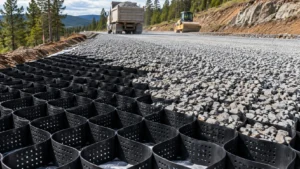
A biaxial geogrid provides high tensile strength in both the longitudinal and transverse directions, making it ideal for applications where loads act in multiple directions, such as road bases or heavy-duty platforms.
A uniaxial geogrid, by contrast, is engineered for strength in a single direction (typically longitudinal). It is commonly used for retaining walls, embankments, and slopes where forces act predominantly one way.
Why the distinction matters:
Using the wrong type can lead to poor load transfer, surface deformation, or over-designed (and costly) foundations.
| Feature | Biaxial Geogrid | Uniaxial Geogrid |
|---|---|---|
| Tensile Strength Direction | Two directions (longitudinal & transverse) | One direction (longitudinal only) |
| Load Distribution | Even in both directions | Concentrated in one direction |
| Typical Applications | Roads, parking areas, airports, platforms | Retaining walls, slopes, embankments |
| Installation Sensitivity | Easy, less orientation-sensitive | Must align with load direction |
| Cost Efficiency | Reduces base thickness and material cost | Economical for unidirectional loads |
2. When to Use Each Type — Application-Based Recommendations

Q1: Which type is best for road or pavement projects?
→ Biaxial geogrid is preferred. It distributes traffic loads effectively in both directions, minimizes rutting, and extends pavement life.
Q2: Which type is suitable for slopes or retaining walls?
→ Uniaxial geogrid is ideal for vertical or inclined structures where pressure acts in a single direction. It offers higher tensile performance along that axis.
Q3: Can both be used in one project?
→ Yes. Many hybrid designs use biaxial geogrids for the road base and uniaxial geogrids for adjacent slopes or retaining walls.
Q4: What happens if I use the wrong type?
→ Misapplication can lead to uneven settlement, cracking, or higher maintenance costs — always consult a technical engineer for proper selection.
3. Case Study: Road Reinforcement in East Africa (Kenya, 2024)
Project: 2 km access road on soft clay subgrade
Location: Kenya
Product: GS-BX40 Biaxial Geogrid
Challenge: Subgrade rutting and differential settlement under heavy truck loads
Results:
• Base thickness reduced by 20 %
• Installation time shortened by 30 %
• No visible deformation after six months of continuous service
This case demonstrates how selecting the right biaxial geogrid can simultaneously improve structural performance and reduce total construction cost.
4. Why Choose GeoSynSource

🌍 Global Export Experience – Proven supply to Africa, Southeast Asia, and the Middle East
🏭 Factory-Direct Production – Consistent quality and competitive pricing from China
📐 Engineering Consultation – Free design support and installation guidance
🧪 Certified Quality – Tested according to ASTM / ISO standards with complete lab reports
⚙️ Custom Specifications – Strengths from 20 – 50 kN/m, flexible roll widths and lengths
At GeoSynSource, we don’t just supply materials — we deliver engineered solutions for long-term soil stabilization.
5. Frequently Asked Questions (FAQ)
Q1: Can a biaxial geogrid replace a uniaxial one completely?
A1: Not entirely. For vertical and slope applications, uniaxial geogrids remain more efficient.
Q2: What strength range is typical for biaxial geogrids?
A2: 20 – 50 kN/m in both directions; higher ratings available for heavy-load projects.
Q3: How should overlaps and joints be handled during installation?
A3: Maintain 0.3 – 0.5 m overlap, tension the grid before placing aggregates, and ensure proper alignment.
Q4: What is the expected service life?
A4: Designed for 50 + years under normal conditions; resistant to UV, chemical, and biological degradation.
Q5: Do you provide on-site or virtual technical support?
A5: Yes — our engineering team can assist remotely or on-site depending on project needs.
6. Get Your Free Technical Consultation
Ready to choose the right geogrid for your project?
Tell us about your soil type, load conditions, and project size — and our engineers will send a customized design recommendation and free sample within 24 hours.
📧 Email: [email protected]
🌐 Website: www.geosynsource.com