Introduction
Geo bags are widely used in civil engineering projects, but most online explanations only focus on basic erosion control. In reality, their applications are far broader and more advanced.
This guide explains not only what geo bags are used for, but also how they work, when to use them, and how they compare to alternative solutions—based on real engineering logic rather than simple definitions.
What Is a Geo Bag?
A geo bag (also known as a geotextile bag) is a permeable fabric container made from polypropylene (PP) or polyester (PET), filled with sand, soil, or slurry materials.
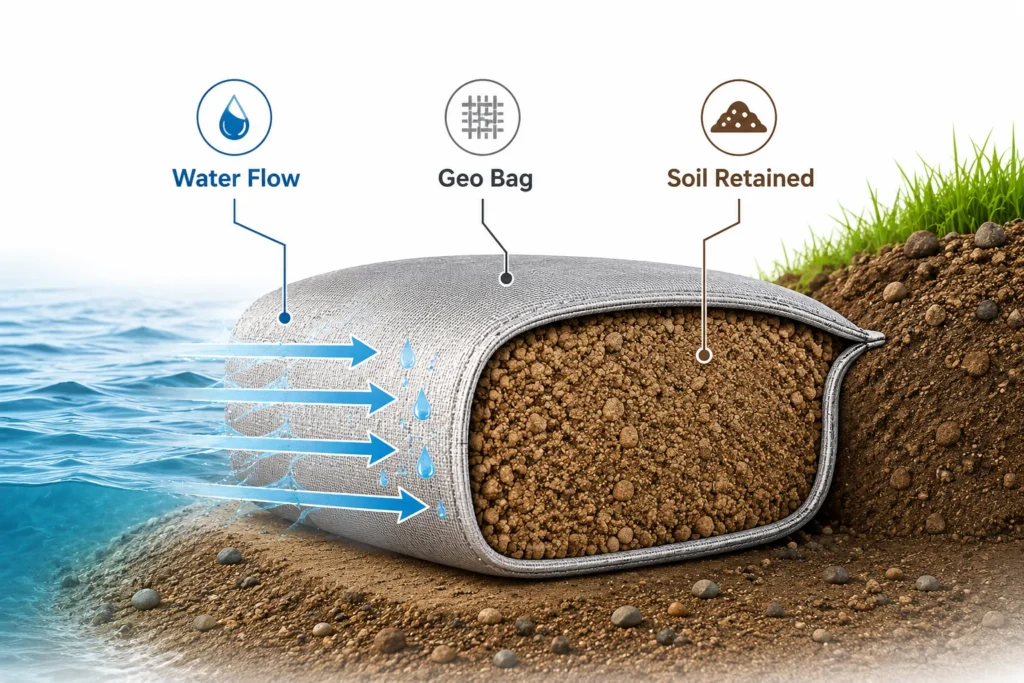
Once filled and placed, geo bags form stable, flexible structures that allow water to pass through while retaining soil particles.
Unlike traditional materials such as rock or concrete, geo bags combine filtration, containment, and structural support in a single system.
How Do Geo Bags Work?
Geo bags function through a combination of hydraulic and mechanical principles:
Filtration and Drainage
The geotextile fabric allows water to flow out while retaining soil particles, preventing erosion.
Soil Retention
The contained fill material creates mass and stability, helping resist external forces.
Energy Dissipation
Geo bags absorb and reduce the energy of waves, currents, and runoff.
Flexible Structural Support
Unlike rigid materials, geo bags conform to uneven surfaces and adapt to settlement.
This multi-functionality is what makes geo bags highly effective in both temporary and permanent applications.
When geobags are selected for permanent or project-scale erosion-control applications, fabric strength, filtration properties, seam quality and bag dimensions should be evaluated together. You can review our nonwoven geotextile bags for available product specifications.
When Should You Use Geo Bags?
Best Use Cases
- Soft or unstable soil conditions
- Remote construction sites with limited access
- Cost-sensitive infrastructure projects
- Temporary or emergency flood protection
When Not Recommended
- High-energy wave environments without reinforcement
- Long-term exposure to UV without protection
- Deep-water or heavy-load structural foundations
Choosing the correct application scenario is critical to long-term performance.
Main Applications of Geo Bags (2026 Updated)
1. Riverbank and Coastal Erosion Control
Geo bags are widely used to stabilize shorelines and prevent soil loss caused by flowing water and wave action.
2. Breakwaters, Groynes, and Revetments
They are stacked to form hydraulic structures that reduce wave energy and protect coastal infrastructure.
3. Flood Control and Emergency Barriers
Geo bags provide fast and effective temporary protection during floods and extreme weather events.
4. Slope Stabilization and Retaining Structures
Geo bags can be used to construct flexible retaining systems.
See more: Geobag Retaining Wall
5. Sludge Dewatering (Key Modern Application)
Geo bags are increasingly used in environmental engineering.
Process:
- Slurry is pumped into the bag
- Water drains through the fabric
- Solids are retained inside
This significantly reduces waste volume and disposal costs.
6. Scour Protection for Foundations
Geo bags protect bridge piers, pipelines, and marine structures from erosion caused by water flow.
7. Land Reclamation and Containment
They are used to contain fill material and stabilize reclaimed land in coastal development projects.
8. Eco-Engineering and Habitat Creation
Geo bags support vegetation growth and are used in environmentally sensitive shoreline projects.
This is a growing trend in sustainable infrastructure.
Geo Bags vs Other Solutions
Geo Bags vs Rock (Riprap)
| Feature | Geo Bags | Rock |
|---|---|---|
| Cost | Lower | High |
| Installation | Easy | Heavy equipment required |
| Flexibility | High | Low |
Geo Bags vs Gabions
Geo bags are more flexible and easier to install, while gabions provide higher structural rigidity.
Geo Bags vs Geotubes
Geo bags are smaller units used for stacking and structural applications, while geotubes are large containers mainly used for dewatering and containment.
Advantages of Geo Bags
- Cost-effective (uses local fill materials)
- Easy and fast installation
- Flexible and adaptable to ground conditions
- Environmentally friendly
- Durable with proper material selection
Limitations of Geo Bags
- UV exposure may reduce lifespan without protection
- Limited load capacity compared to rigid structures
- Performance depends heavily on proper design
Proper engineering design is essential for long-term success.
Design and Installation Considerations
- Filling method (sand, soil, slurry)
- Placement pattern and stacking method
- Anchoring and toe protection
- Layering system for stability
These factors determine the effectiveness and durability of the installation.
How Long Do Geo Bags Last?
The lifespan of geo bags depends on material type, environmental conditions, and installation quality.
Learn more: How Long Do Geobags Last
Conclusion
Geo bags are no longer just simple erosion control tools.
Today, they are widely used in coastal protection, environmental engineering, and infrastructure stabilization projects.
With the right design and application, geo bags provide a cost-effective, flexible, and sustainable alternative to traditional construction materials.
FAQ
What are geo bags used for?
Geo bags are used for erosion control, slope stabilization, flood protection, sludge dewatering, and coastal engineering projects.
Are geo bags better than sandbags?
Yes, geo bags are more durable and suitable for long-term engineering applications, while sandbags are mainly used for temporary protection.
How long do geo bags last?
Geo bags can last from several years to decades depending on material quality and environmental exposure.
What is the difference between geobag and geotube?
Geo bags are smaller units used for structural applications, while geotubes are larger systems mainly used for dewatering and containment.