Short Answer
The main difference between HDPE and LLDPE geomembrane is how each material responds to stiffness, flexibility, deformation, and installation conditions.
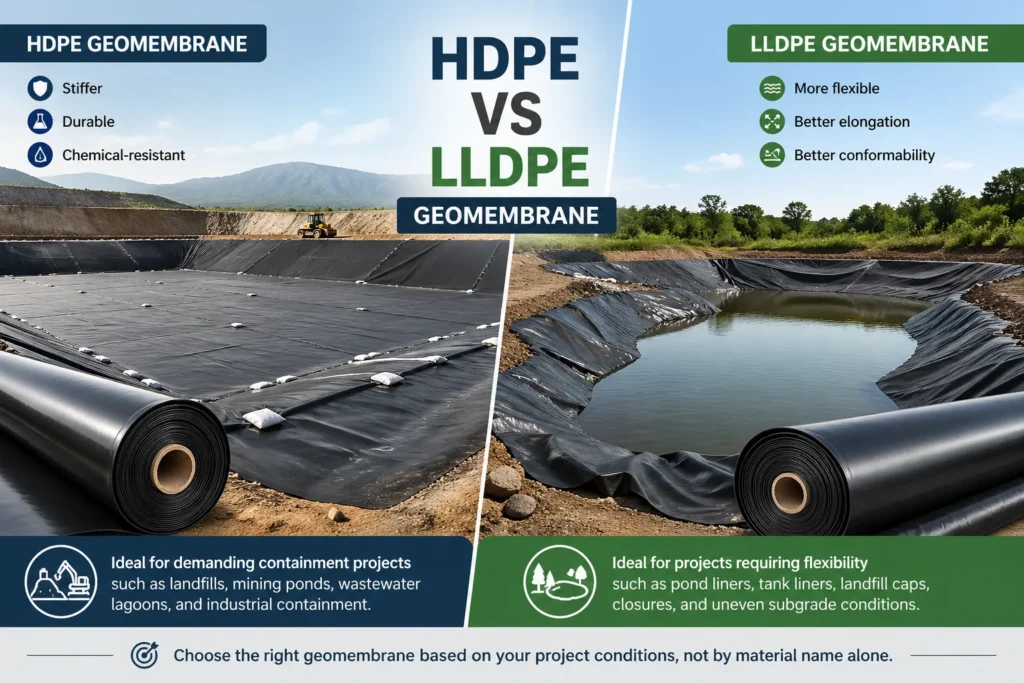
HDPE geomembrane is denser, stiffer, and commonly used for demanding containment projects such as landfills, mining ponds, wastewater lagoons, and industrial containment areas. LLDPE geomembrane is more flexible and better suited for projects where the liner needs to conform to uneven surfaces, tolerate settlement, or be prefabricated into large panels.
Both materials are polyethylene geomembranes, but they are not used in exactly the same way. The better choice depends on the project environment, subgrade condition, chemical exposure, installation method, and long-term movement.
HDPE vs LLDPE Geomembrane: Quick Comparison
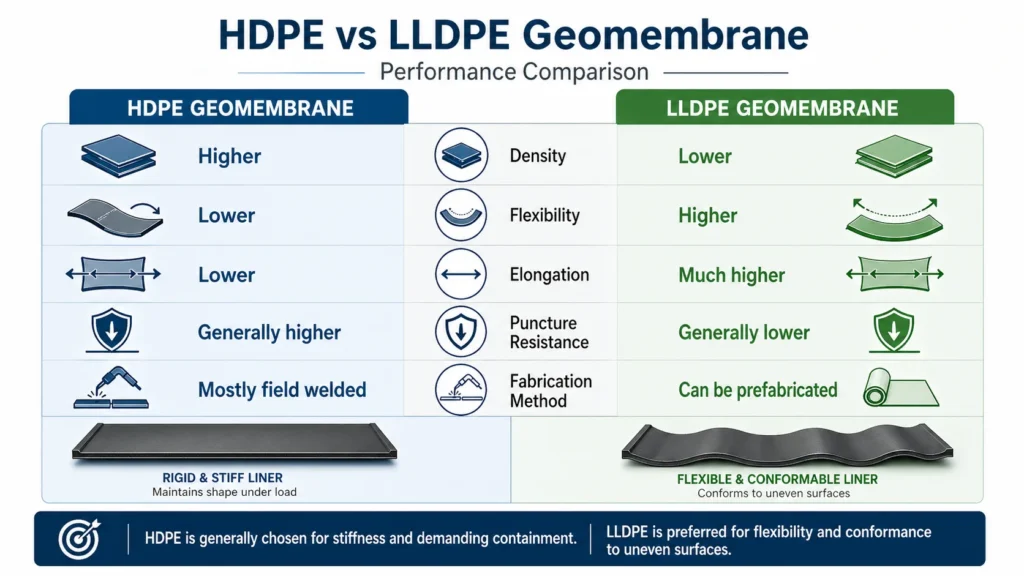
| Factor | HDPE Geomembrane | LLDPE Geomembrane |
|---|---|---|
| Full Name | High-Density Polyethylene | Linear Low-Density Polyethylene |
| Main Characteristic | Stiffness and durability | Flexibility and elongation |
| Density | Higher density | Lower density |
| Flexibility | Lower | Higher |
| Elongation | Lower than LLDPE | Much higher than HDPE |
| Puncture Resistance | Generally higher at the same thickness | Generally lower than HDPE at the same thickness |
| Installation | Usually field welded | Can be field welded or factory prefabricated |
| Best For | Landfills, mining, wastewater, chemical containment | Tank liners, pond liners, landfill caps, closures, irregular surfaces |
| Main Limitation | Less flexible under deformation | Requires proper anchoring and wrinkle control |
According to GRI-GM13, HDPE geomembranes are defined with a formulated sheet density of 0.940 g/ml or higher, while GRI-GM17 defines LLDPE geomembranes with a formulated sheet density of 0.939 g/ml or lower. This density difference is one reason why HDPE and LLDPE behave differently during installation and long-term use.
What Is HDPE Geomembrane?
HDPE geomembrane is a high-density polyethylene liner used as an impermeable barrier for liquid, solid waste, and chemical containment applications.
It is one of the most widely used geomembrane materials because it offers good chemical resistance, UV resistance, durability, and long-term containment performance. HDPE geomembrane is commonly used in:
- Landfill bottom liners
- Mining ponds
- Heap leach pads
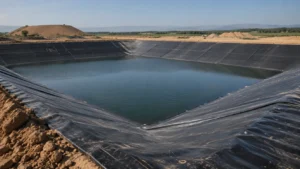
- Wastewater lagoons
- Industrial containment areas
- Chemical storage ponds
- Agricultural water storage
- Secondary containment systems
The key advantage of HDPE is its stiffness and strong resistance to many harsh containment environments. For large-scale engineering projects where the subgrade can be properly prepared and the liner will be installed under strict quality control, HDPE is often the first material to evaluate.
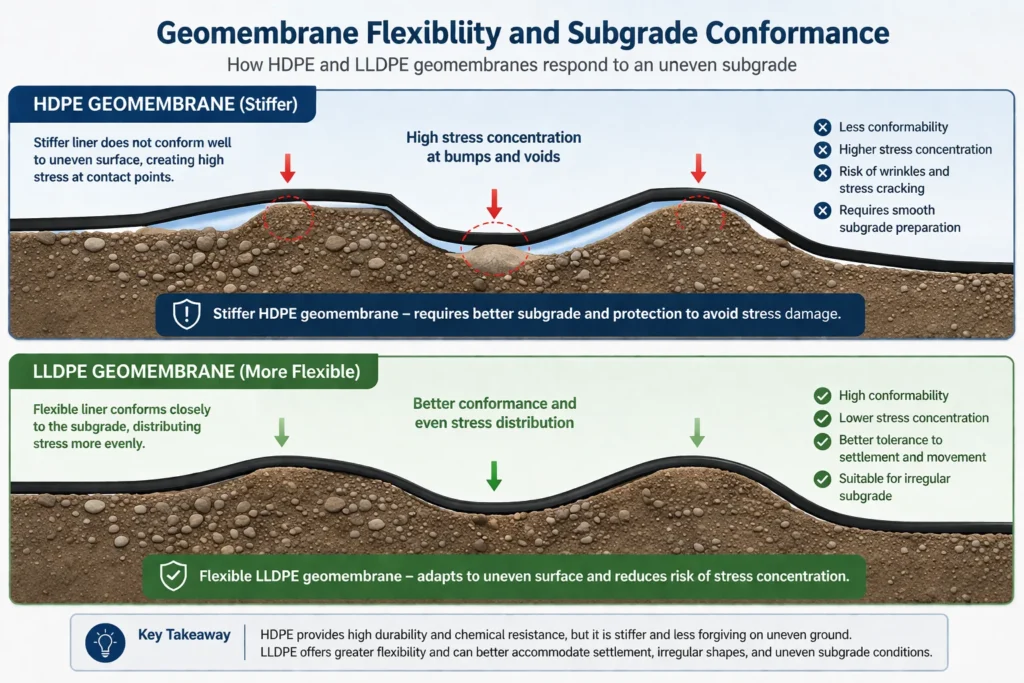
However, HDPE is less flexible than LLDPE. It is not ideal for sharp folding, complex shapes, uneven subgrade, or areas where significant settlement may occur.
What Is LLDPE Geomembrane?
LLDPE geomembrane is a linear low-density polyethylene liner designed to provide better flexibility and elongation than HDPE.
Its main advantage is not simply that it is “softer.” The real advantage is that LLDPE can better conform to irregular surfaces and tolerate movement without creating the same level of stress concentration that may occur with a stiffer liner.
LLDPE geomembrane is commonly used in:
- Pond liners
- Tank liners
- Landfill caps and closures
- Irrigation canals
- Floating covers
- Secondary containment
- Decorative ponds
- Areas with uneven subgrade
- Projects requiring prefabricated panels
LLDPE is especially useful when the liner needs to be folded, prefabricated, transported, and unfolded on site. Because of its flexibility, it can often reduce the amount of field seaming required in certain projects.
Key Differences Between HDPE and LLDPE Geomembrane
1. Density and Material Structure
The most basic difference between HDPE and LLDPE geomembrane is density.
HDPE has a higher density and a more rigid molecular structure. This gives it greater stiffness and strong mechanical performance in many containment applications.
LLDPE has a lower density and a more flexible molecular structure. This allows the liner to stretch more easily and conform better to irregular surfaces.
In simple terms:
HDPE behaves more like a rigid containment barrier.
LLDPE behaves more like a flexible containment barrier.
This difference affects installation, seam layout, wrinkle behavior, stress resistance, and long-term performance.
2. Flexibility and Elongation
Flexibility is usually the most important practical difference between HDPE and LLDPE geomembrane.
HDPE is stiffer. This makes it suitable for large and demanding containment systems, but it also means the liner has less tolerance for folding, stretching, and deformation.
LLDPE is more flexible and has much higher elongation. It can stretch over irregular surfaces and adapt better to settlement or movement.
This is why LLDPE is often preferred for projects with:
- Irregular shapes
- Uneven subgrade
- Corners or transitions
- Settlement risk
- Prefabricated panels
- Smaller ponds or containment areas with complex geometry
The main difference is not simply strength. It is how the liner responds when the ground moves or when the installation surface is not perfectly smooth.
3. Puncture Resistance
HDPE generally has higher puncture resistance than LLDPE at the same thickness. Layfield’s comparison also notes that HDPE can show greater puncture resistance, while LLDPE offers better flexibility and can be stretched more easily over obstructions.
However, puncture resistance should not be judged alone.
In real projects, puncture performance depends on:
- Liner thickness
- Subgrade preparation
- Stone size under the liner
- Protection geotextile
- Cover soil
- Installation equipment
- Seaming quality
- Traffic during construction
A thinner HDPE liner on a poorly prepared subgrade may perform worse than a properly protected LLDPE liner. Material selection should always consider the full system, not only the liner sheet.
4. Chemical Resistance
Both HDPE and LLDPE geomembranes are polyethylene-based liners and generally offer good chemical resistance.
HDPE is commonly preferred for demanding chemical containment, landfill bottom liners, mining applications, and industrial wastewater projects because of its stiffness, durability, and long history of use in critical containment systems.
LLDPE also provides good chemical resistance, but chemical compatibility should still be confirmed based on:
- Type of liquid
- Chemical concentration
- Temperature
- Exposure duration
- Project design standards
- Required service life
For aggressive chemical containment, the final material choice should not be based only on the name “HDPE” or “LLDPE.” A proper chemical compatibility review is still necessary.
5. Installation and Welding
Installation is another major difference between HDPE and LLDPE geomembrane.
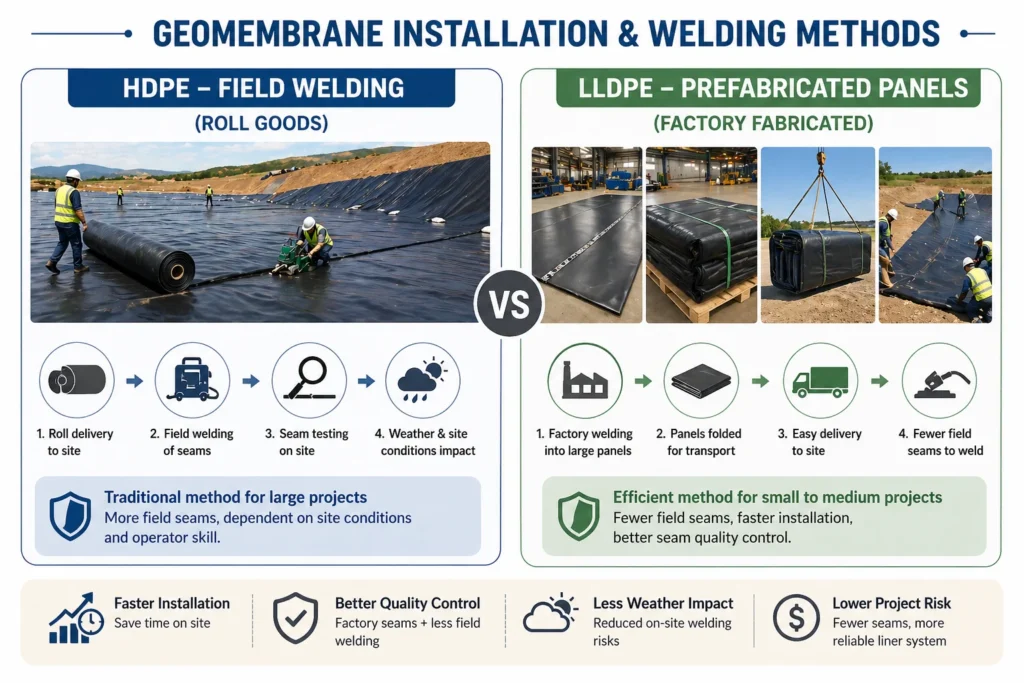
HDPE is usually supplied in rolls and welded in the field. Because it is stiffer, it is not usually folded into large prefabricated panels in the same way as more flexible liners.
LLDPE can be field welded, but it can also be factory fabricated into larger panels. These panels can be folded, shipped to site, unfolded, and seamed with fewer field welds.
This can provide several advantages:
- Less field welding
- Faster installation for suitable projects
- Better seam control in factory conditions
- Reduced weather-related welding risk
- Fewer on-site quality control challenges
However, for very large projects, HDPE roll dimensions and field installation efficiency may still make HDPE the practical option. The best choice depends on project size, site access, panel layout, and installation conditions.
6. Stress Cracking and Ground Movement
HDPE is strong and durable, but because it is stiffer, it requires careful installation to avoid stress concentration.
Potential problem areas include:
- Sharp folds
- Excessive wrinkles
- Poor subgrade preparation
- Sudden grade transitions
- Unsupported voids
- Improper anchoring
- Damage during cover soil placement
LLDPE is more flexible and can better accommodate deformation. This makes it useful for settlement-prone areas, landfill caps, pond liners, and projects where the liner may need to move with the subgrade.
This does not mean LLDPE is always better. It means LLDPE is better when flexibility is more important than stiffness.
Which Geomembrane Should You Choose?
Choose HDPE Geomembrane If:
HDPE is usually the better choice when your project requires strong containment performance under demanding conditions.
You should consider HDPE geomembrane if:
- The project is a landfill bottom liner
- The liner will contain wastewater, leachate, or chemicals
- High durability is required
- UV exposure is expected
- The subgrade can be well prepared
- Field welding is acceptable
- The project requires a commonly accepted engineering specification
- The containment area is large and relatively simple in shape
HDPE is often the safer default option for heavy-duty environmental and industrial containment projects.
Choose LLDPE Geomembrane If:
LLDPE is usually the better choice when flexibility and deformation tolerance are important.
You should consider LLDPE geomembrane if:
- The project has an irregular shape
- The subgrade is uneven
- Settlement may occur
- The liner needs to fit corners or complex transitions
- Factory prefabricated panels are preferred
- Fewer field seams are desired
- The project is a tank liner, pond liner, landfill cap, or closure system
- The liner needs to move with the ground
LLDPE is often selected when the liner must conform to the site rather than resist movement as a stiff sheet.
Application Guide: HDPE or LLDPE?
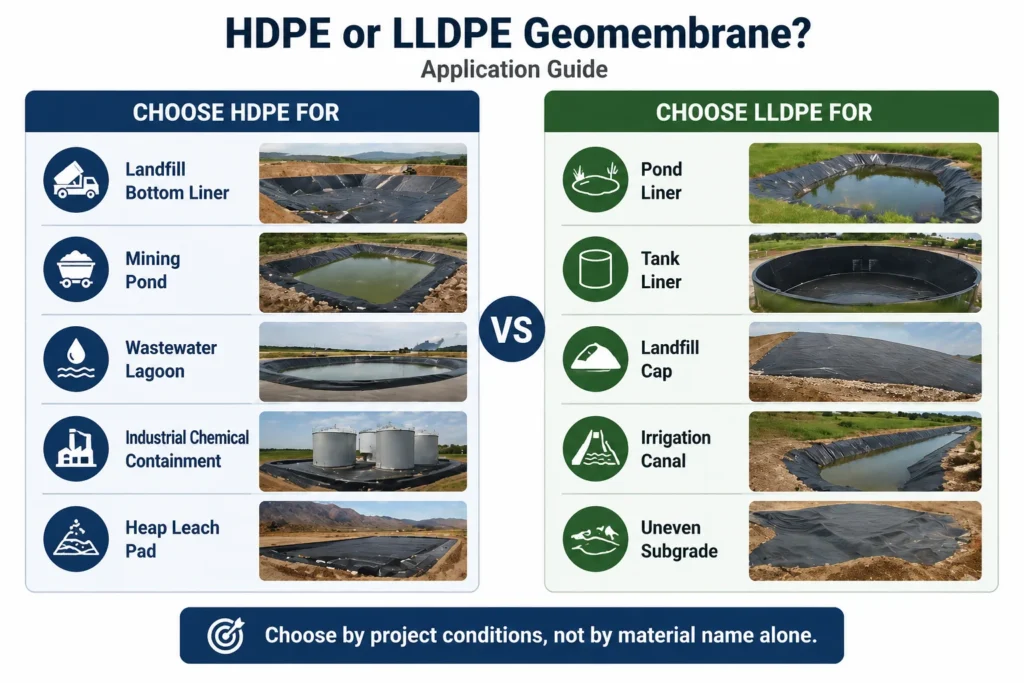
| Application | Better Choice | Reason |
|---|---|---|
| Landfill bottom liner | HDPE | Strong chemical resistance and widely accepted for critical containment |
| Landfill cap or closure | LLDPE | Better flexibility and settlement tolerance |
| Mining pond | HDPE or LLDPE | Depends on chemical exposure, subgrade, and movement |
| Heap leach pad | HDPE | Commonly used for demanding mining containment |
| Wastewater lagoon | HDPE | Good durability and chemical resistance |
| Decorative pond | LLDPE | Easier to fit irregular shapes |
| Tank liner | LLDPE | Better flexibility and prefabrication potential |
| Irrigation canal | LLDPE | Better conformance to long and uneven surfaces |
| Industrial chemical containment | HDPE | Often preferred for demanding chemical exposure |
| Secondary containment | HDPE or LLDPE | Depends on liquid type, layout, and installation method |
Is HDPE Better Than LLDPE?
HDPE is not always better than LLDPE.
HDPE is better when the project requires stiffness, strong chemical resistance, high puncture resistance, and long-term performance in demanding containment systems.
LLDPE is better when the project requires flexibility, elongation, prefabrication, and better conformance to uneven or settlement-prone surfaces.
The right question is not:
“Which material is stronger?”
The better question is:
“Which material fits the actual project conditions?”
A landfill bottom liner, tank liner, decorative pond, wastewater lagoon, mining pond, and landfill cap do not all need the same geomembrane.
Common Mistakes When Comparing HDPE and LLDPE Geomembranes
Mistake 1: Thinking LLDPE Is a Lower-Quality Version of HDPE
LLDPE is not a lower-grade HDPE.
It is a different polyethylene geomembrane designed for different performance needs. Its value comes from flexibility, elongation, and conformance.
For many projects, those properties are more important than stiffness.
Mistake 2: Choosing Only by Thickness
A thicker liner is not automatically the better liner.
Thickness matters, but it is only one part of the design. You also need to consider:
- Chemical exposure
- Subgrade condition
- Installation method
- Welding quality
- Protection layer
- UV exposure
- Slope design
- Expected settlement
- Long-term service conditions
A properly selected and protected liner system is more important than thickness alone.
Mistake 3: Ignoring Subgrade Preparation
Even a high-quality geomembrane can fail if the subgrade is poorly prepared.
Before installation, the surface should be smooth, compacted, and free from sharp stones, roots, debris, or sudden voids. In many projects, a geotextile cushion layer is used to protect the geomembrane from puncture and installation damage.
This is especially important for HDPE because a stiffer liner is less forgiving when installed over irregular surfaces.
Mistake 4: Ignoring Field Seams
Seams are one of the most important parts of a geomembrane lining system.
For HDPE projects, field welding quality is especially important because most seams are completed on site. For LLDPE projects, factory fabrication may reduce the amount of field welding, but field seams and panel connections still need proper testing.
Good material cannot compensate for poor welding.
Mistake 5: Using One Material for Every Project
HDPE and LLDPE both have strong use cases.
Using HDPE for every project may create flexibility problems in settlement-prone areas. Using LLDPE for every project may not be ideal for demanding chemical or heavy-duty containment applications.
The best geomembrane is the one that matches the actual site conditions.
Final Recommendation
For rigid, heavy-duty containment systems, HDPE geomembrane is usually the first material to evaluate. It is widely used in landfills, mining, wastewater treatment, and industrial containment projects.
For projects involving settlement, irregular shapes, prefabricated panels, or uneven subgrade, LLDPE geomembrane may be the better option because of its flexibility and elongation.
Before choosing between HDPE and LLDPE, evaluate:
- What liquid or material will be contained
- Whether chemical resistance is critical
- Whether the site has uneven subgrade
- Whether settlement is expected
- Whether the liner will be exposed to sunlight
- Whether field welding or factory fabrication is preferred
- Whether a protection geotextile is needed
- Whether the project follows a specific engineering standard
If you are not sure whether HDPE or LLDPE geomembrane is better for your project, send us your application, liner thickness requirement, site condition, and contained liquid. We can help recommend a suitable geomembrane option based on your project needs.
FAQ
What is the main difference between HDPE and LLDPE geomembrane?
The main difference is flexibility. HDPE geomembrane is denser and stiffer, while LLDPE geomembrane is more flexible and has higher elongation. HDPE is often used for heavy-duty containment, while LLDPE is better for irregular surfaces, settlement-prone areas, and prefabricated liner panels.
Is HDPE geomembrane stronger than LLDPE geomembrane?
HDPE usually has higher stiffness and higher puncture resistance at the same thickness. However, LLDPE has better flexibility and elongation, which can make it better for projects involving movement, settlement, or uneven surfaces.
Is LLDPE geomembrane good for ponds?
Yes. LLDPE geomembrane can be a good choice for ponds, especially when the pond has an irregular shape or uneven subgrade. Its flexibility helps the liner fit complex surfaces more easily.
Which geomembrane is better for landfill liners?
HDPE is commonly used for landfill bottom liners because of its chemical resistance and durability. LLDPE is often used for landfill caps and closures where flexibility and settlement tolerance are more important.
Can HDPE and LLDPE geomembranes be welded?
Yes. Both HDPE and LLDPE geomembranes can be thermally welded. HDPE is usually welded in the field, while LLDPE can be field welded or factory prefabricated into larger panels depending on the project.
Is LLDPE cheaper than HDPE?
Price depends on thickness, specification, roll size, quantity, and project location. LLDPE is not simply a cheaper version of HDPE. It should be selected when flexibility and installation conditions make it the better material choice.
Which geomembrane is better for chemical containment?
HDPE is often preferred for demanding chemical containment projects. However, both HDPE and LLDPE can offer good chemical resistance, and final selection should be based on chemical type, concentration, temperature, and exposure time.
Should I choose HDPE or LLDPE for an uneven subgrade?
LLDPE is usually better for uneven subgrade because it is more flexible and can conform to irregular surfaces more easily. However, proper subgrade preparation and a protection layer are still important.