Quick Explanation
Type 4 geotextile fabric usually refers to a specification-based geotextile used in civil engineering, road construction, soil stabilization, separation, drainage, or erosion control projects.
However, “Type 4” is not always a universal product name. Its meaning can vary depending on the project specification, DOT standard, local agency requirement, or supplier classification.
In some indexed product examples, Type 4 geotextile fabric is a woven polypropylene geotextile used for separation and soil stabilization. In other specifications, Type 4 may refer to a different application or material requirement. That is why buyers should not select a product by the name “Type 4” alone.
Before choosing Type 4 geotextile fabric, always check the required application, woven or nonwoven structure, tensile strength, elongation, puncture resistance, apparent opening size, permittivity, roll size, and applicable project standard.
What Does “Type 4” Mean in Geotextile Fabric?
If you are new to geotextile materials, you can first learn what geotextile fabric is used for before comparing different specification types.
“Type 4” is best understood as a specification reference, not a complete product description.
For example, one indexed product page describes a Type 4 HGC geotextile as TerraTex® GS, a woven geotextile made from polypropylene yarns, used for separation and stabilization. The same page also states that the product meets AASHTO M288 Class 3 for separation and stabilization.
This is important because it shows that “Type 4” and “AASHTO Class 3” are not automatically the same thing. A supplier may market a product as Type 4, while the engineering compliance may be tied to another standard or class.
DOT specifications can also define Type 4 differently. For example, NCDOT lists Type 4 under geotextile requirements with a typical application of soil stabilization, while also stating that woven or nonwoven geotextiles may be used when properties meet the required table.
In another example, Kentucky Transportation Cabinet moved from older “Type” terminology toward application-based and AASHTO M288 Class-based geotextile descriptions. It notes that some uses previously called Type IV are now described as Class 1 or Class 2 geotextile depending on the application.
So the safest definition is:
Type 4 geotextile fabric is a project- or specification-defined geotextile grade, commonly used for stabilization, separation, drainage, or erosion control, but the exact material requirements must be confirmed from the project specification.
Is Type 4 Geotextile Fabric Woven or Nonwoven?
When filtration, drainage, cushioning, or soil retention is the main requirement, a nonwoven geotextile fabric may be more suitable than a woven stabilization fabric.
Type 4 geotextile fabric can be woven or nonwoven depending on the specification.
In the A-1 Supply example, the Type 4 HGC product is described as a woven polypropylene geotextile. It includes properties such as grab tensile strength, elongation, trapezoid tear, CBR puncture, permittivity, water flow rate, AOS, and UV resistance.
But that does not mean every Type 4 geotextile fabric is woven.
A woven geotextile is usually selected when the project needs higher strength, separation, and stabilization. It is commonly used under roads, construction access routes, aggregate bases, parking areas, and soft subgrade conditions.
A nonwoven geotextile is usually selected when the project needs filtration, drainage, soil retention, cushioning, or protection. Nonwoven geotextiles are commonly used around drainage systems, under riprap, behind retaining walls, and in landscape or erosion control projects.
The correct question is not only:
Is Type 4 woven or nonwoven?
The better question is:
What does the project specification require Type 4 to do?
Type 4 vs Grade A, Class B, and General Geotextile Fabric
For simple landscape separation or weed control, a geotextile for garden and landscaping projects may be enough, but engineered Type 4 geotextile should be selected by project specifications.
In local markets, especially for landscaping and small construction supply, geotextile fabric may be sold under labels such as Grade A, Class B, NW, or general geotextile fabric. These labels should not be confused with Type 4.
For example, one Singapore supplier lists a geotextile product as Class B with a width of 2 m, thickness of 1.1 mm, and roll length up to 150 m. Another supplier lists Geotextile Fabric Grade A with a size of 2 m x 1 m and describes geotextiles as permeable fabrics that can filter, protect, and drain.
Another product page lists NW geotextile fabric for landscape use, artificial grass installation, separation, filtration, drainage, landfill, pipeline protection, retaining walls, and other applications.
These product labels are useful for retail or local purchasing, but they are not the same as a project-specified Type 4 geotextile fabric.
If your drawing or tender document says “Type 4 geotextile fabric,” do not replace it with Grade A, Class B, or NW fabric unless the physical properties and standard requirements match.
Common Uses of Type 4 Geotextile Fabric
Soil Stabilization
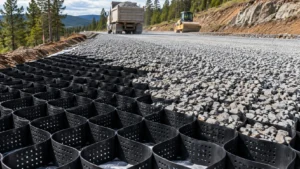
Type 4 geotextile fabric is often used for soil stabilization, especially when the project involves weak subgrade, unpaved access roads, temporary construction roads, or aggregate base support.
In this application, the fabric helps reduce the mixing of soft soil and aggregate. It can also improve the performance of the base layer by keeping the aggregate structure more stable under traffic or construction loads.
Road Base Separation
One of the most common functions of geotextile fabric is separation.
When installed between the subgrade and aggregate base, the fabric helps prevent fine soil particles from migrating into the aggregate layer. This can reduce rutting, improve base performance, and extend the service life of the road structure.
Drainage and Filtration
If Type 4 geotextile is used in a drainage-related application, hydraulic properties become very important.
The fabric must allow water to pass while preventing uncontrolled soil movement. In this case, properties such as apparent opening size, permittivity, and water flow rate are just as important as tensile strength.
Nonwoven geotextiles are commonly used for filtration and drainage because they are permeable and flexible. Palmetto Industries describes nonwoven geotextiles as suitable for filtration, drainage, and erosion control because of their high permeability and flexibility.
Erosion Control
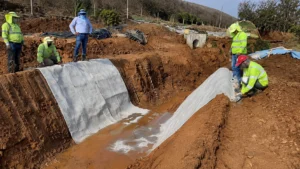
Type 4 geotextile fabric may also be used under riprap, slope protection, ditch lining, channel lining, or riverbank protection depending on the specification.
In erosion control, the fabric acts as a filter and separator. It helps retain soil while allowing water to pass through, reducing soil loss beneath rock or protective cover layers.
Wall Tag describes geotextiles as permeable fabrics used to reduce erosion and maintain soil stability, and also notes nonwoven geotextiles are used to prevent erosion and keep backfill materials in place.
Construction Access Roads
For temporary or permanent access roads, Type 4 geotextile fabric can be placed between the soft subgrade and aggregate fill.
The purpose is to reduce aggregate loss, improve construction traffic support, and create a more stable working platform. For this type of application, tensile strength, puncture resistance, and elongation are key performance indicators.
Key Specifications to Check Before Choosing Type 4 Geotextile Fabric
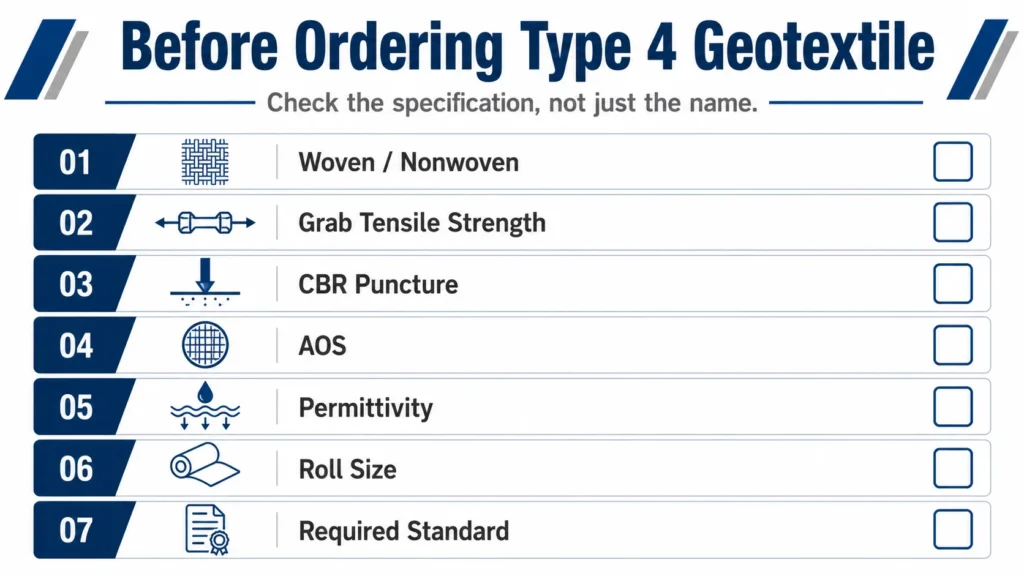
The name “Type 4” is not enough. You need to verify the technical properties.
| Specification | Why It Matters |
|---|---|
| Application | Confirms whether the fabric is for stabilization, separation, drainage, filtration, or erosion control |
| Woven or Nonwoven | Determines strength, permeability, elongation, and installation behavior |
| Grab Tensile Strength | Shows resistance to installation and construction stress |
| Elongation | Helps identify whether the fabric behaves more like woven or nonwoven material |
| CBR Puncture Resistance | Important under aggregate, riprap, or heavy construction loads |
| Trapezoid Tear Strength | Shows resistance to tearing during handling and installation |
| Apparent Opening Size, AOS | Controls soil retention and filtration performance |
| Permittivity | Indicates how easily water passes through the fabric |
| Water Flow Rate | Important for drainage and filtration applications |
| UV Resistance | Important if the fabric is exposed before covering |
| Roll Width and Length | Affects overlap planning, coverage, labor, and waste |
| Required Standard | Confirms whether the fabric meets DOT, AASHTO, or project-specific requirements |
The A-1 Supply Type 4 product example includes values for grab tensile, grab elongation, trapezoid tear, CBR puncture, permittivity, water flow rate, AOS, and UV resistance, which shows the kind of properties buyers should verify before ordering.
Type 4 Geotextile Fabric vs Other Geotextile Types
The exact meaning of geotextile types can vary by agency or specification. The table below is a practical way to understand how Type 4 may compare with other common type labels.
| Geotextile Type | General Meaning | Common Use |
|---|---|---|
| Type 1 | Often used for lighter separation or drainage applications | Shoulder drains, filtration, basic separation |
| Type 2 | Often used under riprap or drainage structures | Riprap underlayment, drainage, erosion control |
| Type 3 | May be used for silt fence or lighter stabilization depending on the agency | Sediment control, site protection |
| Type 4 | Often used for soil stabilization or higher-performance separation depending on the specification | Road base, access roads, soil stabilization, separation |
| Type 5 | Often used for more demanding applications such as temporary walls or severe-duty reinforcement | Temporary walls, heavy reinforcement, demanding site conditions |
NCDOT’s geotextile table is a good example of why the actual specification matters: it lists Type 1, Type 2, Type 3, Type 4, and Type 5 with different typical applications such as shoulder drains, under riprap, silt fence fabric, soil stabilization, and temporary walls.
How to Choose the Right Type 4 Geotextile Fabric
Step 1: Check the Project Specification
Start with the drawing, tender document, DOT requirement, or engineer’s note.
Look for:
- Type or class
- Application
- Required test methods
- Minimum average roll values
- Woven or nonwoven requirement
- Approved product list
- Installation notes
Do not choose by product name alone.
Step 2: Confirm the Main Function
Determine what the fabric is expected to do.
For stabilization, focus on tensile strength, puncture resistance, elongation, and survivability.
For filtration, focus on AOS, permittivity, water flow rate, and soil retention.
For erosion control, focus on filtration performance, puncture resistance, survivability, and cover material.
For separation, focus on strength, survivability, and ability to prevent soil-aggregate mixing.
Step 3: Match Woven or Nonwoven Structure
Choose woven geotextile when the project needs strength, separation, and stabilization.
Choose nonwoven geotextile when the project needs filtration, drainage, cushioning, or better conformance to uneven surfaces.
For mixed conditions, do not guess. Match the product to the required specification.
Step 4: Check Roll Size and Installation Conditions
Roll size affects installation speed, overlap waste, shipping, and site handling.
For large road or stabilization projects, wider rolls may reduce seams and labor. For landscaping or small drainage projects, smaller rolls may be easier to handle.
Also check whether the fabric will be exposed to sunlight before covering. UV resistance matters when storage or installation delays are expected.
Step 5: Ask for a Data Sheet
Before ordering Type 4 geotextile fabric, request a technical data sheet showing:
- Product name
- Material
- Woven or nonwoven structure
- Roll size
- Test methods
- MARV values
- AOS
- Permittivity
- Puncture resistance
- UV resistance
- Applicable standard or approval
A product without technical data may be acceptable for simple landscaping, but it should not be used for engineered stabilization or DOT-related projects unless it meets the required specification.
Common Mistakes When Buying Type 4 Geotextile Fabric
Mistake 1: Assuming Type 4 Means the Same Everywhere
Type 4 can mean different things in different specifications. Always check the project document.
Mistake 2: Confusing Type 4 with Grade A or Class B
Grade A, Class B, NW, and Type 4 are not automatically equivalent. They may come from different supplier systems or market categories.
Mistake 3: Choosing Only by Price
Low price may be acceptable for simple landscape separation, but engineered stabilization requires proper tensile strength, puncture resistance, filtration properties, and compliance.
Mistake 4: Ignoring Water Flow
For drainage and filtration, a strong fabric is not enough. AOS, permittivity, and water flow rate must be checked.
Mistake 5: Ignoring Installation Damage
A geotextile may fail if it is damaged during placement of aggregate, riprap, or fill. Puncture resistance and proper installation practices are important.
Final Recommendation
For engineered projects, it is important to work with geotextile suppliers that can provide technical data sheets, roll specifications, and project-based recommendations.
Type 4 geotextile fabric should be selected by specification, not by name alone.
For road base, construction access roads, and soil stabilization, Type 4 may require a woven geotextile with strong tensile and puncture resistance.
For drainage, erosion control, or filtration, the project may require a nonwoven geotextile with suitable AOS, permittivity, and water flow performance.
The best approach is to confirm the project application first, then match the fabric properties to the required standard.
Before purchasing, send the supplier your project specification, required application, roll size, and required test values. A qualified supplier should be able to recommend a suitable woven or nonwoven geotextile fabric based on the actual project conditions.
FAQ
What is Type 4 geotextile fabric?
Type 4 geotextile fabric usually refers to a specification-based geotextile used for civil engineering applications such as soil stabilization, separation, drainage, filtration, or erosion control. The exact meaning depends on the project specification, DOT requirement, or supplier classification.
Is Type 4 geotextile fabric woven or nonwoven?
Type 4 geotextile fabric can be woven or nonwoven depending on the project specification. Woven fabric is usually used for stabilization and separation, while nonwoven fabric is usually used for filtration, drainage, cushioning, and erosion control.
What is Type 4 geotextile fabric used for?
Type 4 geotextile fabric is commonly used for soil stabilization, road base separation, construction access roads, erosion control, riprap underlayment, slope protection, and some drainage applications.
Is Type 4 the same as AASHTO M288 Class 3?
No. Type 4 and AASHTO M288 Class 3 are not automatically the same thing. A product may be marketed as Type 4 while also meeting an AASHTO class for a specific application. Buyers should always verify the exact project requirement.
Is Type 4 geotextile the same as Grade A geotextile fabric?
No. Type 4 and Grade A are not automatically the same. Grade A is often a supplier or retail product label, while Type 4 is usually connected to a project or agency specification. Always compare the technical data sheet before substitution.
What specifications should I check before buying Type 4 geotextile fabric?
Check woven or nonwoven structure, grab tensile strength, elongation, CBR puncture resistance, tear strength, AOS, permittivity, water flow rate, UV resistance, roll size, and the required DOT or project standard.
Can Type 4 geotextile be used for road construction?
Yes, Type 4 geotextile fabric may be used for road construction when the specification requires it for soil stabilization, separation, or subgrade support. The fabric must match the required strength and survivability values.
Can I use landscape geotextile fabric instead of Type 4 geotextile fabric?
Not unless it meets the same specification. Landscape geotextile fabric may work for simple garden or artificial grass applications, but engineered Type 4 geotextile fabric for road or stabilization projects requires verified technical properties.