Introduction
When planning a road, yard, or working platform, the stability of the ground is always the first concern. A weak or moving base leads to rutting, pumping, and costly repairs. Biaxial geogrid has become one of the most effective ways to reinforce sub-bases, distribute loads, and extend the service life of pavements.
As a manufacturer and exporter of geosynthetics, we often get asked: “What exactly is a biaxial geogrid, and do I need to combine it with geotextiles?” This article gives a clear, practical answer—based on field experience, not just theory.
What is a Biaxial Geogrid?
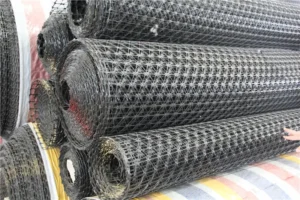
A biaxial geogrid is a polymer mesh, usually made from polypropylene (PP) or high-density polyethylene (HDPE). It is produced by extruding, punching, and stretching the material in two perpendicular directions.
The result is a grid with similar tensile strength both along and across the roll (e.g. 20/20, 30/30, 40/40 kN/m). The square apertures interlock with aggregate particles and provide lateral restraint under traffic loads.
If you are comparing biaxial and uniaxial options for a project, this biaxial vs uniaxial geogrid guide explains how to choose correctly.
How Does it Work?
-
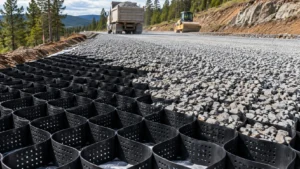
Interlock: Aggregate particles lock into the apertures, preventing sideways movement.
-
Load Distribution: Wheel loads are spread over a wider area, reducing rutting.
-
Confinement: Keeps the granular layer together, improving stiffness and lifespan.
(Tip: add a simple diagram showing soil + geogrid + aggregate interaction here)
When to Use Biaxial Geogrid with Geotextile
This is where many suppliers give vague answers. In reality, it depends on ground conditions:
-
Dry, firm subgrade → Geogrid alone is usually enough.
-
Moderately weak or moist soil → We recommend a geotextile separator under the geogrid.
-
Very soft ground / high water table → Geotextile + geogrid is essential.
Typical design indicators:
-
CBR < 3 → combination advised.
-
Moisture content > Plastic Limit + 5%.
-
Groundwater at or above subgrade level.
Why Add Geotextile?

A geotextile placed under the geogrid provides four functions:
-
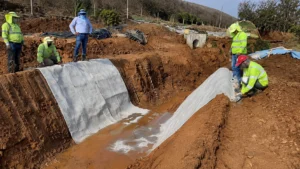
Separation: Stops fines from pumping into the aggregate.
-
Filtration: Allows water to pass but holds back soil particles (O95/D85 criteria).
-
Drainage: Keeps the base drier, reducing soft spots.
-
Protection: Prevents aggregate punching into very soft soil.
We typically recommend a nonwoven geotextile with permeability ≥ 1×10⁻³ m/s. Importantly, the geotextile is placed under the geogrid, so it does not block the aggregate interlock. Laboratory tests (friction angle / interface shear) confirm that the combination increases stability.
Technical Data Buyers Care About
-
Tensile strength: 20/20, 30/30, 40/40 kN/m grades.
-
Stiffness at 2% and 5% strain: controls early rutting.
-
Junction strength: ensures nodes do not tear under load.
-
Aperture size: typically 25–40 mm, matched to aggregate D50.
-
Roll sizes: 3.9–5.0 m width, 50 m length.
-
Durability: UV stabilized with carbon black, resistant to chemicals (pH 3–9).
(Insert a table of your product specifications here)
Installation Tips from Site Experience
-
Lay subgrade level and free from sharp objects.
-
Overlap: geotextile ≥ 0.3–0.5 m, geogrid ≥ 0.3–0.6 m.
-
Avoid wrinkles—pull grids taut before covering.
-
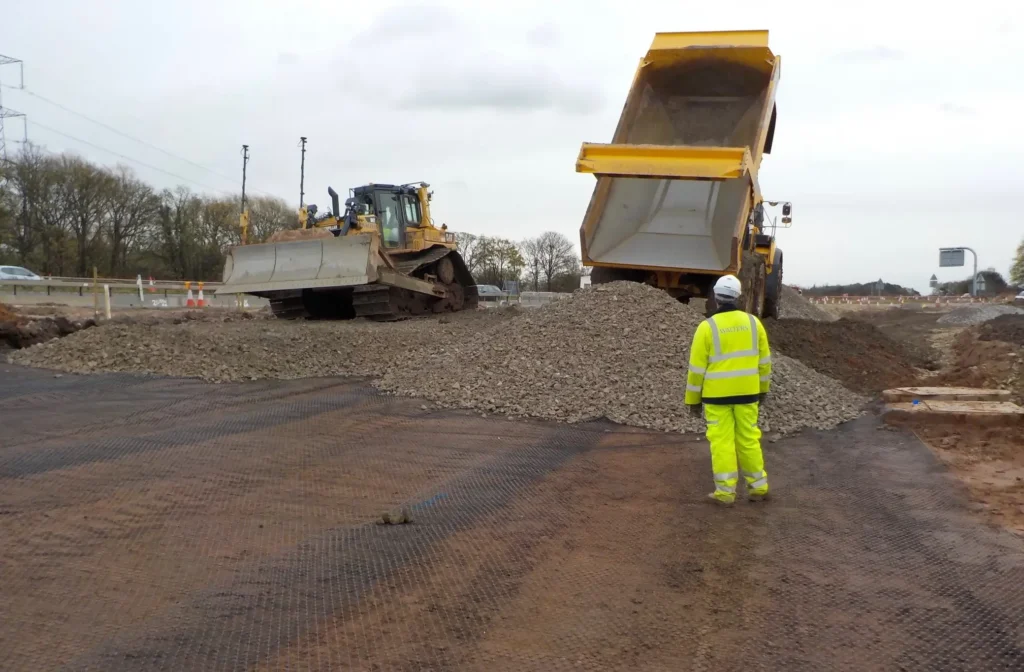
Cover immediately with ≥ 150 mm aggregate.
-
First passes: light tracked equipment, then compaction.
These practical steps reduce damage during construction and maximize performance.
Case Example – Savings with Combination

On a highway soft ground section, designers first estimated 500 mm of crushed stone over soft soil. After applying BX30/30 geogrid with 200 g/m² nonwoven geotextile, the base thickness was reduced to 350 mm.
Result:
-
30% aggregate savings.
-
Lower transport and installation costs.
-
Improved long-term rut resistance.
What Buyers Usually Ask
-
Cost difference? Combination adds 5–10% to material cost but can cut 20–30% in aggregate use.
-
When is it economical? Especially on soft soils or where aggregate is expensive to haul.
-
Durability? Our grids contain carbon black and have UV/aging test data for 25+ years.
-
Lead time and packaging? Standard rolls ship in 7–10 days, palletized for container loading.
Conclusion
Biaxial geogrid is a proven, cost-effective way to strengthen roads, yards, and platforms. Used correctly, it reduces rutting, saves aggregate, and speeds up construction.
For normal subgrades, a single layer of geogrid is often sufficient. For soft and wet conditions, combining it with a geotextile separator ensures long-term stability and economy.
📩 Contact our technical team for datasheets, samples, or a quotation. We are ready to support your project with reliable geosynthetics.