Quick Answer
The lifespan of a geogrid typically ranges from 20 to 120 years, depending on the material type, exposure conditions, and application.
In most buried civil engineering applications, geogrids commonly achieve 50 to 100+ years of service life.
Typical lifespan ranges include:
- Buried PP geogrid: 50–120 years
- PET retaining wall geogrid: 30–80 years
- Exposed slope geogrid: 20–40 years
- Fiberglass asphalt geogrid: 30–40 years
Lifespan by Real Project Type
| Project Type | Typical Lifespan | Notes |
|---|---|---|
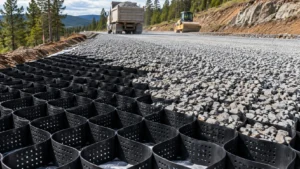
| Driveway / gravel road | 30–75 years | buried under aggregate |
| Road base stabilization | 50–120 years | best buried condition |
| Retaining walls | 30–80 years | depends on creep & soil chemistry |
| Exposed slope reinforcement | 20–40 years | UV exposure critical |
| Asphalt pavement overlay | 30–40 years | fiberglass grid |
What Determines the Lifespan of a Geogrid?
The service life of a geogrid is not a fixed number.
It depends on five major engineering factors.
1. Material Type (Most Important)
Different polymers have different long-term durability.
Polypropylene (PP)
PP geogrids are commonly used for:
- road construction
- base stabilization
- driveways
Typical buried lifespan:
50–120 years
PP offers excellent resistance to:
- chemical attack
- moisture
- oxidation
Polyester (PET)
PET geogrids are widely used in:
- retaining walls
- reinforced slopes
- MSE structures
Typical design life:
30–80 years
PET provides superior long-term tensile performance and creep resistance.
Fiberglass Geogrid
Typically used in asphalt overlays.
Typical lifespan:
30–40 years
These are commonly used for crack control and pavement reinforcement.
Buried vs Exposed Geogrid Lifespan
This is one of the biggest factors affecting durability.
Buried Installation
When geogrid is installed below aggregate or soil cover:
- protected from sunlight
- stable temperature
- low oxidation risk
This is why road geogrids can last:
50–120 years
Exposed Installation
For slope protection or temporary erosion control:
- UV radiation
- temperature cycling
- weather exposure
These conditions reduce service life to:
20–40 years
How Long Does Geogrid Last in Weak Soil?
In weak subgrades, properly selected geogrids can still provide long-term performance.
For example:
CBR below 3% commonly requires reinforcement
When buried under adequate aggregate cover, biaxial geogrids can maintain performance for:
50–100 years
This is especially common in:
- unpaved roads
- temporary access roads
- industrial yard stabilization
Why Geogrids Fail Early
Premature failure is usually not caused by the material itself.
The most common reasons include:
- UV exposure
- installation damage
- insufficient aggregate cover
- poor overlap
- alkaline or acidic soil
- long-term creep under heavy loads
Key Engineering Insight
UV exposure is the most common reason exposed geogrids fail early.
Can Geogrid Last 100 Years?
Yes.
Many civil engineering designs are based on:
50–100 year service life
Especially in:
- retaining walls
- road embankments
- reinforced slopes
Proper design and installation are critical.
How to Extend Geogrid Lifespan
To maximize durability:
- use high-quality polymer
- bury below UV exposure
- maintain proper cover thickness
- avoid installation damage
- use correct overlap length
- select proper tensile strength
Related Engineering Guides
Before selecting a geogrid, you may also need:
Explore geogrid specifications and engineering solutions for your project.
Frequently Asked Questions
How long does buried geogrid last?
Buried geogrids typically last 50 to 120 years, depending on material type and installation quality.
Does UV exposure shorten geogrid life?
Yes. UV radiation significantly reduces the lifespan of exposed geogrids.
Can geogrid last 100 years?
Yes. Many retaining wall and road stabilization projects are designed for 100-year service life.
Which geogrid lasts the longest?
Buried polypropylene geogrids typically offer the longest service life in road base applications.