
Short Answer:
A geomembrane can last from 10 years to more than 100 years, depending on the material type, exposure condition, thickness, chemical environment, installation quality and protection method.
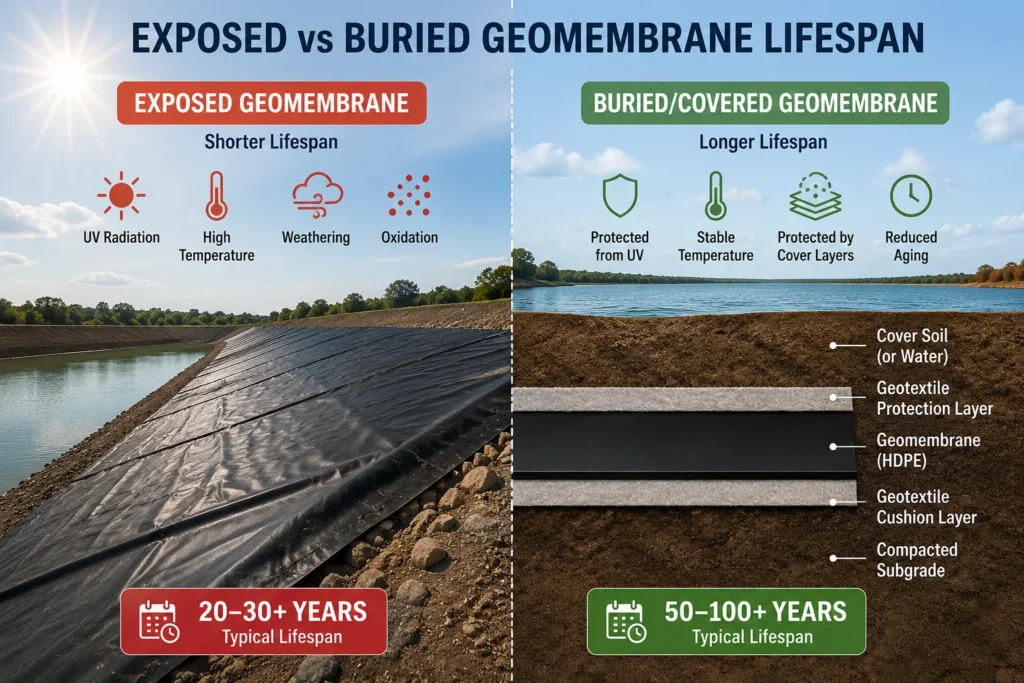
In general, a buried or covered HDPE geomembrane can last 50 to 100+ years under suitable conditions. An exposed HDPE geomembrane usually has a shorter service life, often around 20 to 30+ years, depending on UV exposure, temperature, material formulation and maintenance.
The actual life of a geomembrane is not determined by material name alone. A properly selected, welded and protected liner can perform for decades, while a poorly installed liner can fail much earlier.
What Is the Typical Lifespan of a Geomembrane?
The typical lifespan of a geomembrane depends on whether the liner is covered, buried, exposed, chemically stressed or mechanically loaded.
For long-term containment projects such as landfills, reservoirs, mining pads and wastewater lagoons, the geomembrane is usually designed as part of a complete liner system. This system may include geotextiles, drainage layers, geosynthetic clay liners, protective soil cover, anchor trenches and leak detection systems.
A geomembrane generally lasts longer when it is:
- Covered by soil, water, sand or protective layers
- Protected from direct sunlight
- Installed on a smooth and stable subgrade
- Properly welded and tested
- Matched to the chemical environment
- Protected from puncture and abrasion
- Inspected and repaired when damage occurs
A geomembrane usually has a shorter lifespan when it is:
- Permanently exposed to UV radiation
- Installed over sharp stones or roots
- Selected only by low price or insufficient thickness
- Used in chemically aggressive environments without compatibility review
- Poorly welded or not tested after installation
- Left with large wrinkles, folds or unsupported stress points
In real procurement conversations, most early geomembrane failures are not caused by natural aging. They are usually caused by using the wrong thickness for the application, installing the liner over sharp subgrade, skipping seam testing, or leaving exposed edges without UV protection. This is why the expected lifespan should always be discussed together with the project type, liner thickness, installation method and protection layer.
Geomembrane Lifespan by Exposure Condition
Exposure condition is one of the most important factors affecting geomembrane life expectancy.
| Exposure Condition | Typical Lifespan Range | Main Reason |
|---|---|---|
| Buried or covered HDPE geomembrane | 50–100+ years | Protected from UV, temperature cycling and mechanical damage |
| Exposed HDPE geomembrane | 20–30+ years | UV radiation, heat and thermal movement accelerate aging |
| Pond liner covered by water | 30–50+ years | Water cover reduces UV exposure, but edges may still degrade |
| Exposed PVC geomembrane | 10–20 years | UV exposure and plasticizer loss may reduce service life |
| Buried PVC geomembrane | 20–40 years | Better protected from sunlight and surface damage |
| EPDM pond liner | 20–40+ years | Good flexibility and weather resistance when properly installed |
| Mining or chemical containment liner | 15–30+ years | Chemical exposure, loading and temperature control lifespan |
These are general ranges, not fixed guarantees. The actual lifespan depends on the project environment and the quality of material selection, installation and maintenance.
Buried vs Exposed Geomembrane Lifespan
A buried geomembrane usually lasts much longer than an exposed geomembrane.
When a geomembrane is buried under soil, sand, concrete, water or another protective layer, it is protected from direct sunlight, wind uplift, temperature cycling, abrasion, animal damage and vandalism. This reduces surface aging and helps the liner maintain its barrier function for a longer time.
An exposed geomembrane faces a harsher environment. Sunlight, UV radiation, heat, oxygen, wind and repeated expansion and contraction can slowly reduce the liner’s mechanical properties. This is especially important in hot climates, exposed slopes, canals, reservoirs and wastewater ponds.
For long-term projects, covering the geomembrane or adding a protective geotextile layer can significantly improve service life.
HDPE Geomembrane Lifespan
HDPE geomembrane is one of the most widely used materials for long-term containment projects. It is commonly used in landfills, mining heap leach pads, reservoirs, wastewater lagoons and industrial containment systems.
A properly formulated and covered HDPE geomembrane can often last 50 to 100+ years. In exposed applications, HDPE geomembrane commonly lasts around 20 to 30+ years, depending on climate, UV stabilization, thickness and maintenance.
HDPE has several advantages for long-term service:
- Strong chemical resistance
- Low permeability
- Good UV resistance when properly stabilized
- Reliable hot wedge and extrusion welding
- Long-term performance in landfill and mining projects
- Good resistance to many industrial fluids and wastewater environments
However, HDPE is relatively stiff. It requires good subgrade preparation, controlled panel layout and professional welding. Poor installation can create stress points, wrinkles or weak seams that reduce service life.
For projects that require long-term containment, review HDPE geomembrane properties before selecting thickness and roll size:
LLDPE Geomembrane Lifespan
LLDPE geomembrane is more flexible than HDPE and has better elongation. It is often used when the liner needs to adapt to uneven subgrades, settlement, complex shapes or ground movement.
In buried or protected applications, LLDPE geomembrane can often last 40 to 80 years depending on formulation, thickness and exposure condition. In exposed applications, a well-stabilized LLDPE liner may last around 15 to 25+ years.
LLDPE is commonly used for:
- Ponds
- Canals
- Reservoirs
- Floating covers
- Caps and closures
- Applications with uneven subgrade
- Projects where flexibility is more important than stiffness
LLDPE may be a better choice than HDPE when settlement or movement is expected. However, for highly chemical or critical long-term containment, HDPE is often evaluated first.
For a material comparison, see HDPE vs LLDPE geomembrane:
PVC Geomembrane Lifespan
PVC geomembrane is flexible and easy to handle. It can be useful for smaller ponds, temporary containment, canals and projects with complex shapes.
A buried PVC geomembrane may last 20 to 40 years when properly protected. An exposed PVC geomembrane may last around 10 to 20 years, depending on UV exposure, temperature and formulation.
PVC is easier to install on irregular shapes, but it may be more sensitive to UV exposure and plasticizer loss than polyethylene geomembranes. For long-term exposed containment, HDPE or other UV-stabilized materials are usually preferred.
PVC may be suitable for:
- Decorative ponds
- Temporary liners
- Small reservoirs
- Canal sections
- Projects where flexibility and handling are more important than long-term chemical resistance
EPDM Geomembrane Lifespan
EPDM is a synthetic rubber liner known for flexibility, elongation and weather resistance. It is commonly used in freshwater ponds, decorative ponds, koi ponds and landscaping water features.
A properly installed EPDM pond liner can often last 20 to 40+ years, depending on thickness, exposure and mechanical protection.
EPDM is useful when the project has irregular shapes, corners or complex contours. It is easier to fit around pond shelves and curves than rigid materials. However, EPDM is usually not the first choice for landfills, mining heap leach pads or aggressive chemical containment.
EPDM is commonly used for:
- Koi ponds
- Garden ponds
- Decorative water features
- Golf course ponds
- Freshwater reservoirs
- Irregular pond shapes
Geomembrane Lifespan by Application
The same geomembrane material may have different service lives in different applications. A liner used in a buried landfill system may last much longer than the same material exposed on a canal slope.
| Application | Common Material | Typical Lifespan Range | Main Lifespan Risk |
|---|---|---|---|
| Landfill liner | HDPE | 50–100+ years when buried | Leachate chemistry, seam quality, stress cracking |
| Fish pond / aquaculture pond | HDPE / LLDPE / EPDM | 20–50+ years | Puncture, UV exposure, water level changes |
| Mining heap leach pad | HDPE / LLDPE | 15–30+ years | Chemical attack, high loading, rough subgrade |
| Canal liner | HDPE / LLDPE / PVC | 20–50 years | UV, anchoring, slope movement, abrasion |
| Wastewater lagoon | HDPE / LLDPE | 20–50+ years | Chemical exposure, gas pressure, sludge |
| Secondary containment | HDPE / LLDPE | 15–40+ years | Chemical compatibility, inspection and repair |
| Decorative pond | EPDM / PVC | 10–40+ years | Mechanical damage, UV, installation quality |
For a broader application overview, see geomembrane applications:
Landfill Geomembrane Lifespan
Landfill liner systems usually require long-term containment performance. Their main purpose is to prevent leachate from migrating into soil and groundwater.
HDPE geomembrane is commonly selected for landfill liners because of its low permeability, chemical resistance and field welding reliability. In covered landfill applications, HDPE geomembrane can often last 50 to 100+ years when properly specified, installed and protected.
The main factors affecting landfill geomembrane life include:
- Leachate chemistry
- Operating temperature
- HDPE resin quality
- Antioxidant package
- Liner thickness
- Seam welding quality
- Puncture protection
- Stress cracking resistance
- Construction quality assurance
A landfill geomembrane should not be treated like a simple pond liner. It requires stricter material control, proper seam testing and a complete containment system.
Pond Liner Lifespan
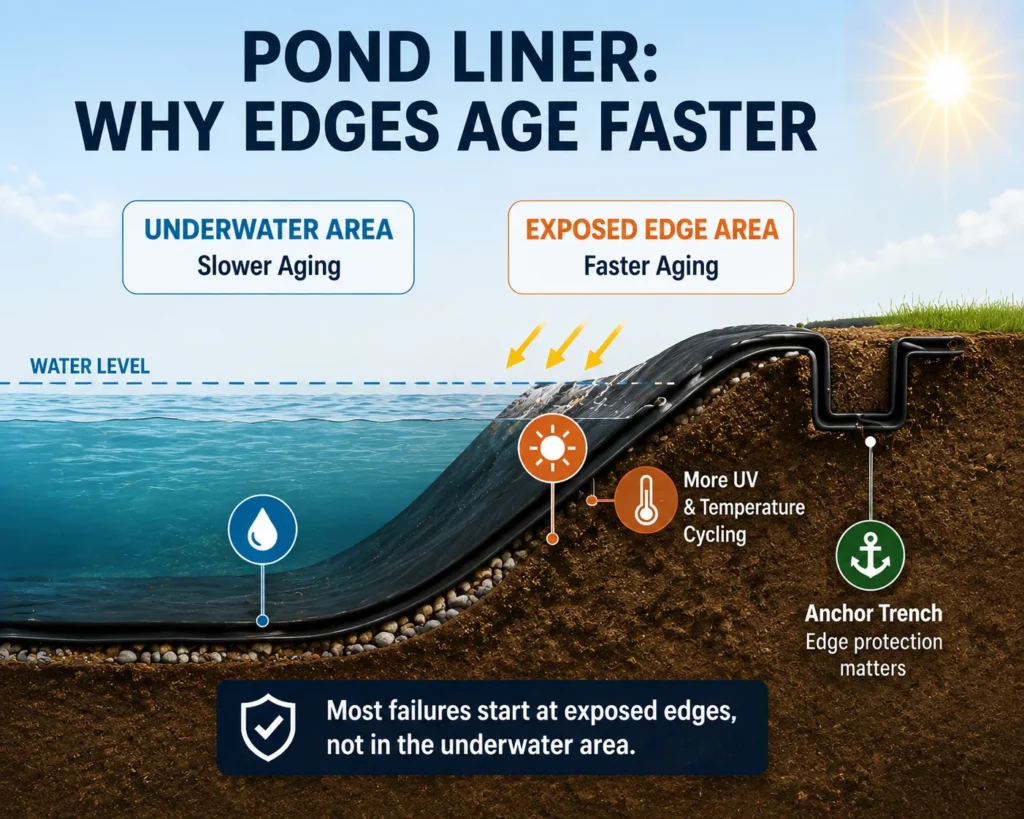
Geomembranes used in ponds and reservoirs may last 20 to 50+ years, depending on material, thickness, subgrade condition and exposure.
For farm ponds, fish ponds and aquaculture ponds, HDPE and LLDPE are common choices. HDPE offers durability and chemical resistance, while LLDPE provides better flexibility on irregular subgrades. EPDM is often used for smaller decorative or koi ponds.
Pond liner lifespan is strongly affected by:
- Water depth
- UV exposure at exposed edges
- Soil smoothness
- Puncture risk from stones or roots
- Fish or aquaculture activity
- Water level changes
- Installation method
- Protection layer
In pond projects, the underwater liner area usually ages more slowly than the exposed edge area. The liner along the slope, anchor trench and waterline often receives more UV exposure and temperature cycling. For this reason, many pond liner failures start near exposed edges, wrinkles, pipe penetrations or poorly protected slopes rather than in the fully submerged bottom area.
For more pond-specific selection advice, see the best pond liner guide
Mining Geomembrane Lifespan
Mining geomembrane applications are more demanding than ordinary water containment. Heap leach pads, tailings ponds and process water ponds may expose the liner to chemicals, high loads, sharp aggregate and temperature changes.
HDPE and LLDPE geomembranes are commonly used in mining. The expected service life may range from 15 to 30+ years, depending on the chemical solution, operating temperature, loading condition and protection design.
The main lifespan risks in mining applications include:
- Chemical attack
- Ore loading
- Sharp rock or aggregate
- Slope stress
- Settlement
- High temperature
- Poor seam testing
- Lack of geotextile cushion
A geotextile protection layer is often needed to reduce puncture risk. In mining projects, the liner should be selected as part of a complete containment system rather than as a single roll product.
Canal and Irrigation Liner Lifespan
Geomembranes used in canals and irrigation channels may last 20 to 50 years, depending on material, exposure and installation details.
Canal liners are often exposed to sunlight, water flow, slope movement and changing water levels. HDPE provides good durability and UV resistance, while LLDPE and PVC may be easier to install on certain canal shapes.
The main factors affecting canal liner service life include:
- UV exposure
- Water flow abrasion
- Slope movement
- Anchoring design
- Animal damage
- Maintenance traffic
- Exposed liner edges
- Wrinkles and thermal movement
For canal applications, proper anchoring and edge protection are especially important because liner movement can cause damage over time.
Wastewater Lagoon Geomembrane Lifespan
Wastewater lagoons, evaporation ponds and treatment basins use geomembranes to prevent wastewater from contaminating surrounding soil and groundwater.
HDPE and LLDPE liners may last 20 to 50+ years in wastewater applications when properly selected and installed. The exact service life depends on wastewater chemistry, pH, temperature, sludge accumulation, gas pressure and seam quality.
In wastewater projects, the geomembrane may need to work with venting layers, geotextile protection layers or drainage systems. Gas buildup under the liner, sharp debris and biological activity can all reduce service life if not considered during design.
For real-world durability issues, review geomembrane performance factors:
https://www.geosynsource.com/key-factors-that-influence-geomembrane-performance-in-real-world-projects/
Buyer Decision Table: Which Geomembrane Lasts Longer for Your Project?
The best geomembrane lifespan depends on the buyer’s actual project condition. The following table helps connect common buying scenarios with material selection.
| Buyer Scenario | Main Concern | Better Choice | Why |
|---|---|---|---|
| I need a landfill liner for long-term containment | Chemical resistance and leachate control | 1.5–2.0 mm HDPE | HDPE provides strong chemical resistance and reliable field welding |
| I need a liner for a fish pond | Water retention and puncture resistance | 0.5–1.0 mm HDPE / LLDPE | Cost-effective and suitable for low-to-medium risk water containment |
| I need a liner for an irregular pond shape | Flexibility | LLDPE / EPDM | More flexible than HDPE and easier to fit complex surfaces |
| I need a mining heap leach liner | Chemical exposure and high loading | 1.5–2.0 mm HDPE / LLDPE | Better resistance to chemicals, puncture and loading |
| I need an exposed canal liner | UV and anchoring | UV-stabilized HDPE / LLDPE | Exposed edges and slopes require UV resistance and good anchoring |
| I need a temporary containment liner | Short-term waterproofing | PVC / thinner PE liner | Easier handling and lower cost for temporary use |
This table should not replace engineering design, but it helps buyers avoid a common mistake: choosing liner material only by price instead of application risk.
Key Factors That Affect Geomembrane Life Expectancy
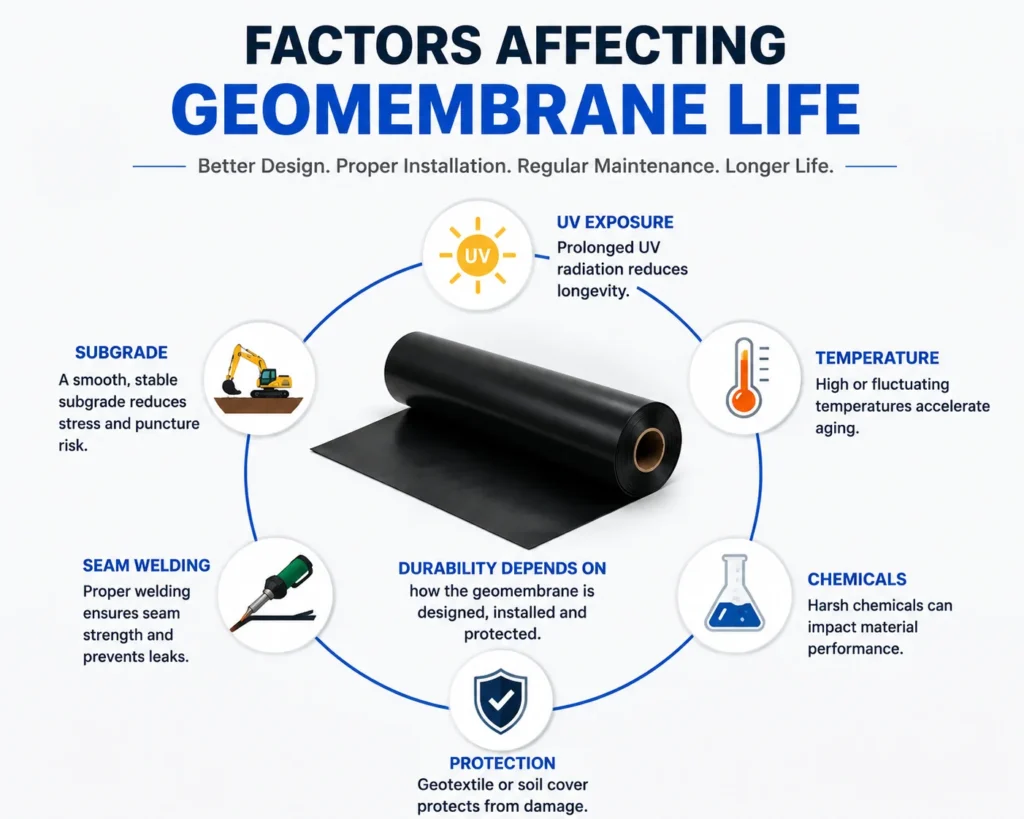
Geomembrane life expectancy is controlled by a combination of material, site, installation and maintenance factors.
1. Material Type and Resin Quality
Different materials age differently. HDPE is generally preferred for long-term chemical containment and landfill applications. LLDPE provides better flexibility. PVC is easier to handle but may be more sensitive to UV and plasticizer loss. EPDM offers excellent flexibility for freshwater and pond applications.
For polyethylene geomembranes, resin quality, antioxidant package and UV stabilizers are critical to long-term performance.
2. Thickness
Thicker geomembranes usually provide better puncture resistance and longer service life, especially in high-risk applications. However, thickness should still match the project environment.
| Thickness | Typical Use |
|---|---|
| 0.5 mm | Small ponds, temporary water containment |
| 0.75 mm | Fish ponds, farm ponds, low-to-medium risk reservoirs |
| 1.0 mm | Irrigation ponds, canals, wastewater ponds |
| 1.5 mm | Landfills, mining pads, industrial containment |
| 2.0 mm | Hazardous waste, mining, high-risk containment |
Choosing thickness only by price is a common mistake. A thin liner may reduce initial cost but increase puncture, repair and leakage risk.
3. UV Exposure
UV radiation accelerates polymer aging. Exposed liners need proper UV stabilization and regular inspection.
Covered or buried liners usually last much longer because they are protected from sunlight. In pond and canal applications, exposed edges may age faster than underwater areas.
4. Temperature
High temperature accelerates oxidation and chemical reactions. Temperature changes also cause expansion and contraction, especially in HDPE liners.
In hot climates or exposed slopes, thermal movement can create wrinkles, stress points and seam stress if not properly managed.
5. Chemical Compatibility
Geomembranes used in landfills, mining, wastewater treatment and industrial containment must be compatible with the contained liquid.
Before selecting a liner, review:
- pH value
- Chemical concentration
- Temperature
- Exposure duration
- Wastewater or leachate composition
- Potential hydrocarbons, acids, alkalis or solvents
A material that works well for a freshwater pond may not be suitable for industrial wastewater or mining solutions.
6. Subgrade Preparation
Poor subgrade preparation can cause early liner failure.
Before installation, the surface should be:
- Smooth
- Compacted
- Free of sharp stones
- Free of roots and debris
- Stable under loading
- Properly graded for drainage and slope
Sharp objects under the liner can create punctures or stress points over time.
7. Seaming and Welding Quality
Seams are one of the most important parts of geomembrane performance. Poor seams can become leakage paths even when the liner material itself is high quality.
HDPE and LLDPE geomembranes are commonly joined by hot wedge welding or extrusion welding. Seams should be tested before the project is filled or covered.
Common seam tests include:
- Air pressure testing
- Vacuum box testing
- Spark testing
- Destructive peel testing
- Destructive shear testing
A geomembrane system is only as strong as its weakest seam.
8. Protection Layer
A geotextile cushion layer, soil cover, sand layer or concrete protection layer can reduce puncture, abrasion and UV damage.
Protection is especially important when:
- The subgrade is rough
- The liner is under heavy loading
- The site contains sharp aggregate
- Equipment may move over the liner
- The project is long-term
- The liner is used in mining or landfill applications
9. Inspection and Maintenance
Regular inspection can extend geomembrane service life by identifying damage before it becomes a major leak.
For exposed liners, inspection should check for:
- Cracks
- Punctures
- Tears
- Abrasion
- Wrinkles
- Seam defects
- Animal damage
- UV aging signs
- Anchor trench movement
Small repairs should be made quickly using compatible materials and approved repair methods.
Questions to Ask Before Buying a Geomembrane for Long Service Life
Before buying a geomembrane, buyers should confirm the following information with the supplier:
- What resin or material grade is used?
- Is the liner made from virgin material or recycled material?
- Is the geomembrane UV-stabilized for exposed use?
- What thickness is recommended for this application?
- What roll size is available for reducing field seams?
- What welding method is recommended?
- Is geotextile protection required under or above the liner?
- Can the supplier provide technical data sheets or test standards?
- Is the liner suitable for the contained liquid or chemical?
- What installation conditions may reduce service life?
These questions help prevent a common problem: selecting a liner only by price while ignoring the factors that actually control lifespan.
Common Reasons Geomembranes Fail Early
A geomembrane usually fails early because of wrong material selection, poor installation or lack of protection, not because the material reaches its natural service life.
Common reasons include:
- Using a thin pond liner in a high-risk industrial or landfill project
- Choosing material only by price
- Ignoring chemical compatibility
- Installing over sharp stones, roots or unstable soil
- Skipping geotextile protection on rough subgrades
- Using untrained welders
- Failing to test seams before filling
- Leaving large wrinkles or folds in the liner
- Poor anchoring on slopes or canal edges
- Leaving exposed liners without UV consideration
- Delaying repair after puncture or seam damage
For buyers, this means the cheapest liner is not always the lowest-cost solution. Early failure can lead to leakage, repair cost, environmental risk and project downtime.
How to Extend the Service Life of a Geomembrane
To make a geomembrane last longer, focus on the full containment system, not only the liner roll.
Recommended practices include:
- Select the correct material for the application.
- Choose thickness based on project risk.
- Review chemical compatibility before ordering.
- Prepare a smooth and stable subgrade.
- Use geotextile protection when puncture risk exists.
- Avoid excessive wrinkles during installation.
- Use trained welding technicians.
- Test all seams before filling or covering.
- Protect exposed edges from UV and mechanical damage.
- Inspect the liner regularly.
- Repair punctures, tears and weak seams immediately.
- Keep heavy equipment away from unprotected liner surfaces.
For long-term containment, the best result comes from correct material selection, professional installation and ongoing inspection.
Geomembrane Lifespan Selection Guide
The following table can help buyers estimate which material is more suitable for different lifespan expectations.
| Project Condition | Better Material Choice | Recommended Protection | Lifespan Priority |
|---|---|---|---|
| Long-term landfill liner | HDPE | Geotextile + cover soil | Chemical resistance and seam integrity |
| Commercial pond or reservoir | HDPE / LLDPE | Smooth subgrade + edge protection | Water retention and puncture resistance |
| Irregular pond shape | LLDPE / EPDM | Underlay protection | Flexibility and easy installation |
| Mining heap leach pad | HDPE / LLDPE | Heavy-duty geotextile cushion | Chemical and puncture resistance |
| Canal liner | HDPE / LLDPE / PVC | Anchoring + UV protection | Seepage control and exposed durability |
| Wastewater lagoon | HDPE / LLDPE | Venting or protection layer if needed | Chemical compatibility and seam quality |
| Temporary liner | PVC / thinner PE liner | Basic subgrade preparation | Short-term waterproofing |
Conclusion
A geomembrane can last from 10 years to more than 100 years, but there is no single lifespan number that applies to every project.
A buried or covered HDPE geomembrane can often last 50 to 100+ years when properly formulated, installed and protected. Exposed HDPE geomembranes usually last around 20 to 30+ years, depending on climate, UV exposure and maintenance. LLDPE, PVC and EPDM liners may have different service lives depending on flexibility requirements, exposure and project conditions.
The real service life of a geomembrane depends on the complete system: material type, thickness, chemical compatibility, subgrade preparation, seam welding, protection layer and maintenance.
For long-term performance, do not select a geomembrane only by price. Select the liner according to the actual application, exposure condition and containment risk.


