Short Answer
The main purpose of a geogrid is to reinforce soil and aggregate layers. In construction projects, geogrid helps distribute loads, reduce lateral movement, control rutting, improve bearing capacity, and increase the stability of roads, driveways, retaining walls, slopes, and working platforms.
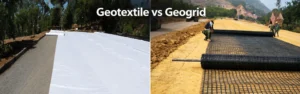
Unlike geotextile fabric, which is often used for separation, filtration, or drainage, geogrid is mainly used for reinforcement and stabilization. Its open grid structure allows soil or aggregate to lock into the apertures, creating a stronger and more stable structural layer.
In simple terms, geogrid helps weak soil or loose aggregate perform better under load.
What Is a Geogrid?
A geogrid is a geosynthetic reinforcement material with an open grid structure. It is usually made from polymers such as polypropylene, polyethylene, polyester, or fiberglass, depending on the application and performance requirement.
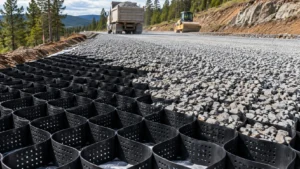
The openings in a geogrid are called apertures. These apertures allow aggregate or soil particles to interlock with the grid. This mechanical interlock is what makes geogrid different from many other geosynthetic materials.
Geogrid is commonly used in:
- Road construction
- Driveways
- Retaining walls
- Slopes
- Embankments
- Parking lots
- Construction access roads
- Base course stabilization
- Asphalt pavement reinforcement systems
The main purpose is not to act as a waterproof layer or drainage fabric. The purpose is to improve structural performance by reinforcing soil or aggregate.
How Does a Geogrid Work?
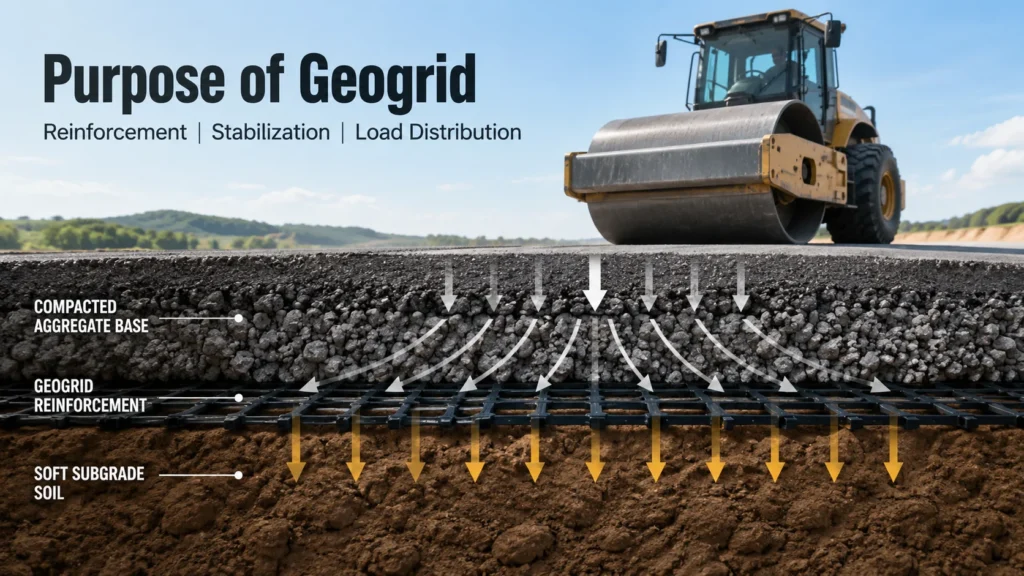
Geogrid works by creating mechanical interlock with soil or aggregate.
When compacted aggregate fills the openings of the geogrid, the aggregate particles become locked within the grid structure. This helps restrain lateral movement, distribute loads over a wider area, and reduce deformation under traffic or structural loading.
Without geogrid, aggregate can move sideways under repeated loading. This movement may lead to rutting, settlement, loss of base support, or surface deformation.
With geogrid, the reinforced layer becomes more stable because the grid helps hold the aggregate in place.
The working principle can be summarized in four steps:
- Geogrid is placed over prepared soil or subgrade.
- Aggregate or fill material is placed over the geogrid.
- Compaction forces aggregate into the grid apertures.
- The locked aggregate and geogrid work together as a reinforced layer.
This is why geogrid is often used when soil conditions are weak, loading is repeated, or the project requires long-term structural stability.
The Main Purpose of Geogrid
Soil Reinforcement
One of the most important purposes of geogrid is soil reinforcement.
In many projects, natural soil does not have enough strength to support roads, retaining walls, slopes, or heavy traffic. Geogrid helps reinforce the soil by limiting movement and improving the overall stability of the structure.
This is especially important in:
- Soft subgrade areas
- Embankments
- Reinforced soil walls
- Slopes
- Construction platforms
- Road base layers
For projects focused specifically on weak ground support, learn more about soil stabilization geogrid
Load Distribution
Another key purpose of geogrid is load distribution.
When vehicles, machinery, or structural loads are applied to an unreinforced base, the load may concentrate in a small area. This can cause rutting, settlement, or base failure.
Geogrid helps spread the load across a wider area. This reduces stress on the subgrade and improves the performance of the aggregate base.
This function is especially useful in:
- Roads
- Parking lots
- Driveways
- Haul roads
- Construction access roads
- Working platforms
For road projects, see this related guide on geogrid for road construction:
https://www.geosynsource.com/geogrid-for-road-construction-guide/
Lateral Restraint
Geogrid also provides lateral restraint.
In road base or gravel systems, aggregate tends to move sideways when pressure is applied from above. This side movement weakens the structure over time.
Geogrid helps restrain this movement by locking aggregate particles within its apertures. This makes the base layer more stable and helps maintain its shape under repeated loading.
Lateral restraint is one of the reasons geogrid is often used under gravel driveways, access roads, and paved road bases.
Rutting and Deformation Control
Rutting is a common problem in roads, gravel driveways, parking areas, and construction access routes.
Rutting usually happens when the base material shifts, the subgrade is weak, or repeated traffic creates permanent deformation.
Geogrid helps reduce rutting by stabilizing the aggregate layer and limiting lateral movement. It does not make poor soil perfect, but it can help the pavement or gravel structure perform better when properly designed and installed.
For driveway applications, you can read more here:
https://www.geosynsource.com/is-geogrid-good-for-driveways/
Structural Stabilization
Geogrid is also used to improve the stability of larger soil structures.
In retaining walls, geogrid is placed in horizontal layers behind the wall facing. These layers help reinforce the soil mass and reduce the risk of movement or failure.
In slopes and embankments, geogrid can help stabilize the fill material and improve resistance to sliding or deformation.
For retaining wall projects, see this guide:
https://www.geosynsource.com/geogrid-retaining-wall-ultimate-guide/
Where Is Geogrid Commonly Used?
Geogrid is used in many civil engineering and construction applications. The exact purpose depends on the project design.
| Application | Purpose of Geogrid |
|---|---|
| Road construction | Stabilizes base layers and distributes traffic loads |
| Driveways | Reduces rutting and improves gravel stability |
| Retaining walls | Reinforces soil behind the wall |
| Slopes | Helps reduce soil movement and improve stability |
| Parking lots | Supports repeated vehicle loading |
| Construction access roads | Improves temporary working platform stability |
| Embankments | Reinforces fill material and controls deformation |
| Asphalt pavement systems | Supports base and subgrade layers below the asphalt |
| Gravel roads | Reduces aggregate movement and surface deformation |
| Industrial yards | Improves load support for heavy vehicles and equipment |
For a broader overview of different project uses, visit our geogrid applications guide:
https://www.geosynsource.com/geogrid-applications/
What Problems Does Geogrid Help Solve?
Geogrid is often used when the existing soil or aggregate layer cannot provide enough stability on its own.
It can help solve problems such as:
- Weak subgrade
- Rutting
- Base course movement
- Aggregate loss
- Soil movement
- Settlement
- Slope instability
- Retaining wall pressure
- Repeated vehicle loading
- Poor load distribution
- Construction access problems
Geogrid does not replace good engineering design, proper soil preparation, or correct installation. However, when used correctly, it can improve the performance and service life of many ground structures.
Geogrid vs Geotextile: Are They Used for the Same Purpose?
Geogrid and geotextile are both geosynthetic materials, but they are not used for exactly the same purpose.
| Material | Main Purpose | Typical Function |
|---|---|---|
| Geogrid | Reinforcement and stabilization | Interlocks with aggregate to distribute loads and reduce movement |
| Geotextile | Separation, filtration, drainage, and protection | Prevents soil mixing, allows water flow, and protects other layers |
Geogrid is mainly used when the project needs structural reinforcement.
Geotextile fabric is often used when the project needs separation, filtration, or drainage.
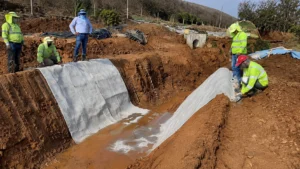
In some projects, geogrid and geotextile may be used together. For example, geotextile may separate soft soil from aggregate, while geogrid reinforces the aggregate layer above it.
If you are comparing these materials, the key question is:
Do you need reinforcement, filtration, drainage, or separation?
Does Geogrid Drain Water?
Geogrid is not mainly designed for drainage.
Because geogrid has open apertures, water can pass through the grid structure. However, its primary purpose is reinforcement, not filtration or drainage.
If the project needs water filtration, soil retention, or drainage control, geotextile fabric may be needed together with geogrid.
This is an important distinction. Using geogrid alone may not solve drainage or filtration problems if the project actually requires a geotextile layer.
When Should You Use Geogrid?
You should consider using geogrid when the project needs better soil or base stability.
Geogrid may be useful when:
- The soil is weak or unstable
- The project needs better load support
- Gravel or aggregate is moving sideways
- Rutting is expected
- A retaining wall needs reinforced soil
- A slope needs additional stability
- A road or driveway needs longer service life
- Heavy vehicles will use the area repeatedly
- A construction access road needs a stronger working platform
The right geogrid type depends on the application, soil condition, aggregate size, tensile strength requirement, and installation method.
For choosing the right type, see our guide on biaxial vs uniaxial geogrid:
https://www.geosynsource.com/biaxial-vs-uniaxial-geogrid-how-to-choose-the-right-one-for-your-project/
What Type of Geogrid Do You Need?
Not sure which geogrid fits your project? Explore our geogrid products to compare options for roads, retaining walls, and other reinforcement applications.
Different geogrids are designed for different functions.
Biaxial Geogrid
Biaxial geogrid provides strength in both machine and cross-machine directions. It is commonly used for base stabilization, road construction, parking lots, driveways, and construction platforms.
Uniaxial Geogrid
Uniaxial geogrid provides high strength mainly in one direction. It is often used for retaining walls, steep slopes, embankments, and reinforced soil structures.
Fiberglass Geogrid
Fiberglass geogrid is commonly used in asphalt pavement reinforcement systems. Its purpose is to help reduce reflective cracking and improve pavement layer performance when used in the correct pavement design.
In asphalt pavement systems, the function can be different from aggregate stabilization or reinforced-soil applications. Fiberglass geogrid is commonly used as an asphalt reinforcement interlayer where reflective crack control is required.
Plastic Geogrid
Plastic geogrids are commonly used for road base, gravel stabilization, driveway support, and soil reinforcement applications.
The best type depends on what the geogrid needs to do in the project.
Is Geogrid Always Necessary?
No, geogrid is not always necessary.
If the soil is strong, the load is light, and the base layer is properly designed, a project may perform well without geogrid.
Geogrid becomes more valuable when the project has challenging conditions such as weak subgrade, repeated traffic, soft soils, steep slopes, high wall loads, or limited base thickness.
In other words, geogrid is not used just because it exists. It is used when reinforcement or stabilization is needed.
Common Mistakes When Using Geogrid
Mistake 1: Using Geogrid for Drainage
Geogrid is not a drainage fabric. It allows water to pass through, but it does not filter soil particles like geotextile fabric.
Mistake 2: Choosing the Wrong Type
Biaxial, uniaxial, and fiberglass geogrids are not interchangeable. Each type is designed for different applications.
Mistake 3: Ignoring Aggregate Size
Geogrid works through mechanical interlock. If the aggregate does not lock properly into the apertures, performance may be reduced.
Mistake 4: Poor Installation
Wrinkles, poor overlap, weak subgrade preparation, or insufficient compaction can reduce geogrid performance.
Mistake 5: Expecting Geogrid to Fix Every Soil Problem
Geogrid improves reinforcement and stabilization, but it should still be used as part of a proper engineering design.
Final Recommendation
The purpose of a geogrid is to make soil and aggregate layers work together as a stronger, more stable structure.
It is mainly used for:
- Soil reinforcement
- Load distribution
- Lateral restraint
- Rutting control
- Base stabilization
- Retaining wall reinforcement
- Slope and embankment stability
If your project involves weak subgrade, repeated vehicle loading, retaining walls, slopes, or gravel movement, geogrid may be an effective solution.
However, the right geogrid should be selected based on the project application, soil condition, aggregate size, tensile strength requirement, and installation method.
For cost planning, you can also read our guide on geogrid material cost:
https://www.geosynsource.com/what-is-the-cost-of-geogrid-material-in-2025/
FAQ
What is the main purpose of a geogrid?
The main purpose of a geogrid is to reinforce soil or aggregate layers. It helps distribute loads, reduce lateral movement, control rutting, and improve the stability of roads, driveways, retaining walls, slopes, and working platforms.
How does geogrid reinforce soil?
Geogrid reinforces soil by creating mechanical interlock with aggregate or fill material. When compacted aggregate locks into the grid openings, the geogrid helps restrain movement and spread loads across a wider area.
Is geogrid used for drainage?
Geogrid is not mainly used for drainage. Water can pass through its open grid structure, but its main function is reinforcement and stabilization. If filtration or drainage is needed, geotextile fabric may be used with geogrid.
What is geogrid used for in road construction?
In road construction, geogrid is used to stabilize the base layer, improve load distribution, reduce rutting, and support traffic loads over weak or variable subgrade conditions.
What is geogrid used for in retaining walls?
In retaining walls, geogrid is used to reinforce the soil behind the wall. It helps create a stronger reinforced soil mass and improves overall wall stability.
Is geogrid better than geotextile?
Geogrid is not simply better than geotextile. They serve different purposes. Geogrid is mainly used for reinforcement and stabilization, while geotextile is often used for separation, filtration, drainage, and protection.
When should I use geogrid?
You should use geogrid when the project needs better load support, soil reinforcement, base stabilization, rutting control, or retaining wall reinforcement. It is especially useful over weak subgrade or in areas with repeated loading.
What type of geogrid do I need?
The right geogrid depends on the application. Biaxial geogrid is commonly used for base stabilization, uniaxial geogrid is used for retaining walls and slopes, and fiberglass geogrid is used for asphalt pavement reinforcement.