
Short Answer
Geogrid is not always necessary — and in some situations, it adds little or no performance benefit.
When pavement or ground issues are driven by surface-related problems, strong subgrade conditions, or non-structural failure mechanisms, alternative solutions may be more appropriate and cost-effective.
Understanding when geogrid does not work as expected is just as important as knowing when it does.
Why This Question Matters
Geogrid is often recommended as a general “reinforcement solution.”
However, using geogrid without understanding the actual failure mechanism can lead to:
Unnecessary material cost
No measurable performance improvement
False expectations about long-term behavior
This page focuses on common situations where geogrid is unlikely to deliver meaningful value.
When the Problem Is Surface-Related, Not Structural
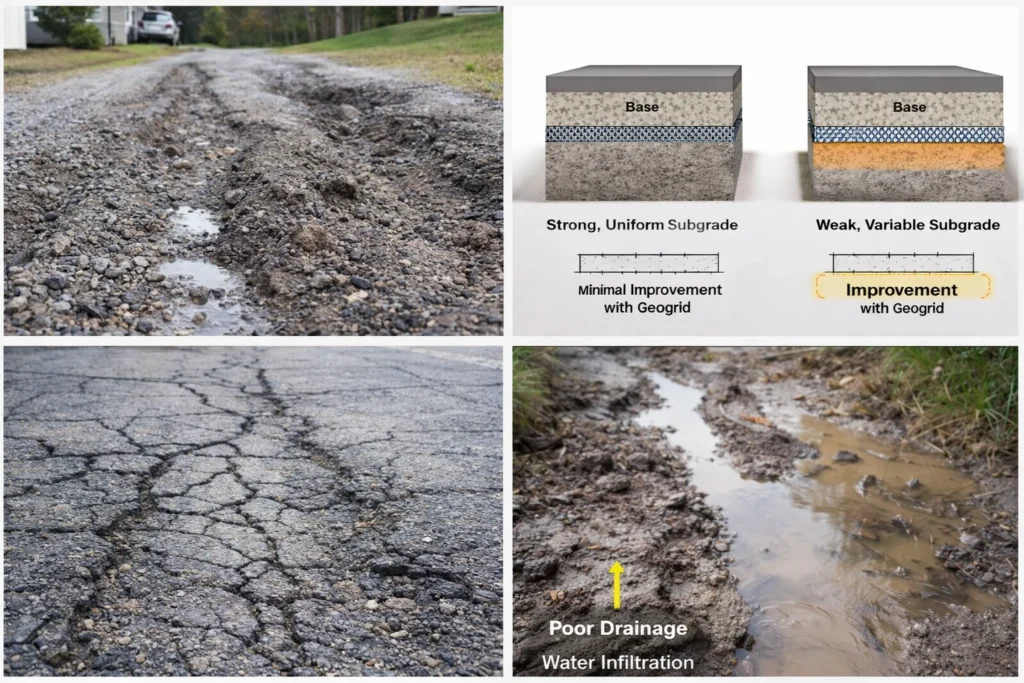
Geogrid works by reinforcing base and subgrade layers.
If the problem exists only at the surface, geogrid may not address it.
Typical surface-driven issues include:
Gravel migration or spreading
Surface rutting caused by loose aggregate
Aesthetic or maintenance concerns
In these cases, surface confinement systems (such as gravel grids or cellular paving) are often more effective than subsurface reinforcement.
👉 Related reading:
Geogrid vs Gravel Grid
When Subgrade Strength Is Already Adequate
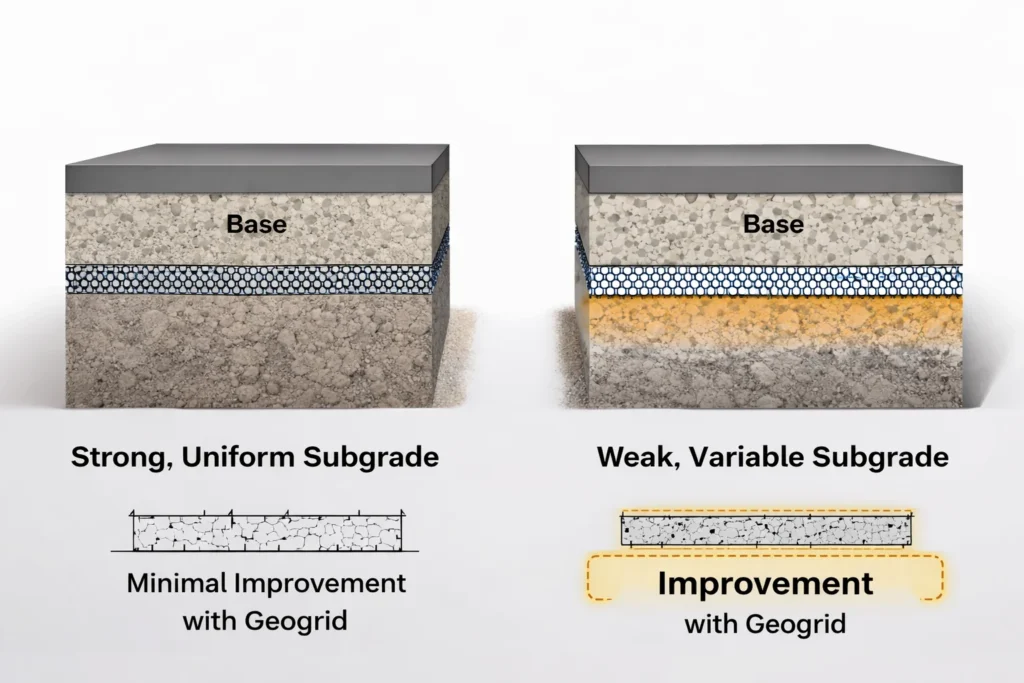
Geogrid provides the greatest benefit when subgrade strength is low or highly variable.
If the subgrade is:
Strong
Uniform
Properly compacted
then conventional base design alone may already meet performance requirements.
In such cases, adding geogrid may result in minimal improvement, especially under light or moderate loading.
When Pavement Distress Is Caused by Asphalt or Surface Materials
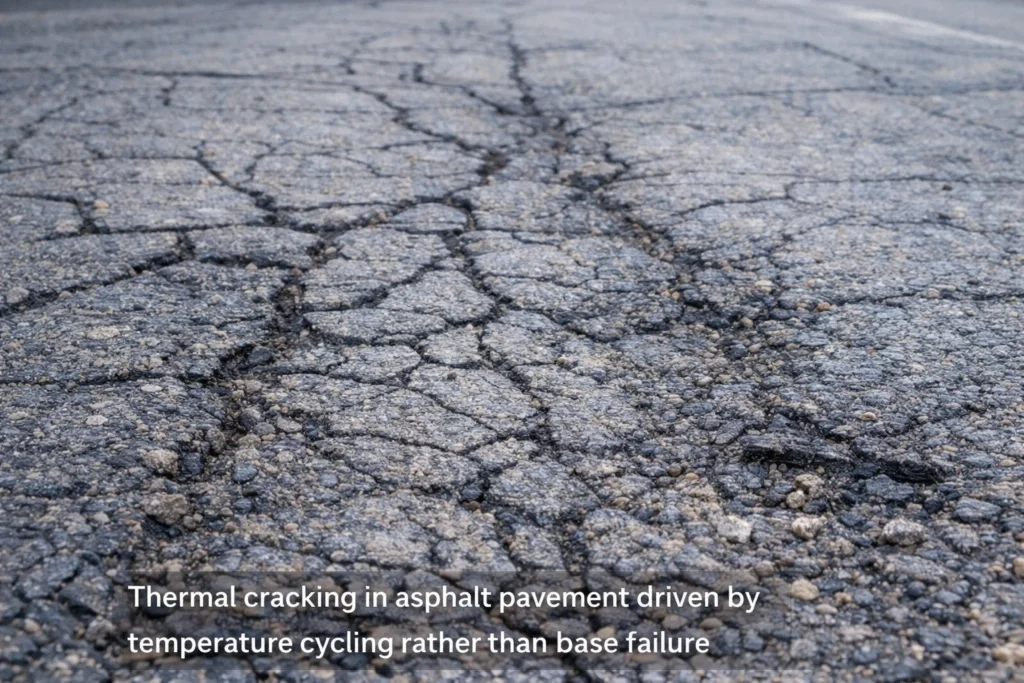
In paved applications, visible distress often leads to the assumption that reinforcement is needed below.
However, geogrid may offer limited benefit when pavement problems are primarily caused by:
Asphalt mix design deficiencies
Thermal cracking due to temperature cycles
Aging or oxidation of asphalt binder
Because these issues originate within the surface layer, reinforcing the base with geogrid does not directly address the root cause.
👉 Related reading:
Geogrid for Asphalt Pavement
When Drainage and Water Issues Are Not Addressed
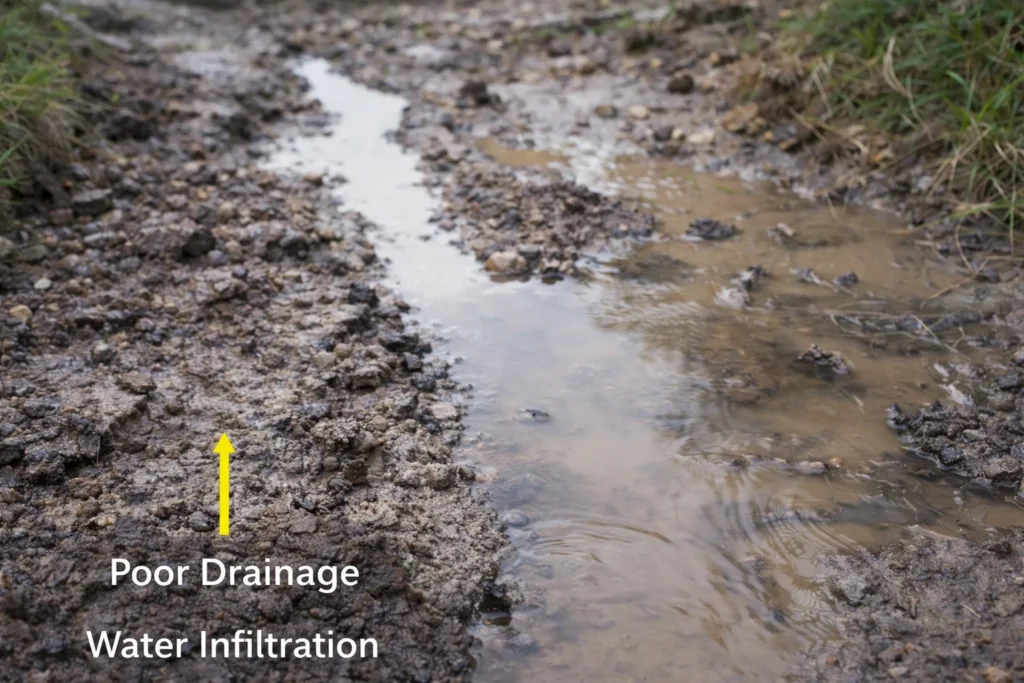
Poor drainage is a leading cause of pavement and ground failure.
If water infiltration and drainage paths are not properly managed:
Subgrade strength can fluctuate
Base materials may lose confinement
Reinforcement benefits can be reduced
In these conditions, drainage improvements often provide greater performance gains than adding geogrid alone.
When Loads Are Minimal and Traffic Is Infrequent
For very light-duty applications, such as:
Occasional vehicle access
Low-frequency residential use
Areas with minimal loading
the structural demand may be too low for geogrid reinforcement to produce noticeable benefits.
In these cases, simpler solutions may achieve acceptable performance with lower cost and complexity.
Common Misconception: “Geogrid Always Improves Performance”
A common assumption is that geogrid will always enhance ground or pavement performance.
In reality:
Geogrid improves performance only when reinforcement targets the governing failure mechanism.
For example, a 4 ft retaining wall may not need geogrid when the backfill is level, drainage is good, and there is no surcharge load.
If deformation, rutting, or instability is not driven by subsurface behavior, geogrid may not be the right tool.
How to Decide Before Using Geogrid
Before specifying geogrid, ask these questions:
Is the failure mechanism structural or surface-related?
Is subgrade strength a limiting factor?
Are drainage conditions adequate?
Are traffic loads sufficient to justify reinforcement?
Clear answers to these questions help determine whether geogrid will add real value — or whether alternative solutions should be considered.
How This Fits Within Geogrid Applications
This page complements application-specific guides by defining practical boundaries for geogrid use.
For scenarios where geogrid does make sense, see:
Final Thought
Geogrid is a powerful engineering tool — but only when used in the right context.
Understanding when not to use geogrid helps avoid unnecessary cost, improves design decisions, and leads to more reliable long-term performance.


