Short Answer
Not always. A 4 ft retaining wall does not automatically require geogrid reinforcement.
Whether geogrid is needed depends on soil conditions, drainage, wall type, backfill quality and loading above the wall — not height alone.
In many residential situations, a properly designed gravity wall can perform without geogrid. However, reinforcement may become necessary when the wall supports weak soil, poor drainage, a slope, driveway, structure or other surcharge load.
Do You Need Geogrid for a 4 ft Retaining Wall?
This is one of the most commonly searched questions in retaining wall design, largely because 4 ft is often treated as a regulatory or permitting threshold.
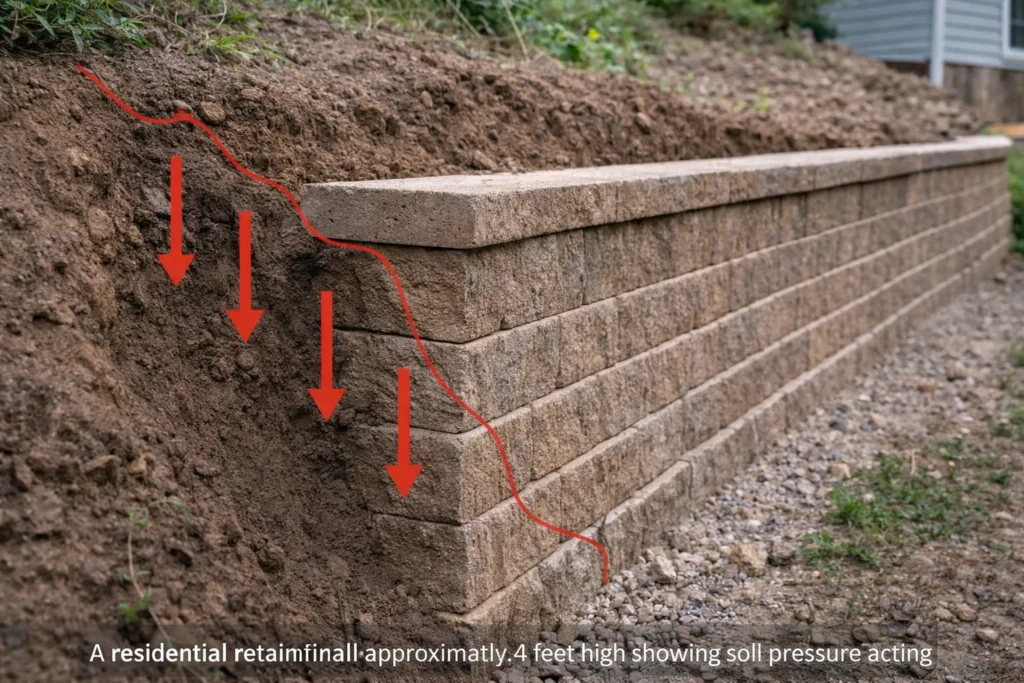
From an engineering standpoint, height alone does not determine whether geogrid is required. A 4 ft wall may perform well without reinforcement, or it may require geogrid, depending on how soil pressure, water and surcharge loads interact behind the wall.a
Is 4 ft a Structural Threshold?
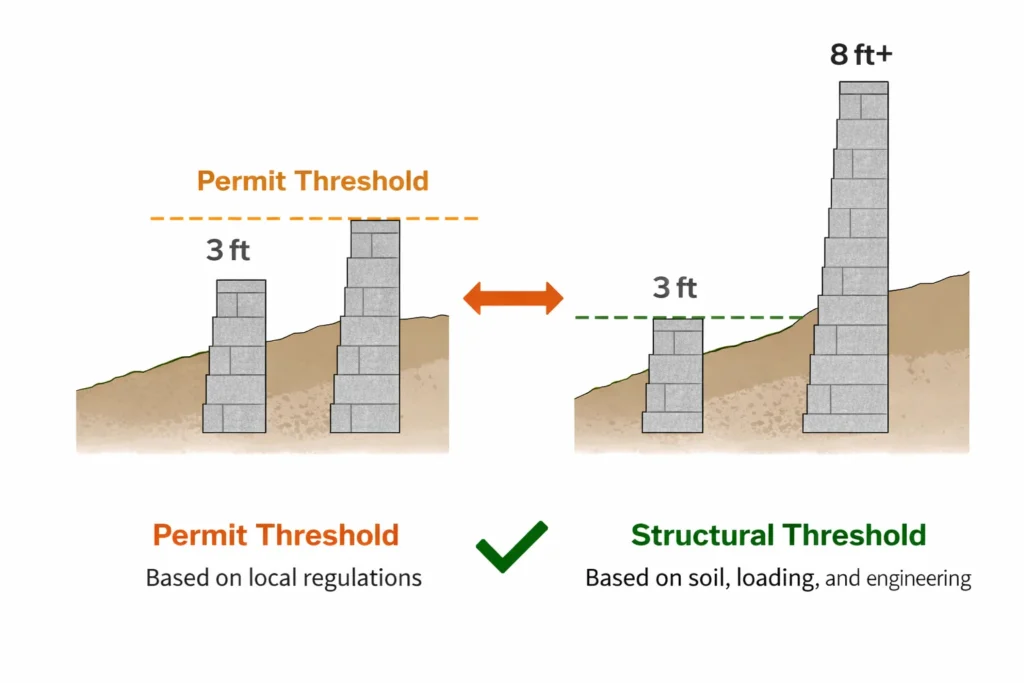
For SEO and engineering clarity, it is important to separate permit thresholds from actual structural behavior. A permit rule does not automatically mean the wall is structurally safe or unsafe without geogrid.
Four feet is not a universal structural limit.
It is frequently referenced because:
-
Many local codes require permits or engineering review above ~4 ft
-
Segmental wall systems often introduce reinforcement guidelines around this height
However:
Manufacturer recommendations apply to specific wall systems and should not be treated as universal engineering rules.
Two 4 ft retaining walls can behave very differently depending on site conditions.
When a 4 ft Retaining Wall May Not Need Geogrid

A 4 ft retaining wall often does not require geogrid when all of the following are true:
-
The wall functions as a true gravity wall
-
Backfill soil is granular, free-draining, and properly compacted
-
Foundation soil is strong and uniform
-
There are no surcharge loads (driveways, slopes, structures)
-
Drainage behind the wall is correctly installed
In these cases, stability is achieved through wall mass and geometry, rather than soil reinforcement.
In these conditions, the wall may rely on wall mass, setback and proper backfill design rather than reinforced soil behind the wall.
Related links:is geogrid necessary for a retaining wall?
When a 4 ft Retaining Wall Does Need Geogrid?

Geogrid is typically required when wall performance is controlled by soil behavior, not wall weight.
Common scenarios include:
-
Weak, clayey, or variable backfill soils
-
Limited space behind the wall, reducing effective wall mass
-
Slopes or additional loads above the wall
-
Walls supporting driveways or vehicle traffic
-
Poor drainage conditions that may allow water pressure buildup
In these cases, geogrid creates a reinforced soil mass, increasing resistance to sliding and overturning.
4 ft Retaining Wall Geogrid Decision Table:
The table below can help you understand when geogrid reinforcement is more likely to be needed for a 4 ft retaining wall.
| Site Condition | Is Geogrid Usually Needed? | Why It Matters |
|---|---|---|
| Level backfill, good drainage, no surcharge load | Usually not | A properly designed gravity wall may rely on wall mass and geometry. |
| Granular, well-compacted backfill | Usually not | Free-draining soil reduces lateral pressure behind the wall. |
| Weak, clayey, or variable soil | Often yes | Poor soil conditions increase deformation and lateral pressure. |
| Driveway or vehicle load above the wall | Often yes | Surcharge loads add extra pressure behind the wall. |
| Slope above or behind the wall | Often yes | Sloped backfill increases the driving force on the wall. |
| Poor drainage or water buildup | Design review required | Water pressure can cause failure even when geogrid is used. |
| Limited space behind the wall | Often yes | A narrower reinforced or gravity mass may reduce stability. |
Geogrid is most useful when the retaining wall needs soil reinforcement. If the main problem is water buildup, poor drainage should be corrected before relying on reinforcement.
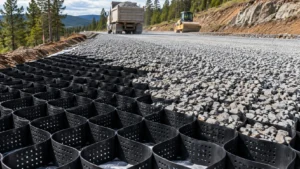
For retaining wall reinforcement, geogrid should be selected based on tensile strength, wall height, backfill condition and surcharge load. In many retaining wall projects, HDPE geogrid or uniaxial geogrid is used to create a reinforced soil mass behind the wall.
Related products:Composite Drainage Board,
                                Geotextile fabric
Does a 4 ft Retaining Wall Need Drainage?

Yes — drainage is critical regardless of wall height.
Water pressure can exceed earth pressure and is one of the most common causes of retaining wall failure.
Even short walls can fail if drainage is neglected.
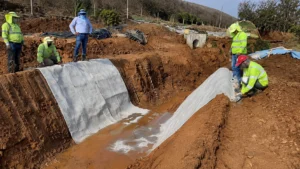
Geogrid reinforces soil, but it does not remove water pressure. For long-term retaining wall performance, drainage stone, weep holes, drainage pipe, geotextile filter layers or drainage board may be needed depending on the wall system.
Proper drainage helps:
-
Maintain consistent soil strength
-
Reduce lateral pressure on the wall
-
Protect long-term wall performance
A lack of drainage can make reinforcement ineffective, even when geogrid is used.
Does Wall Thickness Decide Whether Geogrid Is Needed?
Wall thickness alone does not determine whether a 4 ft retaining wall needs geogrid.
The need for reinforcement depends more on wall type, soil condition, backfill slope, surcharge load, drainage design and the overall stability system.
Gravity walls rely on mass and setback, while reinforced walls rely on geogrid and compacted backfill to create a stable reinforced soil mass.
Need Geogrid for a Retaining Wall Project?
If your site condition shows that geogrid is likely needed, the next step is to choose the right geogrid type and specification.
Geosynsource provides geogrid solutions for retaining wall reinforcement, slope stabilization, road base reinforcement and soil stabilization projects.
Send us your wall height, wall length, soil condition, backfill type and loading details. Our team can help recommend a suitable geogrid option for your project.
View HDPE Geogrid
How Tall Can a Retaining Wall Be Without Geogrid?
Engineering Note
This article provides general guidance for understanding when geogrid may be needed behind a 4 ft retaining wall. Final reinforcement requirements should be confirmed based on the wall system, retained height, soil type, drainage design, surcharge loads, local codes, and project-specific engineering review.
For commercial, roadway, driveway, or high-load retaining wall projects, a qualified engineer or wall system manufacturer should verify the final geogrid layout before installation.
There is no fixed maximum height at which geogrid becomes mandatory.
Short walls may still require reinforcement under unfavorable soil or loading conditions, while taller walls may not require geogrid if gravity design, drainage, and backfill are adequate.
Reinforcement decisions should be based on failure mechanisms, not height alone.
Common Online Advice vs Engineering Reality
Online discussions often focus on excavation depth, block size, or construction tips.
While these details matter, they do not determine wall stability by themselves.
Retaining wall performance depends on how soil pressure, water, geometry, and loading are managed together as a system.
How This Fits Within Retaining Wall Applications
This article addresses a specific decision point within retaining wall design.
For broader context and detailed reinforcement principles, see:
👉 Geogrid Retaining Wall Ultimate Guide
👉 Is Geogrid Necessary for a Retaining Wall?
Final Thought

A 4 ft retaining wall does not automatically require geogrid.
The correct decision depends on soil behavior, drainage, loading, and wall design, not a single height threshold.
Understanding this distinction helps avoid unnecessary cost while ensuring long-term stability where reinforcement is truly needed.